
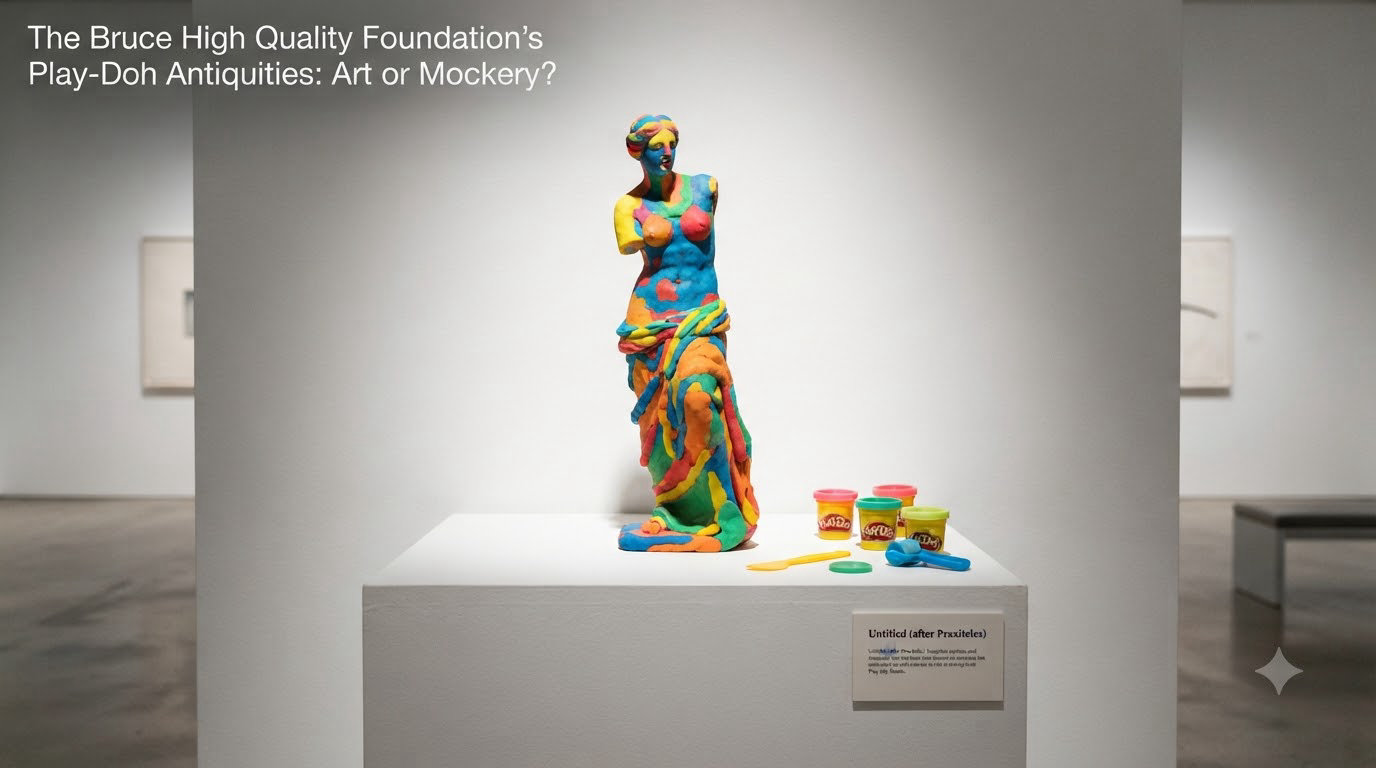
When Pablo Picasso famously said that art is a lie that reveals the truth, he might have been anticipating the Bruce High Quality Foundation’s Play-Doh Antiquities. Standing before these curious recreations of ancient Greek and Roman artifacts at a 2013 gallery opening, I found myself asking the same question that has haunted art critics ever since: Is this genuine art or elaborate mockery? The Bruce High Quality Foundation Play-Doh Antiquities project forces us to confront the uncomfortable boundary between homage and satire, between institutional reverence and artistic rebellion.
The collective’s audacious undertaking – recreating some 17,000 antiquities from the Metropolitan Museum of Art’s collection using modeling clay reminiscent of childhood Play-Doh – immediately divided viewers. Some saw meticulous craftsmanship and profound respect for art history. Others saw an elaborate joke at the art world’s expense. The brilliance of the project lies in how it sustains both interpretations simultaneously.
In this article, I examine the dual nature of this controversial work. I’ll explore who these anonymous artists are, what drove them to spend decades on such an absurd yet ambitious project, and why the question “art or mockery” ultimately misses the point. The answer, as we’ll discover, is more complex than a simple either-or.
Table of Contents
Who Is the Bruce High Quality Foundation?
The Bruce High Quality Foundation is an anonymous art collective based in Brooklyn, New York, comprised of five to eight rotating members whose identities remain secret. Founded in the aftermath of September 11, 2001, the group emerged from Cooper Union, the prestigious tuition-free art school that has produced generations of avant-garde artists. Their founding mission was simple yet ambitious: “to foster an alternative to everything.”
The collective takes its name from a fictional artist persona – Bruce High Quality – who supposedly perished while saving artworks from the World Trade Center on 9/11. This origin story, entirely fabricated, immediately established their trademark approach of blending fiction with reality, sincerity with irony. By creating a martyred artist identity, they could both honor and parody the romantic notion of the suffering genius.
Their anonymity serves multiple purposes. It allows them to critique the art world’s obsession with individual genius and celebrity. It enables collective decision-making without ego interference. Most importantly, it keeps the focus on their ideas rather than their personalities. This approach connects them to a tradition of anonymous art collectives including the Guerrilla Girls and Bernadette Corporation.
Beyond their art practice, the Foundation established the Bruce High Quality Foundation University (BHQFU) in 2009, an alternative art school offering free classes taught by artists and critics. This educational arm extended their mission of democratizing art access and challenging institutional gatekeeping. Their philosophy draws heavily from Joseph Beuys’s concept of “social sculpture” – the idea that society itself could be transformed through creative acts.
The Play-Doh Antiquities: The Meditations Project
In November 2013, the Bruce High Quality Foundation opened “Meditations,” an ambitious exhibition split between two Manhattan galleries. The centerpiece was a potentially decades-long project to recreate approximately 17,000 antiquities from the Metropolitan Museum of Art’s Greek and Roman collection. The twist? Every piece was rendered in modeling clay similar to Play-Doh.
The technical execution surprised many skeptics. These were not crude approximations but carefully studied reproductions. Artists spent hours in the Met’s galleries sketching and photographing original antiquities before reconstructing them in their studios. The resulting sculptures captured the essence of classical busts, breast plates, life-size lions, and decorative vessels with unexpected fidelity to the originals.
Consider their recreation of a Greek kylix drinking cup. The Foundation’s version captured the shallow bowl shape, the twin horizontal handles, and the characteristic red-figure decoration. Yet the material betrayed the effort – the slightly waxy surface, the telltale fingerprint impressions, the colors slightly too bright to be ancient terracotta. This tension between expert reproduction and humble material defines the project’s power.
The choice of medium was deliberate and loaded with meaning. Play-Doh represents childhood, impermanence, and creative freedom untainted by market concerns. By transposing this material onto the sacred ground of museum antiquities, the Foundation created a visual paradox that demands interpretation. Is the medium mocking the masterpieces, or is the craftsmanship elevating the humble material?
The project also engaged with art historical traditions of copying and appropriation. Since the Renaissance, artists have learned by copying masterworks. The Foundation extended this practice to absurd lengths, questioning where education ends and obsession begins. Their work echoed Marcel Duchamp’s readymades while simultaneously paying genuine tribute to classical aesthetics.
The scale of the undertaking – 17,000 objects over potentially decades – suggested something beyond a simple prank. This was commitment. This was labor. This was an artist’s life devoted to a singular, slightly ridiculous vision. The project forces us to ask whether endurance and dedication can transform even the most playful concept into serious art.
The Case for Art: Homage, Craft, and Reverence
Viewing the Play-Doh Antiquities as legitimate art requires focusing on the evident skill and dedication involved in their creation. The Foundation members spent countless hours studying original antiquities, understanding their proportions, decorative schemes, and historical significance. This was not casual appropriation but deep engagement with art history.
The technical achievement is undeniable. Modeling clay requires different skills than marble carving or bronze casting, but it demands its own expertise. The Foundation had to solve problems of structural support, color matching, and surface finish. Their sculptures had to stand on their own while clearly referencing their ancient counterparts. This represents genuine artistic problem-solving.
From a conceptual standpoint, the work connects to established art historical traditions. Joseph Beuys argued that creativity could reshape society itself – what he called “social sculpture.” By democratizing access to classical forms through humble materials, the Foundation extends this vision. They ask: Why should ancient art be locked behind museum glass, accessible only to the privileged?
The project also functions as education. Many viewers encountered Greek and Roman forms they might never have examined closely. The Play-Doh versions, freed from the intimidating context of the Met’s marble halls, invited touch and close inspection. In this reading, the Foundation serves as teachers, using playful methods to share serious knowledge.
Their auction record supports the “art” interpretation as well. When Christie’s offered Play-Doh Antiquities in their contemporary art sales, estimates ran between $4,000 and $6,000 per piece. The market – that ultimate arbiter in the art world – recognized value. Collectors were willing to pay for these humble sculptures, suggesting the art world at least partially accepted them as legitimate works.
The Case for Mockery: Institutional Critique and Parody
The mockery interpretation finds ammunition in the medium itself. Play-Doh is inherently absurd as a material for reproducing sacred museum objects. It evokes children at kitchen tables, not master sculptors in studios. By choosing this material, the Foundation seems to wink at viewers, suggesting that perhaps we take antiquities too seriously.
The project functions as institutional critique – a genre of art that examines and challenges the power structures of museums, galleries, and the art market. The Foundation targets the Metropolitan Museum specifically, that temple of cultural authority. By recreating its collection in a degraded medium, they question the museum’s role as arbiter of value and taste.
Their approach recalls Marcel Duchamp’s “Fountain” – the urinal submitted as sculpture in 1917. Like Duchamp, the Foundation asks: Who decides what counts as art? What makes a Greek vase in the Met more “art” than the same form rendered in modeling clay? Their work exposes the arbitrary nature of these distinctions.
The title “Meditations” adds another layer of irony. It suggests spiritual contemplation, philosophical depth, artistic seriousness. Yet the material undercuts this gravitas. The juxtaposition creates a humorous tension that feels intentional. They are playing with us, testing whether we’ll play along or take offense.
The art market context supports the mockery reading too. The Foundation emerged during a period of intense speculation in contemporary art. Their humble sculptures, fetching thousands at auction, comment on the absurdity of art pricing. A lump of modeling clay shaped like an ancient bust sells for the price of a used car. The joke, if it is a joke, is on the collectors.
The Synthesis: Why It Is Both Art and Mockery
The false choice between art and mockery dissolves upon closer examination. The Bruce High Quality Foundation’s genius lies precisely in maintaining both interpretations simultaneously. Their Play-Doh Antiquities are simultaneously homage and parody, appreciation and critique, serious and absurd.
This duality reflects a deeper truth about the relationship between art and reality. Art has always contained elements of deception – the painted window that isn’t a window, the sculpted figure that seems to breathe. The Foundation simply makes this deception explicit. Their “ancient” busts are obviously modern, obviously fake, obviously playful. Yet they carry genuine emotional and aesthetic weight.
The work asks us to consider what we value in art. Is it the material? The skill? The age? The institutional endorsement? By reproducing antiquities in Play-Doh, they isolate these variables. We see the form without the marble, the craft without the patina, the art without the museum label. What remains is the essential question: Does it move us?
The Foundation’s anonymity reinforces this synthesis. Without individual artists to credit or blame, viewers must confront the work itself. There is no genius to celebrate, no personality to follow. Just the objects, humble yet ambitious, playful yet reverent. The meaning emerges from the viewer’s engagement, not the artist’s intention.
Critical Reception and Market Response
The art world’s response to the Play-Doh Antiquities has been predictably divided, generating exactly the debate the Foundation likely intended. Major publications covered the 2013 “Meditations” opening with a mixture of fascination and skepticism. The New York Times described the project as “simultaneously a massive act of homage and mockery,” capturing the central tension.
Institutional recognition came quickly. The Brooklyn Museum hosted a major Bruce High Quality Foundation retrospective in 2013, bringing their work to a mainstream audience. The Whitney Museum included them in the prestigious Whitney Biennial, validating their place in contemporary art discourse. These exhibitions suggested that major institutions, at least, accepted the work as legitimate art.
The market has spoken as well. Christie’s auction house included Play-Doh Antiquities in contemporary art sales, with estimates between $4,000 and $6,000. Some pieces from related projects sold for substantially more – their “Hooverville” installation reportedly fetched $425,000. Market validation doesn’t determine artistic merit, but it does indicate collector confidence.
Critics have debated whether the Foundation represents genuine institutional critique or merely coasts “on a bed of mockery” to fame. Some see depth in their pedagogical mission and educational programs. Others dismiss them as pranksters capitalizing on art world pretensions. The debate itself serves their purpose, keeping their work relevant and discussed years after the initial exhibitions.
Their influence extends to younger artists exploring collective practice, anonymity, and institutional critique. The Foundation demonstrated that serious art could emerge from playful premises. They proved that questioning the art world’s structures didn’t require leaving the art world. Their model – operating both within and against the system – has inspired subsequent generations.
Frequently Asked Questions
Who said art is a lie that reveals the truth?
Pablo Picasso is credited with this famous quote about art’s relationship to truth. The Spanish painter and sculptor, one of the most influential artists of the 20th century, suggested that art presents an artificial or constructed version of reality that paradoxically reveals deeper truths about the human condition. This quote is particularly relevant to the Bruce High Quality Foundation’s Play-Doh Antiquities, which use obviously false materials to illuminate truths about art, value, and institutional authority.
What are the Bruce High Quality Foundation Play-Doh Antiquities?
The Play-Doh Antiquities are a series of sculptures created by the anonymous art collective Bruce High Quality Foundation. They are meticulous recreations of approximately 17,000 Greek and Roman antiquities from the Metropolitan Museum of Art’s collection, rendered in modeling clay similar to Play-Doh. First exhibited in 2013 as part of the ‘Meditations’ exhibition, these works simultaneously pay homage to classical art while questioning the institutions that preserve and value it.
What message does the artist convey through the Play-Doh Antiquities?
The Bruce High Quality Foundation conveys multiple messages through their Play-Doh Antiquities project. First, they question the authority of museums as arbiters of cultural value. Second, they explore the relationship between original and copy, asking whether reproduction in humble materials diminishes or democratizes art. Third, they challenge the art market’s commodification of cultural heritage. Finally, they demonstrate that art can be simultaneously serious and playful, reverent and critical. The message ultimately asks viewers to think critically about how we determine what counts as art and who gets to decide.
What type of art technique is used in the Play-Doh Antiquities?
The Bruce High Quality Foundation uses modeling clay techniques similar to working with Play-Doh to recreate classical antiquities. This involves studying original Greek and Roman sculptures at the Metropolitan Museum, then reconstructing them using hand-modeling techniques. The process requires understanding structural support for larger pieces, color mixing to approximate ancient terracotta and marble tones, and careful attention to proportional accuracy. While the material is humble, the technique demonstrates genuine sculptural skill and art historical knowledge.
What is the relationship between art and reality in this project?
The Play-Doh Antiquities explore art’s relationship with reality through deliberate deception and revelation. The sculptures present obvious copies as if they were genuine antiquities, blurring the line between real and fake. Yet this artificiality reveals truths about how we value art based on material, age, and institutional context rather than form alone. The project suggests that art is always a constructed version of reality, and that recognizing this construction can lead to deeper understanding. The Foundation’s work embodies Picasso’s idea that art is a lie that makes us see truth more clearly.
Conclusion
The Bruce High Quality Foundation’s Play-Doh Antiquities resist simple categorization. They are neither purely art nor purely mockery, but a sophisticated synthesis of both. This ambiguity is not a flaw but the work’s central achievement. By refusing to resolve the tension between homage and satire, the Foundation creates space for genuine critical engagement.
The project asks us to examine our assumptions about value, authority, and authenticity in the art world 2026. Why do we privilege marble over modeling clay? Why does institutional endorsement matter? What makes an ancient object more valuable than a contemporary reproduction? These questions remain relevant as the art market continues to grapple with digital reproductions, NFTs, and new forms of appropriation.
Whether you view the Play-Doh Antiquities as profound institutional critique or elaborate prank, their impact is undeniable. They have sparked debate, influenced subsequent artists, and earned recognition from major museums and auction houses. The Bruce High Quality Foundation achieved their goal of fostering “an alternative to everything” by demonstrating that art can question the system while operating within it.
Perhaps the final answer to “art or mockery” is simply “yes.” The work succeeds precisely because it sustains both interpretations. It respects the art it copies while questioning the institutions that preserve it. It demands serious engagement while refusing to take itself too seriously. In this balance, the Foundation found something rare: art that matters precisely because it refuses to settle for easy answers.