
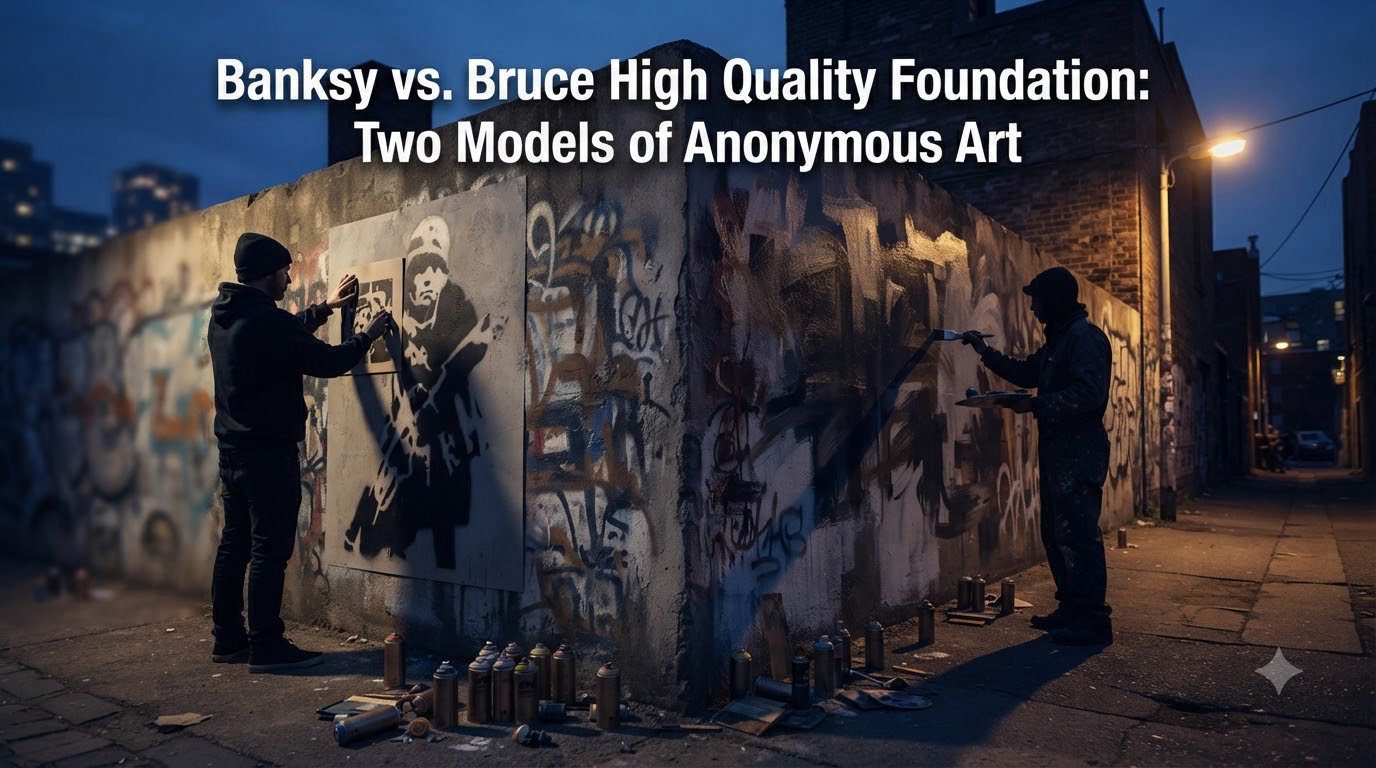
There is something deeply strange about anonymous artists becoming household names. Banksy has achieved global recognition without ever showing his face. The Bruce High Quality Foundation has exhibited at the Whitney Museum while maintaining that their collective identity is more important than any individual member. These two forces in contemporary art represent fundamentally different approaches to the same question: how do you create significant cultural impact while refusing the celebrity that typically comes with it?
In the art world of 2026, anonymity is not merely a privacy choice. It is a strategic framework that shapes every aspect of how art is made, distributed, authenticated, and sold. Banksy and the Bruce High Quality Foundation have each built entire careers on concealment, yet they have done so through opposite models. Banksy operates as a single pseudonymous individual, while BHQF functions as a rotating collective under a shared fictional identity. Understanding these two models of anonymous art reveals much about the contemporary art market, the nature of authorship, and the complex relationship between an artist’s identity and their work.
This comparison examines how each model functions in practice. We will look at the origins, techniques, authentication methods, and commercial paradoxes that both artists navigate. Whether you are an art historian, a collector, or simply curious about how anonymity works in creative industries, this exploration offers insight into one of the most fascinating tensions in modern culture.
Table of Contents
Banksy: The Solo Anonymity Model
Banksy emerged from Bristol’s underground scene in the early 1990s, developing a stencil technique that allowed for quick execution of complex images. The method was born of necessity. Stenciling let him create detailed work rapidly, reducing the risk of arrest while maintaining visual sophistication. What began as a practical solution evolved into a signature aesthetic recognized worldwide.
The solo anonymity model operates on a simple premise: one person creates, decides, and takes responsibility while remaining personally invisible. Banksy has maintained this position for over three decades. During that time, he has produced thousands of works across continents, directed an Academy Award-nominated documentary, and staged elaborate installations. All of this has happened without ever confirming his legal identity or appearing publicly undisguised.
How does such a system function operationally? Banksy works with a network of assistants, handlers, and collaborators who protect his anonymity while executing his vision. These helpers know his identity but have maintained silence. The arrangement resembles a intelligence operation more than a traditional art studio. Information is compartmentalized, communication is encrypted, and operational security is paramount.
The solo model grants certain advantages. Decisions can be made instantly without committee approval. The artistic voice remains consistent and unilateral. When Banksy shredded his painting moments after it sold at Sotheby’s in 2018, that was a single person’s prank executed with military precision. No collective vote was required. No group consensus was sought.
Iconic Works and Cultural Impact
Girl with Balloon may be the most recognizable image in contemporary street art. First appearing on London’s Waterloo Bridge in 2002, the stencil depicts a child reaching toward a heart-shaped balloon floating away. The image has been reproduced millions of times, adapted endlessly, and yet its creator remains unknown to the public.
The Walled Off Hotel in Bethlehem demonstrates how Banksy’s anonymity enables politically charged work. Opened in 2017, the hotel offers rooms with “the worst view in the world” overlooking the Israeli separation wall. Guests sleep in rooms decorated with Banksy originals. The project required extensive local coordination, construction permits, and operational logistics. All of this happened without revealing who was paying the bills or signing the contracts.
Dismaland, the 2015 “bemusement park” in Weston-super-Mare, England, turned the solo anonymity model into large-scale spectacle. For five weeks, a derelict seaside resort became a dystopian theme park featuring works by fifty artists, all orchestrated by an invisible director. The logistics required hundreds of workers, yet the public face remained exclusively the Banksy persona.
The shredded painting incident at Sotheby’s illustrates the marketing power of this model. When Girl with Balloon partially self-destructed immediately after selling for $1.4 million, the value paradoxically increased. The work was renamed Love is in the Bin and later sold for $25.4 million. The stunt generated global media coverage worth far more than any advertising budget could buy.
Bruce High Quality Foundation: The Collective Anonymity Model
The Bruce High Quality Foundation was founded in 2001 by a group of Cooper Union graduates who wanted to challenge the art world’s obsession with individual genius. They named themselves after a fictional artist, Bruce High Quality, who supposedly died in the September 11 attacks while saving a cat from a burning building. This origin story is entirely fabricated, which is precisely the point.
Where Banksy maintains the fiction of a single person, BHQF openly embraces collective creation. Anyone can be Bruce. Membership rotates. The collective includes artists, writers, filmmakers, and art workers who collaborate under the shared pseudonym. No individual takes credit for specific works. The foundation itself is the author.
The collective model emerged from specific Brooklyn conditions. The founders were working-class artists watching their peers struggle with debt and credentialism. They created BHQF as both an art practice and an alternative institution. The fictional foundation structure satirizes the nonprofit industrial complex while actually producing exhibitions, performances, and educational programs.
Their anonymity works differently than Banksy’s. Rather than hiding one person’s identity, BHQF obscures how many people are involved and who they are individually. Interviews are conducted in disguise or through written statements. Performance events feature members in costume. The collective has maintained this structure for over two decades, even as individual members have pursued separate visible careers.
Major Works and Institutional Critique
We Like Art and Art Likes Us, their ongoing series of public interventions, began with the founders wearing novelty dollar-sign glasses while offering free guided tours of museum collections. The performances mocked art world elitism while demonstrating genuine knowledge and appreciation. This tension between satire and sincerity characterizes their approach.
The Brucennial, their alternative to the Whitney Biennial, ran from 2010 to 2012 in a raw Hudson Street space. While the official Biennial featured established artists selected by curators, the Brucennial accepted anyone who showed up with work. Over 3,000 artists participated. The event demonstrated that the exclusionary mechanisms of major institutions could be bypassed through collective energy.
BHQFU (Bruce High Quality Foundation University) operated from 2009 to 2017 as an actual art school offering free classes. Courses included “Art History with Bruce,” “Professional Practices,” and “Working Art World Jobs.” The university was staffed by volunteers and funded by donations and BHQF art sales. At its peak, it served hundreds of students who could not afford traditional art education.
Their 2010 Artisanship Grant performance at the Whitney Museum represents the paradox of institutional critique. BHQF received a $25,000 grant from the museum they were satirizing. They used the money to create a self-portrait made of donated art supplies. The piece now hangs in the Whitney collection. The critique and the institution merged.
Model A vs Model B: The Key Differences
The fundamental distinction between these two approaches lies in who makes decisions. Banksy’s solo model allows for rapid, unilateral action. When an opportunity arises, the response is immediate. BHQF’s collective model requires consensus-building, which can slow execution but produces work that reflects multiple perspectives.
Authentication works differently for each. Banksy established Pest Control Office, an official body that verifies his work while protecting his identity. The system is bureaucratic by necessity. Buyers need certainty about authenticity, so Banksy created a verification infrastructure that functions without his personal involvement. BHQF takes the opposite approach. Their works are self-authenticating through context, performance, and institutional presence. The question “is this really by BHQF?” is answered by whether the collective acknowledges it.
The geographic centers reflect their origins and operational needs. Banksy works globally but maintains strong connections to Bristol and London. His anonymity is protected by British privacy laws and a community that respects the secret. BHQF is distinctly Brooklyn, operating from New York’s specific art ecosystem. Their collective structure fits the collaborative, networked nature of the city’s creative industries.
Artistic medium differs as well. Banksy works primarily in stencils, installations, and film. These formats allow for solo execution or small team coordination. BHQF works across sculpture, performance, video, and social practice. These forms benefit from collective labor and diverse skills. The medium and the anonymity model reinforce each other.
Anonymity as Artistic Strategy
Artists choose anonymity for multiple strategic reasons. Both Banksy and BHQF explicitly reject the art world’s celebrity machinery. The contemporary market runs on personality. Artist bios, press photographs, and personal narratives drive sales and attention. By refusing to participate, anonymous artists force focus onto the work itself.
The strategy also serves political purposes. Banksy’s anonymity allows him to create illegal work without legal consequences. His street pieces are technically vandalism. Without a confirmed identity, authorities cannot prosecute. The anonymity is a shield against the legal system he critiques. BHQF’s collective anonymity serves different political aims. It challenges the ideology of individual genius that justifies inequality in the art world. If no one knows who made a masterpiece, the system of expensive art schools, exclusive galleries, and star curators looks arbitrary.
Mystery itself becomes a medium. Both artists use anonymity to create narrative tension. Who is Banksy? How many people are in BHQF? These questions generate press coverage, social media discussion, and word-of-mouth promotion that no publicist could match. The mystery is part of the aesthetic experience. Looking at a Banksy or BHQF work includes wondering about its creator.
The strategic outcomes differ significantly. Banksy’s solo model produces consistent brand identity. You know a Banksy when you see it. The style, politics, and humor are reliably present. BHQF’s collective model produces more varied output. Different members bring different concerns and techniques. The only consistency is the critical attitude toward art institutions.
The Commercial Paradox
Anonymous art presents a fascinating commercial contradiction. How does work created to critique capitalism become enormously valuable in capitalist markets? Both artists have faced this paradox, and each has developed different responses.
Banksy has embraced commercial success while maintaining anti-capitalist rhetoric. His prints sell for hundreds of thousands of dollars. His originals fetch millions. Pest Control Office manages these sales professionally. The money supports further work, but the contradiction remains visible. Banksy has commented on this through pieces that destroy themselves or mock their own buyers.
BHQF has taken a more interventionist approach to the market. They have staged fake auctions, sold art at flea markets, and created works that critique the buyers who purchase them. The We Like Art series explicitly addresses the relationship between money and aesthetic value. Yet they also participate in galleries and accept museum acquisitions. The critique and the commerce are inseparable.
The paradox resolves somewhat when you recognize that both artists are not anti-art but anti-art-world. They want art to reach everyone, not just wealthy collectors. Their commercial success funds this democratizing mission. Banksy’s street work remains free to view. BHQF’s university was free to attend. The expensive sales subsidize the accessible work.
Market value and anonymity have a complex relationship. Conventional wisdom suggests knowing an artist’s identity increases value. Buyers want provenance, biography, and the assurance of investing in a known quantity. Anonymous art inverts this. The mystery becomes the selling point. Owning a Banksy means participating in a secret. The value derives partly from the unresolved question of who created it.
Authentication and Identity Verification
Authentication is where anonymity becomes logistically challenging. Buyers need to know they are getting genuine work. Museums need provenance. Insurance companies need verification. Anonymous artists have invented novel systems to solve these problems without revealing themselves.
Pest Control Office represents the most sophisticated authentication infrastructure in anonymous art. Established in 2008, it functions as Banksy’s official verification body. Collectors submit work for examination. Pest Control issues certificates of authenticity or denies them. The process involves documentation review, technical analysis, and provenance research. All of this happens without Banksy’s personal involvement.
The system has faced legal challenges. In 2020, Banksy lost a European Union trademark case because he could not reveal his identity to demonstrate personal creation of the works. The court ruled that anonymity conflicts with trademark law’s requirement of identifiable ownership. This suggests there may be limits to how far commercial anonymity can extend.
BHQF handles authentication through performance and presence. Their works are typically created publicly or in documented events. The collective’s acknowledgment serves as verification. This model works because BHQF does not produce the kind of easily forged studio paintings that require technical authentication. Their social practice and installation work are self-documenting.
Both systems rely on trust networks. Pest Control’s certificates are trusted because the art world accepts them. BHQF’s acknowledgments are trusted because the collective has built institutional relationships. Authentication in anonymous art is ultimately a social convention rather than a technical procedure.
Cultural Impact and Legacy
The influence of these two models extends far beyond their immediate work. Banksy has inspired thousands of stencil artists worldwide. Street art has moved from vandalism to respected medium largely through his example. Museums that once rejected graffiti now mount major exhibitions of similar work. The solo anonymity model proved that one person could challenge institutions without joining them.
BHQF’s influence is more diffuse but equally significant. Their demonstration that collectives could operate as named entities has enabled similar formations. The artist collective as brand, the fictional institution as real organization, and the satirical project as functional school all trace back to their innovations. The collective anonymity model offers an alternative to the isolation of solo artistic practice.
Both models have entered art school curricula. Students study Banksy’s techniques and BHQF’s institutional critique. The two approaches represent viable career paths for emerging artists who want to question the system while participating in it. This pedagogical impact ensures their influence will continue for generations.
The larger legacy may be the normalization of anonymity as artistic choice. Where once anonymous artists were automatically suspect, now they are recognized as strategic practitioners. The art world has learned to work with unknown creators, developing new protocols for sales, exhibitions, and criticism. This structural change benefits future artists who choose concealment.
FAQs
Why is Banksy anonymous?
Banksy maintains anonymity for multiple strategic reasons. First, it protects him legally from prosecution for street art that technically constitutes vandalism. Second, it shifts focus from the artist’s personality to the work itself, forcing viewers to engage with the message rather than the celebrity. Third, the mystery generates media attention and public fascination that amplifies his cultural impact. Finally, anonymity aligns with his anti-establishment political stance, rejecting the art world’s obsession with individual genius and biographical narrative.
What is Robin Gunningham Banksy’s identity?
Robin Gunningham is the most widely circulated theory about Banksy’s true identity. A former student at Bristol Cathedral School, Gunningham was first named as Banksy by a 2008 Mail on Sunday investigation. Multiple former classmates and acquaintances have claimed to recognize Banksy’s work as Gunningham’s. However, Banksy has never confirmed this, and other theories have been proposed, including connections to the band Massive Attack. The Robin Gunningham theory remains unproven speculation rather than established fact.
Why is Banksy considered controversial?
Banksy generates controversy through several aspects of his practice. His street art is legally vandalism, creating tension with property owners and law enforcement. His political messages challenge authority, capitalism, and social inequality, provoking those who disagree with his views. The shredding of his painting at Sotheby’s auction disrupted the art market and raised questions about artistic control versus ownership. Some critics argue his commercial success contradicts his anti-capitalist message. Others debate whether his work qualifies as fine art or remains mere graffiti.
How to tell if street art is Banksy?
Identifying genuine Banksy work requires looking for specific characteristics. His signature stencil technique creates crisp, repeatable images with layered colors. Common themes include rats, children, police officers, and political commentary. Locations tend to be publicly visible walls in urban centers. The most reliable verification comes from Pest Control Office, Banksy’s official authentication body. Banksy sometimes documents new work on his website or social media accounts. Be cautious of imitations; many artists copy his style. When in doubt, consult Pest Control Office for professional authentication before purchasing or claiming a work as genuine.
Is Banksy considered street art?
Yes, Banksy is widely considered the most influential street artist in the world. He began his career painting illegally on walls in Bristol and London using stencils, a classic street art technique. His work maintains the core characteristics of street art: public location, often unauthorized installation, political or social messaging, and accessibility to general audiences rather than gallery visitors. While Banksy has expanded into museum exhibitions and commercial sales, his practice remains rooted in street art traditions. His success has helped elevate street art from vandalism to respected contemporary art form.
Who is the Bruce High Quality Foundation?
The Bruce High Quality Foundation is an anonymous art collective based in Brooklyn, New York. Founded in 2001 by Cooper Union graduates, the group operates under a fictional identity honoring a supposed artist named Bruce High Quality who died saving a cat on September 11. In reality, no such person existed. The collective includes rotating membership of artists, writers, and filmmakers who collaborate without individual credit. They are known for satirical performances, the Brucennial exhibition series, and the Bruce High Quality Foundation University (BHQFU), a free art school that operated from 2009 to 2017.
How does anonymous art work commercially?
Anonymous art operates commercially through specialized authentication systems and the marketability of mystery. Banksy uses Pest Control Office to verify authenticity without revealing his identity. Buyers trust these certificates as they would an artist’s signature. The anonymity itself becomes a selling point; mystery increases desirability. Prices for anonymous work often exceed those of known artists because the story of concealment adds value. Collectors participate in the secret by owning verified pieces. Both Banksy and BHQF have demonstrated that anonymous art can achieve significant commercial success while maintaining critique of the art market’s commercialization.
What is social sculpture?
Social sculpture is an artistic concept developed by Joseph Beuys and adapted by the Bruce High Quality Foundation. It refers to artworks that use social processes, human interaction, and institutional intervention as their primary medium. Rather than creating physical objects, social sculpture shapes society itself through performance, education, and collective action. BHQF’s university, public interventions, and alternative exhibitions are examples of social sculpture. The concept treats human relationships and social structures as malleable materials that artists can reshape. For BHQF, social sculpture allows them to critique art institutions by actually creating alternative institutions.
Conclusion
Banksy and the Bruce High Quality Foundation represent two viable paths for artists who refuse the celebrity model. The solo approach offers speed, consistency, and singular vision. The collective approach offers sustainability, diverse perspective, and shared labor. Both have proven that anonymity is not a limitation but a different kind of artistic resource.
In 2026, the questions they raise remain urgent. Does art require a known author to have meaning? Can you critique institutions while participating in them? Is mystery compatible with commerce? These artists have not resolved these paradoxes but have shown that productive work can happen within them. Their legacy is not a single answer but a demonstration that multiple answers are possible.
The two models of anonymous art will continue to influence emerging practitioners. Some will adopt the solo path, concealing individual identity while maintaining personal control. Others will choose collective anonymity, finding strength in numbers and shared purpose. Both approaches expand what art can be and how it can relate to the world. In an age of total surveillance and personal branding, the choice to remain unknown becomes increasingly radical. Banksy and BHQF have mapped the territory for those who would follow.