
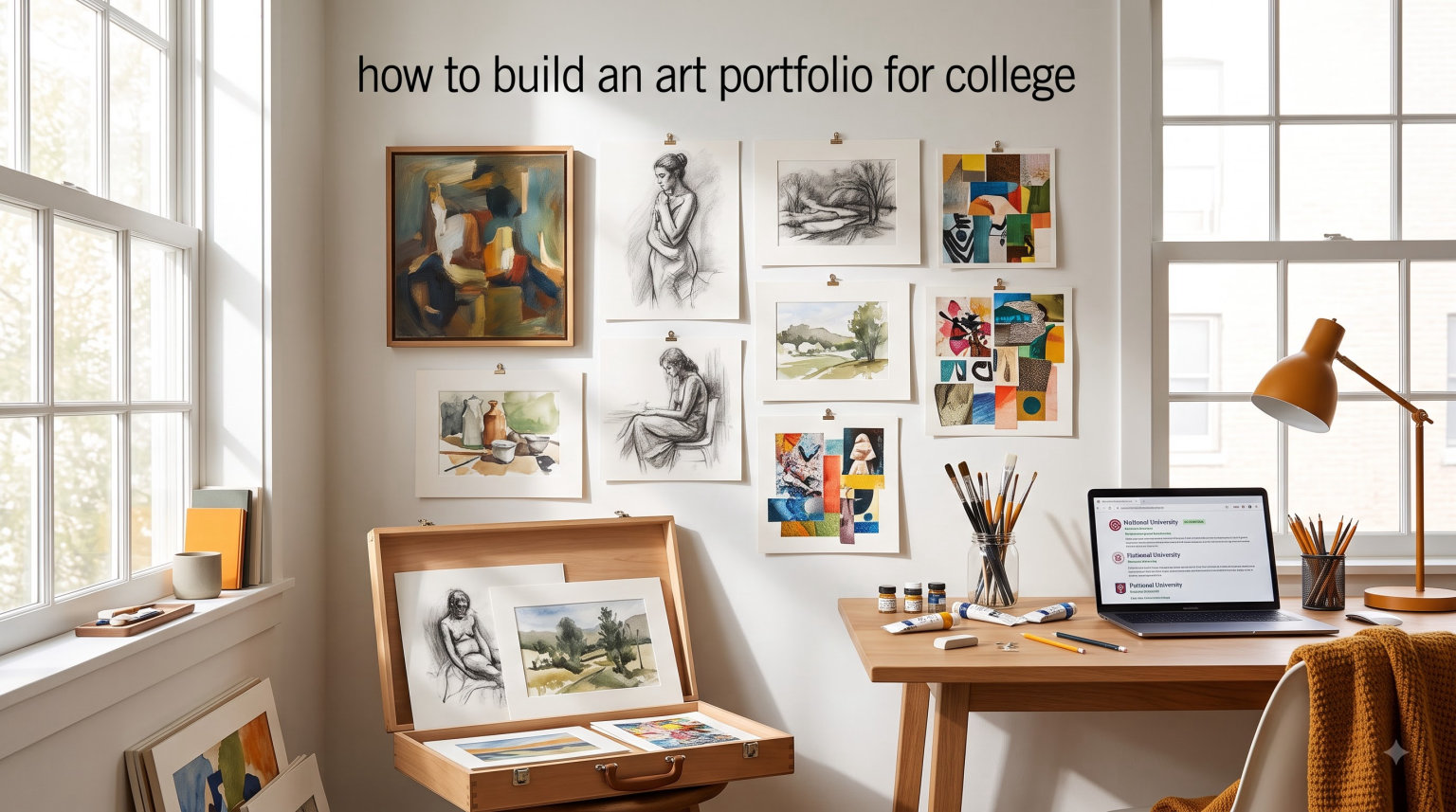
Building an art portfolio for college feels overwhelming at first. I remember staring at blank sketchbook pages, wondering if my drawings were good enough for art school admissions committees. After researching what colleges actually want and talking to students who got accepted, I’ve learned that a strong portfolio isn’t about being perfect. It’s about showing your potential, your work ethic, and your unique creative voice.
In this guide, I’ll walk you through exactly how to build an art portfolio for college that gets noticed. You’ll learn the specific skills admissions counselors look for, how to organize your work, and practical tips from students who successfully navigated this process.
Table of Contents
What Is an Art Portfolio for College?
An art portfolio for college is a curated collection of your artwork that demonstrates your creative skills, technical abilities, and artistic potential to admissions committees. It serves as visual proof of your talent beyond grades and test scores.
Think of your portfolio as a story about who you are as an artist. Colleges use it to assess your foundational skills (especially observational drawing), your creative thinking abilities, and how you communicate ideas visually. Most art schools and creative programs require 10 to 20 pieces, though some accept up to 25.
Your portfolio matters because it’s often the deciding factor in art school admissions. When I spoke with students on forums like Reddit’s r/ArtistLounge, they consistently mentioned that their portfolio carried more weight than their GPA or SAT scores for art programs.
How to Build an Art Portfolio for College: An 8-Step Process
Building a standout portfolio takes time and planning. I’ve broken the process into eight manageable steps that mirror what successful students actually did. Work through these in order, and you’ll end up with a portfolio that genuinely represents your abilities.
Step 1: Research School-Specific Requirements
Every art school has different expectations, so start by checking each school’s portfolio requirements. Some want 10 pieces minimum, others accept up to 25. Certain programs emphasize specific skills (like observational drawing) while others focus on conceptual work.
Visit the admissions pages of schools you’re interested in and note:
- Piece count limits and minimums
- Required mediums or subject matter
- Digital vs physical submission format
- Deadlines for early action vs regular decision
- Additional requirements like artist statements
If you’re applying to multiple schools, create a spreadsheet tracking each school’s requirements. This prevents last-minute scrambling and ensures you don’t miss important details.
Step 2: Understand the 7 Elements of Art
The seven elements of art form the foundation of every successful portfolio. Admissions counselors look for evidence that you understand and can apply these fundamentals.
The seven elements are:
- Line: The path of a moving point. Show control through contour drawings and expressive mark-making.
- Shape: Flat areas defined by lines or color changes. Include both geometric and organic shapes.
- Form: Three-dimensional objects with height, width, and depth. Demonstrate this through still life drawings.
- Color: The visual property of objects. Show color theory knowledge through harmonious compositions.
- Value: The lightness or darkness of tones. Essential for creating depth and volume.
- Texture: The surface quality of objects. Include both actual texture (in mixed media) and implied texture (in drawings).
- Space: The area around, between, or within objects. Demonstrate through perspective and composition.
You don’t need a piece explicitly showcasing each element. Instead, choose work where multiple elements work together harmoniously.
Step 3: Prioritize Observational Drawing
Observational drawing is the single most important skill to demonstrate in your portfolio. This means drawing from life, not from photographs or imagination. Art schools want to see that you can look at real objects and translate what you see onto paper.
Focus on these observational drawing subjects:
- Still life arrangements with varied textures and forms
- Self-portraits or figure drawings from a mirror or model
- Interior and exterior spaces showing perspective
- Natural objects like shells, bones, or plants
Avoid drawing from photographs when possible. While photo references are sometimes necessary, admissions counselors can tell the difference. Work done from direct observation shows better proportions, more natural forms, and stronger spatial relationships.
Practice drawing for at least 30 minutes daily in the months leading up to your portfolio submission. Consistent practice improves your skills faster than cramming.
Step 4: Show Variety in Mediums and Techniques
Your portfolio should demonstrate range without sacrificing quality. Include 2 to 4 different mediums to show you’re comfortable with various materials.
Consider including:
- Graphite or charcoal drawings for tonal values
- Colored pencil or pastel for color work
- Painting (acrylic, watercolor, or oil) for color mixing
- Printmaking or mixed media for experimentation
- Digital work if relevant to your intended major
Quality matters more than quantity. If you only have strong work in graphite and watercolor, submit those rather than forcing weaker pieces in unfamiliar mediums. That said, pushing yourself to try new materials shows growth mindset, which admissions counselors value.
Include both quick sketches and finished pieces. Sketchbook pages showing process work add depth to your portfolio.
Step 5: Demonstrate Originality and Creative Voice
Colleges want to admit students with unique perspectives, not copies of other artists. Originality matters more than technical perfection.
Show your creative voice by:
- Choosing personal subject matter that matters to you
- Avoiding overused subjects (sad anime characters, floating eyes, generic sunsets)
- Taking risks with composition or concept
- Including work that shows your personality
One student I heard from on forums mentioned getting accepted after including a series about their grandmother’s garden. The subject was personal, the observation was strong, and the emotional connection came through in the work.
If you include fan art or copied work, clearly label it as such. However, most admissions counselors advise against including copied work at all. Focus on original creations.
Step 6: Select and Curate Your Best Work
This is where the 80/20 rule applies. In portfolio building, this means roughly 80% of your portfolio should demonstrate strong foundational skills (observational drawing, technical accuracy), while 20% can showcase creativity and experimentation.
When selecting pieces, ask yourself:
- Does this show my best technical ability?
- Does this demonstrate observation from life?
- Is this original work I’m proud of?
- Does this add something new to my portfolio?
Remove anything that looks unfinished, shows obvious photo reference, or duplicates skills already demonstrated by stronger pieces. It’s better to submit 12 excellent pieces than 20 mediocre ones.
Similarly, the 70/30 rule suggests about 70% of your portfolio should be finished work, while 30% can be process pieces or sketchbook pages. This ratio shows you can complete work while also revealing your thinking process.
Lay out all your potential pieces and rank them from strongest to weakest. Cut from the bottom until you reach your target number.
Step 7: Organize and Present Professionally
Presentation matters almost as much as content. A poorly photographed or disorganized portfolio undermines strong artwork.
For physical portfolios:
- Use clean, professional presentation cases
- Ensure all edges are clean and nothing is falling apart
- Label each piece with title, medium, size, and date
- Order pieces strategically (start and end strong)
For digital submissions:
- Photograph work in even, natural light
- Edit photos for accurate color representation
- Use consistent file naming conventions
- Follow each school’s specific formatting requirements
When photographing art, shoot in indirect sunlight or with two light sources at 45-degree angles to avoid harsh shadows. Edit in photo software to match the original colors as closely as possible.
For tips on presenting your work beautifully, check out our art display and presentation tips.
Step 8: Get Feedback and Iterate
Don’t submit your first draft. Get eyes on your portfolio from people who know what art schools want.
Seek feedback from:
- Art teachers (especially those familiar with college admissions)
- Professional artists or working designers
- National Portfolio Day reviews
- Peers with strong observational skills
National Portfolio Day events happen across the country and let you get free portfolio reviews from admissions counselors. Students on forums consistently call these events invaluable for understanding what schools actually look for.
When receiving feedback, listen for patterns. If three different people mention the same weakness, fix it. If one person disagrees with everyone else, consider their perspective but don’t necessarily change course.
Our guide on art criticism skills can help you give and receive feedback more effectively.
Common Mistakes to Avoid
I’ve seen students make the same errors repeatedly. Here are the mistakes that hurt your chances:
Submitting copied work or fan art: Art schools want to see your original ideas. Fan art shows technical skill but not creative thinking.
Relying too heavily on photo references: Drawing from photos flattens forms and distorts proportions. Prioritize drawing from life.
Quantity over quality: Twenty mediocre pieces won’t beat ten excellent ones. Be ruthless in cutting weak work.
Poor photography: If submitting digitally, bad photos can ruin strong artwork. Take time to photograph properly.
Ignoring requirements: Each school has specific guidelines. Missing deadlines or format requirements gets your application rejected regardless of talent.
Playing it too safe: Admissions counselors see hundreds of portfolios. Work that takes creative risks stands out more than technically perfect but boring pieces.
Tailoring Your Portfolio by Major
Different art programs emphasize different skills. Here’s how to adjust your portfolio based on your intended major.
Fine Art
Focus on observational drawing, figure studies, and personal expression. Include sketchbook work and process documentation. Show conceptual thinking alongside technical skill.
Graphic Design
Demonstrate typography understanding, composition skills, and digital proficiency. Include logo designs, layout projects, and work showing visual problem-solving.
Fashion Design
Show figure drawing skills, fabric understanding, and design sketches. Include illustrations of original garment designs and any sewn pieces.
Architecture
Emphasize perspective drawing, spatial understanding, and drafting skills. Include sketches of buildings, interior spaces, and structural studies.
Animation
Include gesture drawings, character designs, and sequential art. Show understanding of movement and timing through sketchbook studies.
If you’re writing an artist statement to accompany your portfolio, our artist statement guide can help you communicate your intentions clearly.
What If You Have Limited Experience?
Many students worry they can’t apply to art school without years of formal training. This isn’t true. I’ve seen students get accepted with just one year of serious portfolio preparation.
If you’re starting late:
- Focus intensely on observational drawing. Even six months of daily practice produces significant improvement.
- Use free online resources like YouTube tutorials and museum websites.
- Draw every day, even for just 20 minutes.
- Attend free figure drawing sessions at local community colleges or art centers.
- Don’t apologize for being self-taught. Many successful artists started exactly where you are.
Quality of observation matters more than years of experience. A student with one year of dedicated practice often produces stronger work than someone with five years of casual hobbyist drawing.
Frequently Asked Questions
What is the 70/30 rule in art?
The 70/30 rule in art portfolios suggests that approximately 70% of your portfolio should consist of finished, polished artwork, while 30% can be process pieces, sketchbook pages, or developmental work. This ratio shows admissions counselors that you can complete professional-quality work while also demonstrating your creative process and thinking.
What is the 80/20 rule in art?
The 80/20 rule in art portfolio building recommends that about 80% of your work should demonstrate strong foundational skills like observational drawing, technical accuracy, and traditional techniques, while 20% can showcase creative experimentation, personal expression, and unique concepts. This balance proves you have solid fundamentals while also showing creative potential.
Who famously got rejected from art school?
Several famous artists faced art school rejections. Vincent van Gogh was rejected from the Antwerp Academy and struggled to find formal training. Adolf Hitler famously applied twice to the Academy of Fine Arts Vienna and was rejected both times. More recently, some contemporary artists have shared stories of being rejected from prestigious programs before finding success through alternative paths. Rejection doesn’t determine your artistic potential.
What are the 7 elements of art portfolio?
The 7 elements of art that should be demonstrated in a portfolio are: 1) Line – the path of a moving point, 2) Shape – flat areas defined by boundaries, 3) Form – three-dimensional objects with depth, 4) Color – the visual property of light reflected from objects, 5) Value – the lightness or darkness of tones, 6) Texture – surface quality, and 7) Space – the area around, between, or within objects. Strong portfolios show understanding of how these elements work together.
How many pieces should be in an art portfolio for college?
Most art schools require between 10 and 20 pieces in a portfolio, though some accept up to 25. Always check specific school requirements as they vary by program. Quality matters more than quantity. It’s better to submit 12 excellent pieces than 20 mediocre ones. Some schools have minimums (often 10-12) while others have maximums but no minimums.
What should I include in my art portfolio if I have no experience?
Start with observational drawing from life. Draw everyday objects, self-portraits, interior spaces, and natural forms. Include sketchbook pages showing your process. Focus on demonstrating basic skills like proportion, perspective, and value rather than complex compositions. Quality observation matters more than years of experience. Even beginners can create strong portfolios by drawing consistently from life.
Do art schools want to see fan art in portfolios?
Most art schools prefer original work over fan art. While fan art can demonstrate technical skill, it doesn’t show creative thinking or original ideas. Some schools explicitly discourage fan art submissions. If you do include it, clearly label it as fan art and ensure it’s a small portion of your overall portfolio. Focus primarily on original observational drawings and personal creative projects.
Conclusion
Learning how to build an art portfolio for college takes time, but the process itself makes you a better artist. By focusing on observational drawing from life, showing variety in your mediums, and curating only your best work, you create a portfolio that genuinely represents your potential.
Remember that admissions counselors want to see authentic work, not perfection. They look for students who can observe carefully, think creatively, and commit to growth. Your portfolio should tell the story of who you are as an artist right now.
Start today. Pick up a pencil and draw something in front of you. That first mark is the beginning of your portfolio.