
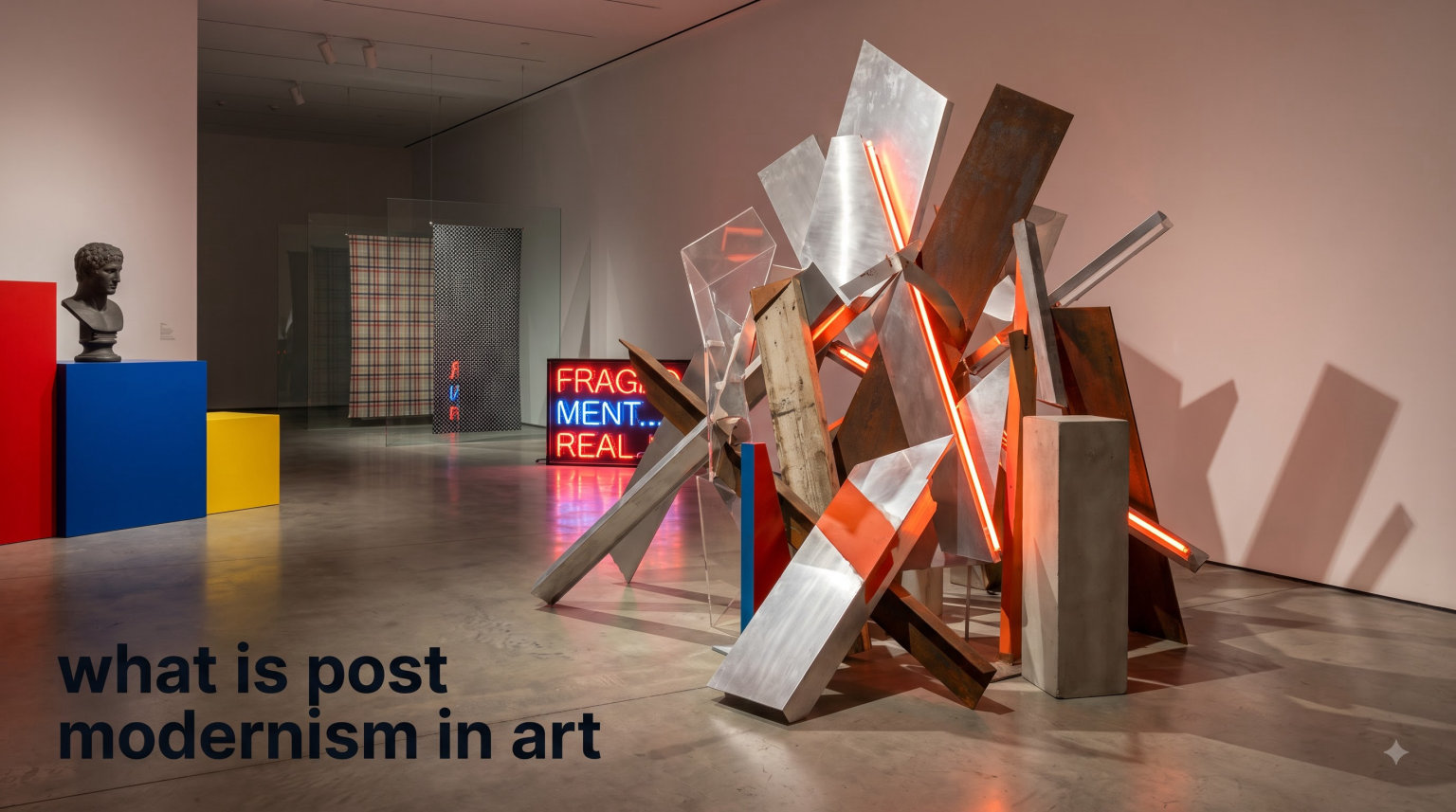
Postmodernism in art is a late 20th-century movement that emerged as a reaction against the ideals and certainties of modernism. Rather than pursuing universal truths and progressive ideals, postmodern art embraces complexity, contradiction, and a playful sense of irony. It rejects the boundaries between high culture and popular culture, questioning what counts as “real” art and who gets to decide.
Our team has spent years studying how art movements develop and interact across history. What strikes us about postmodernism is how thoroughly it transformed the conversation around what art can be and do. Where modernism sought clarity and purpose through unified visual languages, postmodernism celebrates ambiguity and challenges every assumption artists and viewers hold. This guide will walk you through everything you need to understand this pivotal movement that reshaped contemporary visual culture.
You will learn the core definitions, how postmodernism differs from modernism, the key characteristics that define postmodern work, the major artists who shaped the movement, and why it remains so relevant today. Whether you are an art student seeking foundational knowledge or a curious reader wanting to make sense of contemporary exhibitions, this article provides the context you need.
Table of Contents
What Is Post Modernism in Art?
Postmodernism in art describes a broad set of approaches and attitudes that emerged primarily between 1970 and 1990, though its influence continues strongly today. According to the Tate, it can be seen as “a reaction against the ideas and values of modernism” as well as “a description of the period that followed modernism’s dominance in cultural theory and practice.” Rather than following a single unified style, postmodernism represents a fundamental shift in how artists conceptualize their work, engage with audiences, and understand the very nature of artistic meaning.
The movement emerged partly as a response to the perceived failures of modernist utopias. When modernism’s grand promises of progress and rational enlightenment failed to deliver paradise, artists began questioning the entire framework. Think about it: the 20th century witnessed unprecedented atrocities committed in the name of ideology and progress. This historical context made modernist faith in universal truths seem naive at best, dangerous at worst. Our team found that this skepticism toward meta-narratives became one of postmodernism’s defining philosophical features.
Artists stopped believing in one right way to make art and instead embraced multiple simultaneous possibilities. Where modernist artists sought purity and simplification, postmodernists celebrated contamination and plurality. This shift fundamentally changed how art gets made, distributed, and interpreted across global cultures. The movement rejected the idea that art should embody timeless, universal values in favor of examining how meaning gets constructed within specific contexts, communities, and power structures.
Philosophically, postmodernism draws heavily from thinkers like Jean-François Lyotard, who defined it as “incredulity toward meta-narratives.” This means postmodern artists distrust grand explanations that claim to explain everything about human experience. Instead, they favor local stories, personal perspectives, and fragmented truths that acknowledge how incomplete and situated all knowledge really is. The movement also incorporates ideas from post-structuralism and deconstruction, applying linguistic analysis to question how meaning gets created and communicated through visual form.
The V&A describes postmodernism as “one of the most controversial movements in art and design history,” noting that “Over two decades, from about 1970 to 1990, Postmodernism shattered established ideas about art and design.” This controversy arose because the movement challenged fundamental assumptions about what art should look like, how it should be made, and who gets to define quality and legitimacy. The controversy also stems from postmodernism’s embrace of contradiction as a positive value rather than something to overcome.
Modernism vs Post Modernism: Key Differences
Understanding postmodernism requires seeing clearly how it differs from its predecessor. Modernism, spanning roughly 1860 to 1970, pursued the idea that art could represent universal truths through increasingly simplified forms. Think of how Piet Mondrian reduced landscape to grids and primary colors, seeking underlying order in visual experience. Or consider how Clement Greenberg championed abstract expressionism as the purest possible art, stripping away any unnecessary content to reveal essential visual truth. Modernists believed in progress, innovation, and finding essential meanings hidden beneath surface appearances.
Postmodernism rejects these assumptions entirely. Where modernism valued purity and singular vision, postmodernism embraces contamination and plurality. The Museum of Modern Art describes it as “less a cohesive movement than an approach and attitude toward art, culture, and society.” This fundamental shift changes everything about how art gets made, displayed, and interpreted. While modernism sought to elevate visual language to universal heights, postmodernism questions whether universal language exists at all.
The comparison reveals how fundamentally different these two movements approached art-making. We find it helpful to think of modernism as searching for the one perfect answer, while postmodernism celebrates asking better questions. Modernism believed art could reveal transcendent truths; postmodernism suggests all truth claims are situated within power structures and cultural contexts that shape what can be said and seen. This philosophical shift has profound implications for how artists work and how audiences engage with their work.
| Aspect | Modernism | Postmodernism |
|---|---|---|
| Core Belief | Universal truths and progressive improvement | Relativism and skepticism toward grand narratives |
| Art’s Purpose | Express essential realities and timeless truths | Challenge assumptions and expose cultural contradictions |
| Style Approach | Unified, singular vision per artist | Hybrid, multiple voices and references simultaneously |
| Culture Hierarchy | High culture elevated above mass culture | High and mass culture treated as equally valid sources |
| Artist Role | Genius creator and visionary leading culture | Appropriator, commentator, questioner within culture |
| Viewer’s Role | Passive recipient of meaning transmitted by artist | Active interpreter and collaborator in meaning-making |
| View of History | Linear progress toward improvement | Cyclical recurrence and fragmented references |
| Treatment of Tradition | Break from tradition to find fresh expression | Ironically engage, quote, and subvert tradition |
The comparison table above reveals how profoundly different these two movements approach art-making. When you explore our deeper discussion of modern art vs contemporary art, you will see how this shift played out across the entire art world. The modernist belief in unbroken progress gave way to postmodern recognition that history repeats in fragmented, self-aware ways. Each return to the past carries irony rather than sincere reverence.
Key Characteristics of Post Modern Art
Several defining characteristics help identify postmodern art when you encounter it in galleries, museums, or public spaces. Understanding these traits allows you to engage more deeply with contemporary work and recognize the philosophical commitments underlying different artistic choices.
Irony serves as perhaps the most recognizable trait of postmodern art. Postmodern artists employ irony to comment on cultural assumptions while maintaining critical distance that prevents simple interpretation. This is not simple sarcasm but a sophisticated tool for revealing contradictions between what cultures say they believe and what they actually do. Irony allows artists to critique without prescribing solutions, leaving viewers to work through implications themselves. The best postmodern irony feels simultaneously playful and serious, inviting laughter while prompting deeper reflection.
Pluralism appears throughout postmodern work, manifesting as the simultaneous use of multiple styles, references, and cultural sources within single works or across an artist’s practice. Rather than committing to one visual language, postmodern artists mix freely across periods, cultures, and traditions without hierarchy or judgment. A single artwork might reference medieval religious painting, contemporary advertising, and indigenous craft traditions in equal standing. This radical inclusivity challenges the modernist idea that art should evolve in linear sequence, each movement advancing beyond the previous one.
Appropriation became central to the postmodern movement, with artists borrowing freely from history, advertising, mass media, and other artists’ work. This technique challenges romantic notions of artistic originality by demonstrating that all cultural expressions build on what came before. Artists like Richard Prince famously rephotographed existing images, transforming context rather than creating original content. The question becomes not whether something is original but how meaning shifts when content gets recontextualized. Our deeper exploration of appropriation art shows how this technique evolved from Duchamp through digital culture.
Parody and Pastiche frequently appear in postmodern work, though they serve different purposes. Parody mocks a specific target, using humor to expose something’s absurdity or contradictions. Pastiche simply copies style without satirical intent, creating works that evoke earlier periods or movements without ironic distance. Both challenge the romantic idea of pure originality while acknowledging that cultural production always involves recycling existing forms. Postmodern artists freely combine parody and pastiche within single works or across their careers.
Bricolage describes the practice of assembling artworks from diverse found materials, creating unexpected combinations that reveal hidden connections. The term comes from anthropology, describing how non-industrial cultures use available materials to solve problems. In art, bricolage manifests as collage, assemblage, and installation work that combines disparate elements into new configurations. This recursive quality emphasizes that all cultural production builds on existing materials, however transformed they become.
Self-awareness and Meta-commentary characterize postmodern work that examines its own nature as art. These pieces often comment on art history, the gallery system, or the role of the artist in ways that dissolve boundaries between creation and criticism. A work might literally include its own review, or an artist might discuss their working process in the artwork itself. This reflexive quality creates layered meanings that engage with art history while addressing current concerns.
Anti-authoritarianism manifests as deliberate boundary-crossing and challenge to what institutions and critics define as legitimate art. Postmodern artists deliberately work in “low” forms rejected by fine art traditions, embrace materials considered inappropriate for serious art, and question who gets to determine quality and value. This stance emerges from recognition that all artistic value systems reflect power structures rather than objective standards.
Notable Post Modern Artists and Their Works
The postmodern movement produced many artists whose work defined the era and continues influencing contemporary practice. Understanding these figures helps illustrate how theoretical positions translate into visual strategies. Our team has studied these artists extensively, and we want to share what makes each one significant to the movement.
Jeff Koons became one of postmodernism’s most recognizable figures through sculptures that appropriate kitsch imagery and craft traditions usually dismissed as low culture. His “Puppy” (1992), a giant West Highland White Terrier covered in flowering plants, stands outside the Guggenheim Museum Bilbao as a statement about transformation and accessibility. Koons transforms found objects and craft techniques into monumental fine art statements that challenge viewers’ assumptions about taste and value. His “Banality” series explicitly engaged with decorative traditions, bringing them into high art contexts with deliberate irony.
Barbara Kruger created iconic text-and-image works that comment on power, gender, and consumption in American culture. Pieces like “Your Body is a Battleground” (1989) combine found photographs with confrontational typography, merging commercial language with political critique. Kruger’s stark white text on red backgrounds demands attention while her content exposes cultural contradictions. Her work demonstrates how postmodern art weaponizes the very visual strategies of advertising and media against themselves, using corporate aesthetic against corporate messages.
Cindy Sherman explored identity construction through innovative photographic self-portraiture. In her groundbreaking “Untitled Film Stills” series (1977-1980), she photographed herself in various female archetypes drawn from film noir, magazine imagery, and popular culture. Each photograph presents Sherman’s face transformed by costume, lighting, and pose into cultural stereotypes of femininity. The work reveals how identity gets constructed through cultural images, a key postmodern concern with the fluidity and performativity of selfhood. Sherman continues exploring this territory across her career, each series examining different cultural fantasy or historical period.
Mike Kelley worked across installation, sculpture, performance, and video to examine American folk culture, class identity, and institutional critique. His monumental installations frequently incorporated found objects and craft traditions, challenging hierarchies between high and low culture. Kelley pushed against boundaries separating art from everyday experience, embracing materials and subjects usually excluded from galleries. His 1991 installation “The Uncanny” explored how objects carry psychological meaning beyond their functional purposes. Kelley embodied postmodern pluralism in his multivalent practice, refusing to specialize in one medium or approach.
Rosalind Krauss contributed both art criticism and artwork that theorized postmodern practice. As a critic, her writings on “sculpture in the expanded field” and the “postmedium condition” shaped how scholars understood postmodern art. As an artist, she created works that literally embodied her theoretical concerns. Her 1999 sculpture “Fifty Eight Quartered” demonstrates how artists can translate complex intellectual positions into visual form without sacrificing either theoretical rigor or aesthetic impact.
Major Post Modern Art Movements
Several distinct movements emerged within the broader postmodern framework, each addressing different aspects of the movement’s concerns. Understanding these tendencies helps contextualize individual artists within larger developments while recognizing the diversity of postmodern practice.
Conceptual art emerged as one of postmodernism’s most influential tendencies, prioritizing ideas over visual or material craft. Artists like Sol LeWitt created works where the concept or idea itself constituted the artwork, with execution potentially delegated to others. This “dematerialization” of the art object challenged fundamental assumptions about what art is and how it carries meaning. If the idea matters more than the physical object, traditional hierarchies of craft and skill become irrelevant. Conceptual art aligned perfectly with postmodern skepticism toward claims of singular meaning or permanent value.
Performance art became a crucial vehicle for postmodern experimentation, emphasizing the artist’s body, time, and presence as primary medium. Performance art often blurred boundaries between artist and audience, creating participatory experiences that resisted commodification. Artists like Marina Abramovic created durational works testing physical and psychological limits. This form aligned perfectly with postmodernism’s challenge to traditional art objects and institutional frameworks, proposing live experience as art independent of material traces.
Installation art expanded the possibilities of spatial experience, creating immersive environments that transformed viewers’ relationship to space and time. Artists like Dan Graham created works that dissolved boundaries between artwork and architecture, between seeing and being seen. James Turrell’s light installations created perceptual experiences that questioned whether what viewers saw was “real.” These installations embodied postmodern concerns with context, perception, and the viewer’s active role in meaning-making. Walking through such works, viewers became components of the artwork rather than observers from outside.
Neo-expressionism returned to figurative painting and emotional intensity during the 1980s, but with self-conscious awareness that distinguished it from earlier expressionism. Artists like Jean-Michel Basquiat combined gestural painting with text, appropriation, and cultural critique. His paintings referencing his Puerto Rican and Haitian background while engaging with street art and ancient symbols embodied postmodern pluralism. This movement demonstrated postmodernism’s capacity to embrace apparent contradictions, reviving traditional techniques while subverting their usual contexts.
Picture Generation emerged in the 1970s and 1980s, focusing on how images shape consciousness and identity. Artists like James Welling and Barbara Kruger examined how photographs construct reality rather than reflect it. This movement aligned with broader cultural analysis of how media shapes perception, connecting postmodern art to emerging theories of simulation and hyperreality. The movement foresaw our current situation where images increasingly constitute experience rather than merely documenting it.
Contemporary Relevance: Why Post Modernism Matters Today
Postmodernism’s influence permeates contemporary art and culture far more than most people realize. The movement established frameworks through which we now interpret visual culture, from advertising to social media to digital art. Every time you see an artist mixing styles, questioning authorship, or challenging cultural hierarchies, you are witnessing postmodern principles at work in contemporary practice.
The digital landscape has amplified postmodern concerns about authenticity, originality, and cultural hierarchy in ways that would have seemed impossible during the movement’s initial emergence. Social media platforms democratize image-making while simultaneously blurring boundaries between high and low culture. Anyone can now create and distribute visual work, challenging traditional gatekeepers while creating new forms of cultural hierarchy based on engagement rather than institutional validation.
Memes exemplify postmodern artistic strategies on a massive scale. They appropriate existing images, recontextualize them with text, transform meaning through repetition, and spread across cultural boundaries without regard for traditional categories. The most successful memes employ irony, parody, and pastiche while achieving the kind of mass cultural penetration that postmodern artists could only dream about. This demonstrates both how postmodernism succeeded and how it transformed into something beyond artistic movements into general cultural literacy.
The relationship between street art and gallery art demonstrates how postmodernism’s boundary-crossing continues reshaping art institutions and audience expectations. Artists like Banksy achieved international recognition while maintaining deliberate anonymity and challenging commercial gallery systems. Their work embodies postmodern irony and anti-authoritarianism while reaching audiences far beyond traditional art-world contexts. The same dynamics operate in music, film, fashion, and every cultural domain where boundary-crossing and ironic appropriation have become standard practice.
Contemporary artists continue employing postmodern strategies like appropriation, irony, and self-reflection, but often with heightened awareness of the movement’s historical significance. This self-consciousness creates layered meanings that engage with art history while addressing current concerns. Artists working today often explicitly engage with postmodern precedents, either continuing their project or explicitly questioning whether postmodern frameworks remain adequate for contemporary conditions.
We find that understanding postmodernism provides essential context for interpreting today’s most innovative artwork. The movement established the conceptual vocabulary and visual strategies through which contemporary artists work, even as they extend or critique postmodern positions. Whether you are examining a gallery exhibition, analyzing social media content, or trying to understand contemporary visual culture, postmodern frameworks help reveal how meaning gets constructed, challenged, and reconstructed in our shared environment.
Frequently Asked Questions
What is the main concept of post-modernism in art?
Postmodernism in art emerged as a reaction against modernism’s belief in universal truths and progress. It embraces complexity, irony, and pluralism while rejecting the boundaries between high culture and mass culture.
What is an example of postmodernism in art?
A classic example is Jeff Koons’ ‘Puppy’ (1992), a giant sculpture of a West Highland White Terrier covered in flowers. The work appropriates kitsch imagery while challenging what art should be, embodying postmodern irony and the blurring of cultural boundaries.
What are the three key principles of postmodernism in art?
The three key principles are: (1) Anti-authoritarianism – challenging established art institutions and traditions, (2) Pluralism – embracing multiple perspectives and styles simultaneously, and (3) Self-awareness – art that comments on itself and its own nature.
How to explain postmodernism in simple terms?
Think of postmodern art as art that says ‘there is no single right answer.’ While modernism believed in progress and universal truths, postmodernism questions everything, mixes high and low culture, and often uses irony and parody to challenge our assumptions about what art should be.
What is postmodernism in art in simple terms?
Postmodernism in art is a movement that started around 1970 where artists stopped trying to create one unified style or message. Instead, they embraced contradiction, mixed different cultures and styles, and questioned what makes something ‘art’ in the first place.
Conclusion
Postmodernism in art represents one of the most significant shifts in how we understand creative expression and cultural meaning. Rather than pursuing the modernist dream of universal truths and progressive evolution, postmodern artists embrace complexity, contradiction, and plurality as positive values. The movement questions everything, from what art should look like to who gets to define legitimate culture and value.
What makes postmodernism so important is how thoroughly it transformed the entire art landscape. The strategies it pioneered—appropriation, irony, self-reflection, boundary-crossing, and anti-authoritarianism—continue shaping contemporary practice across every visual medium. Understanding this movement helps you interpret everything from gallery exhibitions to social media content, providing essential frameworks for navigating today’s complex visual culture.
Whether you are examining a Jeff Koons sculpture in a museum, analyzing a meme spreading across social platforms, or trying to make sense of contemporary art exhibitions, postmodern principles help reveal how meaning gets constructed, challenged, and reconstructed in our shared visual environment. The movement may have emerged in response to specific historical conditions, but its insights and strategies remain vital for understanding how contemporary culture works and how artists continue pushing against boundaries of what seems possible.