
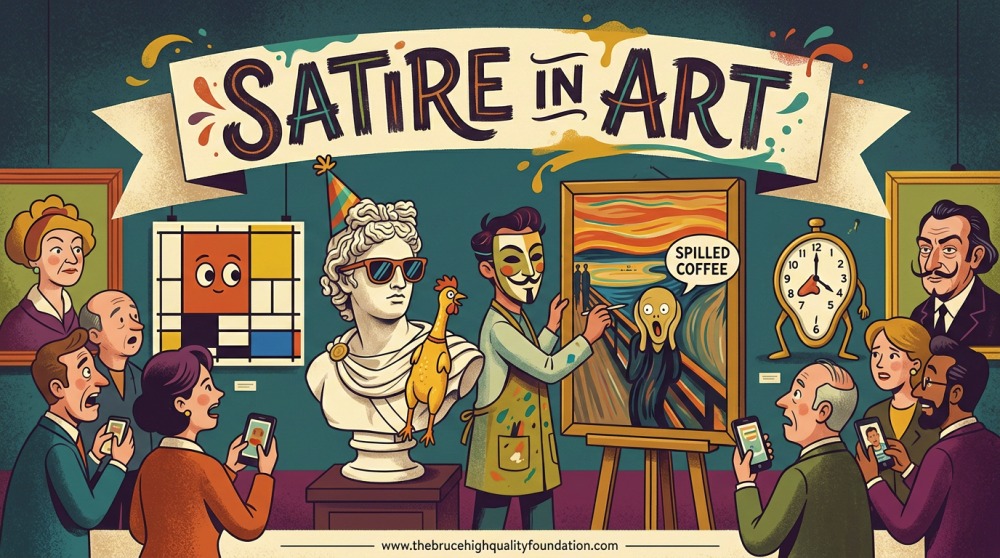
Great art doesn’t always hang quietly in galleries. Sometimes it sneaks up behind you and makes you laugh before you realize you’ve been punched in the gut by a hard truth. Satire in art has served as one of the most potent weapons against power for centuries, wielding humor like a scalpel to expose hypocrisy, corruption, and the absurdities of human behavior.
When artists use humor to challenge power, they create something far more dangerous than outrage. They create reflection. I’ve spent years studying how satirical artists across history have shaped public discourse, and the pattern is striking: laughter opens doors that anger slams shut. A joke about the king lands where a manifesto gets you imprisoned.
This guide explores how satire in art works, why it matters, and the artists who have mastered its delicate balance. From 18th-century printmakers to contemporary street artists, we’ll examine the techniques, the risks, and the enduring power of art that refuses to take power seriously.
Table of Contents
What Is Satire in Art?
Satire in art is a genre that uses humor, irony, exaggeration, and ridicule to expose and critique societal vices, political corruption, and human folly. Unlike simple comedy, satirical art carries an underlying desire for reform. It wants to change what it mocks.
The distinction between satire, parody, and irony matters here. Parody imitates for comic effect, often celebrating what it copies. Irony states the opposite of what is meant, creating distance between appearance and reality. Satire attacks, using whatever tools work best for the target. It can borrow parody’s imitation and irony’s contradictions, but its goal remains constant: the improvement of society through critique.
Visual satire operates differently from literary satire. Without words, artists must communicate through exaggeration, juxtaposition, and symbolic substitution. A king becomes a pig. A politician grows a Pinocchio nose. These visual shortcuts bypass rational defenses and strike emotional chords.
The five elements of satire give artists their framework. First, attack: targeting specific vices or follies rather than general complaints. Second, judgment: the implicit moral evaluation that separates satire from mere mockery. Third, wordplay: clever use of language, visual puns, and ironic reversals. Fourth, humor: the engagement mechanism that makes the medicine go down. Fifth, and most crucial, the desire for reform: satire wants its target to change, not just suffer.
The Historical Power of Satirical Art
The marriage of art and mockery stretches back to ancient times, but satire as a political weapon crystallized in the 18th century. William Hogarth’s series “A Rake’s Progress” (1735) used narrative painting to attack moral decay in London society. His prints circulated widely among the middle class, proving that art could influence public opinion beyond the elite circles of traditional patronage.
Hogarth understood something fundamental about visual satire: sequential storytelling amplifies impact. Following his protagonist Tom Rakewell from inheritance to madhouse, viewers witnessed cause and effect with devastating clarity. Each scene built upon the last, creating an argument more persuasive than any single image could achieve.
Across the Channel, Honoré Daumier carried the torch into the 19th century. His lithographs for French newspapers mocked King Louis-Philippe as “Gargantua,” a fat monster devouring the nation’s resources. The authorities responded with six months’ imprisonment, proving satire’s power to threaten power. Daumier emerged from jail and immediately resumed his attacks, establishing a pattern of persecution and persistence that would define political art for generations.
Francisco Goya’s “Los Caprichos” (1799) pushed satire into darker territory. His etchings attacked Spanish superstition, corruption, and the decline of reason. “The Sleep of Reason Produces Monsters” remains one of art history’s most enduring images, suggesting that without rational critique, society becomes prey to its worst impulses. Goya’s work demonstrated that satire need not be funny to be effective. Sometimes horror serves the satirical purpose better than humor.
The early 20th century brought Dada, a movement that weaponized absurdity itself. Marcel Duchamp’s “Fountain” (1917), a porcelain urinal signed “R. Mutt,” submitted to an art exhibition, asked a question more threatening than any political cartoon: who decides what counts as art? By mocking the institution’s authority directly, Duchamp performed satire on the meta-level, challenging the power structures that enable all other artistic commentary.
Pop Art in the 1950s and 60s refined these techniques for the consumer age. Artists like Roy Lichtenstein and Andy Warhol used commercial imagery against itself, exposing how advertising and media shape consciousness. Their deadpan presentation, lacking obvious critique, forced viewers to supply the judgment themselves. This participatory satire proved particularly suited to an era of television and mass marketing.
How Artists Use Irony and Humor to Challenge Authority
Technique separates effective satire from simple insult. The best practitioners have developed approaches that maximize impact while minimizing the risk of dismissal or censorship. Understanding these methods reveals how artists challenge the power of society’s thinking through strategic visual communication.
Exaggeration remains the satirist’s most reliable tool. By amplifying a subject’s distinctive features to grotesque proportions, artists make the familiar strange and the acceptable ridiculous. When James Gillray drew Napoleon as a tiny tyrant or when modern cartoonists emphasize a politician’s most recognizable flaw, they apply techniques refined over centuries. The eye recognizes the target while the mind recoils from the distortion.
Juxtaposition creates meaning through unexpected combination. Placing a homeless person outside a luxury boutique, or a war monument in a shopping mall, generates friction between images that words would struggle to articulate. Barbara Kruger mastered this technique with her text-overlay works, combining found photographs with aggressive slogans that recontextualize familiar scenes into political statements.
Appropriation steals the enemy’s weapons. By taking corporate logos, political symbols, or advertising campaigns and subverting their original meaning, artists turn the powerful’s own tools against them. The Situationist International perfected this approach with their détournement techniques, while contemporary street artists continue to hijack billboards and public signage for counter-messages.
Visual puns exploit the gap between what we see and what we understand. When Eugène Bataille painted the Mona Lisa with a pipe and mustache in 1887, he created “L.H.O.O.Q.,” a French homophone for crude provocation. The image mocked both artistic reverence and bourgeois taste simultaneously. Such layered communication rewards sustained viewing while delivering immediate impact.
Deadpan presentation presents absurdity with straight-faced seriousness. Maurizio Cattelan’s works, from the banana duct-taped to a wall to the solid gold toilet, refuse to signal whether they celebrate or critique their subjects. This ambiguity forces viewers to complete the meaning themselves, making the satirical message more personally involving than overt commentary could achieve.
Contemporary Satirical Artists Making an Impact
The tradition of satire in art thrives in 2026, with practitioners across mediums finding new targets and techniques. These six artists demonstrate the diversity of approaches currently challenging power structures worldwide.
Banksy: Anonymous Provocation
Banksy has become synonymous with political street art, maintaining anonymity while achieving global recognition. His stencil-based works appear overnight in public spaces, delivering pointed commentary on surveillance, consumerism, and political hypocrisy. The very fact of his unknown identity performs a satirical function, mocking the art world’s obsession with artist personality and biography.
His 2018 auction prank exemplified satirical art’s power to disrupt institutional frameworks. Immediately after “Girl With Balloon” sold for $1.4 million, a shredder hidden in the frame partially destroyed the work. The renamed “Love is in the Bin” then doubled in value, proving that the market values spectacle over substance and that destruction can be creation in the right context.
Barbara Kruger: Confrontational Text
Barbara Kruger’s signature white Futura Bold text on red bands over black-and-white photographs creates immediate visual authority. Slogans like “Your body is a battleground” and “I shop therefore I am” repurpose advertising aesthetics for feminist and political critique. Her work colonizes the same spaces as the messages she attacks, appearing on billboards, buses, and museum walls with equal force.
Kruger’s genius lies in making viewers complicit. The pronouns she uses, “you” and “we,” implicate the observer in the systems being critiqued. You are the consumer. We are the problem. This direct address prevents comfortable detachment, demanding engagement rather than passive observation.
Maurizio Cattelan: Absurdist Spectacle
Maurizio Cattelan has built a career on works that straddle the line between profound critique and elaborate joke. “America” (2016), a fully functional golden toilet installed at the Guggenheim Museum, invited visitors to relieve themselves on precious metal. The piece commented on wealth, democracy, and the art market’s absurd valuations while literally allowing the public to shit on value.
His 2019 work “Comedian,” a banana duct-taped to a wall at Art Basel Miami, sold for $120,000 before being eaten by a performance artist. Cattelan’s response, taping another banana, demonstrated that satire can function as both critique and market participation simultaneously, refusing easy moral categorization.
The Guerrilla Girls: Masked Activism
Since 1985, the anonymous collective known as the Guerrilla Girls has attacked sexism and racism in the art world. Wearing gorilla masks and assuming names of dead women artists, they produce data-driven posters exposing institutional inequality. Their 1989 poster “Do women have to be naked to get into the Met. Museum?” compared the percentage of women artists in the modern art sections with the percentage of naked female subjects in the same galleries.
The masks serve multiple satirical functions. They protect individuals from retaliation while mocking the art world’s obsession with individual genius. By wearing gorilla masks rather than something elegant, they reject the pressure on women to present themselves attractively. Their collective anonymity argues that the message matters more than the messenger.
David Shrigley: Deadpan Drawing
David Shrigley’s crude drawings and handwritten texts occupy a space between childlike innocence and adult despair. His stick figures confront existential dread with banal observations, creating humor from the gap between form and content. A drawing of a dog with the caption “I’m doing my best” communicates more about human limitation than polished technique could achieve.
Shrigley’s work suggests that authenticity of voice matters more than technical polish. His deliberately amateur style satirizes both the art world’s fetishization of skill and the self-help industry’s toxic positivity. By appearing to try so little, he paradoxically achieves significant emotional and satirical impact.
Ai Weiwei: Monumental Resistance
Chinese artist and activist Ai Weiwei brings satirical strategies to human rights advocacy. His “Dropping a Han Dynasty Urn” (1995) photographic series showed him destroying ancient artifacts, provoking outrage that he then redirected toward cultural destruction during the Cultural Revolution. The work demonstrated how shock can be repurposed for critique when properly contextualized.
His “Sunflower Seeds” installation at Tate Modern, consisting of 100 million hand-painted porcelain seeds, addressed mass production, individual identity, and collective labor. Visitors were originally encouraged to walk on the seeds, engaging physically with themes of consumption and value. This participatory element extends satire into embodied experience.
Digital Age Satire: Memes and New Media
The internet has democratized satirical art production while accelerating its circulation. Memes function as collective, anonymous satirical artworks, remixing found images with new captions to comment on current events. This represents a historical shift from individual authorship to distributed creation, challenging traditional art world structures as effectively as any gallery exhibition.
Digital satire moves faster than institutional art. While a painting takes months to create and years to circulate, a meme responds to yesterday’s news by this afternoon. This velocity enables commentary on rapidly evolving situations, political scandals, and cultural moments that traditional media cannot address in time. The cost is permanence. Yesterday’s brilliant satirical meme disappears beneath today’s content tsunami.
New media artists have embraced these tools. Cory Arcangel’s modified video games and obsolete technology works comment on obsolescence and consumer culture. Petra Cortright’s webcam videos and digital paintings explore how online identity construction has become everyone’s second job. These practitioners extend satirical traditions into territories that didn’t exist when Duchamp submitted his urinal.
The relationship between internet satire and power has grown complex. Authoritarian regimes now employ meme warfare themselves, blurring the distinction between satirical critique and disinformation. Artists must navigate an environment where mockery flows in all directions, and distinguishing genuine political art from manufactured content requires constant vigilance.
Punching Up vs Punching Down: The Ethics of Satirical Art
Not all satire deserves praise. The crucial distinction lies in direction. Satire that punches up, targeting those with more power than the artist, operates differently from satire that punches down, mocking those with less. The former challenges authority. The latter reinforces hierarchy. Telling the difference requires examining both intent and effect.
Historical examples illuminate the stakes. Colonial-era cartoons mocking colonized peoples reinforced racial hierarchies that enabled exploitation. Satirical attacks on marginalized groups, however clever their execution, serve oppression rather than challenging it. The Guerrilla Girls’ work succeeds because it targets powerful institutions. Had they mocked struggling artists instead, the same techniques would become bullying.
Contemporary debates about cancel culture and censorship often confuse these categories. Artists claiming persecution for “edgy” work sometimes merely complain that punching down now carries social consequences. True satirical courage involves attacking power despite risk, not mocking the powerless because it’s safe. The tradition from Hogarth to Banksy demonstrates that meaningful political art threatens someone who can fight back.
Cultural context and timing prove crucial for satirical effectiveness. A joke that lands in one decade may read as offensive or merely confusing in another. Artists working with charged material must consider not just their immediate targets but how their work circulates across time and audience. The best satirical art anticipates these shifts, remaining potent because its critique addresses structural rather than surface problems.
Forum discussions among art students reveal persistent anxiety about these boundaries. How can you incorporate humor into art practice without causing harm? What makes satire effective versus falling flat? The consensus suggests that self-interrogation matters more than rule-following. Artists who ask whether their targets deserve critique, whether their humor illuminates or obscures, and whether their work invites thinking or merely laughing, tend to navigate these waters more successfully than those convinced of their own righteousness.
Frequently Asked Questions
What is an example of satire in art?
Famous examples include Eugène Bataille’s parody of the Mona Lisa smoking a pipe, Banksy’s political street art critiquing consumerism, William Hogarth’s 18th-century moral narratives like ‘A Rake’s Progress,’ and Marcel Duchamp’s ‘Fountain’ (1917), which used a urinal to challenge artistic authority and question what counts as art.
How do artists challenge the power of society’s thinking?
Artists challenge societal thinking through satire, irony, and visual provocation. By using humor to expose contradictions, exaggerating societal flaws, and presenting familiar concepts in unexpected ways, they disrupt accepted norms and invite viewers to question power structures, consumerism, and cultural assumptions that typically go unexamined.
What are the 5 elements of satire?
The five elements of satire are: 1) Attack – targeting specific vices or follies rather than general complaints, 2) Judgment – implicit moral evaluation that separates satire from mere mockery, 3) Wordplay – clever use of language, visual puns, and ironic reversals, 4) Humor – the engagement mechanism that makes critique accessible, and 5) Desire for Reform – the underlying goal of improving society through critique.
What is the 70 30 rule in art?
The 70-30 rule in art composition suggests using 70% of one element (such as a dominant color, texture, or visual weight) and 30% of another to create visual balance and interest. This principle helps artists avoid compositions that feel either too monotonous or too chaotic by establishing clear hierarchy while maintaining variety.
Why Satire Remains Essential in 2026
Satire in art endures because power never stops providing material. Each generation finds new hypocrisies to expose, new corruptions to mock, and new audiences hungry for commentary that makes them laugh while they think. From Hogarth’s prints to Banksy’s stencils to the anonymous meme creators of today, the tradition continues because it works.
Artists who use humor to challenge power perform a vital function in democratic societies. They create space for questioning authority without requiring the courage of direct confrontation. They make critique accessible to audiences who might avoid political discourse but will engage with a clever image. They preserve the possibility that the current order might be ridiculous, and therefore changeable.
The risks remain real. Satirical artists face censorship, imprisonment, and exile in authoritarian regimes. Even in free societies, they encounter market pressures, institutional resistance, and the challenge of keeping work relevant as events overtake commentary. Yet the alternative, a culture without artistic critique, proves too costly to accept.
As you encounter satirical art in galleries, on streets, or scrolling through your feeds, consider what it asks of you. The best satirical art doesn’t just make you laugh at its target. It makes you examine your own complicity in the systems being mocked. That discomfort, wrapped in humor, carries the power to change minds and, eventually, the structures that shape our shared world.