
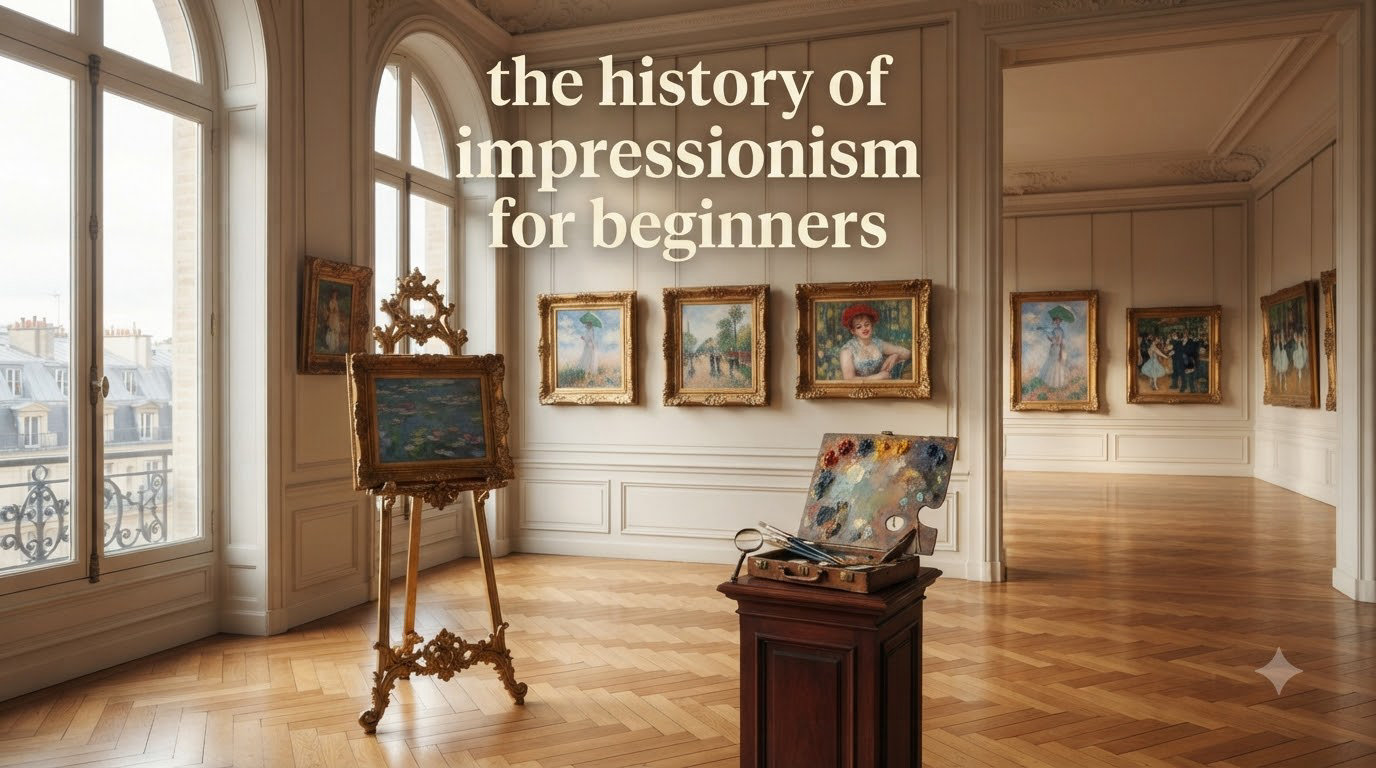
Impressionism is a 19th-century French art movement defined by loose brushwork, vivid colors, and a focus on capturing fleeting moments of light in everyday life. If you have ever stood in front of a Monet painting and felt like you were looking at a memory rather than a photograph, you already understand the essence of Impressionism.
The history of Impressionism for beginners is really the story of a small group of artists who decided the rules of the art world were wrong. They painted outside, used colors that shocked critics, and built a movement that changed everything that came after. This guide walks you through how it all happened, who made it happen, and why it still matters in 2026.
Whether you are an art student starting your first class, a museum visitor wanting to understand what you are looking at, or simply curious about one of the most popular art movements in history, this article covers the complete story from its origins in 1860s Paris to its lasting influence on modern art.
Table of Contents
What Is Impressionism? A Simple Definition
Impressionism is an art movement that began in France during the late 1860s and flourished through the 1870s and 1880s. The Impressionist artists rejected the polished, highly detailed style taught by the official French art academy. Instead, they prioritized capturing the immediate visual impression of a scene, the way light hit a surface, the way water shimmered, the way a busy street felt in a single moment.
The movement gets its name from Claude Monet’s painting Impression, Sunrise (1872), a hazy harbor scene that critic Louis Leroy mocked in a newspaper review. Leroy used the word “impression” as an insult, implying the painting was nothing more than a rough sketch. The artists embraced the name instead, and Impressionism was born.
At its core, Impressionism is about three things: light, color, and everyday life. The Impressionists painted outdoors to observe natural light directly. They applied paint in small, visible strokes of pure, unmixed color that the eye would blend together at a distance. And they chose subjects that the art establishment considered unworthy of serious painting: cafes, train stations, gardens, people walking in parks.
Before Impressionism, the most respected paintings were historical scenes, mythological narratives, and formal portraits with smooth, invisible brushwork. The French art establishment, known as the Salon, controlled what was considered “good art.” The Impressionists challenged all of that. They said that painting a sunset over a harbor or a woman at her toilette was just as valid as painting a Roman emperor.
This idea, that everyday moments matter as much as grand historical events, is one of Impressionism’s most enduring contributions to art. It shifted the purpose of painting from telling a story to capturing an experience.
How Did Impressionism Start? Origins and Historical Context
Impressionism did not appear out of nowhere. It grew out of a specific time and place: Paris in the 1860s. Paris was the undisputed art capital of the Western world, and the city itself was being transformed. Baron Haussmann’s massive renovation project tore down medieval neighborhoods and replaced them with wide boulevards, parks, and uniform stone buildings. This new, modern Paris became one of Impressionism’s greatest subjects.
The French art world was dominated by the Academie des Beaux-Arts and its annual exhibition, the Salon. The Salon jury favored paintings with smooth finishes, historical or mythological subjects, and careful, invisible brushwork. Artists who wanted recognition, sales, and careers needed the Salon’s approval. Rejection by the Salon meant virtual invisibility.
Several movements paved the way for Impressionism. Romanticism (Delacroix, Gericault) had already challenged the strict rules of Neoclassicism. Realism, led by Gustave Courbet, insisted on painting ordinary people and contemporary life rather than idealized classical scenes. Edouard Manet, though he never officially joined the Impressionists, became a critical bridge figure. His paintings Le Dejeuner sur l’herbe (1863) and Olympia (1863) depicted modern women in contemporary settings with a directness that scandalized the Salon and inspired younger artists.
In the 1860s, a group of young artists began meeting at the Cafe Guerbois in the Batignolles neighborhood of Paris. This informal gathering, sometimes called the “Batignolles Group,” included Claude Monet, Pierre-Auguste Renoir, Edgar Degas, Camille Pissarro, Alfred Sisley, and Frederic Bazille. They shared a frustration with the Salon system and a desire to paint the world as they actually saw it.
Their ideas were also shaped by technology. The invention of portable paint tubes in the 1840s made it practical to paint outdoors for extended periods. New research into color theory, particularly the work of Michel Eugene Chevreul on complementary colors, gave artists a scientific basis for their experiments. Even photography played a role: the camera could capture reality in perfect detail, which freed painters to explore perception and sensation instead.
By the early 1870s, this group had a shared vision but no official venue. The Salon continued to reject their work. So they decided to take matters into their own hands, and that decision led to one of the most important events in art history.
Understanding Impressionism’s origins means understanding that it was both an artistic rebellion and a practical response to a rigged system. These artists were not just experimenting with brushwork. They were building an alternative to the entire institutional structure of French art, a theme that connects directly to how contemporary art continues to challenge conventions today.
The First Impressionist Exhibition of 1874
In 1874, a group of thirty artists formed the Societe Anonyme Cooperative des Artistes Peintres, Sculpteurs, Graveurs (Cooperative and Anonymous Association of Painters, Sculptors, and Engravers). Their goal was simple: exhibit and sell their work without the Salon’s gatekeeping. They rented the studio of photographer Nadar, located at 35 Boulevard des Capucines in Paris, and mounted their first independent exhibition in April 1874.
About 3,500 people attended over the course of a month. The exhibition featured 165 works by artists including Monet, Renoir, Degas, Pissarro, Cezanne, Sisley, and Berthe Morisot. The response from mainstream critics was largely hostile. Most reviewers found the paintings unfinished, sloppy, and offensive to good taste.
The critic Louis Leroy wrote a satirical review for the newspaper Le Charivari, mocking Monet’s painting Impression, Sunrise (1872). He titled his piece “The Exhibition of the Impressionists,” using the word as a term of derision. Leroy wrote that the painting looked like it was made with loaded pistols, that wallpaper in its early stages was more finished than this seascape.
But the name stuck. The artists adopted it, and “Impressionism” entered the vocabulary of art history. What began as an insult became the label for one of the most beloved art movements ever created.
The group held eight exhibitions between 1874 and 1886. Not every artist participated in every show. Degas, for example, exhibited in seven of the eight but frequently disagreed with the others about what should be included. Monet and Renoir declined to participate in some later exhibitions, believing the shows had become too diverse and diluted. Despite these internal tensions, the exhibitions established the Impressionists as a legitimate force and gradually attracted collectors, dealers, and public interest.
The 1874 exhibition is worth remembering because it represents a turning point in how art reaches the public. By organizing their own shows outside the Salon system, the Impressionists created a model that independent artists and movements have followed ever since.
The Key Impressionist Artists You Should Know
The Impressionist circle included dozens of artists, but a few names come up again and again. Here are the most important figures in the history of Impressionism for beginners to learn first.
Claude Monet (1840-1926)
Monet is the artist most closely associated with Impressionism, and for good reason. His painting Impression, Sunrise gave the movement its name. Monet was obsessed with light and how it changed the appearance of a subject throughout the day. He painted the same scenes over and over at different times: the Rouen Cathedral, haystacks in a field, the water lilies in his garden at Giverny.
Monet’s later Water Lilies series, painted across dozens of massive canvases, is considered one of the most ambitious projects in the history of art. His garden at Giverny, which he designed and maintained himself, became his primary subject for the last thirty years of his life.
Pierre-Auguste Renoir (1841-1919)
Renoir brought warmth and joy to Impressionism. While Monet focused on landscapes and light, Renoir was drawn to people. His paintings burst with lively social scenes: couples dancing, friends dining on a balcony, children playing in the grass. His masterpiece Dance at Le Moulin de la Galette (1876) captures a sunny afternoon at a popular Parisian outdoor cafe with such energy that you can almost hear the music.
Renoir’s use of color was softer and more sensual than Monet’s. He once said that art should be joyful and pretty, a philosophy that made his work popular with collectors during his lifetime.
Edgar Degas (1834-1917)
Degas was the outlier of the group. He never fully embraced the core Impressionist practice of painting outdoors. Instead, he preferred indoor subjects: ballet dancers rehearsing, women bathing, horses at the racetrack. His compositions were heavily influenced by photography and Japanese prints, often featuring unusual angles and cropped frames that made the viewer feel like a casual observer.
Degas is famous for his pastel drawings of ballet dancers. He produced over 1,500 works on this subject alone, capturing the exhaustion, discipline, and grace of young dancers backstage. He also experimented with sculpture, creating wax figures that were cast in bronze after his death.
Camille Pissarro (1830-1903)
Pissarro was the only artist to exhibit in all eight Impressionist exhibitions. He served as a mentor and father figure to the group, maintaining friendships with Monet, Renoir, and Degas even when they disagreed with each other. Pissarro’s work focused on rural landscapes and the daily lives of peasants, painted with a quiet, steady observation that set him apart from the more dramatic styles of his colleagues.
He was also one of the first Impressionists to experiment with Pointillism, the technique developed by Georges Seurat that used tiny dots of color to build an image. Pissarro’s willingness to keep evolving made him a bridge between Impressionism and the movements that followed.
Berthe Morisot (1841-1895)
Berthe Morisot was one of the founding members of the Impressionist movement and exhibited in all but one of the eight Impressionist exhibitions. Her work is characterized by light, feathery brushwork and an intimate focus on domestic life: women in gardens, mothers with children, private moments at home. She painted the world she lived in, and that world was largely indoors and domestic because of the social restrictions placed on women of her class.
Morisot married Eugene Manet, brother of Edouard Manet, and the two families were closely connected. Her work was well received by critics during her lifetime, but after her death she was largely written out of standard art histories. Modern scholarship has restored her to her rightful place as one of the most important Impressionist artists.
Mary Cassatt (1844-1926)
Mary Cassatt was an American painter who moved to Paris in 1866 and became the only American to exhibit with the Impressionists. Degas invited her to join the group in 1877, and she participated in four of their exhibitions. Cassatt is best known for her paintings of mothers and children, rendered with a tenderness and psychological depth that went beyond sentimentality.
Cassatt also played an important role as an advisor to American collectors, helping to build some of the earliest and finest collections of Impressionist art in the United States. Much of the Impressionist work in American museums today exists because Cassatt encouraged wealthy patrons to buy it.
Edouard Manet (1832-1883)
Manet never exhibited with the Impressionists, but he is often called the “father of Impressionism” because of the way his work broke with tradition and inspired the younger generation. His flat areas of color, modern subjects, and direct gaze at the viewer were radical departures from academic painting. Manet’s Salon submissions were regularly rejected or ridiculed, but he remained committed to the official system even as his friends built their independent exhibitions.
Revolutionary Techniques That Changed Painting Forever
The Impressionists did not just paint different subjects. They painted in an entirely different way. Understanding their techniques is a big part of understanding the history of Impressionism for beginners. Here are the key innovations that set them apart.
En Plein Air Painting
Before Impressionism, most paintings were created in studios from sketches and memory. The Impressionists took their easels outside and painted directly from nature, a practice called en plein air (French for “in the open air”). This allowed them to observe and capture the actual effects of sunlight, shadow, and atmosphere in real time.
Painting outdoors required speed. Light changes quickly, and an artist trying to capture a specific effect might have only minutes before the scene looked completely different. This time pressure forced the Impressionists to work fast, which contributed to their loose, energetic brushwork.
Forum discussions among modern painters reveal that beginners often struggle with en plein air painting because it requires letting go of detail and focusing on big shapes, an approach that feels unnatural if you are used to careful, controlled work. Experienced artists recommend starting with simple compositions and short sessions of 20 to 30 minutes before attempting more complex scenes.
Short, Broken Brushwork
Instead of carefully blending paint to create smooth transitions, the Impressionists applied paint in small, distinct strokes and dabs. Up close, an Impressionist painting can look almost chaotic, a mess of colored marks. Step back a few feet, and those marks resolve into a coherent image. This technique relies on optical mixing, the idea that the viewer’s eye blends the colors together rather than the artist blending them on the palette.
This approach was radical because visible brushwork was considered a sign of technical failure in academic painting. The Impressionists turned it into a virtue, making the physical act of painting part of the visual experience.
Pure, Unmixed Color
The Impressionists placed colors side by side on the canvas rather than mixing them on the palette. If they wanted to show a green shadow, they might place strokes of blue and yellow next to each other, letting the eye do the mixing. They also discovered that shadows are not simply darker versions of the local color; they contain complementary colors. A shadow on orange stone might appear blue or violet.
This understanding of color relationships gave Impressionist paintings a vibrancy and luminosity that earlier paintings lacked. The colors seem to shimmer and glow, especially when viewed from the right distance.
Capturing Light and Atmosphere
Light was the single most important subject for the Impressionists. Monet in particular was obsessed with how the same subject looked at dawn, midday, and dusk, in summer and winter, in clear weather and fog. His series paintings (haystacks, Rouen Cathedral, the Houses of Parliament) are extended studies of how light transforms everything it touches.
The Impressionists also paid close attention to atmosphere: the haze of a morning, the reflection on wet pavement, the dappled light filtering through tree leaves. These effects, which academic painters considered mere background, became the main event.
Everyday Subjects and Modern Life
Perhaps the most democratic innovation of Impressionism was its subject matter. The Impressionists painted ordinary people doing ordinary things: waiting for a train, sitting at a cafe, walking along a riverbank. They painted middle-class leisure, working-class labor, and domestic interiors with equal seriousness.
This was a direct rejection of the academic hierarchy that ranked subjects by their importance: history painting at the top, then portraiture, then landscape, then still life at the bottom. The Impressionists flattened that hierarchy, saying a bowl of fruit or a train station could be as worthy of serious artistic attention as a mythological scene.
Famous Impressionist Paintings Every Beginner Should See
Understanding Impressionism is easier when you look at the actual paintings. Here are six works that define the movement and are worth seeking out, whether in person at a museum or in a good reproduction.
Impression, Sunrise (1872) – Claude Monet
This is the painting that started it all, or at least the painting that gave the movement its name. It shows the harbor at Le Havre, Monet’s hometown, bathed in the hazy orange light of dawn. The painting is small (about 19 by 24 inches) and deliberately loose. Monet later said he could not have painted a more detailed version even if he had wanted to because the light was changing too fast.
Dance at Le Moulin de la Galette (1876) – Pierre-Auguste Renoir
This large canvas captures a Sunday afternoon dance at a popular outdoor cafe in Montmartre. Dappled sunlight filters through trees, couples twirl across the dance floor, and the entire painting radiates warmth and movement. It is one of the most joyful paintings in all of art history and a perfect example of Renoir’s ability to capture the pleasure of social life.
The Ballet Class (1874) – Edgar Degas
Degas shows a ballet rehearsal from an unusual angle, as if the viewer is standing in the doorway looking in. The dancers are caught in moments of rest and fatigue as much as in graceful poses. The painting’s off-center composition and cropped figures show the influence of photography and Japanese woodblock prints on Degas’s work.
A Summer’s Day (1879) – Berthe Morisot
Morisot paints two women in a boat on a lake, surrounded by summer greenery. The brushwork is incredibly loose and feathery, almost abstract in places. The painting demonstrates Morisot’s ability to capture the feeling of a moment with minimal detail, relying on color and gesture to convey atmosphere.
The Cradle (1872) – Berthe Morisot
This intimate painting shows Morisot’s sister Edma gazing at her newborn baby. The curtain draped around the crib echoes the curves of the mother’s arm, creating a composition of remarkable tenderness. It is one of the most celebrated paintings of motherhood in Western art and a powerful reminder that women Impressionists brought unique perspectives to the movement.
Little Girl in a Blue Armchair (1878) – Mary Cassatt
Cassatt’s painting shows a young girl sprawled on a large blue chair, clearly bored or tired. The unusual perspective looks slightly downward, and the room is filled with the same deep blue as the furniture. Degas reportedly contributed to the composition. The painting captures a genuine, unposed moment of childhood, something that rarely appeared in formal art before Impressionism.
The Legacy of Impressionism: How It Shaped Modern Art
Impressionism did not just change painting in the 1870s. It fundamentally altered the trajectory of Western art. By the time the last Impressionist exhibition closed in 1886, the movement had already planted seeds that would grow into some of the most important art movements of the 20th century.
Post-Impressionism was the most direct successor. Artists like Paul Cezanne, Vincent van Gogh, Paul Gauguin, and Georges Seurat built on Impressionist innovations in color and technique while pushing in new directions. Cezanne structured his paintings around geometric forms, laying groundwork for Cubism. Van Gogh used Impressionist color theory as a starting point and then turned the intensity up to levels the original Impressionists never imagined.
The broader influence of Impressionism is harder to overstate. By proving that artists could succeed outside the official Salon system, the Impressionists gave permission to every avant-garde movement that followed: Fauvism, Expressionism, Cubism, Abstract art. The idea that art should challenge convention rather than follow rules is a direct inheritance from the Impressionist rebellion.
Impressionism also changed what people expect from a painting. Before Impressionism, a painting was supposed to tell a story or depict a specific person or event with clarity. After Impressionism, a painting could be about an experience, a sensation, a fleeting impression. This shift opened the door to abstraction and all the experiments of modern art.
Today, Impressionist paintings are among the most visited and reproduced artworks in the world. Museums like the Musee d’Orsay in Paris, the Metropolitan Museum of Art in New York, and the Art Institute of Chicago draw millions of visitors each year to see Impressionist collections. Contemporary artists continue to find inspiration in Impressionist techniques, particularly the emphasis on light, color, and the beauty of ordinary moments.
Artists like Erin Hanson, who describes her style as “Open Impressionism,” apply Impressionist principles to modern landscapes using thick impasto paint and vibrant color. David Hockney, while not an Impressionist, shares their fascination with light, landscape, and the challenge of capturing perception on canvas. The Impressionist tradition of painting en plein air remains popular among amateur and professional painters alike, as forum discussions on Reddit and art communities confirm.
The history of Impressionism for beginners ultimately comes down to this: a small group of determined artists changed what art could be, and we are still living with the consequences of that change.
FAQs
Was Gustav Klimt an Impressionist?
No, Gustav Klimt was not an Impressionist. Klimt was an Austrian Symbolist painter and a leading figure in the Vienna Secession movement. While he shared the Impressionists’ interest in light, color, and modern subjects, his style is distinctly different. Klimt’s work features gold leaf, decorative patterns, and allegorical themes that place him closer to Art Nouveau and Symbolism than to French Impressionism.
What disability did Monet have?
Claude Monet developed cataracts in both eyes during his later years, which significantly affected his vision and his painting. By the 1910s, his perception of color shifted toward yellowish and reddish tones, and his paintings from this period show broader, less defined brushwork. Monet eventually underwent surgery for his cataracts in 1923, which restored some of his vision but changed how he perceived colors, causing him to see some objects with a blue tint.
Is David Hockney an Impressionist?
David Hockney is not an Impressionist. He is a British painter, draftsman, and printmaker associated with the Pop Art movement of the 1960s, though his work spans many styles. However, Hockney shares several interests with the Impressionists: a fascination with light and landscape, a commitment to observational painting, and an enthusiasm for working outdoors. His recent landscape paintings of the Yorkshire countryside show a clear connection to the Impressionist tradition of capturing seasonal light and atmosphere.
What type of artist is Erin Hanson?
Erin Hanson describes her painting style as Open Impressionism, a contemporary approach that builds on traditional Impressionist principles. She paints landscapes using bold, thick brushwork and vibrant, unmixed colors applied in an alla prima (wet-on-wet) technique. Her work is inspired by the Impressionist practice of painting outdoors and capturing natural light, but her style features more saturated colors and heavier paint application than the original Impressionists used.
How did Impressionism get its name?
Impressionism got its name from a sarcastic newspaper review. When the first Impressionist exhibition opened in 1874, critic Louis Leroy wrote a mocking review of Claude Monet’s painting Impression, Sunrise (1872) for the newspaper Le Charivari. He titled his article The Exhibition of the Impressionists, using the word as an insult to suggest the paintings were unfinished sketches rather than completed works. The artists adopted the name with pride, and it became the official label for the movement.
What is the difference between Impressionism and Post-Impressionism?
Impressionism focused on capturing the immediate visual impression of a scene, emphasizing light, color, and everyday moments with loose brushwork. Post-Impressionism, which emerged in the 1880s and 1890s, built on Impressionist innovations but moved in more structured, expressive, or symbolic directions. Post-Impressionist artists like Cezanne, Van Gogh, and Gauguin were less interested in optical accuracy and more interested in emotional expression, structural form, and personal vision. Think of Impressionism as capturing what the eye sees and Post-Impressionism as capturing what the artist feels.
Final Thoughts on the History of Impressionism
Learning the history of Impressionism for beginners means understanding a story about rebellion, friendship, and the courage to see the world differently. A handful of artists in 1860s Paris decided that the official art world was wrong about what mattered. They painted light instead of legends. They painted ordinary moments instead of historical dramas. They were mocked, rejected, and dismissed. And then they changed art forever.
The best way to deepen your understanding is to look at the paintings yourself. Visit a museum with an Impressionist collection, preferably the Musee d’Orsay, the Met, or the Art Institute of Chicago. Stand in front of a Monet or a Renoir and let your eyes relax. Notice how the individual brushstrokes dissolve into color and light. That experience, the moment the painting comes alive, is exactly what the Impressionists wanted you to have.
If you want to continue exploring art history, I recommend reading about how Impressionism connects to the broader story of modern art vs contemporary art. The Impressionists opened a door, and the artists who came after walked through it in directions no one could have predicted.