
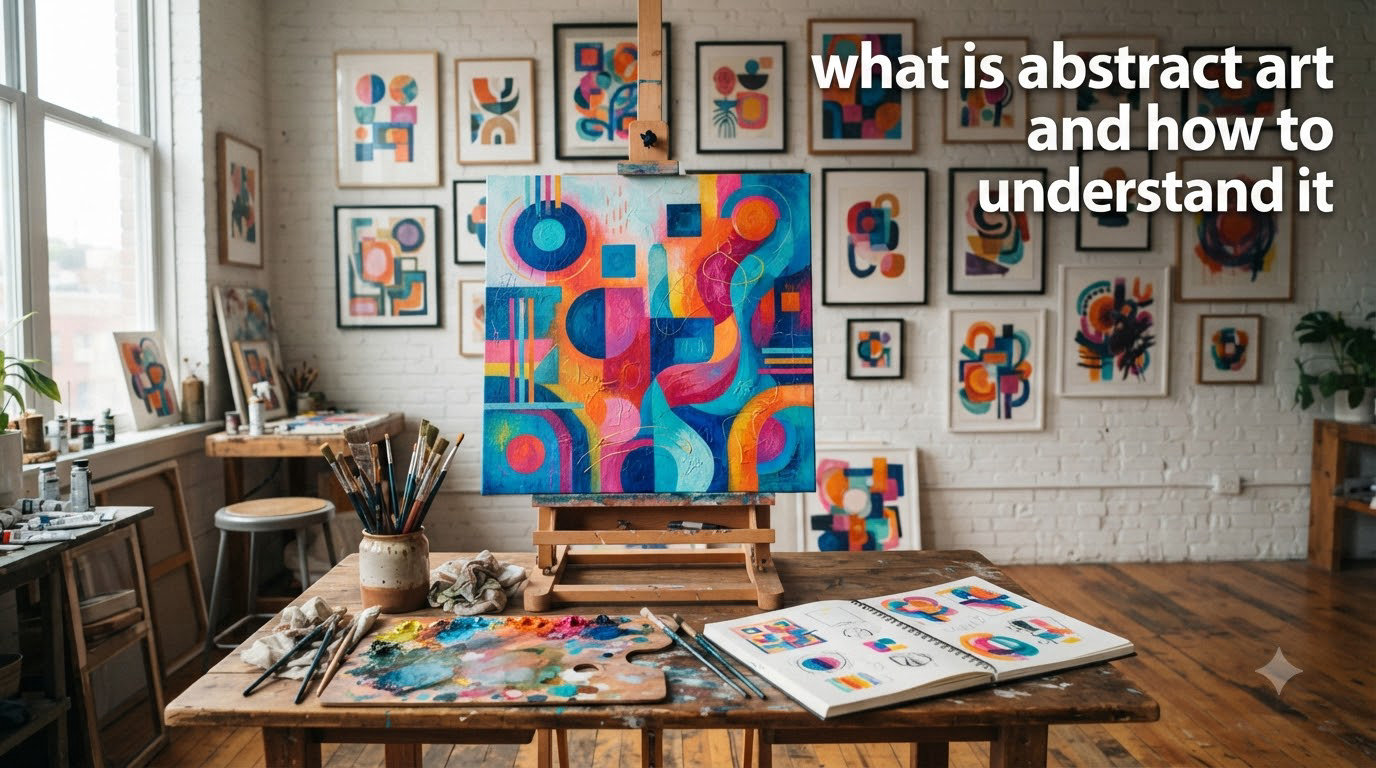
Abstract art is art that does not attempt to represent an accurate depiction of visual reality but instead uses shapes, colors, forms and gestural marks to achieve its effect. If you have ever stood in front of a painting and wondered what it means or why it sells for millions, you are not alone. This guide will walk you through the fundamentals of abstract art, helping you interpret it with confidence and discover what makes this style so powerful.
By the end of this article, you will understand what abstraction really means, how to analyze abstract work using a proven framework, and why artists chose to move away from realistic representation. Whether you are an art student, a curious beginner, or someone who has always felt alienated by modern art, these tools will transform how you see abstract work.
Table of Contents
What Is Abstraction?
Abstraction is the process of simplifying or distorting visual reality to emphasize certain qualities of a subject. In abstract art, the subject may be barely recognizable or completely disconnected from anything in the physical world. Artists who work abstractly often focus on elements like color relationships, compositional balance, emotional resonance, and the physical act of painting itself.
Think of abstraction as a conversation between the artist and the canvas. Rather than copying what they see, the artist translates their emotional response, mood, or conceptual idea into visual language. A representational painter might show you a landscape exactly as it appears. An abstract artist might show you how that landscape makes them feel through sweeping brushstrokes, bold color fields, or geometric forms that suggest movement and energy.
The key difference between abstract and representational art lies in intent. Representational art aims to replicate visual reality with some accuracy. Abstract art aims to create something that exists on its own terms, where meaning comes from the visual elements rather than from recognizable subject matter.
The 7 Elements of Art in Abstract Work
Every piece of abstract art, regardless of how chaotic it appears, relies on the seven fundamental elements of art. Understanding these elements gives you a vocabulary for describing and analyzing abstract work. Here is how each element functions in abstract art.
Line in abstract art can be bold or subtle, curved or angular, continuous or broken. Artists like Piet Mondrian used vertical and horizontal lines to create a sense of harmony and order. Jackson Pollock let lines drip and splatter across his canvases, creating a record of physical movement and energy.
Shape appears in both geometric and organic forms in abstract work. Geometric shapes like circles, squares and triangles create order and structure. Organic shapes, which are irregular and flow naturally, add spontaneity and dynamism. Both approaches appear frequently in abstract art for different effects.
Form refers to three-dimensional shapes in artwork. In two-dimensional abstract paintings, form is suggested through shading, overlapping shapes, and the way elements interact to create depth.
Color is perhaps the most powerful element in abstract art. Artists can use color to evoke emotion, create rhythm, establish mood, and guide the viewers eye across the composition. Color field painters like Mark Rothko used vast areas of color to trigger emotional responses in viewers.
Value describes the lightness or darkness of colors in a work. In abstract art, value contrast helps create visual interest and can establish focal points within the composition.
Texture refers to the surface quality of the artwork. Some abstract pieces have thick, impasto textures you can almost feel by looking. Others are smooth and flat. Texture adds tactile dimension even to two-dimensional work.
Space in abstract art is about how elements are arranged in relation to each other and to the edges of the canvas. Abstract artists play with positive and negative space to create balance, tension, and movement.
A Brief History of Abstract Art
Abstract art emerged in the early twentieth century as artists began questioning the need to represent the physical world realistically. The movement accelerated after the invention of photography, which could capture visual reality more accurately than any painter could.
Wassily Kandinsky is often cited as one of the pioneers of pure abstraction. Around 1910, he began creating works that moved away from recognizable subjects entirely. His paintings used color and form to express spiritual and emotional concepts, influenced by music and his belief that art should transcend the physical world.
Abstract Expressionism dominated the mid-twentieth century, particularly in New York. Artists like Jackson Pollock, Willem de Kooning, and Franz Kline created large-scale works emphasizing spontaneous, gestural mark-making. This movement prioritized the act of painting itself as a direct expression of the artists emotional state.
Color field painting emerged as a counterpoint, with artists like Mark Rothko and Barnett Newman creating works featuring large, flat color areas designed to produce contemplative, spiritual experiences in viewers. Geometric abstraction also flourished through artists like Piet Mondrian, whose grid-based compositions emphasized balance, harmony, and universality.
Today, abstract art continues to evolve with contemporary artists exploring new materials, digital mediums, and conceptual approaches while building on the foundations these early pioneers established.
Types of Abstract Art
Abstract art is not a single style but an umbrella term covering several distinct approaches. Understanding these types helps you recognize the specific strategies artists use in their work.
Gestural abstract art emphasizes visible brushstrokes and the physical act of painting. Artists apply paint in expressive, spontaneous ways that reveal their process and emotional state. Pollock is the most famous example, but many artists use gestural approaches to convey energy and movement.
Geometric abstraction relies on mathematical precision, using shapes like circles, squares, and triangles in organized compositions. Mondrian perfected this approach with his primary color grids. This type often conveys ideas of order, harmony, and rationality.
Lyrical abstraction blends elements of both gestural and geometric styles, creating works that feel organic yet structured. This approach emphasizes mood, atmosphere, and personal expression through color and form.
Minimalist abstract art strips away complexity to focus on essential elements. Artists reduce their work to fundamental forms, often using limited color palettes and emphasizing negative space. This approach challenges viewers to find meaning in simplicity.
How to Understand Abstract Art: A Step-by-Step Guide
When you encounter abstract art and feel confused, follow this five-step framework to guide your interpretation. This approach, inspired by the DAIS art criticism framework, gives you a systematic method for engaging with any abstract work.
Step 1: Look without judging. Before you try to understand what the art means, simply spend time looking at it. Notice what catches your attention first. Stand at different distances if possible, as some abstract works change significantly when viewed up close versus far away.
Step 2: Identify the visual elements. Name what you see. Describe the colors, shapes, lines, and textures. Is the color palette warm or cool? Are the shapes geometric or organic? Are there thick brushstrokes or smooth surfaces? Writing these observations down helps train your eye.
Step 3: Consider the composition. Ask yourself how the elements are arranged. Is there a focal point or does your eye move across the canvas? Does the composition feel balanced or asymmetrical? Is the work dense or sparse?
Step 4: Explore your emotional response. What mood does the work create in you? Do you feel energized, calm, uncomfortable, or curious? There are no wrong answers here. Your personal response is valid and often reveals something meaningful about both the artwork and yourself.
Step 5: Research and reflect. Once you have formed your own interpretation, learn about the artist and their intentions. Understanding the historical context or the artists statement can deepen your appreciation, though your initial response remains valuable.
Many beginners feel that abstract art looks like random lines and colors that mean nothing. This reaction is understandable but misses the point. Abstract artists make deliberate choices about every element in their work. That sweeping blue line is there for a reason. That patch of textured paint serves a purpose. Training yourself to see those choices transforms your experience of abstract art.
Understanding Composition: The 70/30 Rule
The 70/30 rule is a composition principle that many abstract artists apply intuitively or deliberately. The rule suggests that roughly 70 percent of a composition should consist of the dominant element or subject, while 30 percent provides contrast and visual interest through secondary elements.
In practice, this means the primary visual force in the work occupies most of the space, while supporting elements create balance and prevent monotony. In a Rothko painting, the large color field might represent 70 percent, with the subtle variations, borders, and surrounding space creating the contrasting 30 percent.
This principle does not mean all abstract art follows this ratio rigidly. Rather, it describes a tendency in effective abstract compositions where contrast and hierarchy create visual harmony. When you notice this balance in abstract work, ask yourself how the artist achieved it through color, value, shape, or other elements.
Famous Abstract Artists and Their Styles
Understanding abstract art becomes easier when you examine the work of artists who defined major movements and approaches.
Jackson Pollock created action paintings by dripping, pouring, and splattering paint onto canvases laid on the floor. His work captures physical movement and energy, with layers of paint creating complex, dense compositions. His drip paintings remain among the most recognizable abstract works globally.
Wassily Kandinsky pioneered pure abstraction, creating works filled with color, geometric forms, and dynamic movement. He believed color could evoke specific emotional and spiritual responses, and his paintings often resemble musical compositions in their rhythm and flow.
Mark Rothko specialized in color field paintings featuring large, luminous rectangles of color. Viewers often report profound emotional responses to his work, which Rothko intended to create contemplative, almost spiritual experiences.
Piet Mondrian developed a strict geometric style using only vertical and horizontal lines with primary colors against white backgrounds. His work represents a search for universal harmony and balance through radical simplification.
Is Frida Kahlo an abstract artist? This question appears frequently because Kahlo combines surrealist imagery with deeply personal symbolism. While her work maintains identifiable subjects rather than pure abstraction, her artistic approach includes abstract qualities. Experts typically classify her as a surrealist rather than an abstract artist, though her work transcends simple categorization.
Contemporary abstract artists continue to push boundaries, exploring new materials, digital mediums, and conceptual approaches. The legacy of these pioneers lives on in the work of emerging artists worldwide.
If you want to explore more contemporary abstract work, we have profiles of contemporary abstract artists that showcase how abstract art continues to evolve today.
FAQs
How to understand abstract art for beginners?
Use a step-by-step approach: look without judging first, identify visual elements like color and shape, consider the composition and how elements relate, explore your emotional response honestly, then research the artist and context. This framework helps beginners engage meaningfully with abstract work.
What are the 7 elements of abstract art?
The 7 elements are line, shape, form, color, value, texture, and space. In abstract art, these elements become the primary subject matter rather than serving representational purposes. Artists emphasize these formal qualities to create meaning and emotional impact.
What is the 70/30 rule in art?
The 70/30 rule suggests that approximately 70 percent of a composition should feature the dominant visual element, while 30 percent provides contrast through secondary elements. This principle helps create balance and visual hierarchy in abstract work.
Is Frida Kahlo an abstract artist?
Frida Kahlo is typically classified as a surrealist rather than an abstract artist. While her work contains abstract qualities and emotional intensity, she maintained identifiable subjects rather than working in pure abstraction. Her paintings blend personal symbolism with surrealist imagery.
Conclusion
Abstract art can feel mysterious if you approach it without tools. Once you understand that meaning comes from visual elements rather than recognizable subjects, the art form becomes far more accessible. The next time you encounter abstract work, try the five-step framework and notice how your perception shifts.
The history of abstract art reveals a continuous exploration of how visual elements can communicate directly with viewers emotions and intellect. From Kandinsky spiritual compositions to Pollocks energetic drip paintings, abstract artists have created new ways to experience and understand the world.
If you are curious about deeper questions regarding what makes something art, or how to develop your own critical vocabulary through the DAIS framework, explore our related guides. Abstract art rewards patience and attention, and understanding it enriches your engagement with all visual art going forward.