
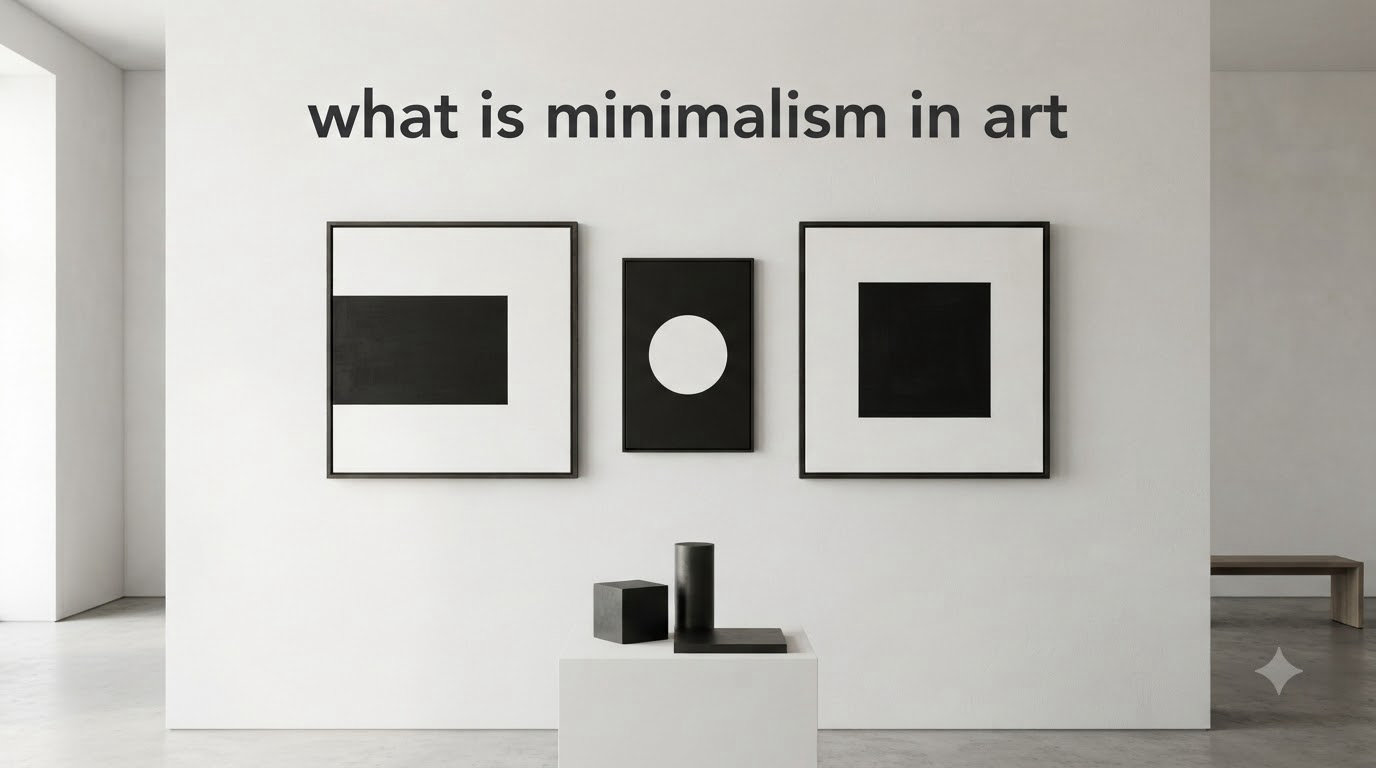
Minimalism in art is an extreme form of abstract art that emerged in the United States during the 1960s, characterized by simple geometric shapes, industrial materials, and works that exist as autonomous objects rather than representations of something else. Artists working in this movement sought to strip away metaphor, personal expression, and symbolic meaning, focusing instead on pure material form and the object’s presence in space. The movement fundamentally challenged how we define art itself, asking viewers to abandon interpretation and simply perceive what stands before them.
If you have ever stood before a stack of metal boxes in a museum and wondered why it qualifies as art, you are experiencing the same question minimalism posed to the world. This guide breaks down everything you need to understand about minimalism in art, from its historical roots to the artists who defined it and its lasting influence on modern visual culture. By the end, you will have a comprehensive understanding of why this movement matters and how it continues to shape the art we encounter today.
Table of Contents
The Historical Context: Where Minimalism Began
Minimalism did not emerge in a vacuum. It developed in the post-World War II cultural climate of 1950s and 1960s New York, a time when artists were grappling with the legacy of Abstract Expressionism and the growing anxieties of the Cold War era. The modern art movements of the early 20th century, particularly Russian Constructivism, Suprematism, and the Dutch De Stijl movement, provided important precedents for thinking about art as pure form rather than representation. These earlier avant-garde movements had already experimented with geometric abstraction and the reduction of art to essential elements.
Abstract Expressionism had dominated American art since the 1940s, emphasizing gestural brushwork, emotional intensity, and the artist’s subjective experience. Artists like Jackson Pollock and Willem de Kooning created works saturated with personal expression and psychological depth, where the visible brushstroke became a window into the artist’s inner world. By the late 1950s, a younger generation of artists grew restless with what they saw as the excesses and pretensions of this approach. They questioned whether art needed to be expressive, symbolic, or emotionally charged to be meaningful.
The rise of industrial fabrication and new manufacturing technologies also shaped minimalist thinking. Artists gained access to factory-produced materials and precision techniques that allowed them to create works with exact, uniform surfaces. This mechanization appealed to artists who wanted to remove the artist’s hand from the artwork entirely, creating works that looked manufactured rather than handmade. The aesthetic of the factory, with its emphasis on standardization and repetition, became a model for artistic production.
The cultural context of the Cold War also played a role. During an era of ideological competition between the United States and the Soviet Union, American artists sought to define a distinctly American modern art. Minimalism’s clean, rational aesthetic can be seen as a response to both the perceived emotional excess of Abstract Expressionism and the sterile functionalism of Soviet modernism. The movement represented a particular American combination of industrial optimism and formal restraint.
Core Characteristics of Minimalist Art
Minimalist art is defined by several interconnected characteristics that distinguish it from other modern art movements. Understanding these qualities helps explain why minimalism emerged when it did and how it continues to influence contemporary art practice.
Geometric Forms and Simple Shapes
Minimalist artists gravitated toward the most basic geometric forms: squares, rectangles, and simple curves with hard edges. Unlike the organic, biomorphic shapes of Abstract Expressionism or the complex forms of Surrealism, minimalist works feature regular, uniform geometries that the eye can immediately grasp and comprehend. Frank Stella famously stated, “What you see is what you see,” encapsulating the movement’s insistence that viewers should respond only to what is directly in front of them, without searching for hidden meanings or symbolic interpretations.
This reduction to geometric fundamentals connected minimalist artists to earlier avant-garde movements. The square and rectangle had been central to geometric abstraction since Kazimir Malevich’s Suprematist compositions of 1915. What made minimalism distinct was not the use of geometric forms themselves but the insistence that these forms should be experienced literally, without symbolic or expressive overtones.
Industrial Materials and Fabrication
The choice of materials was central to minimalist practice. Artists turned to industrial materials such as steel, aluminum, plywood, concrete, plexiglass, and later fluorescent lights. These materials carried associations with mass production, corporate architecture, and the built environment. Rather than celebrating the tactile qualities of traditional art materials like oil paint, marble, or bronze, minimalists embraced surfaces that looked factory-made, anonymous, and impersonal.
Using industrial fabrication meant that works could be produced according to specifications without the artist’s direct handling of materials. Donald Judd, for example, would create designs that were then executed by metalworkers in factories. This delegation of production challenged romantic notions of artistic genius and handcraft. The work that resulted looked precisely manufactured, with no visible traces of individual artistic decision-making or expressive gesture.
Repetition and Seriality
Many minimalist works feature repetition of identical or nearly identical forms. This serial approach challenges the traditional Western emphasis on originality and unique artistic expression. When a viewer encounters ten identical steel boxes arranged in a grid or a row, the experience becomes about patterns, rhythm, and the accumulation of similar forms rather than about individual creative genius.
Seriality had roots in earlier art movements, particularly the systematic approaches of artists like Josef Albers and the production methods of industrial manufacturing. Minimalist artists embraced seriality as a way of emphasizing the artwork’s relationship to industrial production and challenging the notion that each artwork must be a unique, unrepeatable object. Sol LeWitt’s modular structures and Carl Andre’s metal tile arrangements exemplify this approach to repetition.
Objecthood and the “Specific Object”
Minimalism introduced the concept of “objecthood” into art discourse. Rather than representing something else, minimalist works insist on their own presence as objects in space. Donald Judd coined the term “specific objects” to describe works that could not be classified as either painting or sculpture but existed in a category of their own. These works demanded to be experienced as pure presence, not as windows into the artist’s psyche or symbolic systems.
This emphasis on objecthood meant that minimalist works resisted interpretation. Viewers could not look beyond the surface to find hidden meanings or symbolic content. The work simply was what it was: a metal box, a fluorescent light, a geometric form occupying space. This directness was revolutionary for its time and remains one of minimalism’s most significant contributions to art theory.
Key Minimalist Artists and Their Work
The minimalist movement was driven by a remarkable group of artists, each contributing distinct approaches to the shared project of reducing art to its essentials. These artists came from diverse backgrounds and brought different sensibilities to their work, yet all shared a commitment to exploring what remains when everything extraneous is removed.
Donald Judd
Donald Judd is often considered the leading theorist of minimalism. His 1965 essay “Specific Objects” became a manifesto for the movement, articulating the philosophical foundations of the new approach. Judd moved from painting to creating three-dimensional works that looked like neither sculpture nor painting but occupied their own category entirely. His signature works are stacks of identical metal boxes, often in stainless steel or brass, arranged vertically at regular intervals against walls.
These works, produced by commercial fabricators according to Judd’s specifications, eliminated any trace of the artist’s hand and emphasized industrial production over handmade craft. The boxes appeared to float slightly off the wall, creating shadows that emphasized their physical presence. Judd also created spaces filled with furniture-like objects that blurred the line between artwork and environment, exploring how art could exist in lived spaces rather than isolated in galleries.
Frank Stella
Frank Stella challenged painting itself with his “Black Paintings” (1959) and subsequent shaped canvases. Where Abstract Expressionists had emphasized the physicality of paint and the expressive potential of the brushstroke, Stella created works with uniform, mechanical patterns that seemed to deny any possibility of personal expression. The black paintings featured parallel bands of black paint applied with commercial precision, creating surfaces that invited viewers to see the paintings as objects rather than windows into emotion.
Stella’s “Protractor Series” of the late 1960s featured geometric paintings with angular forms that extended to the edges of the canvas and sometimes beyond, dissolving the traditional rectangular format entirely. These shaped canvases drew attention to the physical presence of the painting as an object in space rather than an illusionistic window. Stella’s insistence on the literal presence of the artwork anticipated the conceptual turn that would dominate art in later decades.
Dan Flavin
Dan Flavin transformed fluorescent tube lights into art, using commercially available bulbs in various colors to create immersive light installations. His works engage directly with architecture, as the light seems to expand beyond the physical boundaries of the tube to fill entire rooms and corridors. Flavin once described his work as “the literalization of light,” emphasizing that his art exists in the viewer’s experience of illumination rather than in any physical object that can be owned or collected.
Flavin’s works range from single tubes mounted on walls to massive installations that transform entire spaces. The commercial availability of the materials was important: by using ordinary fluorescent lights, Flavin rejected the specialness of art materials and embraced the aesthetic of everyday objects. The lights also connected his work to corporate and institutional spaces, where fluorescent lighting is ubiquitous but rarely considered artistic.
Sol LeWitt
Sol LeWitt developed conceptual systems that bridged minimalism and conceptual art. His “Wall Drawings” consist of instructions that can be executed by others, placing the idea rather than the execution at the center of the artwork. A curator or assistant could follow LeWitt’s instructions to create the drawing on any wall, meaning that the work existed as a set of propositions rather than a unique physical object.
LeWitt’s serial structures, such as his “Steel Pieces” series, use simple geometric modules arranged according to predetermined rules. These works emphasize the idea behind the form rather than any individual instance of the form. LeWitt’s famous statement “The idea becomes the machine that makes the art” anticipated the conceptual art movement that would emerge in the late 1960s and transform how we understand artistic authorship and production.
Robert Morris
Robert Morris created minimalist sculptures and installations that emphasized the viewer’s physical experience of space. His “Black Paintings” and “White Paintings” series featured identical panels with reflective surfaces that seemed to dematerialize the painting’s surface and draw attention to the viewer’s own presence in the space. Morris also pioneered the use of modular units that viewers could rearrange, collapsing the distinction between artwork and environment.
His 1966 essay “Notes on Sculpture” articulated the theoretical foundations of minimalism’s attention to phenomenology and viewer perception. Morris argued that minimalist sculptures required the viewer to move through space to fully experience them, making the bodily encounter central to the artwork’s meaning. This attention to the viewer’s experience distinguished minimalist sculpture from traditional approaches that emphasized the object’s formal qualities from a fixed viewpoint.
Carl Andre
Carl Andre created works that challenged sculptural conventions by placing metal tiles directly on the floor rather than mounting them on pedestals. His “Equivalent VIII” consisted of 120 firebricks arranged in a rectangular formation on the ground, prompting public controversy about what qualifies as art. The work was interpreted by some as deliberately provocative, questioning whether art requires special materials or techniques.
Andre’s works demand horizontal rather than vertical attention, asking viewers to look down at the floor and consider how a work of art relates to the space we walk through. By placing identical tiles in arrangements that mirror architectural floor plans, Andre connected sculpture to the built environment and invited viewers to reconsider the relationship between art and the spaces they inhabit.
Agnes Martin
Agnes Martin represents a softer, more emotional strand of minimalism. Her canvases feature delicate grids of pencil lines and washes of pale color, creating works that seem to vibrate with subtle presence. While her formal vocabulary shares minimalist geometry, Martin’s intention was spiritual and meditative rather than coldly industrial. She described her work as “inspired by the emotions,” distinguishing her practice from the supposedly affectless approach of her contemporaries.
Martin’s paintings reward slow, sustained attention. The grids that appear simple from a distance reveal subtle variations and imperfections when viewed closely. She sought to create works that evoked happiness and contentment rather than intellectual engagement, using minimal forms to invoke emotional responses. Her practice demonstrated that minimalism could accommodate subjective experience even as it maintained formal restraint.
Eva Hesse
Eva Hesse pushed beyond minimalism’s rigid boundaries into what critics would later call “post-minimalism.” Her late works used latex, fiberglass, and rope to create organic, body-like forms that hung from walls or sprawled across floors. These works seemed to reject the hard edges and industrial materials of minimalism in favor of soft, vulnerable forms that engaged with impermanence and decay.
Hesse’s work emerged from her experience as one of the few women in the male-dominated minimalist movement. Her use of unconventional materials and her attention to bodily forms challenged the universalizing claims of minimalist aesthetics. Hesse’s untimely death in 1970 at age 34 cut short a career that was already expanding minimalist vocabulary into territories her colleagues had not imagined.
Minimalism vs Abstract Expressionism
Understanding minimalism requires understanding what it was reacting against. Abstract Expressionism and minimalism represent fundamentally opposing philosophies of art, and the tension between them shaped the development of American art in the 1960s.
Abstract Expressionists celebrated the artist’s emotional and psychological state. Paintings by Pollock or de Kooning bear visible evidence of physical action, gestural energy, and subjective experience. The brushstroke itself became a sign of the artist’s presence, a trace of the creative moment when the work was made. Viewers were invited to enter the painting’s world and share in the artist’s inner life.
Minimalists rejected this emphasis on personal expression. For them, Abstract Expressionism had become overly romantic and pretentious, drowning art in the artist’s ego and emotional display. Minimalist works deliberately lack the visible traces of artistic decision-making. The uniformity of industrial materials and the repetition of identical forms seem to erase the artist’s personality entirely, creating works that appear anonymous and impersonal.
Where Abstract Expressionism invited interpretation and symbolic reading, minimalism insists on direct perception. Viewers are not supposed to ask what a work represents or what the artist felt. They are supposed to simply see what is there: a shape, a material, a form in space. The minimalist artwork asks to be experienced rather than interpreted, encountered rather than analyzed.
This shift represented a revolution in art philosophy. Minimalism asked fundamental questions about what art is, what it can be, and how it relates to the viewer’s experience of the world. By insisting on direct perception and rejecting symbolic reading, minimalism opened new territories for artistic exploration that subsequent movements would continue to develop.
Global Perspectives: Mono-ha and Post-Minimalism
While minimalism developed primarily in the United States, similar impulses emerged in Japan and would later expand into post-minimalism and related movements that broadened the movement’s impact.
Mono-ha: The Japanese Response
The Mono-ha movement emerged in Japan around 1968, led by artists including Lee Ufan, Nobuo Sekine, and Nobuyoshi Araki. Like minimalism, Mono-ha focused on the relationship between materials and space, but with distinct philosophical underpinnings rooted in Japanese cultural traditions. Mono-ha artists emphasized the encounter between different materials, often combining industrial and natural elements like steel and stone or wood and paper.
The movement drew on Zen Buddhist concepts of emptiness and presence, viewing art as a way of making visible the normally unnoticed relationships between objects and their environments. Rather than emphasizing the artwork as a discrete object, Mono-ha artists drew attention to the spaces and intervals between things. Lee Ufan’s “Relatum” sculptures, for example, placed steel plates and rocks in relationships that highlighted the tension between industrial and natural materials.
Mono-ha represented an important parallel development that demonstrated minimalism’s global resonance. While American and Japanese minimalists were largely unaware of each other’s work, they had arrived at similar conclusions through different cultural contexts. This parallel emergence suggests that minimalism responded to broader cultural forces beyond the specific American context.
Post-Minimalism and Earthworks
By the late 1960s and early 1970s, artists began expanding minimalist vocabulary in new directions. Post-minimalism embraced impermanence, organic forms, and environmental engagement, pushing against the supposed rigidity of minimalist aesthetics. Artists like Robert Smithson created works that engaged with geological time and natural processes rather than industrial precision.
Earthworks like Smithson’s “Spiral Jetty” (1970) took art out of the gallery entirely, creating massive interventions in landscapes that would change over time through natural processes. Artists like Nancy Holt and Walter De Maria created works that engaged with natural forces, cosmic scale, and the viewer’s experience of vast spaces. These developments showed that minimalism’s emphasis on material presence and viewer experience could extend far beyond geometric shapes and gallery walls.
Body art and performance also emerged from minimalist impulses, using the human body as material rather than the industrial forms of Judd or Andre. These developments demonstrated that minimalism’s concerns with presence, materiality, and perception could be explored through media beyond sculpture and painting.
The Lasting Influence of Minimalism
Minimalism did not remain confined to galleries and museums. Its influence permeated architecture, design, and visual culture in ways that continue to shape our everyday environment. Understanding this influence helps explain why minimalist aesthetics have become so dominant in contemporary life.
Dieter Rams’s design principles for Braun, emphasizing simplicity, functionality, and restraint, directly parallel minimalist art concerns. Rams’s famous dictum “Less but better” could serve as a minimalist manifesto, and his influence on product design has been enormous. When Apple designer Jony Ive created the first iPhone, he was working in a tradition that minimalism helped establish decades earlier.
Contemporary architects continue to draw on minimalist principles, creating spaces with clean lines, simple geometric forms, and industrial materials. The minimalist aesthetic has become dominant in interior design, graphic design, and even product packaging, shaping how modern consumers experience the built environment. From smartphone interfaces to office interiors, minimalist design surrounds us in daily life.
The distinction between minimalism as an art movement and minimalism as a lifestyle philosophy matters here. While artists in the 1960s sought to remove personal expression from artwork, minimalism as a lifestyle philosophy emphasizes simplifying one’s possessions and commitments. These are related but distinct phenomena, both drawing on the principle that reduction can lead to clarity and that less can indeed be more.
Today, influential contemporary artists continue to engage with minimalist concerns, even as art has diversified into countless other directions. The movement’s emphasis on direct perception, material presence, and viewer experience remains foundational to understanding modern and contemporary art. Whether explicitly referencing minimalism or unconsciously absorbing its principles, contemporary artists continue to work with ideas that minimalism helped establish.
FAQs
What is the concept of minimalism in art?
Minimalism in art is an extreme form of abstract art that emerged in the USA in the 1960s, characterized by simple geometric shapes, industrial materials, and works that exist as autonomous objects rather than representations of something else.
What is the meaning of minimalism in art?
Minimalist art means stripping away metaphor, personal expression, and symbolic meaning to focus purely on material form, geometric shape, and the object’s presence in space. It asks viewers to respond only to what is directly in front of them.
Who is a well-known minimalist artist?
Donald Judd is among the most influential minimalist artists, known for his ‘Specific Objects’ series and industrial metal stacks. Other key figures include Frank Stella, Dan Flavin, Sol LeWitt, Carl Andre, Robert Morris, Agnes Martin, and Eva Hesse.
What is minimalism in simple terms?
In simple terms, minimalism in art is the idea that art can be reduced to its purest form: basic geometric shapes, industrial materials, and removal of anything that could be interpreted as symbolic or emotional. It follows the principle that ‘less is more.’
Conclusion: The Radical Act of Subtraction
Minimalism in art represents one of the most radical simplifications in art history. By stripping away metaphor, symbolism, and personal expression, minimalist artists forced viewers to confront art as pure presence. Their works ask us to abandon the search for hidden meanings and simply see what stands before us.
The movement’s legacy extends far beyond the gallery walls. From the devices we hold to the spaces we inhabit, minimalism has shaped how we understand the relationship between form and function, reduction and meaning. Understanding minimalism helps us understand the foundations of contemporary visual culture and the principles that continue to influence design and art production worldwide.
Whether you find minimalist works deeply moving or难以理解 (difficult to understand), they represent an important moment in art’s ongoing conversation about what it can be and do. The next time you encounter a stack of metal boxes or a fluorescent light installation, you will know the history and philosophy behind what you are seeing. You will understand why an artist might choose to remove everything except the essential, and what that removal reveals about the nature of art itself.