
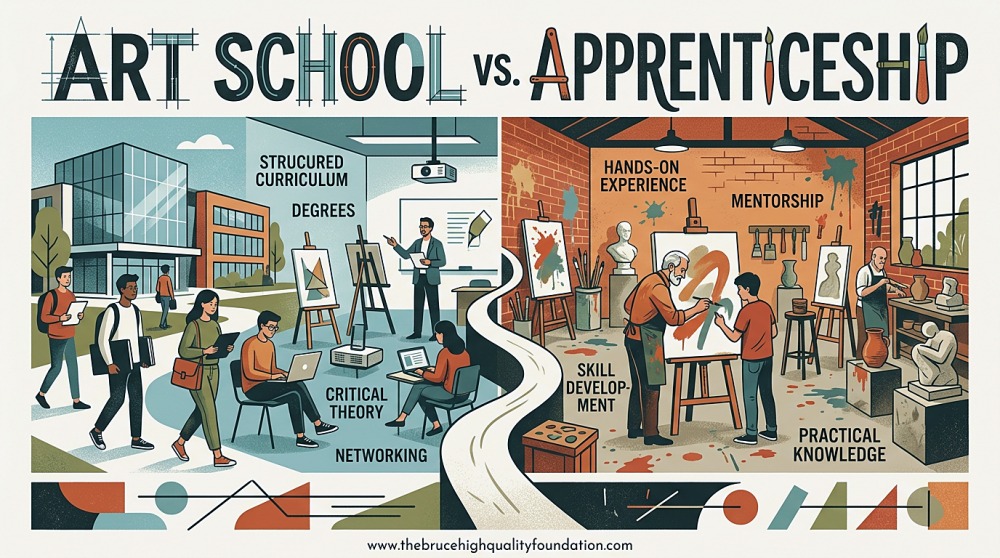
Every aspiring artist faces the same crossroads: should you pursue formal art education or learn through hands-on apprenticeship? After interviewing dozens of professional artists and reviewing career outcomes across both paths, I can tell you there is no single right answer. The art school vs apprenticeship debate ultimately depends on your learning style, financial situation, and career goals.
In this guide, I will break down both paths with real numbers, famous artist examples, and insights from working artists who have walked each road. Whether you are a high school graduate weighing your options, a career changer wondering if it is too late, or a parent helping your child decide, this comparison will give you the clarity you need to make an informed choice about your artistic development.
Table of Contents
What is Art School?
Art school provides structured formal art education through accredited institutions offering degree programs in fine arts, illustration, graphic design, and related creative fields. These programs typically span two to four years and combine technical training with art theory, art history, and portfolio development.
The curriculum follows a progressive structure, starting with foundational courses in drawing, color theory, and composition before advancing to specialized mediums and conceptual work. Students receive regular critique from faculty, interact with peers in studio environments, and graduate with a degree that can open doors to teaching positions, gallery representation, and certain corporate creative roles.
What is an Art Apprenticeship?
An art apprenticeship is a hands-on training arrangement where you work directly under an experienced professional artist, learning their craft through observation, practice, and direct mentorship. Unlike the classroom model, apprenticeships immerse you in the actual work of being a working artist from day one.
Traditional apprenticeships have deep roots in fields like ceramics, tattooing, and fine art atelier training. You might spend months or years learning one master’s specific techniques, business practices, and professional standards. The focus is purely practical: you learn by doing real work, often assisting with commissions while gradually taking on your own projects under supervision.
Art School vs Apprenticeship at a Glance
| Factor | Art School | Apprenticeship |
|---|---|---|
| Duration | 2-4 years | 1-3 years |
| Cost | $20,000-$120,000 | $0-$5,000 (often paid position) |
| Learning Style | Structured curriculum, theory-heavy | Hands-on, practice-focused |
| Credential | Degree (BFA/MFA) | Portfolio and mentor endorsement |
| Networking | Peer network, alumni connections | Industry contacts through mentor |
| Business Skills | Limited focus | Direct exposure to running art business |
The Case for Art School
Formal art education offers advantages that many working artists credit for their success. The structured environment forces you to explore mediums and concepts you might never try on your own. I have heard from gallery-represented painters who discovered their signature style only because a required elective pushed them outside their comfort zone.
The peer network you build in art school becomes your professional community. These classmates become fellow artists who recommend you for shows, share opportunities, and provide honest critique years after graduation. Several artists I interviewed mentioned that their first solo shows came through connections made in their BFA programs.
Pros of Art School
Structured curriculum ensures comprehensive skill building across fundamentals you might skip when self-directing your learning. Faculty bring diverse perspectives and professional connections from their own artistic careers. Studio facilities provide access to expensive equipment like printing presses, kilns, and darkrooms that would cost thousands to access independently.
The degree itself carries weight in certain contexts. Teaching positions at accredited institutions typically require MFA credentials. Some grants, residencies, and gallery submissions specifically seek artists with formal training backgrounds. Corporate creative roles in fields like advertising and product design often list degrees as preferred qualifications.
Cons of Art School
The cost represents the most significant barrier. With tuition ranging from $20,000 at state schools to over $120,000 at private institutions, many graduates start their artistic careers burdened by substantial student debt. This financial pressure forces some artists into commercial work they do not love just to make loan payments.
Curriculum rigidity can feel stifling if your interests diverge from the program’s structure. One sculptor told me she spent two years on required foundation courses before touching clay, nearly quitting from frustration. Academic schedules may not match your natural creative rhythms, and critique sessions can become repetitive rather than constructive.
The Case for Apprenticeship
Learning directly from a working artist gives you something classrooms cannot replicate: immediate exposure to the business of art. From pricing commissions to managing client relationships, apprentices absorb the practical skills that determine whether an artist actually makes a living.
The forum insights from real artists consistently emphasize that determination and work matter more than educational pedigree. As one ceramicist noted in the ArtistLounge community, art school does not make the artist. Work makes the art. Time makes the artist. Your commitment matters more than your diploma.
Pros of Apprenticeship
Zero or minimal cost makes this path financially accessible. Some apprenticeships even pay modest wages as you contribute to the studio’s output. You avoid the debt burden that forces many art school graduates into non-artistic day jobs. The timeline is typically shorter, getting you to professional work in one to three years rather than four.
Business education happens organically. You learn pricing by watching your mentor negotiate commissions. You understand marketing by seeing how they maintain client relationships and promote their work. One tattoo apprentice I spoke with said she learned more about running a profitable shop in six months than her art school friends learned in four years.
Direct mentorship provides personalized feedback impossible in classroom settings. Your mentor knows your strengths, weaknesses, and artistic voice intimately. They can guide your development with specificity rather than generic assignments designed for thirty students simultaneously.
Cons of Apprenticeship
Quality varies dramatically depending entirely on your mentor’s skill and teaching ability. A bad apprenticeship teaches bad habits that can take years to unlearn. Finding the right mentor requires networking and persistence, with no guarantee of placement. The Reddit ArtistLounge community warns that trying to attend art school and apprenticeship simultaneously spreads you too thin.
Your education is limited to what one person knows. Unlike art school where ten faculty members bring different specialties, you master one mentor’s techniques and business model. Diverse perspectives come only if you actively seek additional influences outside your apprenticeship.
Networking is narrower. Rather than fifty classmates becoming your professional community, you have primarily your mentor’s contacts. If that relationship ends poorly or your mentor has limited industry standing, you start your independent career with fewer connections.
Famous Artists Who Proved Both Paths Work
History offers powerful evidence that neither path guarantees success or prevents it. Vincent van Gogh had no formal art training, learning through books and practice while producing some of the most beloved paintings in history. Frida Kahlo was largely self-directed, developing her distinctive style through personal exploration rather than academic instruction.
On the art school side, Andy Warhol earned his BFA from Carnegie Mellon before becoming the face of pop art. Jeff Koons holds an MFA from the School of the Art Institute of Chicago. These artists leveraged their formal training to build conceptual frameworks that defined movements.
Perhaps the most famous art school rejection story belongs to Adolf Hitler, who was rejected twice from the Academy of Fine Arts Vienna. While his path led to dark history rather than artistic contribution, the example illustrates that rejection from formal programs does not preclude impact, nor does admission guarantee creative breakthrough.
Career Outcomes: What Actually Matters
When I asked working artists what determined their success, the answers rarely mentioned educational path. The 80/20 rule for artists suggests that 80 percent of your results come from 20 percent of your effort. Success comes from identifying that high-impact 20 percent rather than grinding inefficiently. Art school and apprenticeship simply offer different frameworks for finding your productive focus.
The 70/30 rule in art suggests a similar balance: 70 percent of your artistic development comes from consistent practice, while 30 percent comes from instruction, feedback, and structured learning. Whether that 30 percent comes from professors or a single mentor matters less than whether you actually put in the 70 percent of independent work.
Survey data on professional artist income shows no significant correlation between education type and earnings. Self-taught artists, art school graduates, and apprenticeship-trained artists cluster similarly across income brackets. What predicts success is not the path chosen but the combination of technical skill, business understanding, and persistent output over time.
Is 25 Too Old for an Art Apprenticeship?
Absolutely not. One of the most common questions in art forums comes from people in their mid-twenties wondering if they have missed their window. The reality is that apprenticeships welcome dedicated learners at any age, and many mentors actually prefer older apprentices who bring maturity and commitment.
Art school also accepts students across age ranges, with many MFA programs specifically seeking applicants with life experience outside academics. Whether you are twenty or forty, what matters is your portfolio, your commitment, and your willingness to learn. Career changers often bring unique perspectives that enrich their artistic work in ways younger students cannot replicate.
How to Choose Your Path in 2026
Choose art school if you learn best in structured environments, want access to diverse faculty perspectives, need specific credentials for teaching or certain corporate roles, or thrive on peer community and critique. The formal art education route suits those who want comprehensive exposure to techniques and theory before specializing.
Choose an apprenticeship if you prefer hands-on learning, want to minimize educational debt, need immediate exposure to the business side of art, or have identified a specific mentor whose work and career you want to emulate. This path suits self-directed learners who can maintain discipline without external assignment structures.
Both paths can lead to becoming a professional artist. Both require years of dedicated practice. The wrong choice is not between art school and apprenticeship, it is choosing either path without committing fully to the work that follows.
Frequently Asked Questions
What is the 80 20 rule for artists?
The 80/20 rule for artists states that 80 percent of your artistic results come from 20 percent of your efforts. This means identifying which practices, techniques, or projects produce your best work and focusing energy there rather than spreading yourself thin across low-impact activities.
Which career is best for artists?
The best art career depends on your skills and interests. Gallery artists sell original work through representation. Illustrators create for publications and media. Tattoo artists build steady client businesses. Art teachers combine creativity with education. Commercial artists work in advertising and product design. Each path suits different temperaments and financial goals.
Who famously got rejected from art school?
Adolf Hitler was famously rejected twice from the Academy of Fine Arts Vienna in 1907 and 1908. The admissions committee felt his work lacked artistic talent, particularly in drawing human figures. This rejection story is often cited in art school debates, though his path ultimately diverged from artistic pursuits.
What is the 70 30 rule in art?
The 70/30 rule in art suggests that 70 percent of your artistic development comes from independent practice and experimentation, while 30 percent comes from instruction, feedback, and structured learning. This ratio emphasizes that regardless of your educational path, most growth happens through consistent personal work rather than formal teaching.
Is 25 too old for an apprenticeship?
No, 25 is not too old for an art apprenticeship. Many mentors prefer older apprentices who bring maturity, clear motivation, and life experience. Unlike some trades with strict age entry points, art apprenticeships welcome dedicated learners across age ranges, with many successful artists starting their training in their late twenties, thirties, or beyond.
What percent of artists went to art school?
Approximately 40-50 percent of professional working artists hold formal art degrees, though precise statistics vary by medium and region. Significant numbers of successful artists are self-taught or learned through apprenticeships. The art world values portfolio quality and professional reputation over educational credentials when evaluating working artists.
Why do people quit apprenticeships?
Common reasons for quitting apprenticeships include personality conflicts with mentors, unrealistic expectations about the timeline, financial pressure from low or no initial pay, limited creative freedom while learning foundational techniques, and discovering that the mentor’s artistic philosophy does not align with the apprentice’s goals. Some apprentices also quit to pursue formal education after realizing they prefer structured learning environments.
Final Thoughts on Art School vs Apprenticeship
After analyzing both paths through the lens of working artists, career outcomes, and educational philosophy, the answer becomes clear. Neither art school nor apprenticeship creates better artists automatically. Better artists create themselves through consistent work, openness to feedback, and business acumen developed through either path.
The art school vs apprenticeship question is really a question about your learning style, financial situation, and career timeline. Choose the structure that matches how you learn best, then commit fully to the work ahead. In 2026, both paths remain viable routes to becoming a professional artist. Your dedication matters more than your diploma or your mentor’s name.