
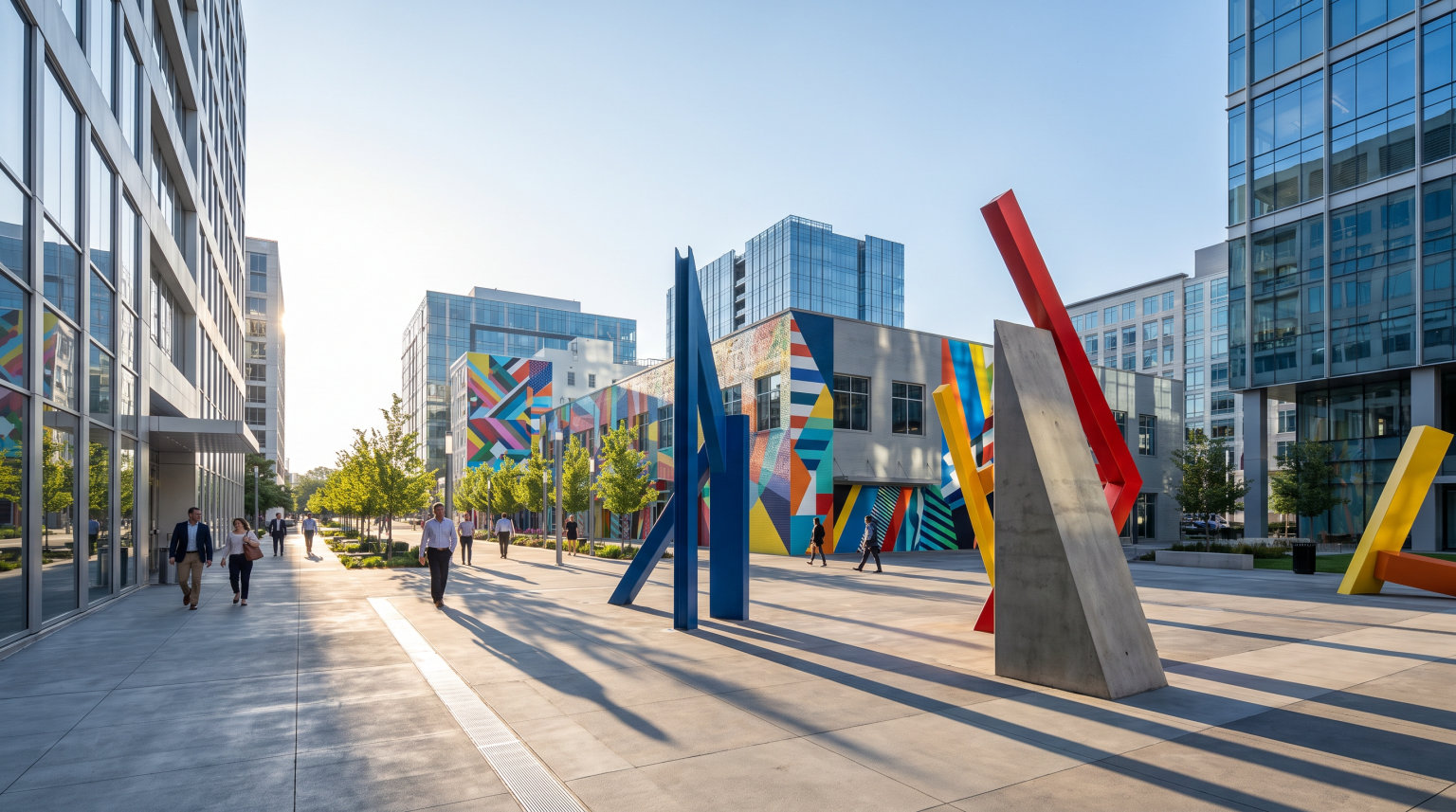
Public art shapes cities by transforming blank walls, vacant lots, and forgotten corners into cultural landmarks that define how people experience a place. It builds community identity, drives economic growth, and turns ordinary streets into destinations worth visiting. From massive sculptures in city plazas to neighborhood murals painted by local residents, public art is one of the most powerful tools cities have to create meaning, connection, and pride in shared spaces.
Our team has spent years studying how public art shapes cities around the world, from the murals of Philadelphia to the street art of Bogota. What we keep finding is that the cities people love most are the ones that treat art as infrastructure, not decoration. This guide breaks down exactly how public art works, why it matters, and what happens when cities get it right or wrong.
Whether you are an urban planner, an artist, a community advocate, or simply someone who cares about the place you live, understanding how public art shapes cities gives you a framework for building stronger, more vibrant communities.
Table of Contents
What Is Public Art and Why Does It Matter?
Public art is any visual artwork created for and displayed in spaces accessible to the general public. Unlike art in galleries or museums, public art exists where people live, work, and gather. It includes murals on building walls, sculptures in parks, mosaics on transit stations, and interactive installations in plazas.
The key difference between public art and studio art is accessibility. Anyone can experience public art without buying a ticket, making a reservation, or knowing the right people. It removes barriers between creative expression and everyday life.
Public art matters because it does something that very few urban investments can: it creates shared cultural experiences at scale. A mural on a busy street corner is seen by thousands of people every day, each one forming their own relationship with the work. Over time, that artwork becomes part of the neighborhood’s identity, a reference point people use to give directions, a backdrop for photographs, and a symbol of what that community values.
According to Americans for the Arts, public art humanizes the built environment and invigorates public spaces. It takes the concrete, steel, and glass of urban infrastructure and gives it personality, history, and emotional resonance.
Cultural Identity and Community Value
Every city has a story, and public art tells it visually. When communities invest in murals, sculptures, and installations, they are making a statement about who they are and what they believe in. This is one of the clearest ways public art shapes cities: by giving neighborhoods a visible, tangible cultural identity.
Public murals often depict the history, struggles, and triumphs of the people who live in a neighborhood. In Latino communities across the American Southwest, murals have documented migration stories, labor movements, and cultural traditions for decades. These are not just decorative paintings. They are historical records painted directly onto the walls of the communities they describe.
The community value of public art goes beyond representation. When residents participate in creating public art, whether through brainstorming sessions, community paint days, or feedback on proposed installations, the finished work carries their ownership. People protect what they helped build. Neighborhoods with community-created public art often see less vandalism, more pedestrian traffic, and stronger social networks among residents.
Research from the Social Life Project shows that public art functions as a reflection of community identity. When people see their own stories, cultures, and experiences represented in the spaces they move through daily, it creates a sense of belonging that no amount of commercial development can replicate.
Economic Benefits and Urban Regeneration
Public art does not just make cities more beautiful. It makes them wealthier. The economic benefits of public art are measurable, significant, and well-documented across cities of every size.
Consider the tourism effect. Cities known for their public art attract visitors who spend money at local businesses. Philadelphia’s Mural Arts Program draws over 15,000 tour participants annually, generating direct spending at nearby restaurants, shops, and hotels. Chicago’s Cloud Gate, known locally as “The Bean,” has become the single most photographed landmark in a city full of famous architecture, driving foot traffic to Millennium Park and the surrounding commercial district.
Property values tell a similar story. Studies conducted in cities like Portland, Baltimore, and Detroit have found that properties near significant public art installations see measurable increases in value. A 2018 study published in the Journal of Urban Economics found that properties within 500 feet of public art installations in New York City saw value increases of 5 to 10 percent compared to similar properties further away.
Urban regeneration through public art works because it changes how people perceive a neighborhood. When a blighted block gets a series of murals or an abandoned building facade becomes a canvas for a large-scale installation, the narrative around that block shifts. Developers take notice. Businesses see potential. Residents feel a renewed sense of possibility. This perception change is the first domino in a chain of reinvestment.
Small cities have found creative ways to capture these economic benefits without massive budgets. Cities like Paducah, Kentucky, and Marfa, Texas, have built entire tourism economies around concentrated public art initiatives that cost a fraction of traditional economic development programs.
How Public Art Shapes Cities Through Environmental Transformation
The physical environment of a city directly affects how people feel and behave in it. Public art shapes cities by altering that physical environment in ways that are both immediate and lasting.
Murals transform blank concrete walls into colorful visual stories. Sculptures turn empty plazas into gathering spaces. Mosaics make transit stations feel welcoming instead of institutional. Green art installations, like vertical gardens and living walls, add nature to urban canyons of concrete and steel.
Street art plays a particularly important role in environmental transformation. In cities like Bogota, Colombia, and Melbourne, Australia, street art has turned entire neighborhoods into open-air galleries. The laneways of Melbourne were once ignored service alleys. Today they are among the city’s top tourist attractions, covered in ever-changing murals and installations that draw visitors from around the world.
Public art also serves practical environmental functions. Many newer installations incorporate sustainable materials, solar-powered lighting, and rainwater collection systems. Vertical gardens on building facades improve air quality and reduce urban heat island effects while creating striking visual statements.
Wayfinding is another environmental benefit. Distinctive public art installations serve as landmarks that help people navigate cities. A unique sculpture at a transit stop or a colorful mural at a major intersection gives people a visual anchor, making the city more legible and welcoming, especially for visitors and new residents.
Social Impact and Community Engagement
Public art creates spaces where people interact who might otherwise never cross paths. A striking installation in a public park draws families, couples, solo visitors, teenagers, and elderly residents into the same space, sharing the same experience. This shared experience builds social cohesion, one of the most important and hardest-to-measure benefits of public art in cities.
Community engagement happens at two levels with public art. The first is the engagement that goes into creating the work. The most successful public art projects involve community input from the beginning, not as an afterthought. When residents help select artists, contribute ideas for themes, or participate in the actual creation of a piece, the resulting artwork reflects the community rather than imposing an external vision on it.
The second level is the ongoing engagement that happens after the art is installed. Well-designed public art invites interaction. People photograph it, discuss it, argue about it, and build events around it. A single public art installation can generate years of community conversation and activity.
Forum discussions among urban planners and artists reveal a consistent theme: community-led public art projects are trusted more and maintained better than top-down installations imposed by city governments. When residents feel ownership over public art, they become its caretakers, reporting damage, organizing cleanups, and advocating for its preservation.
Public art also serves as a tool for social movements and civic dialogue. Throughout history, public art has communicated dissent, celebrated victories, mourned losses, and called communities to action. From the murals of the Mexican Revolution to the street art of the Arab Spring, public art gives visual form to the issues that matter most to communities.
Famous Examples: Cities Transformed by Public Art
Looking at specific cities reveals how public art shapes cities in practice, not just theory. These examples demonstrate the range of approaches and outcomes possible when cities commit to public art.
Philadelphia, Pennsylvania has one of the oldest and largest public art programs in the United States. The Mural Arts Philadelphia program has produced over 4,000 murals since 1984, transforming the city into what many call the “mural capital of the world.” The program grew out of an anti-graffiti initiative and evolved into a community engagement powerhouse that employs local artists, runs youth education programs, and generates millions in tourism revenue annually. Philadelphia’s percent-for-art ordinance, which dedicates a portion of city construction budgets to public art, ensures a steady pipeline of new installations.
Chicago, Illinois demonstrates how a single iconic installation can redefine a city’s image. Anish Kapoor’s Cloud Gate, installed in Millennium Park in 2006, quickly became the visual symbol of modern Chicago. The polished stainless steel sculpture reflects the city skyline and the faces of the millions of visitors who interact with it each year. Chicago’s broader public art collection includes over 700 works, making it one of the most art-dense cities in the country.
Bogota, Colombia took a different approach, leveraging street art and graffiti as legitimate cultural expression rather than treating it as vandalism. After decriminalizing street art in 2011, Bogota saw an explosion of murals that transformed entire neighborhoods. The district of La Candelaria became an open-air gallery attracting tourists from around the world. Local artists gained international recognition, and the city built a creative economy around its urban art scene.
Melbourne, Australia turned its laneways from forgotten service alleys into one of the city’s defining features. The city government actively commissions street art in its laneways while allowing organic, unsanctioned work to coexist. The result is a constantly evolving gallery that keeps residents and visitors coming back to see what has changed. Melbourne’s laneway art has become so central to the city’s identity that it features prominently in tourism marketing campaigns.
Paducah, Kentucky shows how public art can drive transformation in small cities. The Paducah Artist Relocation Program offered financial incentives for artists to purchase and renovate historic homes in a declining neighborhood. The concentration of working artists transformed the Lower Town district into a thriving arts destination, generating new business activity, property value increases, and national recognition as a UNESCO Creative City.
Creative Placemaking: A Strategy for Urban Transformation
Creative placemaking is the intentional use of arts and cultural activities to shape the physical and social character of neighborhoods, towns, cities, or regions. It is not just about installing a sculpture or painting a mural. It is a comprehensive strategy that integrates art into the broader process of community development and urban planning.
The concept gained formal recognition in the United States when the National Endowment for the Arts launched its Our Town grant program in 2011. Since then, creative placemaking has become a standard approach in urban planning, with cities across the country developing formal strategies that position art as a driver of community development rather than an afterthought.
Effective creative placemaking shares several characteristics. It begins with community input, not artist selection. Planners start by asking residents what they want their neighborhood to feel like, what stories they want told, and what problems they want addressed. Artists are then selected based on their ability to respond to those community priorities.
Creative placemaking also requires cross-sector collaboration. The most successful projects involve partnerships between artists, city planners, community organizations, local businesses, and residents. No single stakeholder can make creative placemaking work alone.
The results can be transformative. Projects like the High Line in New York City, which turned an abandoned elevated railway into a park and art corridor, have generated billions of dollars in economic activity while creating a beloved public space. The SteelStacks campus in Bethlehem, Pennsylvania, transformed a shuttered steel mill into an arts and cultural campus that anchors the city’s post-industrial economy.
Challenges: Gentrification, Funding, and Community Concerns
The story of how public art shapes cities is not without complications. The same forces that make neighborhoods more attractive through public art can also make them less affordable for the people who already live there. This is the gentrification paradox, and it is one of the most important challenges cities face when investing in public art.
When public art transforms a neglected neighborhood into a desirable destination, property values rise. New businesses open. Wealthier residents move in. And the original residents, often low-income families and communities of color, get priced out. This is not a hypothetical concern. It has happened in cities across the world, from the Mission District in San Francisco to Brixton in London.
The artists and urban planners we have spoken with in forums and research consistently raise this issue. Public art can be a double-edged sword, making a neighborhood visually appealing to newcomers while displacing the community whose culture gave the neighborhood its character in the first place.
Addressing gentrification requires intentional policy, not just good intentions. Cities can use community land trusts, affordable housing mandates, and rent stabilization alongside public art investments. They can require that public art projects include community benefit agreements that protect existing residents. They can prioritize local hiring and local business support in the economic activity that public art generates.
Funding presents another persistent challenge. Public art costs money to create, install, and maintain. Many cities use percent-for-art programs, which allocate a small percentage of capital improvement budgets to public art. Others rely on private donations, corporate sponsorships, or federal grants. Small cities often struggle to fund public art programs at all, lacking both the tax base and the philanthropic infrastructure of larger cities.
Maintenance is an overlooked aspect of public art funding. Murals fade, sculptures degrade, and installations need repairs. Without dedicated maintenance budgets, public art can deteriorate into visual blight, achieving the opposite of its intended effect. Forum discussions reveal that unclear long-term maintenance responsibilities are a significant source of frustration for both artists and city officials.
The politicization of public art decisions is another real challenge. What counts as good art, appropriate art, or even acceptable art is inherently subjective. Public art selection processes can become battlegrounds for political and cultural debates, particularly when the art addresses controversial topics or represents minority communities. Transparent selection processes with meaningful community input can help, but they do not eliminate conflict entirely.
The Future of Public Art: Digital Installations and AR
Technology is expanding what public art can be and how it reaches people. Digital installations, projection mapping, augmented reality, and interactive media are creating new categories of public art that exist at the intersection of physical space and digital experience.
Projection mapping has transformed building facades into dynamic canvases for temporary art installations. Cities like Sydney, with its Vivid Sydney festival, and Berlin, with its Festival of Lights, have built major cultural events around large-scale projection art that transforms entire city blocks into immersive experiences. Because projection mapping is temporary and reusable, it avoids some of the permanent infrastructure costs associated with traditional public art.
Augmented reality offers an even more accessible approach. AR public art installations can be experienced through smartphones, layering digital artwork onto physical spaces without any permanent changes to the environment. This technology allows cities to host rotating art exhibitions in public spaces, supporting more artists and creating constantly fresh experiences for residents.
Interactive installations that respond to weather, pedestrian movement, or social media input are pushing the boundaries of what public art can do. These works blur the line between art and infrastructure, creating installations that function as both aesthetic experiences and practical urban features. Light installations that brighten dark underpasses when pedestrians approach, or sound installations that play music based on wind patterns, represent a new generation of public art that is functional, responsive, and alive.
Frequently Asked Questions
Why is public art good for cities?
Public art is good for cities because it builds cultural identity, attracts tourism, increases property values, strengthens social cohesion, and transforms neglected spaces into community assets. Cities with strong public art programs report higher resident satisfaction and stronger neighborhood pride, making art a practical investment in urban quality of life.
What is the 70/30 rule in art?
The 70/30 rule in art and design suggests that a composition should have 70 percent of one dominant element, such as a single color, texture, or visual weight, and 30 percent of contrasting elements. This principle creates visual balance and interest, and many public art installations use it to guide scale, color distribution, and spatial relationships within urban settings.
How does street art transform urban spaces?
Street art transforms urban spaces by turning blank walls into visual narratives, converting neglected alleys into tourist destinations, reducing vandalism through community ownership, and creating economic activity in previously overlooked areas. Cities like Melbourne and Bogota have used street art programs to revitalize entire districts, attracting businesses, residents, and visitors.
What did Leo Tolstoy say about art?
Leo Tolstoy argued in his essay ‘What Is Art?’ that art is a means of communication between people, a way of transmitting feelings and emotions from one person to another. He believed that genuine art creates emotional connections and fosters empathy, which is exactly what the best public art does when it brings diverse communities together around shared experiences in public spaces.
Conclusion
Understanding how public art shapes cities means recognizing that art in public spaces is not a luxury or an afterthought. It is infrastructure. It builds cultural identity, drives economic growth, strengthens social bonds, and transforms the physical environment in ways that benefit every resident.
The cities that get public art right are the ones that treat it as a community process, not just a decorative product. They involve residents in decision-making, fund maintenance alongside creation, and address gentrification head-on rather than ignoring it. They see public art as a long-term investment in the people who live there, not just a tourism marketing strategy.
If you want to see how public art shapes cities, start in your own neighborhood. Look at the murals, sculptures, and installations around you. Ask who created them, what stories they tell, and what they mean to the people who pass by them every day. That is where the real impact of public art lives, not in museums or galleries, but in the shared spaces where communities come together.