
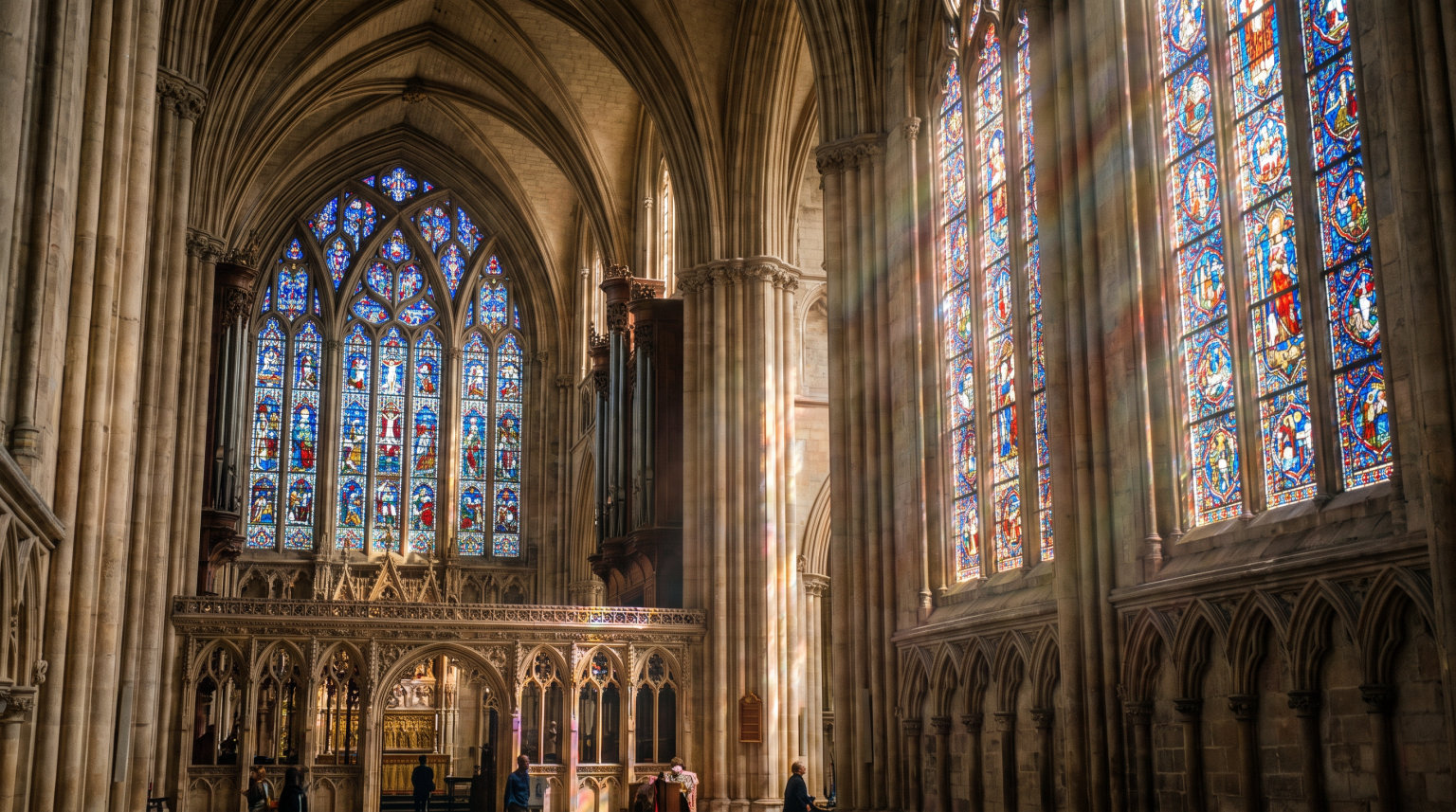
Stained glass is an art form that transforms light itself into a medium of expression. Using colored glass pieces joined by lead strips, artisans create translucent images and patterns that have adorned buildings for millennia. The history of stained glass spans thousands of years, from ancient Egyptian beads to soaring cathedral windows that millions still marvel at today. Unlike painting on canvas or carving in stone, stained glass does not merely represent light—it becomes light, channeling and transforming whatever illumination passes through it into something that seems to glow from within.
In this comprehensive guide, we’ll trace the evolution of stained glass from its earliest origins through its medieval golden age, explore the intricate techniques that craftspeople developed, and examine how this ancient art form continues to inspire contemporary artists. Whether you’re an art history enthusiast or simply curious about the stained glass windows you’ve encountered in cathedrals and churches, this exploration offers insights into one of humanity’s most luminous artistic achievements. We’ll examine how this art form developed across different cultures and periods, delve into the technical innovations that made increasingly ambitious projects possible, and consider the challenges facing conservators and artists working with stained glass today.
Table of Contents
Ancient Origins: From Egyptian Beads to Roman Windows
The story of stained glass begins long before cathedral windows filled European churches with colored light. The earliest known manmade glass dates to Egyptian beads from between 2750 and 2625 BCE, making glass-making one of humanity’s oldest controlled chemical processes. Artisans crafted these beads by winding thin strings of molten glass around a core, creating small decorative objects that caught and reflected light in ways stone and metal could not. These beads were not merely ornamental—they served as status symbols and protective amulets, demonstrating that even in ancient times, people recognized glass’s unique ability to interact with light in visually striking ways.
Ancient Roman craftspeople advanced glass-making techniques significantly during their empire’s height. They discovered that adding metallic oxides to glass created permanent colors that would not fade with time or exposure to light. Copper produced green and turquoise, cobalt yielded deep blue, and manganese could create purple and pink hues. These early experiments with coloration laid the groundwork for the colored glass that would eventually fill architectural openings throughout medieval Europe. Roman glassmakers also developed methods for creating larger glass sheets through techniques like casting in molds and blowing glass into various shapes, though their sheets remained relatively small and imperfect by later standards. The Roman approach to glass-making emphasized functional beauty, producing vessels, windows, and decorative objects that combined technical innovation with aesthetic appeal.
Early Christian communities adopted these glass-making traditions as they spread throughout the Roman Empire, transforming secular techniques into religious expression. By the 4th century, small colored glass windows began appearing in Christian baptistries and chapels throughout the Mediterranean world. These early windows were modest in scale and technical sophistication compared to the great medieval cathedrals that would follow, but they established the crucial precedent of using colored glass in sacred spaces. The transition from creating small decorative objects and vessels to filling large architectural spaces with colored glass represented a fundamental shift in how artists understood the relationship between light, space, and spiritual expression. This evolution required not only technical advances in glass production but also new conceptual frameworks for understanding glass as an architectural medium rather than simply a material for vessels and small objects.
Historians and art scholars suggest that the technique for creating architectural stained glass may have arisen from jewelry making and mosaics, two art forms with ancient roots in the Mediterranean and Near East. Like these earlier art forms, stained glass combines small pieces of material to create larger images and patterns. However, stained glass introduced something new and revolutionary: the glass itself became transparent rather than opaque, allowing light to pass through and transform the entire space around it. This quality of translucency would become central to understanding why stained glass became so associated with religious buildings. The interplay between material solidity and light transmission created visual effects impossible to achieve with opaque materials, establishing an aesthetic language that would reach its peak in medieval cathedrals but whose roots extend far back into human history.
The Medieval Golden Age of Stained Glass
In Europe, the art of stained glass reached its height between 1150 and 1500, when magnificent windows were created for great cathedrals across the continent. This period, often called the medieval golden age of stained glass, coincided with and was made possible by the development of Gothic architecture. As builders learned to create taller structures with thinner stone supports and larger window openings, artists found unprecedented canvas for their work. The Gothic architectural revolution created spaces where walls became almost optional, replaced by vast expanses of glass that seemed to dissolve the boundary between interior and exterior, between human-made structure and natural light.
The association between stained glass and Christian churches developed for several interconnected reasons that together created the conditions for this art form’s flourishing. First, cathedrals were built to inspire spiritual awe in worshippers, and colored light streaming through windows created an otherworldly atmosphere impossible to replicate with solid walls. The way morning light transforms a cathedral interior, flooding the space with blues and reds and golds, produces an emotional and spiritual response that seems to transcend the material fact of colored glass. Second, medieval churches served communities where many people could not read, and stained glass windows functioned as visual Bibles, depicting biblical stories and saints’ lives in vivid colors that communicated the faith narrative to anyone who entered. The educational function of stained glass should not be underestimated in an age before widespread literacy.
Third, and perhaps most importantly, the church had the resources and patronage system to support the elaborate workshops required for large-scale stained glass production. Creating a major cathedral window required coordinating glass-makers, painters, designers, cutters, and lead-workers in extended collaboration. This guild-based workshop system, which developed particularly in France and Germany, represented a significant organizational innovation that made increasingly ambitious projects possible. The church served as the primary patron, commissioning windows that reflected theological programs and displaying the wealth and devotion of religious communities. Without this institutional support structure, the golden age of stained glass would have been impossible.
Light held profound spiritual meaning in medieval Christian theology, providing the theological foundation for stained glass’s central role in church design. Theologians wrote extensively about divine light, drawing on biblical passages that describe God as light and heaven as a place of uncreated brightness. Stained glass transformed ordinary sunlight into colored radiance that seemed to embody the sacred, filling church interiors with what contemporaries experienced as material grace. When light passed through a biblical scene depicted in glass, it was as if the story itself was illuminated from within, participating in the divine light that the image represented. This transformation of material light into spiritual meaning represented something deeply powerful to medieval observers.
Our team has spent considerable time studying the windows that survive from this period, and what strikes us most is how these works were genuinely collaborative endeavors involving dozens of specialists over many years. A single large cathedral window might involve designers who created the cartoons, glassmakers who produced the colored sheets, cutters who shaped individual pieces, painters who added details with vitreous paints, and assembly specialists who fitted everything together with lead came. This workshop system produced some of the most ambitious art projects in human history, rivaling the great cathedral buildings themselves in their scale and complexity. The collaborative nature of stained glass production set it apart from more individual art forms like painting or sculpture.
Production Techniques and Materials
Understanding how medieval stained glass was made reveals the remarkable skill and specialized knowledge that craftspeople developed over generations. The process began with glass production, and medieval workshops used two primary methods to create the glass sheets that would become windows. The crown method involved spinning molten glass on a rod until centrifugal force spread it into a circular sheet. This technique, derived from earlier Roman methods, produced glass with a characteristic bull’s eye mark at the center where the rod attached and a slightly uneven surface that catches light beautifully. The unevenness, far from being a defect, created subtle variations across the glass surface that enhanced the play of light through assembled windows.
The broad sheet method, which became more common later in the medieval period, involved blowing glass into cylinders that were then cut and flattened into rectangular sheets. This technique produced larger, flatter sheets more suitable for windows with extensive architectural requirements. However, broad sheet glass retained the slight ripples and imperfections that give medieval windows their characteristic luminous quality. Both methods required precise control of furnace conditions and careful timing, as glass behaves differently at various temperatures and cooling rates dramatically affect the final material properties. Medieval glassmakers inherited and refined techniques passed down through workshop traditions that stretched back to Roman times.
Medieval glassmakers created colored glass in several distinct ways, each with characteristic visual effects. Pot-metal glass had color mixed throughout the molten glass itself, producing consistent hues throughout the material’s thickness. This method worked well for certain colors but was technically challenging for others. Flashed glass consisted of a thin layer of colored glass fused onto a thicker clear glass base, creating depth through the contrast between layers. This technique was particularly valuable for creating deep colors like ruby red, as the color could be etched away partially to reveal lighter shades beneath, adding dimension to the image. Our research into workshop records shows that some colors, particularly certain reds and purples, remained notoriously difficult to produce consistently, making reliable examples of these hues especially valuable.
Once the glass sheets arrived at the workshop, skilled artisans cut them into shapes using grozing irons, which had notched edges that gripped and snapped the glass along scored lines. This process required considerable experience, as the brittle glass could easily crack unpredictably if handled incorrectly. Master cutters developed specialized techniques over years of practice, learning to read the glass’s behavior and anticipate how it would break along specific fault lines. For complex images requiring fine details and smooth curves, glass painters applied vitreous paint to the surface using techniques similar to those used in manuscript illumination. This paint, containing ground glass and metal oxides mixed with a medium, fused permanently to the glass when fired in a kiln, creating durable coloration that could not be accidentally removed.
Silver stain represented one of the most important innovations in medieval stained glass, expanding the color palette available to artists. Applied to the surface of clear or light-colored glass as a paint-like substance containing silver nitrate, this technique produced yellow to orange hues when fired in a kiln. Unlike vitreous paint, which sat on the glass surface and could theoretically wear away, silver stain penetrated the glass chemically, creating colors that remained visible from both sides of the panel and could not be accidentally removed. This technique allowed artists to add highlights, change the apparent color of specific areas, and create subtle gradations impossible with pot-metal or flashed glass alone.
The design process itself followed a careful method that coordinated the work of multiple specialists. Artists first created full-scale drawings called vidimus, which showed exactly how each piece of glass would look and where the lead lines would fall. These detailed drawings served as master plans for the entire project, requiring approval from patrons and indicating the theological program each window would display. From these approved drawings, craftsmen prepared cartoons, the full-scale templates that guided the cutting and assembly of each window. The joining of pieces used lead came, H-shaped lead strips that held individual glass pieces in place while allowing for some movement and expansion. Craftspeople soldered joints where cames met, creating the stable framework that would hold the window together, then waterproofed the entire panel with a cement made from linseed oil and whiting. Finally, installers fitted the completed panel into stone or wooden frameworks within the building’s window openings.
Famous Stained Glass Cathedrals
Several cathedrals stand out as supreme achievements in the history of stained glass art, their windows representing the highest technical and aesthetic accomplishments of medieval craftsmanship. Chartres Cathedral in France houses what many scholars consider the finest 13th-century stained glass ensemble in existence. Its three rose windows and over 170 other windows, totaling more than 2,600 square feet of glass, survived the centuries with relatively little alteration. The famous Blue Window achieves a depth of color that still astounds visitors entering the cathedral’s dim interior. Chartres also preserves windows from the 12th century, making it one of the most complete medieval stained glass programs anywhere in the world.
I visited Chartres several years ago, and the moment sunlight hits those windows in the morning, the entire cathedral seems to transform into a living painting. The light that enters through the Blue Window seems to have a quality of its own, something almost tangible that fills the space with what can only be described as colored air. Walking through the cathedral at different times of day reveals how the windows transform continuously as the sun moves across the sky, each hour bringing new combinations of color and shadow to the stone floors and pillars. Chartres demonstrates that medieval stained glass was not static decoration but a dynamic art form that changed with the light.
Sainte-Chapelle in Paris represents Gothic stained glass at its most theatrical, designed from the beginning to maximize the dramatic effect of colored light. Built in the 1240s to house Passion relics including fragments of the True Cross, the chapel’s upper level consists almost entirely of stained glass. Fifteen tall windows depicting biblical narratives rise from floor to ceiling, separated only by slender stone columns that seem barely able to support the weight of the vaulted stone ceiling above them. When light floods through these windows, the effect is overwhelming, as if the entire structure exists within a prism. The windows survived the French Revolution through a combination of luck and deliberate protection, emerging as some of the best-preserved medieval stained glass in the world.
Canterbury Cathedral’s stained glass tells a story of cultural exchange as well as religious devotion, reflecting England’s position as a crossroads between continental Europe and other regions. Its 12th-century windows include the famous Ancestors of Christ series, which blend Byzantine styling with native English elements, demonstrating how stained glass designs traveled across cultural boundaries. The cathedral also contains later windows from the 14th and 15th centuries, creating a layered record of changing artistic tastes and technical capabilities. Like Chartres, Canterbury’s windows suffered damage during the Reformation and later periods but survived enough to convey the original artistic ambition. The famous Miracle Windows depicting the murder of Thomas Becket add historical dimension to the cathedral’s glass program.
Other notable examples include York Minster’s Great East Window, which at 76 feet tall is the largest expanse of medieval stained glass in Britain, depicting the entire narrative of scripture from creation to the Last Judgment. Cologne Cathedral in Germany preserves windows from various periods including significant 19th-century restoration work that nevertheless respects the original medieval aesthetic. Notre-Dame de Paris, before its 2019 fire, contained important 13th-century windows including the famous Mays windows commissioned by Parisian guilds. Sainte-Chapelle’s earlier mentioned windows stand alongside panels from lesser-known workshops throughout Europe that together create a mosaic of regional styles and techniques. Each cathedral window reflects not only theological programs but also the specific skills and creative vision of its makers.
Decline and Gothic Revival
The extraordinary flowering of medieval stained glass faced a sharp decline beginning in the 16th century, as the political, religious, and cultural conditions that had made the golden age possible underwent fundamental transformation. Several factors contributed to this downturn, none more significant than the Protestant Reformation that swept through Northern Europe. Protestant leaders viewed elaborate church decoration as wasteful at best and idolatrous at worst, arguing that religious art distracted from the pure worship of God. In England, Henry VIII’s dissolution of monasteries destroyed countless medieval artworks, including many significant stained glass windows that had taken generations to create.
In other Protestant regions, congregations stripped churches of their windows and whitewashed walls, eliminating centuries of artistic achievement in a matter of years or decades. The iconoclastic fury that swept through Switzerland, the Netherlands, and parts of Germany proved particularly destructive. Windows that had taken generations to create were smashed, their fragments sometimes used as building material or simply discarded. The political upheavals of the period, including wars and revolutions, further disrupted the workshop system that had produced medieval masterpieces. Glassmakers and painters found themselves without markets for their skills, forcing many to seek other employment or emigrate to regions where Catholic patronage still supported religious art.
Catholic regions saw less destruction, but even there, changing architectural tastes moved away from the large colored windows that had characterized Gothic buildings. Renaissance and Baroque architecture favored larger clear glass windows that allowed more light for interior activities and showcased classical proportions and decorative schemes. The technical knowledge of medieval stained glass production gradually faded as workshops closed and craftspeople sought other work. The Treatise on the Various Arts, the 12th-century text by Theophilus that preserved much medieval technical knowledge including detailed instructions for making stained glass, fell into obscurity. By the 17th and 18th centuries, stained glass had become a minor art, with few artists practicing and fewer buildings receiving significant commissions.
The Gothic Revival of the 19th century brought stained glass back to prominence, though in altered form that reflected Victorian sensibilities and new technical possibilities. Architects like Augustus Pugin in England and Eugene Viollet-le-Duc in France championed medieval aesthetics, arguing that Gothic architecture represented a spiritual and cultural achievement that modern architecture had squandered. Their buildings required appropriate windows, creating demand that reinvigorated stained glass production. New workshops opened in England, France, and Germany, initially focusing on copying medieval examples but gradually developing contemporary styles that blended medieval techniques with Victorian artistic sensibilities. Figures like William Morris and Edward Burne-Jones created designs that remain influential today.
Preservation efforts during this period were double-edged, with well-meaning but poorly informed interventions sometimes replacing medieval glass with inferior modern imitations. Today, conservators understand more about the importance of distinguishing original medieval work from later additions, and many cathedrals now employ specialist studios dedicated to ongoing care. The challenge of maintaining century-old windows against weather, pollution, and structural movement continues to occupy conservation professionals worldwide. Organizations like the Corpus Vitrearum, an international research project begun in the 1950s, have systematically documented medieval stained glass, creating resources that guide both conservation and scholarly understanding. This academic infrastructure represents an important development in how we preserve and interpret stained glass heritage.
Modern Stained Glass Art
Contemporary stained glass has expanded far beyond church commissions, embracing secular subjects and innovative techniques that would have surprised medieval craftspeople. Modern artists like Louis Comfort Tiffany in America and Emile Galle in France pioneered Art Nouveau approaches in the late 19th and early 20th centuries, creating flowing naturalistic designs in technically sophisticated compositions that emphasized the artist’s individual vision. Tiffany’s famous lampshades and windows demonstrate how stained glass could be adapted for domestic settings and secular purposes while maintaining technical excellence. These developments broadened the contexts in which stained glass could flourish, reducing dependence on religious patronage.
Today, artists worldwide work in stained glass, exploring themes from abstract geometry to social commentary, often combining traditional lead came construction with innovative materials like resin, concrete, and digital printing. The boundaries of what counts as stained glass have expanded considerably, with some contemporary artists using techniques that would be barely recognizable to medieval craftspeople while others maintain strict adherence to traditional methods. This diversity reflects the vitality of a medium that has proven adaptable to vastly different artistic programs and cultural contexts. Gallery exhibitions dedicated to contemporary stained glass demonstrate growing interest in the medium among collectors and institutions that would have seemed impossible a century ago.
The connection between stained glass and prominent contemporary artists continues to surprise many observers, challenging assumptions that stained glass is purely traditional or religious. German painter Gerhard Richter created a celebrated abstract window for Cologne Cathedral’s south transept in 2007, demonstrating that contemporary artists can engage meaningfully with this ancient medium while producing work that speaks to modern sensibilities. British artist Damien Hirst has produced stained glass pieces for ecclesiastical settings that blend his characteristic themes with traditional techniques. These collaborations between secular artists and sacred spaces reflect ongoing dialogues about art, spirituality, and community that stained glass has always embodied, though the specific terms of these dialogues have changed considerably from medieval times.
For those interested in exploring the work of influential artists across various media, our guide to influential contemporary artists provides context for understanding where stained glass artists fit within broader artistic movements and historical developments.
Preservation and restoration remain critical concerns for historic stained glass, as pollution, structural settling, and simple aging threaten medieval windows that have survived for centuries. Major cathedrals undertake decades-long restoration projects, carefully cleaning and repairing windows while documenting their original construction through detailed photography and technical analysis. These efforts require specialized knowledge spanning art history, chemistry, engineering, and traditional craft skills that take years to develop. Professional networks and academic programs dedicated to stained glass conservation help ensure that this knowledge is passed to new generations. The future of historic stained glass depends on training conservators who can balance respect for original work with necessary interventions to ensure survival.
Global traditions beyond European Christianity also contribute to the stained glass story, though their development followed different trajectories than the European tradition. Islamic architecture developed related traditions using colored glass in mashrabiya screens and religious buildings, creating different aesthetic effects suited to different architectural contexts and cultural needs. Japanese and other Asian glass traditions developed independently, though their scale and influence remained smaller than European developments. Understanding stained glass as a global phenomenon, rather than purely European heritage, enriches appreciation for how different cultures have explored light and color as artistic media. This broader perspective suggests that human fascination with translucent colored materials may be more universal than the specific European traditions typically associated with stained glass.
When was stained glass developed, and why is it so associated with churches?
Stained glass developed from ancient Egyptian and Roman glass-making traditions around 2750 BCE with beads, but architectural stained glass emerged in Christian churches during the medieval period (1150-1500). It became associated with churches because cathedrals needed visual teaching tools for illiterate congregations, the church had resources to support elaborate workshops, and colored light held deep spiritual symbolism in medieval theology.
How was stained glass made in the olden days?
Medieval stained glass was made by first producing colored glass sheets using crown or broad sheet methods. Artisans then cut shapes using grozing irons, painted details with vitreous paint that was fired in kilns, assembled pieces using lead came, and soldered joints. Silver stain was applied to create yellow-orange hues. Finally, panels were waterproofed with cement and installed in stone frameworks.
What is the history of stained glass?
Stained glass evolved from ancient Egyptian beads (2750-2625 BCE) to Roman glass vessels, then early Christian colored windows in the 4th century. The art form reached its peak during the medieval golden age (1150-1500) in European cathedrals. After a decline during the Reformation, 19th-century Gothic Revival restored stained glass production. Today contemporary artists continue the tradition in both religious and secular contexts.
How did stained-glass windows come to be associated with religious buildings?
Stained glass became associated with religious buildings because medieval churches needed to teach biblical stories to mostly illiterate congregations, church architecture provided large window openings suited to colored glass, patrons had resources to fund elaborate workshops, and colored light symbolized divine presence and spiritual enlightenment in Christian theology.
Stained glass represents one of humanity’s most ambitious attempts to transform light itself into art. From Egyptian beads to Gothic cathedrals, from Renaissance decline to contemporary revival, this art form has consistently responded to humanity’s desire to capture and manipulate light for spiritual and aesthetic purposes. The medieval craftsmen who filled cathedrals with biblical narratives could not have imagined the digital screens and LED displays of today, yet their fundamental impulse to use light creatively in designed spaces remains unchanged. The history of stained glass reveals something fundamental about human nature: our persistent desire to bring beauty and meaning into the spaces where we live and worship.
The enduring appeal of stained glass lies in its unique combination of material craft and ethereal effect that no other art form quite matches. Each panel requires hundreds of hours of skilled work, yet its purpose is not to display the craftsmanship itself but to create an experience of transformed light. When sunlight passes through a medieval window, it doesn’t merely illuminate the glass; it participates in the artwork, constantly shifting and renewing the image throughout the day as the sun moves across the sky. This collaboration between artist and cosmos gives stained glass a living quality that static art forms cannot match. The same window is different at nine in the morning than at noon, different in winter than in summer, different after rain than on clear days.
As we face the challenges of preserving historic windows and nurturing contemporary practice, the history of stained glass reminds us that art forms are not fixed entities but living traditions that evolve with each generation. Each period interprets and reinterprets inherited techniques and themes, ensuring that while specific works may fade, the creative impulse that produced them continues to inspire new generations of artists. The history of stained glass as an art form is ultimately a story about human creativity, spiritual aspiration, and our ongoing relationship with the light that fills our world. In an age of artificial illumination and digital images, the simple experience of colored light filtering through glass retains a power to move and inspire that connects us directly to people who lived centuries ago.