
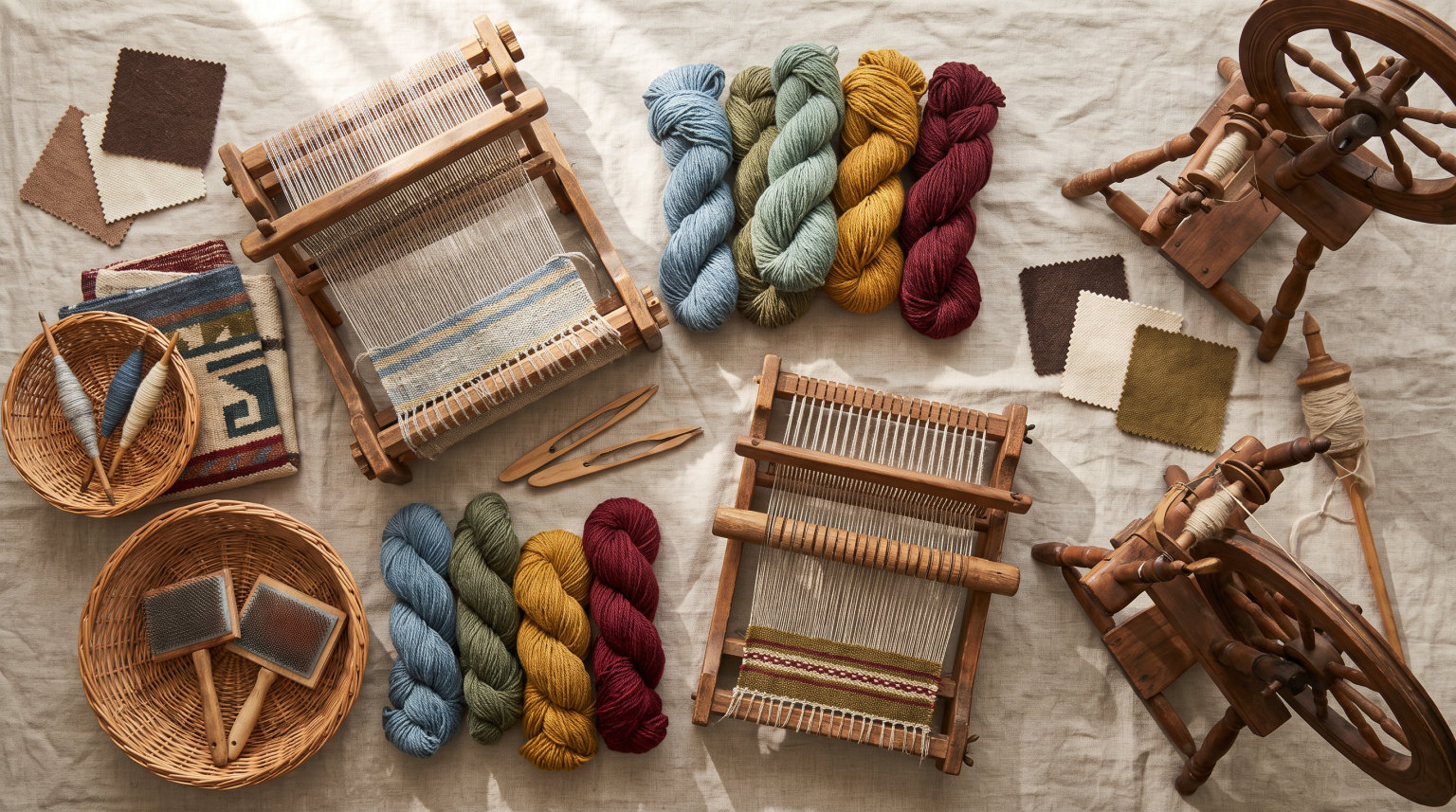
Fiber art stands as one of humanity’s oldest creative traditions, yet its journey from practical craft to celebrated fine art form is a story most people have never heard in full. I have spent years studying textile arts, visiting museum exhibitions, and talking with working fiber artists to understand how threads, yarn, and fabric became powerful tools of artistic expression. The history of fiber art stretches across tens of thousands of years, weaving through ancient civilizations, medieval guild halls, radical feminist studios, and contemporary galleries. This guide traces that entire arc, from the earliest known basketry fragments to the Instagram-fueled fiber art revival happening right now in 2026.
Table of Contents
What Is Fiber Art? A Clear Definition
Fiber art refers to fine art created using natural or synthetic fibers as the primary medium, including materials like wool, cotton, silk, linen, yarn, and fabric. Unlike purely functional textiles such as everyday clothing or mass-produced blankets, fiber art exists first and foremost as an artistic expression. The artist’s intent separates a fiber art wall hanging from a factory-made tapestry.
The distinction between fiber art and textile art causes genuine confusion, even among artists. Textile art is the broader category, covering any creative work made with textiles. Fiber art is a subset that specifically focuses on the material qualities of fiber itself, often emphasizing texture, structure, and dimensionality over decorative pattern. Think of it this way: all fiber art is textile art, but not all textile art qualifies as fiber art.
Common fiber art techniques include weaving, knitting, crocheting, embroidery, needlepoint, quilting, felting, lace-making, and basketry. Contemporary fiber artists also work with soft sculpture, mixed media installations, and three-dimensional fiber constructions that blur the boundaries between textile work and sculpture. Natural fibers like wool, cotton, silk, and flax have been used for millennia, while synthetic fibers such as nylon, polyester, and acrylic opened new possibilities starting in the mid-20th century.
Ancient Origins: Fiber Art in Early Civilizations
The history of fiber art begins long before written records. Archaeological evidence shows that humans were working with plant fibers at least 30,000 years ago. Impressions of woven textiles found on clay fragments in the Czech Republic date to roughly 27,000 BCE, suggesting that our ancestors developed weaving techniques during the Upper Paleolithic period. These early textiles served practical purposes, clothing and shelter, but the care taken in their construction reveals an aesthetic awareness that goes beyond pure utility.
Ancient Egypt produced some of the finest early textiles the world has ever seen. Egyptian weavers worked with flax to create linen of extraordinary quality, and their burial shrouds, garments, and decorative hangings display sophisticated patterns and techniques. The Egyptians developed upright looms by around 2000 BCE, enabling wider and more complex woven works. Textile fragments from Egyptian tombs show dyed patterns, embroidered details, and tapestry-woven sections that demonstrate genuine artistic ambition.
In Mesopotamia, weavers produced wool textiles featuring geometric and figurative designs. The earliest known carpet, the Pazyryk carpet discovered in a Siberian burial mound, dates to approximately 500 BCE and displays astonishing technical skill with over 200 knots per square inch. This level of craftsmanship tells us that ancient textile workers were not mere laborers but skilled artisans whose work commanded enormous value.
Non-Western Fiber Art Traditions
While European and Middle Eastern textile traditions receive the most attention in Western art history, some of the world’s most sophisticated fiber art comes from the Americas, Africa, and Asia. Andean cultures in South America developed textile arts to a level unmatched anywhere in the pre-modern world. Incan and pre-Incan weavers created textiles so finely worked that Spanish conquistadors valued them more highly than gold. These Andean traditions used the backstrap loom and produced cloth with complex symbolic imagery that recorded history, religion, and social status.
In West Africa, Kente cloth weaving by the Ashanti people of Ghana represents a fiber art tradition stretching back over 400 years. Each color and pattern carries specific cultural meaning. Japanese textile arts, including shibori dyeing, sashiko embroidery, and kimono construction, developed their own distinct aesthetic language over centuries. Chinese silk weaving, particularly the intricate brocades of the Tang and Song dynasties, produced some of the most technically demanding textile work in human history.
Medieval Craft to the Industrial Revolution
Medieval Europe elevated textile arts to extraordinary heights. The Bayeux Tapestry, created in the late 11th century, tells the story of the Norman conquest of England through 230 feet of embroidered linen. Despite its name, it is actually an embroidery rather than a true tapestry, worked in wool thread on linen cloth using stem stitching and laid work techniques. The unicorn tapestries housed at the Cloisters in New York, woven around 1500 in the Southern Netherlands, represent the pinnacle of medieval tapestry art with their rich colors and complex allegorical imagery.
Medieval guild systems trained weavers, dyers, and embroiderers through formal apprenticeships. Master weavers held respected social positions, and their workshops produced works for cathedrals, royal courts, and wealthy merchants. Tapestry production centers in Arras, Brussels, and later the Gobelins workshop in Paris became famous across Europe. These workshops operated almost like early art academies, where skilled artisans translated painters’ designs into woven masterpieces.
The Arts and Crafts Movement
The Industrial Revolution of the 18th and 19th centuries transformed textile production. Power looms replaced hand weavers, and factory-made cloth became cheap and abundant. But this mechanization also sparked a backlash. The Arts and Crafts Movement, led by William Morris in England during the 1860s and 1870s, championed handmade textiles as a response to what Morris saw as the dehumanizing effects of industrial production. Morris revived traditional printing, weaving, and embroidery techniques and insisted that functional objects could also be beautiful ones.
Morris and his collaborators at Morris and Company produced wallpapers, fabrics, tapestries, and carpets that drew on medieval and natural motifs. His influence extended across Europe and America, inspiring later movements like Art Nouveau and the Bauhaus. The Arts and Crafts Movement planted a critical seed: the idea that textile work deserved the same respect as painting or sculpture. That idea would take decades to fully take root, but it laid essential groundwork for the fiber art movement of the 20th century.
The 20th Century: Fiber Art Becomes Fine Art
Fiber art crept into the fine art world as early as the 1930s, when artists began treating textiles not just as functional or decorative objects but as vehicles for abstract artistic expression. This shift happened gradually, driven by a small group of pioneering artists who refused to accept that cloth and thread belonged only in the realm of craft. By the 1960s and 1970s, fiber art had exploded into a full-blown movement that challenged every assumption about what art could be.
The Bauhaus Weaving Workshop
The Bauhaus school in Germany, which operated from 1919 to 1933, played a pivotal role in elevating textile work. The Bauhaus weaving workshop attracted talented artists who approached weaving with the same experimental rigor applied to painting, architecture, and industrial design. Anni Albers, who studied and taught at the Bauhaus before fleeing Nazi Germany for the United States, became one of the most influential figures in fiber art history. Her woven works combined geometric abstraction with tactile materiality, and her 1965 book “On Weaving” remains a foundational text in the field.
Albers argued that weaving was a form of thinking, a way of organizing visual and tactile ideas through the interplay of warp and weft. Her work demonstrated that textiles could carry the same intellectual and aesthetic weight as any painting on a gallery wall. When the Museum of Modern Art in New York mounted a solo exhibition of her work in 1949, it was the first time MoMA had ever given a textile artist a one-person show.
The 1960s and 1970s Fiber Art Explosion
The 1960s and 1970s witnessed the most dramatic transformation in the history of fiber art. Artists began creating massive woven works that hung from ceilings, bulged off walls, and filled entire gallery spaces. These were not flat tapestries but three-dimensional textile sculptures that demanded to be experienced in physical space. The movement was international, with major centers in the United States, Poland, France, and Latin America.
A landmark moment came in 1969, when the Museum of Modern Art in New York hosted “Wall Hangings,” an exhibition that presented woven textile works as contemporary art rather than craft objects. This show signaled a turning point in institutional recognition. Around the same time, the Lausanne Biennial in Switzerland, founded by Jean Lurcat in 1962, became the premier international venue for fiber art, drawing artists and collectors from around the world.
Polish artist Magdalena Abakanowicz created enormous woven forms she called “Abakans,” organic, sculptural works made from sisal rope that hung from gallery ceilings like massive living organisms. American artist Sheila Hicks produced vibrant, texturally rich woven works that ranged from small portable pieces to monumental architectural installations. Lenore Tawney created translucent woven sculptures that seemed to dissolve the boundary between textile and air. These three artists, among many others, proved that fiber could compete with bronze, canvas, and stone as a medium for serious artistic expression.
Fiber Art and the Feminist Movement
The rise of fiber art as a recognized fine art form cannot be separated from the feminist art movement of the 1960s, 1970s, and beyond. For centuries, textile work had been classified as “woman’s work,” domestic labor performed in the home rather than creative expression worthy of gallery walls. The feminist art movement challenged this hierarchy directly, arguing that the dismissal of fiber arts was fundamentally tied to the dismissal of women’s creative contributions.
Fiber artists and feminist scholars pointed out an obvious but uncomfortable truth: the art world had historically celebrated painting and sculpture, mediums dominated by men, while dismissing textiles and needlework, mediums traditionally practiced by women. This was not an accident of taste but a reflection of systemic bias. Reclaiming fiber arts as fine art became an act of political resistance.
Judy Chicago’s monumental installation “The Dinner Party,” created between 1974 and 1979, stands as one of the most powerful examples of this reclamation. The work features place settings for 39 mythical and historical women, each with an embroidered runner and a ceramic plate designed with explicit vaginal imagery. The textile elements, including needlework, embroidery, and lace-making, were executed by hundreds of volunteer collaborators. “The Dinner Party” explicitly elevated techniques historically associated with women’s domestic labor to the status of high art.
Classism and the Politics of Fiber Art
The feminist dimension of fiber art history intersects with issues of class and economic privilege. Fiber arts communities have long grappled with a classism problem: expensive materials and formal training are often treated as prerequisites for being taken seriously as a “real” fiber artist. Artists working with affordable materials or self-taught techniques have historically been marginalized within both the craft world and the fine art establishment.
This tension between craft and art, between accessible handwork and elite gallery culture, remains one of the most debated topics in contemporary fiber arts communities. Many artists and scholars argue that the history of fiber art is, at its core, a story about who gets to call themselves an artist and who does not. Understanding that political dimension is essential to understanding the medium itself.
Notable Fiber Artists You Should Know
Dozens of artists have shaped the trajectory of fiber art, but a handful stand out for their outsized influence on the field. These artists come from different eras and traditions, and their work collectively demonstrates the extraordinary range of what fiber art can be.
Sheila Hicks (born 1934) is an American artist who has spent over six decades creating woven works that range from handheld bundles to massive architectural commissions. Her pieces blend color, texture, and form in ways that feel simultaneously ancient and completely contemporary. Hicks studied under Josef Albers at Yale and has exhibited at the Venice Biennale, the Centre Pompidou, and major museums worldwide. A major exhibition at the Metropolitan Museum of Art in recent years introduced her work to a new generation of viewers.
Anni Albers (1899-1994) brought the intellectual rigor of the Bauhaus to American textile art after emigrating to the United States in 1933. She taught at Black Mountain College for decades and wrote extensively about the philosophy of weaving. Her geometric wall hangings and pictorial weavings remain benchmarks of the medium.
Magdalena Abakanowicz (1930-2017) transformed fiber art through her massive sculptural works made from sisal, burlap, and other rough fibers. Her “Abakans” of the 1960s and 1970s were woven forms so large that viewers could walk among and sometimes inside them. She later created haunting figurative sculptures using burlap that addressed themes of dehumanization and collective trauma drawn from her experiences growing up in wartime Poland.
Faith Ringgold (1930-2024) combined quilting, painting, and storytelling to create narrative quilts that address race, gender, and American history. Her “Women on a Bridge” series and her story quilts, which incorporate painted images with quilted fabric borders, challenged both the art world’s bias against textile media and its resistance to engaging with Black women’s experiences.
Contemporary Fiber Art and the Digital Age
Fiber art has experienced a remarkable revival since the early 2000s, driven by a combination of museum recognition, social media visibility, and a broader cultural reassessment of craft-based practices. What was once dismissed as “women’s work” or mere handicraft now fills galleries, museum wings, and Instagram feeds with a kind of energy and creative ambition that earlier fiber artists could only dream of.
Social media platforms have transformed how fiber art is shared and discovered. Artists who might once have been isolated in their studios now build global followings by documenting their process online. Instagram in particular has become a major exhibition space for fiber art, where the medium’s visual and tactile qualities translate powerfully to digital imagery. This online visibility has helped fiber art reach audiences who might never set foot in a traditional gallery.
Museums have responded to this renewed interest with major exhibitions. The Metropolitan Museum of Art’s solo exhibition of Sheila Hicks’s work drew significant attention, as did the Tate Modern’s large-scale fiber installations and the renewed presence of textile artists at the Venice Biennale. These institutional embraces signal that fiber art has firmly arrived in the contemporary art mainstream.
Emerging Fiber Artists to Watch
Meredith Woolnough is an Australian artist known for her intricate freestyle embroidery that mimics natural forms like leaves, coral, and skeletal structures. She uses water-soluble fabric as a base, stitching elaborate designs and then dissolving the backing to leave only the thread network behind. The resulting pieces are delicate, lace-like sculptures that capture the fragility and complexity of organic forms.
Amanda Cobbett is a British textile artist who creates hyper-realistic sculptural embroidery inspired by botanical and mycological specimens. Her tiny stitched mushrooms, mosses, and lichens are so lifelike that viewers often mistake them for preserved specimens. Cobbett’s work demonstrates how fiber art techniques can intersect with scientific illustration and natural history.
The digital age has also brought new tools to fiber artists. Computerized looms, digital pattern design software, and laser-cutting tools have expanded the technical possibilities available to textile artists. Some contemporary fiber artists are even incorporating LED lights, conductive threads, and smart textiles into their work, creating pieces that respond to touch, temperature, or movement. These technological intersections point toward a future where fiber art continues to evolve in directions its early practitioners could never have imagined.
The History of Fiber Art: Key Timeline
Understanding the history of fiber art is easier with a chronological framework. Here are the major milestones that shaped the medium from its earliest origins to the present:
c. 27,000 BCE: Earliest evidence of woven textiles in Central Europe, found as impressions on clay fragments.
c. 6000 BCE: Egyptians begin weaving linen from flax on horizontal ground looms.
c. 500 BCE: The Pazyryk carpet, the oldest known surviving pile carpet, is created in Central Asia.
11th Century: The Bayeux Tapestry is embroidered in Northern Europe, documenting the Norman conquest.
c. 1500: The Lady and the Unicorn tapestries are woven in the Southern Netherlands, masterworks of medieval textile art.
1662: The Gobelins tapestry workshop is established in Paris under royal patronage.
1860s: William Morris founds the Arts and Crafts Movement, championing handmade textiles.
1919-1933: The Bauhaus weaving workshop operates in Germany, training artists like Anni Albers.
1949: MoMA presents Anni Albers’s first solo exhibition, a first for a textile artist at the museum.
1962: The Lausanne International Tapestry Biennial is founded, becoming a major global platform for fiber art.
1969: MoMA hosts “Wall Hangings,” a landmark exhibition legitimizing fiber art as contemporary art.
1974-1979: Judy Chicago creates “The Dinner Party,” merging fiber arts with feminist art politics.
2000s-present: Fiber art experiences a major revival through social media, museum exhibitions, and the contemporary craft movement.
FAQs
What is the history of fiber art?
Fiber art traces back at least 30,000 years to early woven textiles found in Central Europe. Ancient civilizations in Egypt, Mesopotamia, the Andes, and Asia developed sophisticated textile traditions that combined function with artistic expression. Fiber art entered the fine art world in the 1930s through artists like Anni Albers at the Bauhaus, then exploded as a major art movement in the 1960s and 1970s with artists like Sheila Hicks and Magdalena Abakanowicz. The feminist art movement further elevated fiber art by reclaiming textile techniques as legitimate artistic expression. Today, fiber art thrives in major museums, galleries, and online communities worldwide.
When did fiber art become recognized as fine art?
Fiber art began gaining recognition as fine art in the 1930s when artists like Anni Albers brought textile work into the abstract art conversation through the Bauhaus school. The critical turning point came in 1969 when the Museum of Modern Art in New York hosted the ‘Wall Hangings’ exhibition, presenting woven textile works as contemporary art. The Lausanne Biennial, founded in 1962, also played a major role in establishing fiber art within the international fine art community throughout the 1960s and 1970s.
What is the 70-30 rule in art?
The 70-30 rule in art refers to a proportional guideline for composition. It suggests that roughly 70% of a composition should be dominated by one visual element, such as a color, texture, or pattern, while the remaining 30% provides contrast or emphasis. In fiber art specifically, this rule can apply to the balance between textured and smooth areas, dominant and accent colors, or the proportion of woven versus unwoven space in a piece.
Who is Meredith Woolnough?
Meredith Woolnough is an Australian fiber artist known for her intricate freestyle embroidery sculptures. She creates delicate, lace-like works by stitching elaborate patterns onto water-soluble fabric and then dissolving the backing to leave only the thread structure behind. Her work draws inspiration from natural forms including leaves, coral, and skeletal structures, capturing the fragility and complexity of organic systems through thread.
Who is Amanda Cobbett?
Amanda Cobbett is a British textile artist who creates hyper-realistic sculptural embroidery inspired by botanical and mycological specimens. She stitches tiny, lifelike mushrooms, mosses, and lichens using needle and thread, producing works so realistic they are often mistaken for preserved natural specimens. Her work bridges fiber art and scientific illustration, demonstrating the extraordinary precision possible with embroidery techniques.
Is knitting considered fiber art?
Yes, knitting is considered fiber art when practiced with artistic intent. While knitting is often associated with functional items like sweaters and scarves, many contemporary artists use knitting as their primary medium to create sculptural works, installations, and conceptual pieces. Knitted art has been exhibited in major museums and galleries, and the fiber art movement of the 1960s and 1970s helped establish knitting and other textile techniques as legitimate fine art practices.
What is the difference between fiber art and textile art?
Textile art is the broader category that includes any artistic work made with textiles. Fiber art is a subset of textile art that specifically focuses on the material qualities of fiber itself, often emphasizing texture, structure, and dimensionality over decorative patterns. All fiber art is textile art, but not all textile art is fiber art. A mass-produced printed fabric could be textile art, while a hand-woven sculptural wall piece that explores the physical properties of yarn would be classified as fiber art.
Conclusion: Why the History of Fiber Art Matters
The history of fiber art is, at its heart, a story about what counts as art and who gets to decide. From prehistoric basketry to Anni Albers’s Bauhaus weavings, from the feminist reclamation of needlework to the Instagram-fueled revival happening in 2026, fiber art has consistently challenged the boundaries of the art world. Every era brought its own battles: against the dismissal of textile work as mere craft, against the marginalization of women artists, against the classism that gates who gets called a “real” artist.
I believe fiber art’s past points toward an expansive future. The medium continues to absorb new technologies, new cultural influences, and new generations of artists who see thread and fabric not as limitations but as starting points. Whether you are a practicing fiber artist, an art history student, or simply someone who appreciates beautiful things made by hand, understanding this history gives you a richer appreciation for the woven, knitted, stitched, and felted works you encounter in galleries and everyday life alike.
The next time you see a wall hanging in a museum or a crocheted installation in a gallery, remember that it stands on the shoulders of thousands of years of human creativity. Fiber art has always been here. It just took the art world a very long time to notice.