
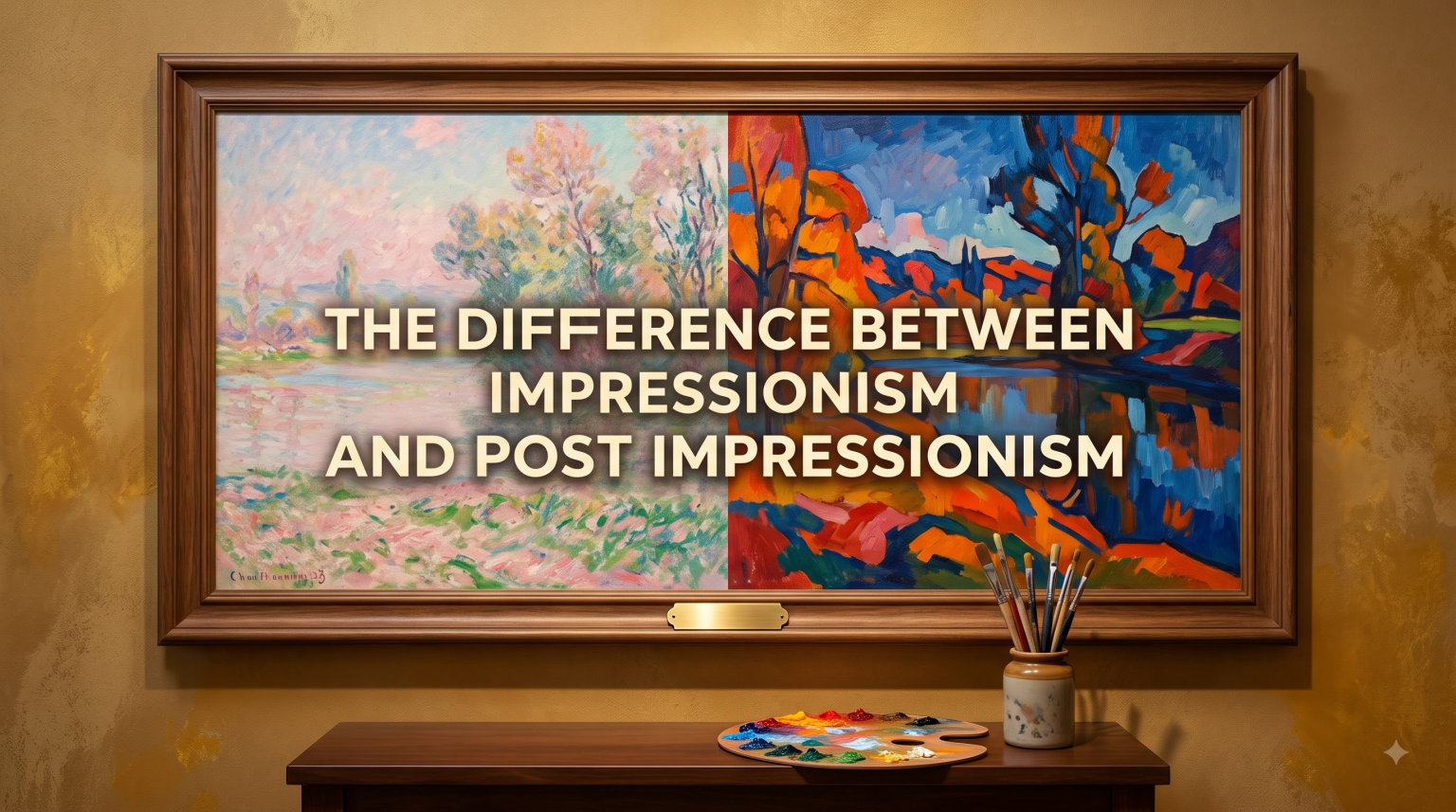
If you have ever stood in front of a painting and wondered whether it belongs to Impressionism or Post-Impressionism, you are not alone. The difference between Impressionism and Post-Impressionism comes down to this: Impressionism captures the fleeting visual impression of light and atmosphere as the eye perceives it, while Post-Impressionism uses color, form, and structure to express emotional and symbolic meaning beyond what the eye sees. Artists like Claude Monet defined the first movement, and Vincent van Gogh, Paul Cezanne, Paul Gauguin, and Georges Seurat led the second by rejecting Impressionism’s limitations in favor of more personal expression.
These two movements reshaped Western art in the late 19th century, emerging from France before spreading worldwide. Together, they form the bridge between traditional academic painting and the modern art movements like Impressionism and Post-Impressionism that defined the 20th century.
In this guide, I will walk you through the history, techniques, key artists, and practical visual cues for each movement. By the end, you will know exactly how to tell them apart the next time you visit a museum or gallery.
Table of Contents
What Is Impressionism?
Impressionism emerged in France during the 1860s and 1870s as a radical departure from the rigid rules of academic painting. The movement took its name from Claude Monet’s painting Impression, Sunrise (1872), which critics initially used as an insult but the artists embraced as a badge of honor.
At its core, Impressionism is about recording the visual world as it appears in a specific moment. The painters wanted to capture how sunlight filters through trees at noon, how water shimmers in the late afternoon, how a busy Parisian street looks on a rainy morning. They prioritized optical truth over idealized beauty.
The first official Impressionist exhibition took place in 1874 at the studio of photographer Nadar in Paris. It was organized by the Anonymous Society of Painters, Sculptors, Printmakers, and others, a group of artists who had been rejected by the official Paris Salon. Thirty artists participated, showing works that shocked traditional critics with their loose brushwork and everyday subjects.
Impressionism was not just a painting style. It was a philosophical stance that said the artist’s eye, not academic convention, should guide the work. This idea was revolutionary in an era when the art establishment valued historical and mythological scenes painted with smooth, invisible brushstrokes.
Key Characteristics of Impressionism
Impressionist painting has several defining traits that set it apart from everything that came before. Here are the most important ones:
1. Short, visible brushstrokes. Impressionists used rapid, broken brushwork that leaves individual marks visible on the canvas. Instead of blending colors smoothly, they placed separate strokes of pure color side by side, letting the viewer’s eye mix them from a distance. This technique is known as broken color.
2. Emphasis on light and its changing qualities. Light is the true subject of most Impressionist paintings. Artists studied how natural light shifts throughout the day, often painting the same scene at different times to capture those changes. Monet’s Haystacks series is the most famous example of this obsession.
3. En plein air painting. Impressionists worked outdoors, directly in front of their subjects, rather than sketching outside and finishing paintings in the studio. Portable paint tubes (invented in the 1840s) made this possible, allowing artists to carry their materials into fields, gardens, and along riverbanks.
4. Open, cropped compositions. Influenced by photography and Japanese woodblock prints, Impressionists often framed their scenes asymmetrically. Figures might be cut off at the edge, and horizons placed off-center, creating a sense of spontaneity and immediacy.
5. Ordinary, everyday subject matter. Instead of mythological or historical scenes, Impressionists painted middle-class leisure: boating parties, cafes, gardens, ballet rehearsals, train stations, and suburban landscapes. They found beauty in modern life as it was actually lived.
Iconic Impressionist Artists and Their Work
The Impressionist movement included many talented painters, but a few stand out for their lasting influence and distinctive contributions.
Claude Monet (1840-1926) is often called the father of Impressionism. His painting Impression, Sunrise gave the movement its name. Monet dedicated decades to series paintings exploring how light transforms a single subject: the Water Lilies cycle, the Rouen Cathedral facade, and the Haystacks are among the most recognized works in all of Western art.
Pierre-Auguste Renoir (1841-1919) brought warmth and sensuality to Impressionism. His Luncheon of the Boating Party (1881) captures the joy of bourgeois leisure with dappled sunlight, flushed skin, and a celebration of human connection. Renoir’s figures feel alive in a way that few other Impressionists achieved.
Edgar Degas (1834-1917) is sometimes called a reluctant Impressionist because he preferred indoor subjects and did not paint en plein air. His ballet rehearsal scenes, such as The Dance Class (1874), capture movement and awkward grace with unconventional cropping that feels almost photographic.
Camille Pissarro (1830-1903) was the only artist to exhibit in all eight Impressionist exhibitions. His rural landscapes and scenes of peasant life bridged the gap between traditional landscape painting and the new Impressionist approach. He also served as a mentor to both Impressionist and Post-Impressionist artists, including Paul Cezanne and Paul Gauguin.
Berthe Morisot (1841-1895) brought a distinctly feminine perspective to Impressionism. Her paintings of domestic interiors, gardens, and women’s daily lives have a lightness and intimacy that set her apart. Works like Summer’s Day (1879) demonstrate her masterful handling of loose brushwork and natural light.
What Is Post-Impressionism?
Post-Impressionism is not really a single movement. It is a label applied retrospectively to several artists who came after Impressionism and extended its ideas in new, often opposing directions. The term itself was coined in 1910 by the English art critic Roger Fry, who organized an exhibition called “Manet and the Post-Impressionists” in London.
The Post-Impressionists shared one thing: they all rejected what they saw as Impressionism’s limitations. While Monet and Renoir chased the fleeting effects of light, the Post-Impressionists wanted something more lasting. They sought emotional depth, symbolic meaning, formal structure, and personal expression that went beyond mere visual observation.
Where Impressionism said “paint what you see,” Post-Impressionism said “paint what you feel about what you see.” This shift from observation to expression is the fundamental philosophical break between the two movements.
The movement spans roughly the 1880s through the early 1900s. Unlike Impressionism, which had group exhibitions and a somewhat shared aesthetic, Post-Impressionism was defined by strong individual voices. Van Gogh, Cezanne, Gauguin, and Seurat each developed highly personal styles that had little in common with one another visually, yet all shared the desire to push past Impressionism’s focus on surface appearance.
Key Characteristics of Post-Impressionism
Because Post-Impressionism encompasses several distinct styles, its characteristics are broader than Impressionism’s. Still, certain traits appear across the movement:
1. Bold, often non-naturalistic color. Post-Impressionists used color for emotional and symbolic impact rather than visual accuracy. Van Gogh painted skies with swirling yellows and blues that no real sky contains, while Gauguin used flat areas of vivid, unnatural color to suggest spiritual meaning.
2. Thick paint application (impasto). Many Post-Impressionists applied paint heavily, building up texture on the canvas surface. Van Gogh’s thick, swirling strokes are perhaps the most recognizable example. The paint itself becomes part of the emotional message.
3. Structured, geometric forms. Cezanne famously wanted to “treat nature by the cylinder, the sphere, the cone.” His analytical approach to form reduced landscapes and still lifes into geometric building blocks, a method that directly inspired Cubism.
4. Emotional and psychological content. Post-Impressionist paintings aim to make you feel something, not just see something. Van Gogh’s turbulent skies, Gauguin’s mysterious tropical scenes, and Toulouse-Lautrec’s melancholic cabaret figures all prioritize inner experience over external reality.
5. Studio-based practice. Unlike the Impressionists, most Post-Impressionists worked primarily in the studio, constructing paintings from memory, imagination, and preparatory sketches rather than painting directly from life outdoors.
6. Individual style over group identity. While Impressionists shared techniques and exhibited together, Post-Impressionists each forged a personal visual language. Seurat’s systematic pointillism has almost nothing in common with Van Gogh’s passionate brushwork, yet both are Post-Impressionist.
Iconic Post-Impressionist Artists and Their Work
The Post-Impressionist label covers artists with wildly different styles, united by their desire to move beyond Impressionism.
Vincent van Gogh (1853-1890) is arguably the most famous Post-Impressionist. His The Starry Night (1889), painted while he was in an asylum in Saint-Remy-de-Provence, transforms a nighttime landscape into an emotional vision of swirling energy. His Sunflowers series uses thick impasto and vivid yellows to convey warmth and vitality. Van Gogh’s influence on 20th-century Expressionism was enormous.
Paul Cezanne (1839-1906) is often called the father of modern art. His Mont Sainte-Victoire series and The Card Players treat nature and figures as geometric constructions. Cezanne built form through carefully modulated patches of color rather than traditional perspective, an approach that directly paved the way for Picasso and Braque’s Cubism.
Paul Gauguin (1848-1903) abandoned European civilization for Tahiti, seeking a purer, more primal form of expression. His massive painting Where Do We Come From? What Are We? Where Are We Going? (1897) uses flat areas of bold color and symbolic figures to pose existential questions. Gauguin’s use of color as symbol rather than description influenced the Symbolist and Fauvist movements.
Georges Seurat (1859-1891) developed pointillism (also called Neo-Impressionism), a technique of building images from thousands of tiny dots of pure color. His masterpiece A Sunday on La Grande Jatte (1886) shows Parisians at leisure but rendered with a scientific precision and stillness that feels nothing like the spontaneity of Impressionism.
Henri de Toulouse-Lautrec (1864-1901) documented the nightlife of Montmartre with sharp observation and bold graphic style. His posters and paintings of dancers, singers, and prostitutes at places like the Moulin Rouge capture both the energy and the loneliness of Parisian entertainment culture.
Impressionism vs Post-Impressionism: The Key Differences
Here is a direct, category-by-category breakdown of how these two movements differ.
Purpose and intent. Impressionism aimed to record the visual world as accurately and spontaneously as possible. Post-Impressionism aimed to express emotional, symbolic, or intellectual content that goes beyond visual appearance. One observed; the other interpreted.
Brushwork and technique. Impressionists used short, rapid strokes with relatively thin paint to catch a moment before the light changed. Post-Impressionists used a wider range of techniques: Van Gogh’s thick impasto swirls, Seurat’s systematic dots, Cezanne’s careful color patches. The brushwork is heavier, more deliberate, and more individual.
Color philosophy. Impressionists used naturalistic colors to represent how light actually looks, mixing colors on the canvas to approximate real-world hues. Post-Impressionists used color for its emotional or symbolic power, often choosing hues that have no basis in natural light. Think of Monet’s soft blue shadows versus Van Gogh’s blazing yellows and deep blues.
Setting and practice. Impressionism was an outdoor movement tied to en plein air painting. Artists set up easels in fields, gardens, and along rivers to capture real light in real time. Post-Impressionism was largely a studio practice, where artists constructed paintings from memory, sketches, and imagination.
Composition. Impressionist compositions tend to feel casual and spontaneous, as if the artist stumbled upon the scene. Post-Impressionist compositions are more deliberately structured. Cezanne carefully balanced every element, and Seurat constructed his paintings with mathematical precision.
Subject matter. Impressionists painted the world around them: cafes, gardens, rivers, ballet studios, train stations. Post-Impressionists painted inner worlds: emotional landscapes, symbolic narratives, personal visions. Even when painting similar subjects, the treatment feels fundamentally different.
How to Tell Impressionism and Post-Impressionism Apart When Looking at a Painting
This is the question I see asked most often on art forums and in art history classes. People read the definitions and still struggle to identify which movement a painting belongs to. Here is a practical guide.
Look at the brushwork first. If the brushstrokes are short, feathery, and dissolve into one another when you step back, you are likely looking at Impressionism. If the paint is thick, heavily textured, or applied in distinct individual marks (dots, swirls, geometric patches), that points toward Post-Impressionism.
Check the color palette. Impressionist colors tend to look natural and luminous, even when vibrant. The light feels like real light. Post-Impressionist colors often look intentionally exaggerated or unnatural. If a sky is vivid turquoise or a face is painted in green shadows, you are probably in Post-Impressionist territory.
Consider the emotional temperature. Impressionist paintings generally feel calm, observational, and pleasant. You sense the artist saying, “Look at this beautiful moment.” Post-Impressionist paintings tend to feel more charged. There is tension, energy, melancholy, or ecstasy. The artist is saying, “This is what I feel about this.”
Examine the composition. Does it feel like a snapshot, with figures casually placed and edges cropped? That suggests Impressionism. Does it feel carefully constructed, with every element in a deliberate position? That leans Post-Impressionist.
Compare two specific paintings. Put Monet’s Water Lilies (1906) next to Van Gogh’s The Starry Night (1889). Both depict nature, but Monet’s work dissolves into soft, blended reflections of light on water. Van Gogh’s sky erupts with thick, swirling paint and colors that exist in his imagination, not in nature. Monet shows you what he sees; Van Gogh shows you what he feels.
Or compare Renoir’s Luncheon of the Boating Party with Cezanne’s The Card Players. Renoir’s scene is warm, spontaneous, and socially alive. Cezanne’s figures are frozen in geometric stillness, more like architectural elements than living people. The emotional register is entirely different.
Understanding how these movements connect to later developments can also help. Both Impressionism and Post-Impressionism as foundational modern art movements established principles that artists continue to draw on today.
Common Misconceptions About Impressionism and Post-Impressionism
Several persistent myths cloud people’s understanding of these two movements. Let me address the most common ones.
“Monet’s late work is Post-Impressionist.” Monet’s enormous late Water Lilies paintings, with their nearly abstract fields of color, do blur the line between movements. However, Monet remained committed to the Impressionist principle of painting visual perception. His goal was still capturing light, not expressing inner emotion. He was an Impressionist to the end.
“Post-Impressionism is more advanced than Impressionism.” Art movements are not a ladder of progress. Post-Impressionism did not improve upon Impressionism; it pursued different goals. Monet’s pursuit of optical truth is no less sophisticated than Cezanne’s pursuit of geometric structure. They are different conversations with different aims.
“There was a clean chronological break.” The two movements overlap significantly in time. Monet was still painting Impressionist canvases well into the 1920s, while Van Gogh produced his Post-Impressionist masterpieces in the late 1880s. The transition was gradual, not a switch that flipped.
“All late 19th-century French painting falls into one of these categories.” Many artists of the period fit neither label neatly. Henri Rousseau, for instance, was a self-taught painter whose dreamlike jungle scenes belong to no established movement. Realism, Symbolism, and academic painting all continued alongside these movements.
The Legacy: How These Movements Shaped Modern Art
The impact of Impressionism and Post-Impressionism extends far beyond the 19th century. Together, they dismantled centuries of academic tradition and opened the door to nearly every major 20th-century art movement.
Cezanne’s geometric approach to form directly inspired Picasso and Braque to develop Cubism around 1907. When Picasso said that Cezanne was “the father of us all,” he meant that Cezanne’s willingness to break objects into facets made modern abstraction possible.
Van Gogh’s raw emotional intensity and expressive brushwork laid the groundwork for Expressionism. Artists like Edvard Munch, Ernst Ludwig Kirchner, and later the Abstract Expressionists all drew on Van Gogh’s belief that paint could convey feeling directly.
Seurat’s systematic approach to color, placing tiny dots of complementary hues side by side, contributed to the development of color theory in painting. His scientific method influenced not only Neo-Impressionist followers but also later movements that treated painting as a structured, analytical process.
Gauguin’s bold, flat color and symbolic content pointed the way toward both the Fauvist movement (with artists like Henri Matisse) and the broader trend toward abstraction. His insistence that color could carry meaning independent of representation was a radical idea that reshaped modern painting.
Without Impressionism’s rebellion against academic rules and Post-Impressionism’s push toward personal expression, the art of the 20th century, from Cubism to Abstract Expressionism to Pop Art, would not exist as we know it.
Frequently Asked Questions
How is Impressionism different from Post-Impressionism?
Impressionism focuses on capturing the fleeting visual impression of light and atmosphere using short, broken brushstrokes and naturalistic colors, usually painted outdoors. Post-Impressionism rejects this limited goal in favor of emotional expression, symbolic content, and structured compositions, often created in the studio with bold, non-naturalistic colors and varied techniques like thick impasto or pointillism.
What are the five characteristics of Impressionism?
The five core characteristics of Impressionism are: (1) short, visible brushstrokes using broken color technique, (2) emphasis on capturing natural light and its changing qualities, (3) en plein air painting practice (working outdoors), (4) open, cropped compositions influenced by photography, and (5) ordinary everyday subject matter including landscapes, leisure scenes, and modern urban life.
What are the key points of Post-Impressionism?
Post-Impressionism is characterized by: bold and often non-naturalistic color used for emotional or symbolic effect, thick paint application (impasto), structured and geometric forms, emphasis on emotional and psychological content, studio-based practice rather than outdoor painting, and strong individual artistic styles rather than a shared group aesthetic. It emerged in the 1880s as a reaction against Impressionism’s focus on visual appearance.
Is Vincent van Gogh a Post-Impressionist?
Yes, Vincent van Gogh is one of the most important Post-Impressionist artists. His bold use of color, thick impasto brushwork, and deeply emotional approach to painting define the movement. Works like The Starry Night (1889) and Sunflowers (1888) exemplify Post-Impressionism’s focus on personal expression rather than visual observation.
Was Chopin an Impressionist?
No, Frederic Chopin (1810-1849) was a Romantic-era composer, not an Impressionist. He died before the Impressionist movement in painting began in the 1860s. However, his music’s emphasis on atmosphere, nuance, and tonal color later influenced Impressionist composers like Claude Debussy, which sometimes causes confusion.
Was Salvador Dali an Impressionist?
No, Salvador Dali (1904-1989) was a leading figure in the Surrealist movement, not Impressionism. Surrealism emerged in the 1920s, decades after Impressionism and Post-Impressionism. Dali’s dreamlike, meticulously detailed paintings of melting clocks and bizarre landscapes have no connection to the Impressionist focus on light and atmosphere.
What is one major difference between Impressionism and Post-Impressionist art?
The single most important difference is intent. Impressionism seeks to capture how the world looks to the eye in a fleeting moment of light, while Post-Impressionism seeks to express how the world feels to the artist emotionally and symbolically. Impressionism observes; Post-Impressionism interprets.
Was Henri Rousseau an Impressionist?
No, Henri Rousseau (1844-1910) was not an Impressionist or a Post-Impressionist. He was a self-taught painter whose dreamlike jungle scenes and naive style belong to no established art movement. Sometimes classified as a Proto-Surrealist, Rousseau painted alongside both movements but developed his entirely personal visual language independent of either group.
Conclusion
Understanding the difference between Impressionism and Post-Impressionism transforms how you experience art in museums and galleries. Impressionism captures the world as it appears: fleeting, luminous, and alive with the play of natural light. Post-Impressionism captures the world as the artist feels it: emotional, structured, and loaded with symbolic meaning.
The practical test is simple. When you look at a painting from this era, ask yourself: is the artist showing me what they see, or what they feel? If the answer is light, atmosphere, and visual spontaneity, you are looking at Impressionism. If the answer is emotion, structure, and personal vision, you are looking at Post-Impressionism.
Both movements changed art forever. Together, they broke the grip of academic tradition and opened the door to the entire modern art era. The next time you stand in front of a Monet or a Van Gogh, you will see not just a beautiful painting but a pivotal moment in the history of human expression.