
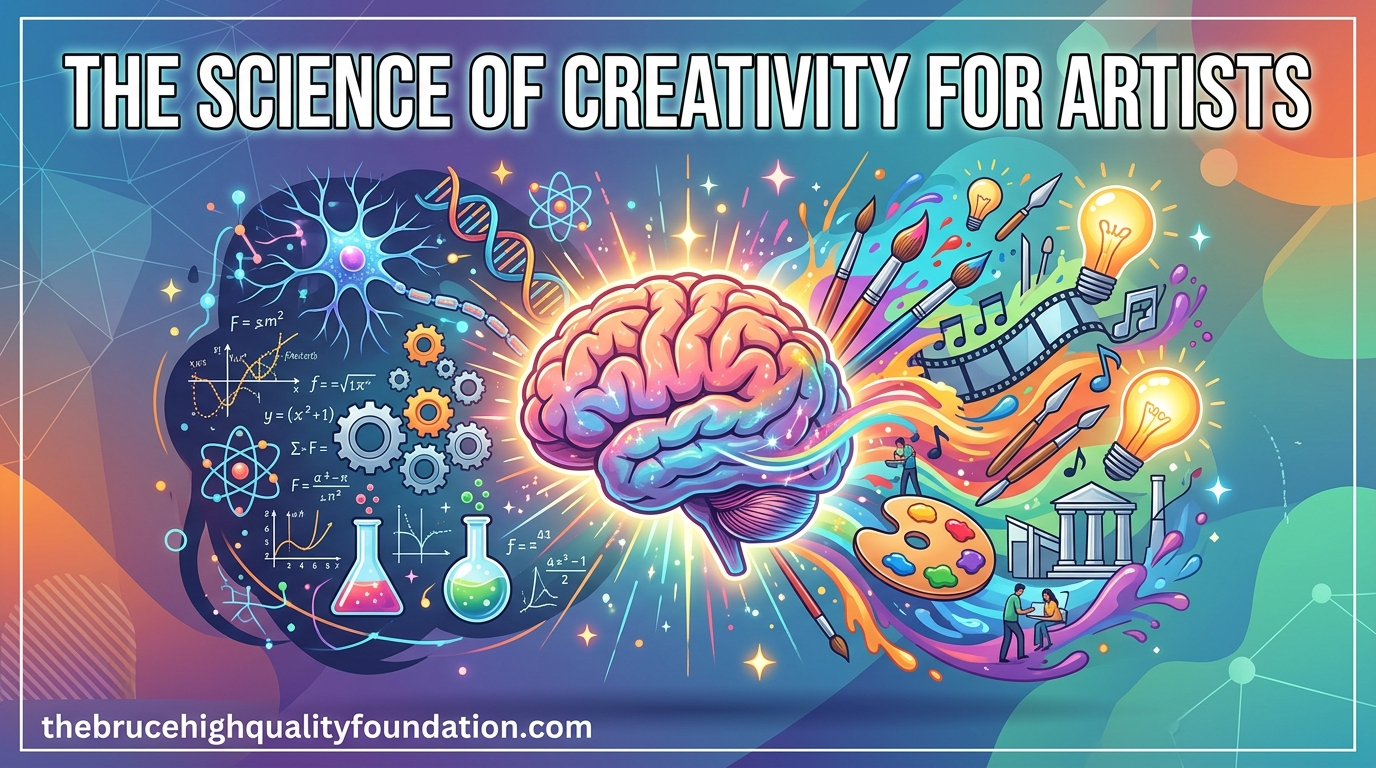
The science of creativity for artists is the study of how the brain generates novel ideas, how neuroplasticity enables artists to rewire their neural pathways through practice, and which brain regions (including the prefrontal cortex, hippocampus, and corpus callosum) contribute to creative thinking and artistic expression. Understanding this scientific foundation helps artists move beyond creative myths and embrace evidence-based techniques that genuinely enhance their creative output.
Our team has spent years exploring the intersection of neuroscience and artistic practice. We have tested techniques alongside artists, reviewed hundreds of research studies, and translated complex brain science into actionable insights. This guide draws on research from the American Psychological Association, peer-reviewed studies from PubMed, and insights from leading creativity researchers like Dr. Keith Sawyer. By the end, you will understand exactly how your brain creates and how to leverage that knowledge in your studio practice.
Table of Contents
How the Brain Creates: Brain Regions Behind Artistic Creativity
Your brain operates as a complex network when you create art, with multiple regions working together in ways that neuroscientists are only beginning to map. Research from PMC shows that creativity in art depends on intact and healthy knowledge systems and semantic conceptual networks. Rather than residing in one “creative center,” your brain distributes creative processing across several regions that communicate through neural pathways.
The Prefrontal Cortex: Your Creative Director
The prefrontal cortex sits at the front of your brain and handles planning, evaluation, and decision-making. When you plan an artwork, evaluate whether a color works, or decide to scrap a direction entirely, your prefrontal cortex is leading the way. This region helps you maintain focus during long projects and enables the cognitive flexibility that lets you pivot when something is not working. Studies show that creative people often have highly active prefrontal regions during the evaluation phase of creative work.
The Hippocampus: Memory and Inspiration
The hippocampus plays a crucial role in creativity by integrating memories and sensory experiences into new combinations. When a smell triggers a childhood memory that appears in your painting, or when a conversation inspires a sculpture concept, your hippocampus is facilitating those connections. This region helps transform scattered experiences into raw material for creative work. Research indicates that artists with robust hippocampal function tend to draw on diverse life experiences in their art.
The Corpus Callosum: Bridging Brain Hemispheres
The corpus callosum is a thick band of nerve fibers connecting your left and right brain hemispheres. This bridge allows information to travel between analytical left-brain processing and intuitive right-brain thinking. Artists often demonstrate strong interhemispheric communication, which enables them to blend technical skills with emotional expression. This connection is why art-making can feel both deliberate and spontaneous simultaneously.
The Science of Neuroplasticity for Artists
Neuroplasticity refers to your brain’s ability to reorganize itself by forming new neural connections throughout life. This discovery, once controversial, is now fundamental to understanding how artists develop their craft. Your brain is not fixed after childhood; it continuously adapts based on what you practice and experience.
What Neuroplasticity Means for Your Creative Practice
Every time you practice your art, you are physically changing your brain. Repetitive creative work strengthens relevant neural pathways while pruning unused ones. A professional painter develops stronger visual-spatial neural networks than someone who rarely paints. This means your creative abilities are not limited by innate talent alone. The brain you have today reflects your past practice, and the brain you want tomorrow is achievable through deliberate work.
How Practice Rewires Your Brain
When you learn a new technique, initially your brain recruits many regions to handle the unfamiliar task. With practice, processing becomes more efficient as dedicated neural circuits form. An experienced ceramicist’s brain requires less conscious effort to center clay than a beginner’s. This efficiency frees up cognitive resources for higher-level creative decisions. The key insight is that consistent practice physically reshapes your brain’s creative infrastructure.
The Left Brain vs Right Brain Myth Debunked
You have probably heard that artists are “right-brained” and logical thinkers are “left-brained.” This popular myth has been repeatedly debunked by neuroscience research. Creativity does not reside exclusively in either hemisphere. While certain functions show some lateralization, creative thinking requires both hemispheres working together.
The left hemisphere handles verbal, analytical, and sequential processing. The right hemisphere excels at spatial, holistic, and intuitive tasks. But creative art-making demands both. When you paint, your left brain might plan composition while your right brain processes color relationships. Your corpus callosum facilitates this collaboration. Research from UCLA Health confirms that creative people’s brains show more diverse neural activity across both hemispheres, not dominance of one side. The takeaway: embrace both analytical thinking and intuitive expression in your work.
The 7 C’s of Creativity: A Science-Based Framework
Researchers have identified seven key principles that describe how creative individuals think and work. These 7 C’s provide a framework for understanding your own creative process and identifying areas for growth.
The 7 C’s Explained
1. Curiosity: Creative artists maintain a sense of wonder and actively seek new experiences, perspectives, and knowledge. This drives exploration that feeds creative work.
2. Complexity: Creative thinkers appreciate nuance and are comfortable with ambiguity. Rather than seeking simple answers, they explore layered problems.
3. Coping: Creative individuals develop resilience and adapt when faced with creative blocks, criticism, or failure. They view obstacles as part of the creative process.
4. Collaboration: While creative work can be solitary, creative people often seek input from others. Diverse perspectives spark new ideas through what researchers call collective creativity.
5. Confidence: Creative artists trust their instincts and develop the courage to express unique visions even when they depart from convention.
6. Concentration: Deep focused work allows creative people to enter flow states where ideas flow without self-criticism. Sustained attention enables breakthrough insights.
7. Celebration: Creative individuals acknowledge creative breakthroughs, however small. This positive reinforcement encourages continued risk-taking and experimentation.
How the 7 C’s Apply to Your Art Practice
Reviewing the 7 C’s, you likely recognize patterns in your own creative habits. Perhaps you excel at curiosity but struggle with concentration. Maybe collaboration energizes you while confidence wavers. This framework helps diagnose where to focus your development. Our team has found that artists who consciously cultivate all seven qualities often experience more consistent creative output and greater satisfaction with their work.
Neuroscience-Backed Techniques to Enhance Your Creativity
Understanding how your brain creates allows you to design habits and environments that support creative work. These techniques are grounded in research and have shown effectiveness for artists across disciplines.
Technique 1: Incubation Walks
Research consistently shows that walking improves creative thinking. A study from Stanford University found that walking increases creative output by up to 60% compared to sitting. The gentle physical activity activates default mode network processing, where your brain makes unexpected connections. Try taking a 20-minute walk before your next studio session. Leave your phone behind to maximize the effect. Many professional artists incorporate daily walks into their creative routine for this reason.
Technique 2: Cross-Training Your Arts
Learning a secondary art form creates new neural pathways that benefit your primary practice. If you are a painter, try working in clay. If you are a photographer, experiment with writing. These cross-training experiences activate different brain regions and can unlock fresh approaches. Research on musicians shows that learning multiple instruments strengthens general auditory and motor networks. Artists who vary their practice maintain more flexible creative brains.
Technique 3: Sleep and Dream Integration
Your brain consolidates memories and makes creative connections during sleep. The hippocampus replays experiences during deep sleep, integrating them with existing knowledge. Many artists report solving problems upon waking. Research confirms that sleep before creative work enhances insight formation. Aim for 7-9 hours and consider keeping a sketchbook by your bed to capture overnight ideas. Avoid viewing your phone first thing, as this can disrupt the creative state upon waking.
Technique 4: Mindfulness Before Creating
Brief mindfulness practice before creative work reduces mind-wandering and increases focused attention. Even five minutes of conscious breathing can shift your brain into a more receptive creative state. Studies show that mindfulness practice increases gray matter density in regions associated with self-awareness and creativity. Try a simple body scan or focused breathing exercise before your next art session to quiet inner critics and open space for creative flow.
Overcoming Creative Blocks: A Neuroscientific Approach
Creative blocks affect every artist at some point. Understanding their neurological basis can help you move through them more effectively rather than fighting against your own brain.
Creative blocks often stem from overactive prefrontal cortex activity during the wrong phase. When you try to evaluate and create simultaneously, the analytical brain can inhibit the intuitive processing needed for breakthrough ideas. The solution is not to push harder but to temporarily shift brain states. Lower your prefrontal cortex activation through physical activity, changing environments, or switching to a different task entirely.
Another common cause is depleted cognitive resources. Creative work requires glucose and neural energy. When you are tired, stressed, or distracted, your brain cannot sustain the activity patterns that produce creative insights. Address this by prioritizing sleep, managing stress through techniques like meditation, and ensuring adequate nutrition. Think of creative energy like physical stamina; it requires recovery to rebuild.
The 70/30 rule in art offers useful perspective here. This principle suggests that roughly 70% of creative output comes from intentional practice and skill development, while 30% stems from innate talent or natural aptitude. When facing a creative block, focus on the controllable 70%: show up, practice deliberately, and trust that consistent effort will eventually produce results. The creative breakthroughs will come.
For artists working on long projects, our team recommends breaking work into distinct phases. Early phases should prioritize generation and exploration with minimal judgment. Later phases handle refinement and evaluation. This separation respects your brain’s natural creative cycles and prevents premature closure on promising directions. Many successful artists maintain separate “sketch” and “finish” practices for exactly this reason.
The Creativity-Intelligence Connection
A common question is whether creative people have higher IQ scores. Research shows creativity and intelligence are related but distinct traits that overlap partially.
Studies indicate that moderate intelligence combined with certain personality traits predicts creativity better than extremely high IQ alone. Individuals with IQ scores between 100-120 often show more creative achievement than those with very high IQs above 130. This seems counterintuitive but makes sense neurologically. People with extremely high intelligence often find creative solutions quickly without needing to explore unconventional approaches. Those with moderate intelligence may work harder to find creative paths, developing stronger cognitive flexibility in the process.
The key takeaway is that you do not need to be a genius to be highly creative. What matters more is domain knowledge, persistence, and the willingness to take risks. Artists at every intelligence level create meaningful, innovative work. Focus on developing your skills and cultivating creative habits rather than worrying about innate ability.
Historical Perspectives: What Leo Tolstoy Said About Art
Russian novelist Leo Tolstoy offered a distinctive view of art that remains relevant for artists today. In his treatise “What is Art?” (1896), Tolstoy argued that the essence of art lies in emotional transmission.
Tolstoy believed that true art occurs when one person, by images and actions, consciously transmits feelings they have experienced to others. The audience then feels those same emotions. This functional definition de-emphasized technical virtuosity in favor of authentic emotional connection. For Tolstoy, the measure of art’s value was its ability to create brotherhood through shared feeling.
Modern neuroscience partly supports Tolstoy’s intuition. When you create art that moves others, your brain’s emotional processing centers activate strongly. The audience’s mirror neuron systems and emotional circuits respond, creating resonance between creator and viewer. While contemporary art theory has evolved beyond Tolstoy’s specific claims, his emphasis on emotional authenticity remains a valuable principle for artists seeking meaningful work.
The Science of Creativity Across Your Artistic Lifespan
One gap in most creativity content is how creative capacity changes throughout an artist’s life. Understanding these patterns helps you adapt your practice at different ages.
In youth, your brain shows heightened neuroplasticity, making it easier to acquire new skills rapidly. Young artists often excel at technical learning and absorbing diverse influences. As you age, while raw learning speed may decrease, other creative capacities often strengthen. Working memory and processing speed decline somewhat, but expertise, domain knowledge, and the ability to make sophisticated judgments typically increase.
Research on creative professionals suggests that peak creative output often occurs in middle age when experience combines with maintained cognitive function. The key is continuing to challenge your brain with new learning rather than relying solely on established patterns. Artists who keep exploring new techniques and ideas throughout their lives tend to maintain creative vitality longer than those who rest on past achievements.
This same principle of intentional curation applies beyond individual practice. Just as museums must continually reassess their collections through evolving curatorial decision-making processes, artists must periodically reevaluate and refresh their creative approaches to maintain relevance and vitality in their work.
Conclusion
The science of creativity for artists reveals that your creative abilities are far more malleable than traditional notions of talent suggest. Your brain continuously rewires itself based on practice, and understanding this process gives you tools to enhance your creative output deliberately.
By understanding the roles of your prefrontal cortex, hippocampus, and corpus callosum, you can work with your brain rather than against it. Embracing the 7 C’s of creativity provides a framework for intentional development. Techniques like incubation walks, cross-training, sleep optimization, and mindfulness help you create conditions where creative insights naturally arise.
The next time you face a creative block or wonder whether your artistic abilities can grow, remember: your brain is always changing. The neural pathways you build today become the creative infrastructure of tomorrow. Start applying these insights to your practice and watch how science-backed approaches transform your artistic development.
FAQs
What is the 70/30 rule in art?
The 70/30 rule in art suggests that roughly 70% of creative output comes from intentional practice and skill development, while 30% stems from innate talent or natural aptitude. This ratio highlights that creativity can be cultivated through dedicated effort rather than relying solely on inborn abilities.
What are the 7 C’s of creativity?
The 7 C’s of creativity are: 1) Curiosity (exploring new ideas), 2) Complexity (appreciating nuanced thinking), 3) Coping (adapting to challenges), 4) Collaboration (leveraging collective intelligence), 5) Confidence (trusting your creative instincts), 6) Concentration (focused deep work), and 7) Celebration (appreciating creative breakthroughs). These principles describe how creative individuals approach problem-solving and artistic expression.
Do creatives have high IQ?
Research shows creativity and IQ are related but distinct. Highly creative people often have above-average intelligence, but many individuals with very high IQ scores are not particularly creative. Studies indicate that moderate intelligence (IQ 100-120) combined with certain personality traits predicts creativity better than extremely high IQ alone.
What did Leo Tolstoy say about art?
Leo Tolstoy believed art should transmit feelings from artist to audience. He wrote in ‘What is Art?’ (1896) that true art occurs when one person, by images and actions, consciously transmits feelings they have experienced to others. He emphasized emotional connection over technical perfection.