
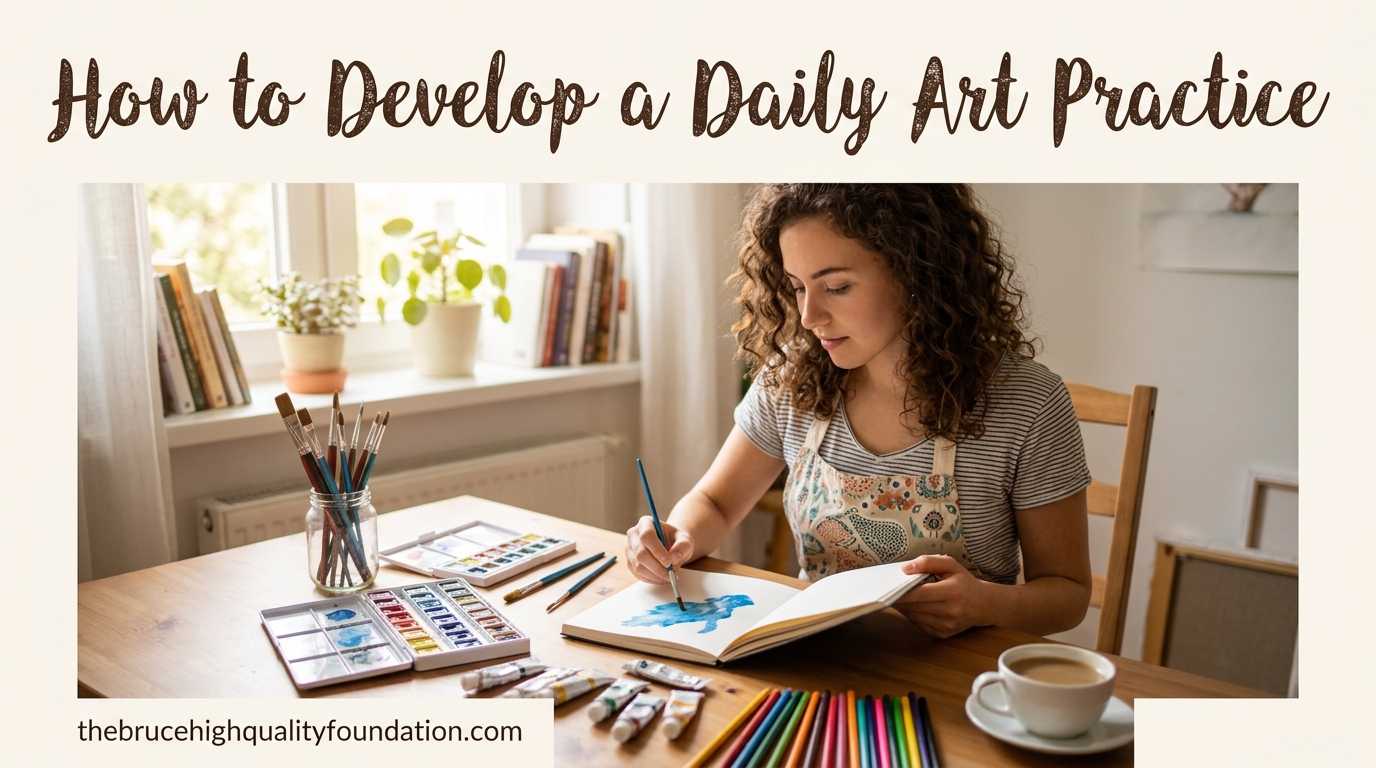
Creating a consistent creative habit transforms your artistic journey in ways you might not expect. Whether you are picking up a pencil for the first time or returning to art after years away, learning how to develop a daily art practice gives your creativity the structure it needs to flourish. The process is not about creating masterpiece after masterpiece—it is about showing up, making marks, and trusting that small steps accumulate into significant growth over time.
Research on drawing and brain function supports what artists have long suspected: regular creative practice strengthens neural pathways, improves observation skills, and enhances memory. A study published in the journal Psychology of Aesthetics, Creativity, and the Arts found that individuals who engaged in daily visual journaling showed improved visual processing and greater creative flexibility compared to those who practiced sporadically. These findings confirm that consistency matters more than talent when it comes to artistic development.
This guide covers everything you need to build a sustainable daily art practice, from setting up your physical space to pushing through the inevitable obstacles every artist faces. You will find specific exercises, time-tested strategies, and a quick-start checklist to help you begin today.
Table of Contents
How to Develop a Daily Art Practice
The difference between artists who improve dramatically over months and those who remain stuck for years often comes down to one factor: consistency. A daily art practice creates momentum, and momentum builds confidence in ways that occasional marathons never can.
When you practice drawing or painting every day—even for just fifteen minutes—your brain forms stronger connections between observation and hand movement. This phenomenon, called muscle memory, does not actually live in your muscles but in the neural pathways that link your eyes to your fingers. Each session reinforces these pathways, making fluid mark-making feel increasingly natural over time.
Beyond skill development, daily practice offers mental health benefits that have been documented across multiple studies. Artists who maintain consistent creative routines report lower stress levels, improved focus, and a greater sense of emotional regulation. The act of drawing activates the brain’s reward centers, releasing dopamine that makes the creative process itself feel more enjoyable.
Consider the results documented by artist improvement communities online. Individuals who committed to daily practice for sixty days consistently reported breakthroughs in areas they had struggled with for years—proportion, shading, perspective, and line weight all showed measurable improvement through concentrated, regular effort alone.
Start Small: The Power of Fifteen-Minute Sessions
One of the biggest mistakes aspiring artists make is scheduling marathon practice sessions that they cannot maintain. Ambition is admirable, but sustainability wins every time. Begin with sessions lasting just ten to fifteen minutes—this duration is short enough to fit into a busy schedule yet long enough to make meaningful progress.
When you start small, you remove the psychological barriers that lead to avoidance. It is far easier to commit to a quarter-hour than to face down three hours of intimidating blank paper. Once you sit down and begin, you often discover that the session naturally extends beyond your planned time. But on days when fifteen minutes is genuinely all you have, that commitment still counts.
Set a timer if you need accountability, but treat the time as a minimum rather than a maximum. Some days your practice will flow for an hour; others will barely reach fifteen minutes before life interrupts. Both sessions fulfill your commitment to showing up daily.
Schedule a Specific Time Each Day
Random creative sessions rarely become habits, no matter how sincere your intentions. Your brain thrives on predictability, so attaching your practice to a specific time cue strengthens the habit loop considerably.
Think about when your energy peaks during the day. Some artists create their best work in early morning hours before the world demands their attention, while others find their creative flow late at night when distractions fade. Experiment with different times for a week each, tracking how each slot feels in terms of focus and motivation.
The morning routine has proven especially effective for many artists. Waking even fifteen minutes earlier to sketch before checking your phone or email creates a protected creative window that belongs entirely to your practice. Others prefer lunch breaks or evening wind-down sessions as their dedicated creative time.
Whatever time you choose, keep it consistent for at least three weeks to let the habit take root. Your internal clock will eventually begin anticipating your practice sessions, making it easier to show up automatically.
Create a Dedicated Creative Space
Your environment shapes your behavior more than you might realize. Setting up a specific area for art—even if it is just a corner of a desk—signals to your brain that it is time to create when you enter that space.
You do not need a studio or expensive setup. A portable sketchbook with a few tools in a pouch works perfectly well for artists who move around. What matters is reducing the friction between your intention to practice and the act itself. If you must dig through drawers to find paper and pencils every time, you will eventually stop bothering.
Keep your materials visible and accessible. A small table with your current sketchbook, a pen cup, and a few pencils creates a mini-station that invites you to sit down and draw. If space is shared, consider using a dedicated container that holds everything you need so you can set up and break down your practice area within minutes. Stocking up on best gifts for artists can help you prepare quality materials for your practice space.
Lighting matters more than most beginners realize. A well-lit space reduces eye strain and helps you see values and colors more accurately. Natural light is ideal, but a good desk lamp works nearly as well for observing subtle transitions in tone.
Essential Beginner Exercises
Knowing what to practice matters as much as practicing regularly. Structured exercises accelerate your progress because they target specific skills rather than repeating what you already know.
Gesture Drawing
Gesture drawing captures the essence of a subject’s movement and posture in rapid, loose strokes. Set a timer for thirty seconds to two minutes and draw what you see—a person standing, an animal in motion, or a still life arrangement. Focus on conveying energy and weight rather than accuracy.
This exercise trains your hand to follow your eye more quickly, breaking the habit of carefully constructing outlines before filling in shapes. It also loosens your line quality, which often tightens when artists concentrate too hard on perfection.
Contour Lines
Continuous contour drawing asks you to trace the edges of a subject without lifting your pen or pencil. You must observe carefully to anticipate where the contour will travel, building hand-eye coordination that transfers to all other drawing tasks.
Start with simple objects—an egg, a cup, or your own hand laid on a table. Move slowly and deliberately, allowing your eye to travel along the edges as your hand follows along the paper.
Blind Contour Drawing
For an even greater challenge, try blind contour drawing—tracing the edges of your subject while looking only at the subject, never at your paper. The resulting image often looks strange, but this exercise dramatically improves your observation skills by forcing you to truly see rather than assume.
Value Studies
Practicing shading with value studies trains you to see light and shadow accurately. Draw a simple object under a single light source, then create a scale of values from lightest highlight to darkest shadow. Practice rendering these values in a grid format until you can reliably produce any value you need.
Use Prompts When Stuck
Every artist encounters days when creativity feels elusive. Having a collection of prompts ensures you can always find something to draw, even when inspiration refuses to arrive uninvited.
Keep a running list of subjects that interest you—photographs from magazines, memories you want to visualize, objects in your home that catch your eye. Some artists maintain a digital swipe file of images on their phone for quick reference during practice sessions.
Constraint-based prompts can unlock fresh approaches. Try drawing with your non-dominant hand, limiting yourself to a single pencil grade, or creating a drawing using only lines without lifting your pen. Restrictions often spark creativity precisely because they eliminate infinite options and force decisions.
Community challenges provide external structure when internal motivation lags. Monthly drawing challenges, Instagram events, and online sketch groups create deadlines and accountability that can carry you through low-motivation periods.
Building Muscle Memory Through Repetition
Muscle memory develops through deliberate repetition, not merely putting in hours. The distinction matters because mindless copying produces far less improvement than focused, attentive practice.
When you draw the same type of subject repeatedly, you encode specific patterns that your brain can recall quickly. A portrait artist who draws fifty heads in three months develops an intuitive sense for facial proportions that someone who draws five heads in the same period simply cannot match. Quality and frequency both contribute to this encoding process.
Observation practice reinforces muscle memory by teaching your hand what your eye has seen. Spend time analyzing subjects before drawing them—noting proportions, angles, and negative spaces. This analytical observation transfers to your motor output, making your marks more accurate representations of what you perceive.
Repetition across different mediums also strengthens your overall hand control. Drawing the same subject with pencil, then charcoal, then pen challenges different aspects of your motor skills while reinforcing the underlying visual information.
Observation Versus Imagination Practice
Artists often wonder whether they should draw from life or from imagination. The answer is not either/or—both approaches develop distinct and necessary skills.
Drawing from observation trains accurate representation. You learn to translate three-dimensional reality onto a two-dimensional surface, developing skills in proportion, perspective, and tonal rendering that transfers to all visual art. Observational drawing also trains patience, as most subjects require sustained attention over extended periods.
Drawing from imagination develops creative problem-solving and personal style. When you compose from memory or invention, you must decide what elements to include, how to arrange them, and how to convey ideas visually without direct reference. This practice builds confidence in your unique creative voice.
Allocate roughly seventy percent of your practice time to observational work and thirty percent to imaginative exploration. This balance provides structured skill development while keeping your creative instincts engaged. As you progress, you can adjust the ratio based on your personal goals.
Keeping Practice Fresh: Medium Switching
Repetition can lead to boredom if your routine becomes too predictable. One of the most effective ways to maintain enthusiasm is switching your drawing medium regularly.
Each medium teaches something different about mark-making and visual properties. Graphite responds differently than charcoal, which behaves differently than ink or colored pencils. Watercolor introduces its own set of challenges around control and planning. By rotating through different tools, you keep practice engaging while expanding your technical vocabulary.
Set a rule to try one new medium per month, even if that means only completing a few small pieces with it. You might discover an unexpected affinity for a medium you previously ignored, opening new avenues for creative expression.
Even small variations help—switching from a mechanical pencil to a wooden graphite holder changes the feel of your line. Using different paper surfaces alters how your tools perform. These subtle shifts prevent stagnation while requiring minimal additional investment.
Overcoming Common Obstacles
Every artist faces obstacles that threaten to derail their practice. Preparing for these challenges before they arise ensures you can push through them when they inevitably appear.
Time Constraints
When life becomes overwhelming, art often gets sacrificed first. Combat this by protecting your practice time as firmly as you would any other appointment. Treat it as non-negotiable in your calendar, even during busy periods.
If you genuinely cannot manage fifteen minutes some days, try five. Consistency matters infinitely more than duration. Showing up—even briefly—maintains the habit loop better than skipping days entirely.
Self-Doubt and Comparison
Measuring your work against others’ online posts creates discourage more than motivation. Understand that social media showcases highlight reels, not the hundreds of imperfect attempts behind each successful piece.
Keep a dated sketchbook of all your work. Looking back at pages from even three months prior often reveals progress you could not perceive when you were too close to the work. This documentation provides concrete evidence of improvement when discouragement strikes.
Boredom and Burnout
Repetitive practice can exhaust even passionate artists. When burnout threatens, change something deliberately—your subject matter, your environment, your medium, or your format. A dramatic change re-energizes your creative attention even if it produces uncomfortable results initially.
Take occasional breaks without guilt. A week away from practice rarely harms your skill and often restores the desire to create. The goal is sustainable practice measured in years and decades, not weeks and months.
Community and Accountability
Solo practice has its place, but community engagement provides motivation and feedback that solitary work cannot replicate. Sharing your work—even imperfectly—creates accountability that encourages consistency. Studying the routines of influential contemporary artists can provide inspiration and models for how to sustain a daily practice over the long term.
Online platforms like Instagram, Reddit’s r/learnart community, and DeviantArt connect artists at all skill levels. Posting work regularly, commenting on others’ pieces, and participating in challenges creates social bonds around creative practice that reinforce your commitment.
Local meetups and sketch groups offer in-person connection and shared learning. Many cities have life drawing sessions open to all skill levels, often for a small model fee. These gatherings provide structured practice while connecting you with fellow artists who understand the challenges you face.
Accountability partnerships work remarkably well. Agreeing with a friend to check in daily about your practice creates mutual responsibility that most people find motivating. Even brief messages confirming you completed your session that day maintain connection and commitment.
Quick-Start Checklist
Use this checklist to launch your daily art practice starting today:
- Commit to a specific time for your practice—choose morning, lunch, or evening and stick with it for three weeks
- Set a timer for fifteen minutes—this is your minimum session length
- Prepare your materials tonight so they are ready tomorrow—sketchbook, pencils, eraser in an accessible location
- Complete one gesture drawing exercise using a thirty-second timer
- Draw something in your immediate environment—a chair, a mug, your own shoes—for at least ten minutes
- Note any subject matter you would like to explore tomorrow in a practice journal
- Share your work somewhere—even a private folder counts as sharing with your future self
Conclusion
Learning how to develop a daily art practice requires patience, experimentation, and the willingness to show up even on days when creativity feels distant. The strategies outlined here—starting small, scheduling specific times, creating dedicated spaces, using structured exercises, and building community connections—provide a foundation you can customize to fit your unique circumstances and artistic goals.
Progress happens through accumulated effort, not sudden transformation. A fifteen-minute daily session compounds into hundreds of hours of practice over months and years. Each mark you make builds upon the previous one, gradually encoding the skills and confidence that turn aspiring artists into accomplished ones.
Your artistic voice deserves the structure that daily practice provides. Begin tomorrow with a single session, and let consistency do the work that talent alone cannot accomplish.
FAQs
How long does it take to see improvement from daily art practice?
Most artists notice measurable improvement within four to six weeks of consistent daily practice. Significant breakthroughs typically appear within three to six months. The exact timeline varies based on practice quality, prior experience, and the specific skills you are developing.
Should I practice drawing every day if I am a beginner?
Yes, daily practice is especially beneficial for beginners because you are building foundational skills and neural pathways from scratch. Starting with just ten to fifteen minutes daily is sufficient. The consistency of practice builds habits and muscle memory more effectively than occasional long sessions.
What should I draw when I have no ideas?
Draw objects in your immediate environment—kitchen items, furniture, plants, or your own hands and feet. Use prompts from online challenge lists or flip through magazines for inspiration. Constraint exercises like drawing with your non-dominant hand or limiting yourself to a single line also work when inspiration feels elusive.
How do I stay motivated during a daily art practice?
Track your progress in a dated sketchbook and review past work monthly. Join online artist communities for accountability and feedback. Switch your medium regularly to keep practice interesting. Accept that motivation fluctuates and focus on showing up regardless—consistency matters more than inspiration.
Is it better to practice from life or from photos?
Both approaches offer unique benefits. Drawing from life develops accurate observation and three-dimensional understanding. Drawing from photos offers convenience and access to subjects you cannot draw from direct observation. Aim for roughly seventy percent life drawing and thirty percent photo reference for balanced skill development.