
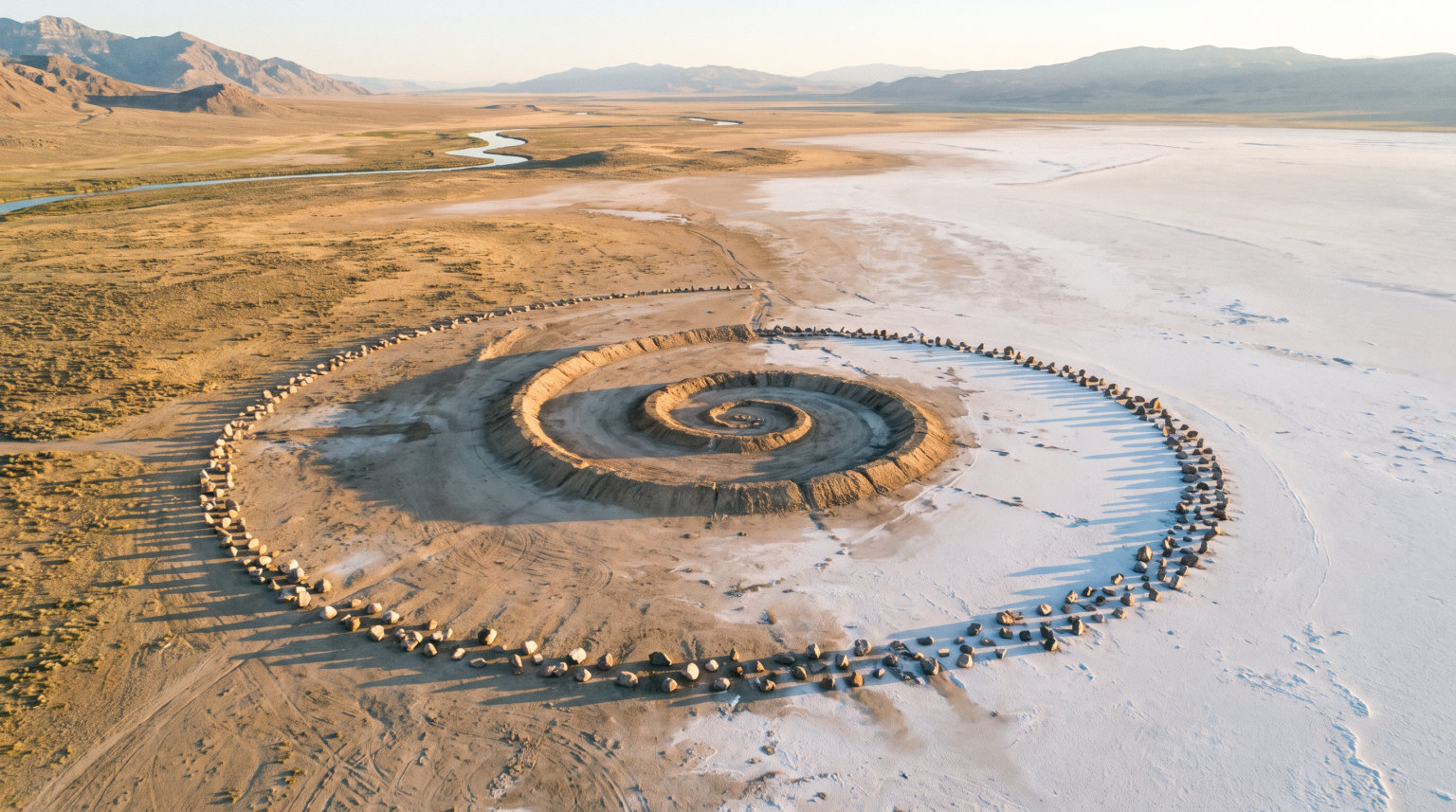
Walking through the American desert, you might stumble upon a massive spiral jutting into a lake, or a field of steel poles stretching toward the sky. These are not accidents of nature. They are land art, works created by artists who shape the earth itself into monumental expressions. If you have ever wondered what separates these massive earthworks from traditional sculpture or why artists choose to work far from any gallery, you are in the right place.
This guide covers the basics of land art explained clearly, from its origins in the 1960s to the philosophical ideas that drive it. You will learn who the key artists are, what works you should know, and why this movement continues to captivate audiences decades after it began.
Table of Contents
What Is Land Art?
Land art is an art movement where creators make works directly in the landscape, sculpting the land into earthworks or arranging natural materials in outdoor settings. Artists use soil, rock, sand, water, and vegetation to form structures that become part of the environment itself.
You will also hear this work called earthworks, earth art, or environmental art. All three terms describe the same idea: art made from the earth, in the earth, often far from any building or gallery. The movement emerged as a direct challenge to the commercial art world. Artists wanted to escape what they saw as the sterile, sales-driven environment of galleries and museums.
Land art differs from traditional sculpture in several important ways. Sculpture typically sits inside a museum or gallery, where lighting and climate are controlled. Land art exists outdoors, exposed to weather, erosion, and time. Some works are meant to last for decades or centuries. Others gradually return to the landscape, changed by nature. This connection between the artwork and its environment is central to the movement.
The History and Origins of Land Art
The 1960s-1970s Emergence
Land art emerged in the United States during the late 1960s and early 1970s. Artists sought alternatives to the growing commercialization of art. They rejected the idea that a painting or sculpture should be bought, sold, and displayed in a controlled space. Instead, they turned to the land itself as their canvas and material.
The American Southwest became a focal point for many land artists. Remote deserts and barren landscapes offered the vast space and isolation these massive projects required. The works could not be contained in any gallery. They required the horizon, the silence, and the scale that only nature could provide.
Minimalism and conceptual art influenced the movement significantly. Like minimalist artists, land artists worked with simple geometric forms and industrial materials. Like conceptual artists, they prioritized the idea over the finished object. Land art combined these approaches with a new emphasis on site and environment.
Key Land Artists You Should Know
Robert Smithson and Nancy Holt
Robert Smithson is the name most closely associated with land art. In 1970, he created Spiral Jetty, a massive coil of black rock and earth that extends into the Great Salt Lake in Utah. The work stretches over 1,500 feet and has become one of the most recognizable land art pieces in the world. Smithson wrote extensively about his ideas, helping to define the movement theoretically as well as practically.
Nancy Holt was Smithson’s partner and a significant land artist in her own right. Her work Sun Tunnels, completed in 1976 in the Utah desert, features four massive concrete tunnels arranged to align with sunrise and sunset during the summer and winter solstices. The tunnels frame views of the surrounding landscape and allow light to pass through in patterns that change with the seasons.
Walter De Maria, Michael Heizer, and Richard Long
Walter De Maria created The Lightning Field in 1977. This installation in New Mexico features 400 stainless steel poles arranged in a grid, designed to attract lightning strikes. The work transforms the empty desert into a site of primal energy and visual drama. De Maria also created the famous Earth Room in 1977, a space filled with 280 cubic yards of earth in a New York gallery.
Michael Heizer is known for Double Negative, a massive sculpture carved into sandstone cliffs in Utah. The work, begun in 1969, involves removing hundreds of tons of rock to create two vast cut spaces in the cliff face. Heizer has spent decades working on Floating Mountain, an ongoing project that will eventually feature massive artificial structures rising from the Nevada desert.
Richard Long works differently. Rather than using heavy machinery to reshape the land, he walks across landscapes and creates works through movement. His pieces often involve stones arranged in lines or circles, made by walking and placing rocks at specific points. This approach connects land art to performance and conceptual practices.
Famous Land Art Works
Spiral Jetty remains the most iconic land art work. When it was created, the lake receded, exposing the black basalt rocks and making the spiral visible from shore. Decades later, water levels have risen again, submerging parts of the work and creating an ever-changing relationship between art and nature. Like street art, land art challenges where art can exist and who gets to experience it.
The Lightning Field offers a different experience. Visitors must make reservations to stay overnight at the installation. Watching storms approach across the flat desert and seeing lightning strike the steel poles provides an encounter unlike any gallery work. The experience depends on weather, time of day, and the viewer’s willingness to wait.
Double Negative sits in a remote Utah canyon, requiring visitors to hike to the site. The cuts in the cliff face create spaces that frame the desert in unexpected ways. Like many land art works, it challenges viewers to consider what art can be and where it can exist.
Sun Tunnels combines precision with natural observation. Nancy Holt aligned the tunnels with astronomical events, creating a work that functions as both sculpture and calendar. The desert light passing through the tunnels changes with the seasons, making each visit a different experience.
Materials and Techniques in Land Art
Land artists work with materials drawn directly from the earth. Rock, soil, sand, and water form the primary vocabulary. Some artists add vegetation, fallen branches, or other organic materials. The choice of material connects the work to its specific location. A work in the Utah desert might use local stone. A work near water might incorporate sandbars or river rock.
Techniques vary widely across the movement. Some artists use heavy machinery to reshape terrain, moving thousands of tons of earth. Others work by hand, placing stones individually. Some works require years of planning and construction. Others emerge from a single action, like Richard Long’s walking works.
Documentation is crucial for land art. Since many works exist in remote locations inaccessible to most people, photographs and videos become the primary means of experiencing them. Artists often plan documentation alongside creation, considering how the work will be recorded and distributed. This creates an interesting tension: the physical work exists in one place, but its documentation travels the world.
The Philosophical Context of Land Art
Site-specificity lies at the heart of land art philosophy. A work exists only in its chosen location. It cannot be moved to a gallery or sold to a collector. The land itself is the material and the context. This approach rejects the idea that art should be portable and commercially viable.
Land art questions the concept of the white cube, the sterile gallery space where art is displayed. By creating works outdoors, exposed to weather and time, land artists argue that art can exist beyond institutional boundaries. This relates to ideas in appropriation art, where artists challenge traditional notions of ownership and originality.
Environmental awareness shapes much land art. Working directly with natural materials forces artists to consider their relationship to the landscape. Some works comment on human impact on the environment. Others embody a more spiritual connection to nature. The movement predates current environmental conversations but resonates deeply with them. Like guerrilla art artists, land artists create works that exist outside traditional art institutions.
Time transforms land art in ways other media cannot match. Erosion, weather, and natural cycles change these works constantly. Spiral Jetty disappears underwater and reappears. Lightning strikes leave marks on steel poles. Stone arrangements shift slightly with each freeze and thaw. This temporality is not a flaw but a feature. It connects the artwork to living processes rather than static permanence.
Contemporary Land Art Today
New artists continue to explore land art approaches. Some follow the monumental tradition of Smithson and Heizer, creating massive earthworks in remote locations. Others work at smaller scales, using urban spaces or combining natural and built environments.
Technology has changed how we experience and document land art. Drones capture aerial views impossible from the ground. Virtual tours allow people to visit remote sites without traveling. Preservation efforts protect significant works for future generations. These developments address one of the movement’s persistent challenges: accessibility.
Contemporary land art often engages explicitly with environmental concerns. Artists create works that comment on climate change, habitat loss, and human relationship to nature. This adds new dimensions to the movement without abandoning its core principles of site-specificity and material connection to the landscape.
Frequently Asked Questions About Land Art
What is an example of earthwork art?
Spiral Jetty by Robert Smithson is one of the most famous examples of earthwork art. Created in 1970 on the Great Salt Lake in Utah, this massive spiral of black rock extends over 1,500 feet into the water. Other notable earthworks include The Lightning Field in New Mexico, Double Negative in Utah, and Sun Tunnels in the Utah desert.
What does earthwork mean in art?
Earthwork is another term for land art. It refers to artworks created by shaping or arranging earth materials directly in the landscape. Earthworks can involve moving large amounts of soil, placing rocks, diverting water, or shaping terrain. The term emphasizes the material connection between the artwork and the ground it occupies.
What is the purpose of land art?
Land art serves multiple purposes. It rejects the commercial gallery system, creating works that cannot be bought or sold in traditional ways. It explores the relationship between humans and nature, often in monumental ways. It questions what art can be and where it can exist. Many land artists seek to create experiences that could never occur inside a museum or gallery.
What is another name for land art?
Land art is also called earth art, earthworks, or environmental art. These terms describe the same movement: art created directly in natural landscapes using natural materials. The alternate names reflect different emphases, with ‘earthworks’ focusing on the material aspect and ‘environmental art’ emphasizing the ecological context.
Who are the most famous land artists?
Robert Smithson is the most famous land artist, best known for Spiral Jetty. Other key figures include Nancy Holt (Sun Tunnels), Walter de Maria (The Lightning Field), Michael Heizer (Double Negative), and Richard Long (walking-based works). These artists defined the movement in its early years and continue to influence contemporary practitioners.
Understanding the Basics of Land Art
The basics of land art explained cover an art movement that challenges everything we assume about where art can exist and what materials it can use. Land artists reshape the earth itself, creating monumental works in remote landscapes that reject traditional gallery boundaries.
Whether you visit Spiral Jetty in Utah, read about The Lightning Field, or explore works through documentation online, land art offers a fundamentally different art experience. It connects the viewer to landscape, time, and natural processes in ways no indoor gallery can match.
If you want to explore further, look into contemporary land artists working today or plan a visit to one of the major sites. Understanding this movement changes how you see the relationship between art, nature, and environment.