
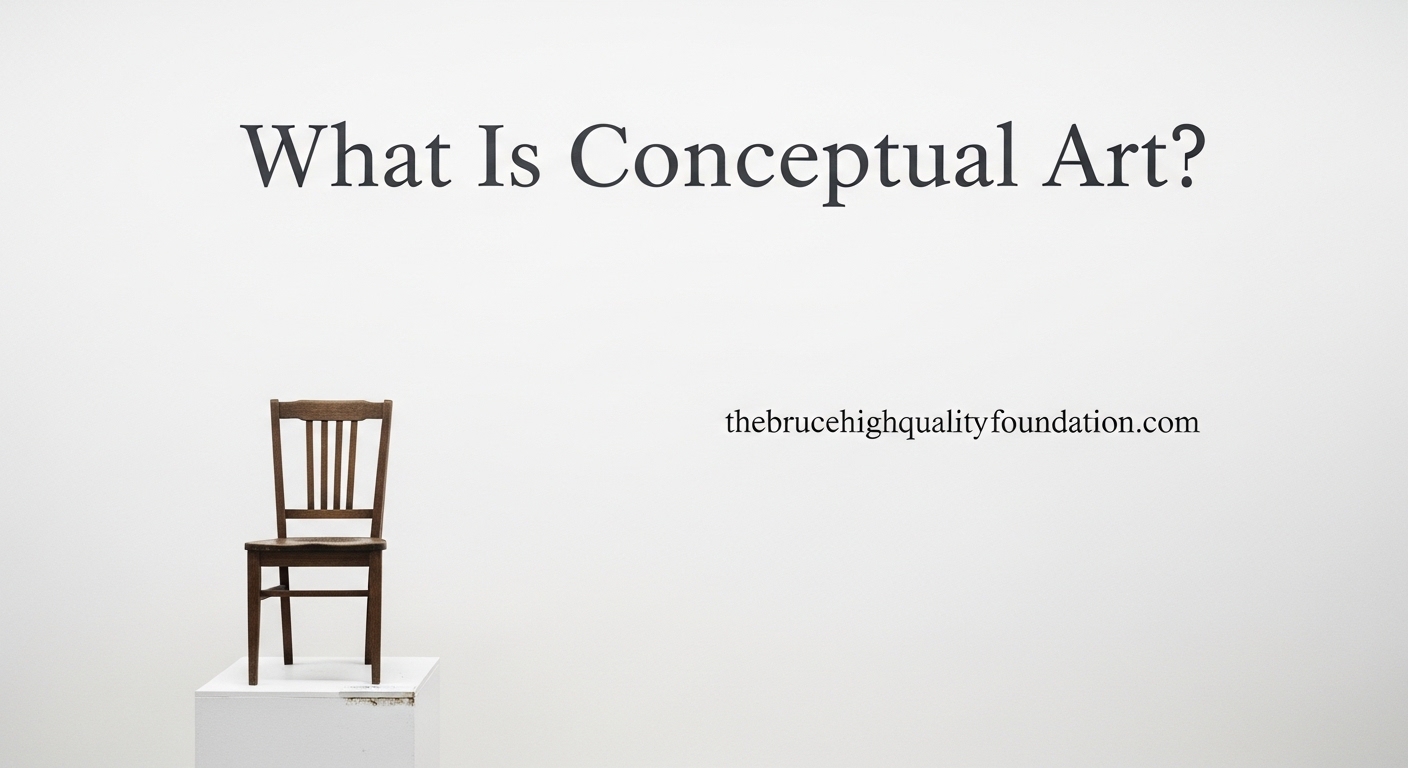
You are standing in a museum gallery. In front of you sits a plain wooden chair, a photograph of that same chair, and a dictionary definition of “chair” printed on the wall. You check the label: One and Three Chairs by Joseph Kosuth, 1965. A voice in your head whispers, “My kid could have done that.”
I have heard this exact sentiment hundreds of times from friends visiting contemporary art museums. It is perhaps the most common reaction to conceptual art. And honestly? That reaction makes perfect sense. When we think of art, we picture something requiring visible skill: brushstrokes, carved marble, years of training. Conceptual art breaks that expectation entirely.
But here is the thing. That discomfort you feel? That confusion? It is not a sign that you are missing something. It is actually the starting point for understanding one of the most influential art movements of the 2026 century. This guide will explain conceptual art in plain English, no art degree required.
Table of Contents
What Is Conceptual Art? (A Simple Definition)
Conceptual art is art where the idea behind the work matters more than the finished physical object. In traditional art, the painting or sculpture is the point. In conceptual art, the painting or sculpture is just a vehicle for something else: a question, a critique, or a philosophical exploration.
The artist Sol LeWitt explained this best in his 1967 essay Paragraphs on Conceptual Art. He wrote: “In conceptual art the idea or concept is the most important aspect of the work. When an artist uses a conceptual form of art, it means that all of the planning and decisions are made beforehand and the execution is a perfunctory affair.”
Think of it like this. In traditional art, the chef’s skill in cooking matters most. In conceptual art, the recipe itself is the artwork. Anyone can follow the recipe, but only one person conceived it. The value shifts from how well you make it to what you thought of making.
This shift sounds simple, but it fundamentally changed what art could be. Before conceptual art, you needed to be good at drawing, painting, or sculpting to be an artist. After conceptual art, you needed to have interesting ideas. The movement proved that thinking is a form of artistic skill.
Where Did Conceptual Art Come From?
Conceptual art emerged as a distinct movement in the 1960s, primarily in New York and Europe. But its roots stretch further to the early 20th century and one particularly rebellious artist: Marcel Duchamp.
In 1917, Duchamp submitted a porcelain urinal to an art exhibition under the title Fountain. He signed it “R. Mutt.” The exhibition rejected it. Duchamp had created what he called a “readymade”: an ordinary manufactured object designated as art. The work asked a radical question: Is art defined by the artist’s hand, or by the artist’s mind? Duchamp argued that the idea mattered more than craftsmanship.
This question simmered for decades. The Dada movement of the 1910s-1920s embraced absurdity and rejected traditional aesthetics. Artists like Man Ray and Hannah Hoch used found objects and photomontage to challenge artistic conventions. But it was not until the 1960s that artists fully committed to the idea that concepts alone could constitute art.
The 1960s provided fertile ground for this shift. The counterculture questioned established institutions. Political movements demanded social change. Artists began asking why museums and galleries held so much power over what qualified as art. Some wanted to make art that could not be bought and sold easily. Others wanted to democratize art-making, proving that you did not need expensive materials or years of training to create meaningful work.
By 1967, Sol LeWitt had formalized the movement’s principles in writing. Lucy Lippard coined the term “dematerialization” to describe how conceptual art removed the precious art object from the center of attention. A small group of artists in New York, including Joseph Kosuth, Lawrence Weiner, and Robert Barry, began creating works that existed primarily as language, instructions, or documentation.
Famous Conceptual Art Examples (And Why They Matter)
Understanding conceptual art becomes easier when you see specific examples. These works might look simple at first glance, but each carries layers of meaning that challenged how people thought about art.
Marcel Duchamp: Fountain (1917)
The urinal. The most famous (or infamous) example of a readymade. Duchamp did not make the urinal. He did not modify it significantly. He simply chose it, titled it, and submitted it to an exhibition.
Why it matters: Fountain asked whether the artist’s selection and context could transform any object into art. It challenged the assumption that art required technical skill. The work was lost shortly after the exhibition (Duchamp made replicas later), which ironically proved another conceptual point: the idea survived even when the object disappeared.
Joseph Kosuth: One and Three Chairs (1965)
A physical chair, a photograph of that chair, and a dictionary definition of the word “chair” displayed together. Three representations of the same concept, each in a different form.
Why it matters: Kosuth was exploring how we understand reality through language and representation. Which is the “real” chair? The object? The image? The definition? The work asks how meaning is constructed, a central question in both art and philosophy. It embodies the conceptual art principle that the idea supersedes any single physical form.
Sol LeWitt: Wall Drawings (1968-2007)
LeWitt created hundreds of wall drawings throughout his career. But here is the twist: he rarely drew them himself. Instead, he wrote instructions. Teams of assistants followed his written directions to create the drawings directly on museum walls.
Why it matters: LeWitt separated the idea from the execution completely. The instructions were the artwork. The drawing on the wall was merely one possible manifestation. When a LeWitt wall drawing is moved to a new museum, the previous one is painted over and redrawn according to the instructions. The idea persists; the specific object is temporary and replaceable.
John Baldessari: I Will Not Make Any More Boring Art (1971)
Baldessari had students at the Nova Scotia College of Art and Design write this sentence repeatedly on a gallery wall, like a classroom punishment. The work existed as documentation of this instruction being carried out.
Why it matters: The piece critiqued both academic art training and the notion of boring art. It used humor to make a serious point about artistic responsibility. By having others execute the work, Baldessari questioned authorship and challenged the romantic idea of the solitary artistic genius.
Yoko Ono: Cut Piece (1964)
Ono sat on stage and invited audience members to cut pieces of her clothing with scissors. The performance varied each time depending on how the audience participated.
Why it matters: Cut Piece explored vulnerability, trust, and the relationship between artist and audience. The concept could not exist without participation. The work raised questions about gender, power, and consent that remain relevant today. It demonstrated that conceptual art could be visceral and emotionally intense, not just intellectual.
Lawrence Weiner: Text-Based Works (1960s-present)
Weiner creates works consisting solely of text, often displayed directly on walls. A typical piece might read: “A 36″ x 36″ REMOVAL TO THE LATHING OR SUPPORT WALL OF PLASTER OR WALLBOARD FROM A WALL.”
Why it matters: Weiner argued that his language-based statements were complete artworks, whether executed physically or not. The idea existed fully in the words. This pushed dematerialization to its logical extreme: art that required no physical form at all to be complete.
Key Features of Conceptual Art
Several characteristics define conceptual art and help distinguish it from other movements. Understanding these traits makes identifying and appreciating conceptual works much easier.
- Dematerialization: This term, coined by critic Lucy Lippard, describes how conceptual art downplays or eliminates the physical art object. A wall drawing can be painted over and redrawn. A performance ends when it ends. The value shifts to documentation, instructions, or the idea itself.
- Idea over execution: The concept comes first. The physical form, if there is one, serves merely to communicate that concept. This is why conceptual works often look simple: complex execution would distract from the idea being presented.
- Language as medium: Many conceptual artists used text as their primary material. Words could express ideas directly without translation into visual form. Instruction-based works turned language into a blueprint for creation.
- Institutional critique: Conceptual artists frequently examined and challenged museums, galleries, and the art market. They questioned who decides what art is worth, how art is bought and sold, and what spaces are considered appropriate for art.
- Anti-commodification: Because conceptual works often existed as ideas, instructions, or temporary performances, they resisted easy collection and sale. This was partly intentional: artists wanted to escape the commercial art market.
- Documentation: For ephemeral works like performances, documentation (photographs, video, written accounts) became crucial. The documentation was not secondary; it was often the primary form in which audiences encountered the work.
Conceptual Art vs Traditional Art
Understanding the differences between conceptual and traditional art helps clarify what makes this movement unique. Neither is “better,” but they operate with different priorities and values.
| Aspect | Traditional Art | Conceptual Art |
|---|---|---|
| Primary Focus | Visual aesthetics, beauty, emotional impact through form | The idea, concept, or question behind the work |
| Materials | Premium materials: oil paint, marble, bronze | Any materials: found objects, text, instructions, body |
| Skill Emphasis | Technical mastery, craftsmanship, years of training | Intellectual rigor, creative thinking, philosophical inquiry |
| Value Location | In the unique physical object | In the idea (object may be temporary or replaceable) |
| Viewer’s Role | Appreciate beauty, skill, emotional expression | Engage intellectually, understand context, question assumptions |
| Permanence | Objects preserved for centuries | Many works intentionally temporary or ephemeral |
Think of traditional art as a destination: you look at the painting and respond to what is there. Think of conceptual art as a starting point: you look at the work and begin a process of questioning and thinking. Both experiences are valid. They simply engage different parts of how we respond to creative work.
How to Understand and Experience Conceptual Art
Walking into a gallery full of conceptual art can feel intimidating. Here is a practical guide for approaching these works without an art history degree.
Step 1: Read the label first. Unlike traditional paintings where the label might feel secondary, conceptual art labels are essential. They tell you what the artist intended, what question they were asking, or what concept they were exploring. The label is part of the artwork’s context.
Step 2: Ask what idea is being presented. Look past the materials. Is the artist questioning what art is? Examining how we use language? Critiquing museums? Investigating the relationship between objects and their representations? Identifying the central question helps the work make sense.
Step 3: Consider the historical context. When was this made? What was happening in the world? Many conceptual works respond to specific moments: the 1960s counterculture, feminist movements, political upheaval. Understanding the context illuminates the artist’s intentions.
Step 4: Embrace your reaction. If you feel confused, frustrated, or skeptical, that reaction is often intentional. Conceptual artists frequently want to disrupt your expectations. Your discomfort is data about where your assumptions lie.
Addressing the “Is This Really Art?” Question
This is the elephant in every conceptual art gallery. Let me be direct: yes, it is art. But the definition of art expanded, just as it has throughout history.
Once, art meant religious paintings and noble portraits. Then landscapes and everyday scenes became art. Then abstract splashes of paint. Then factory-made objects. Each expansion met resistance. Each eventually became accepted.
Conceptual art asks you to value thinking as much as making. It argues that an interesting idea, well-presented, deserves as much attention as a technically perfect painting of a boring subject. You do not have to like every conceptual work. But dismissing the entire approach because it does not match 19th-century expectations means missing some of the most significant artistic developments of the past 60 years.
Frequently Asked Questions
What is conceptual art in simple terms?
Conceptual art is art where the idea behind the work matters more than the finished physical object. Think of it like a recipe: the instructions are the artwork, not just the final dish. The artist’s thinking and concept become the most important part, while the actual object might be simple or even temporary.
What are concept art examples?
Famous examples include Marcel Duchamp’s Fountain (a urinal presented as art), Joseph Kosuth’s One and Three Chairs (a chair, its photo, and a definition displayed together), Sol LeWitt’s wall drawings created from written instructions, Yoko Ono’s Cut Piece (where audience members cut her clothing), and Lawrence Weiner’s text-based works that exist as language statements.
What is the difference between conceptual art and traditional art?
Traditional art prioritizes visual beauty, technical skill, and the unique physical object. Conceptual art prioritizes ideas, intellectual inquiry, and the concept behind the work. In traditional art, craftsmanship matters most. In conceptual art, creative thinking matters most. The value in traditional art is in the object; in conceptual art, the value is in the idea.
What is a key feature of conceptual art?
The key features include: dematerialization (reducing emphasis on the physical object), idea over execution (planning matters more than making), language as medium (using text and instructions), institutional critique (questioning museums and markets), and anti-commodification (resisting easy buying and selling of art).
Is Andy Warhol conceptual art?
Andy Warhol has conceptual elements but is primarily associated with Pop Art. His factory production method (having assistants make his art) and his focus on ideas like mass reproduction and celebrity culture share territory with conceptual art. However, Warhol remained more interested in visual aesthetics and traditional art objects than pure conceptual artists like Kosuth or LeWitt. Some scholars describe him as bridging Pop Art and conceptual art.
Conclusion
Conceptual art challenges us to value thinking as much as making. It asks whether an interesting idea can be as significant as perfect technique. The movement, emerging in the 1960s and continuing to influence artists in 2026, expanded what art could be and who could be an artist.
You do not need to love every conceptual artwork to appreciate what the movement accomplished. You only need to understand that art can exist in ideas, instructions, and questions, not just in beautiful objects. The next time you encounter a work that seems too simple to be art, pause and ask what idea the artist might be exploring. That question is exactly where conceptual art begins.
Ready to explore more? Visit a contemporary art museum and test your new understanding. Read the labels. Ask the questions. Engage with the ideas. Conceptual art is not trying to exclude you; it is inviting you to think differently.