
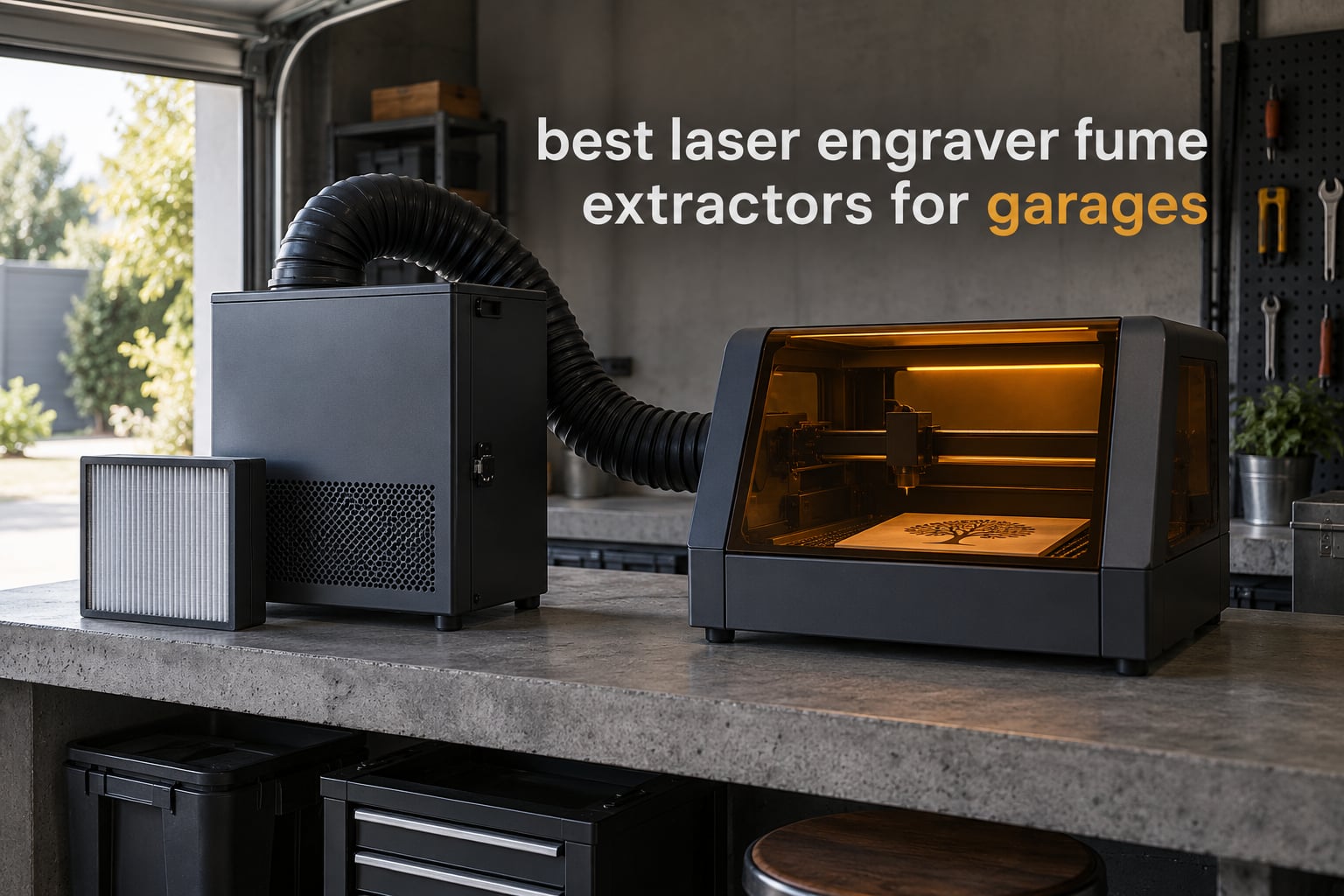
Garages are the worst possible room for laser fumes. A two-car bay holds roughly 1,000 to 1,400 cubic feet, has no window you can leave open in January, and every surface in it is porous. OSB sheathing, drywall, ceiling joists, cardboard boxes of seasonal decorations and the shop cabinets you spent a weekend finishing will all absorb smoke permanently. That is why searching for the best laser engraver fume extractors for garages is not about matching a spec sheet; it is about how much air you move before the first job and whether you can afford the filter costs afterward.
We spent weeks reading manufacturer datasheets, cross-checking airflow figures against buyer review patterns, and comparing what actually happens when a unit runs in a small hard-walled room rather than in a showroom. What follows covers ten extractors across the full range, from a small cube that sits beside a 10W diode machine to cabinets rated for 60W fiber work and 40W CO2 cutting. Every pick states its published airflow in both CFM and cubic meters per hour, its noise figure, and where you can actually buy replacement filters.
One boundary up front, because it matters more than any spec. Never cut PVC, vinyl, or vinyl-clad MDF in a recirculating setup. When chlorine-containing plastic is vaporised it releases hydrogen chloride gas, and a HEPA filter traps the particles while doing nothing at all for the gas. Those materials need a machine that exhausts outdoors through ducting. Everything else in this guide assumes wood, acrylic, leather, cardboard, and metals.
If you are also outfitting the room, our guides to the best warehouse ladders for garages and the best outdoor refrigerators for garages cover two pieces of the same puzzle. And if you ever wondered whether a wet-vac-style carpet extractor counts as fume extraction, the answer is no: it moves liquid, not filtered air.
Table of Contents
Top 3 Laser Engraver Fume Extractors For Garages (October 2026)

xTool SafetyPro AP2
- 6-layer SuperCyclone filtration
- 99.99% dust and odor removal
- 55 dB operation
- Bluetooth sync with xTool lasers

FumeClear FC-2002A
- 153 CFM (260 m3/h) suction
- 3-stage pre-filter HEPA and carbon
- 99.97% at 0.3 micron
- under 55 dB
KQZ KQZ-200 Laser Fume Extractor
- 330 m3/h from a 210W brushless motor
- noise under 50 dB
- 3-stage filtration at 99.97%
- suits lasers under 60W
Quick Comparison: All 10 Fume Extractors Side by Side in 2026
| Product | Specifications | Action |
|---|---|---|
| xTool SafetyPro AP2 |
|
Check Latest Price |
| FumeClear FC-2002A |
|
Check Latest Price |
 Genmitsu 5-Layer Smoke Purifier Genmitsu 5-Layer Smoke Purifier |
|
Check Latest Price |
 FumeClear FC-2004 FumeClear FC-2004 |
|
Check Latest Price |
| KQZ KQZ-200 |
|
Check Latest Price |
 VEVOR 165 CFM Solder Fume Extractor VEVOR 165 CFM Solder Fume Extractor |
|
Check Latest Price |
 ATOMSTACK D3 ATOMSTACK D3 |
|
Check Latest Price |
 FumeClear FC-2003 FumeClear FC-2003 |
|
Check Latest Price |
 BlazeX MD2 BlazeX MD2 |
|
Check Latest Price |
 Zericuf XBY180-1 Zericuf XBY180-1 |
|
Check Latest Price |
1. xTool SafetyPro AP2 – Best Overall and the Only Unit with App-Based Filter Tracking
- Six-layer filtration handles long jobs without odor building up
- Noticeably quiet for its airflow strength
- Auto sync and ramp-up with xTool lasers over Bluetooth
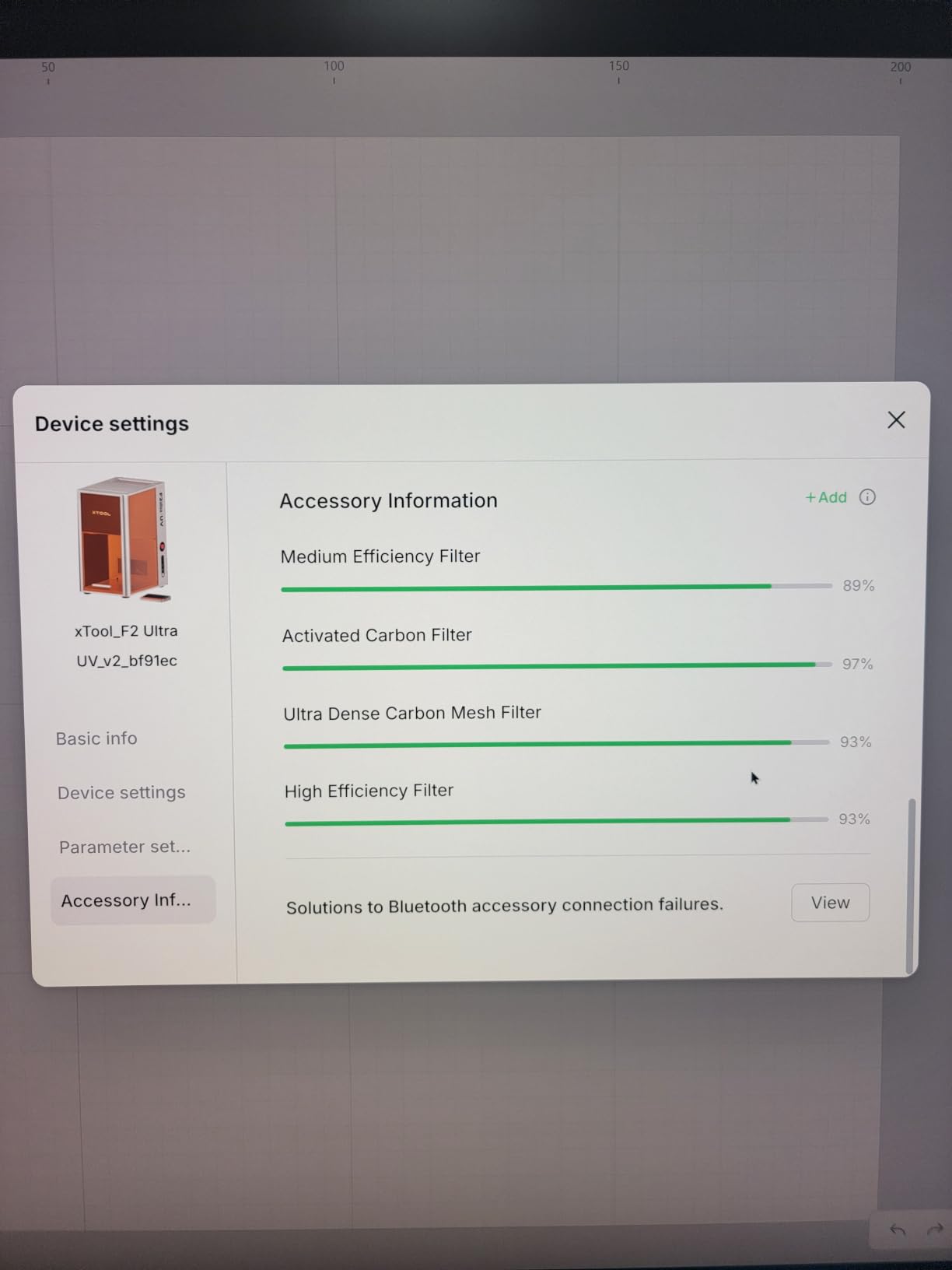
- App shows filter life so you do not buy whole sets blindly
- Solid build with casters and a washable cyclone layer
- Replacement filters sold only through xTool direct
- App and Bluetooth features are useless outside the xTool ecosystem
- Heavy at a listed 20.9 kg
- False airflow or clogged errors can appear when a hose is attached
The SafetyPro AP2 is the extractor we keep coming back to for a garage, and the reason is not raw suction. It is that the 36-chamber SuperCyclone pre-separation stage strips out bulk debris before air ever reaches the expensive layers, so the carbon and HEPA stages keep working for far longer than they would on a single-stage design. Owners running long MDF and plywood sessions report the difference clearly, and plywood in particular is the material that chokes cheaper units fastest.
Published capacity is 150 m3/h or less, or roughly 88 CFM, which covers diode engravers and fiber marking comfortably. It will not run an xTool P3, which needs 238 m3/h of extraction. If your machine is in that class, this is the wrong cabinet and the manufacturer says so plainly, which is more than most listings tell you.
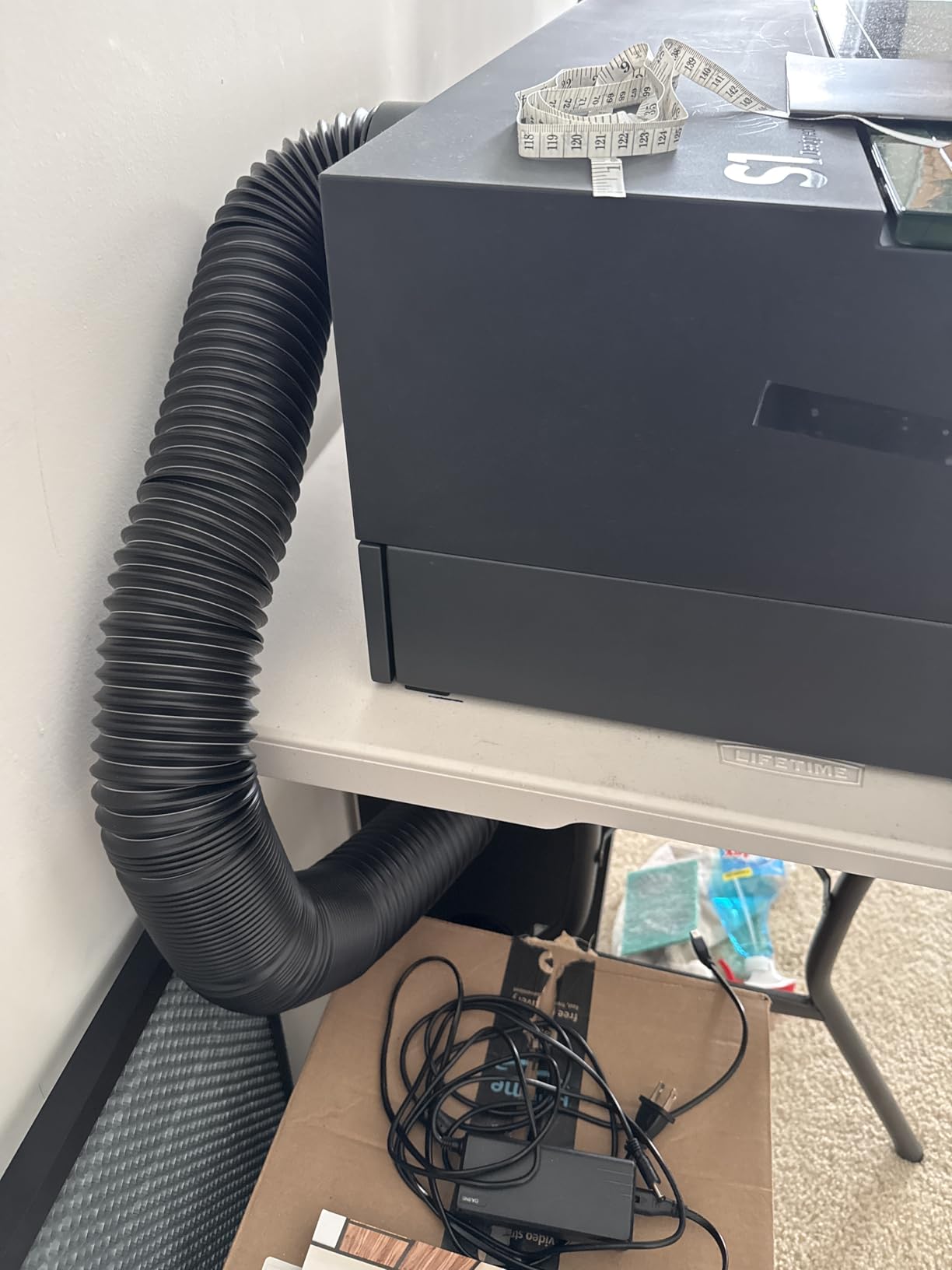
The 55 dB figure is measured in lab conditions, and a garage with bare walls and a concrete floor will add to that. Still, owners consistently report the laser itself being the louder of the two machines in the room. At a listed 20.9 kg it is not something you drag between benches, so plan a permanent spot near your machine rather than treating it as portable.
Filter life is rated at 100 to 600 hours per stage depending on material, which is a wide range because plywood and MDF sit at one end and acrylic and anodised metal at the other. The catch is sourcing: replacement cartridges are sold through xTool directly rather than on Amazon. That is a real long-run cost lock-in, and if you do not own an xTool machine the app, firmware and filter tracking features are effectively dead weight.
What to check before you commit to the xTool ecosystem?
Check whether your machine is on the supported list. The automatic on/off and ramp-up sync only works with xTool hardware, and without it you are manually switching the extractor, which is exactly the window when smoke escapes at job start-up. Several reviews also mention false airflow or clogged error messages once a hose is connected, so have the manual nearby on day one.
Check the filter channel, not just the machine. Buying a cabinet whose consumables come from one source is a deliberate trade: you get the app monitoring and the 6-layer stack, and you accept that refills run through the manufacturer rather than a two-minute Amazon reorder.
Where it falls short in a garage?
At a listed 20.9 kg it stays where you put it, which is fine for a fixed station and annoying if your laser travels. It also is not the strongest unit here, and for 40W CO2 cutting or 60W fiber work the higher-flow cabinets below are a better match.
If you run anything other than xTool hardware, skip it. The filtration is genuinely good, but you would be paying for smart features that never activate and filters you can only order from one seller.
2. FumeClear FC-2002A – Best All-Round Cabinet for a Garage with No Window Access
FumeClear FC-2002A Laser Fume Extractor with Outdoor Vent for Odor Removal
- Strong suction for its class pulls in powder and chips near the hood
- High-iodine coconut shell carbon lasts a long time between changes
- Quiet for a unit moving this much air
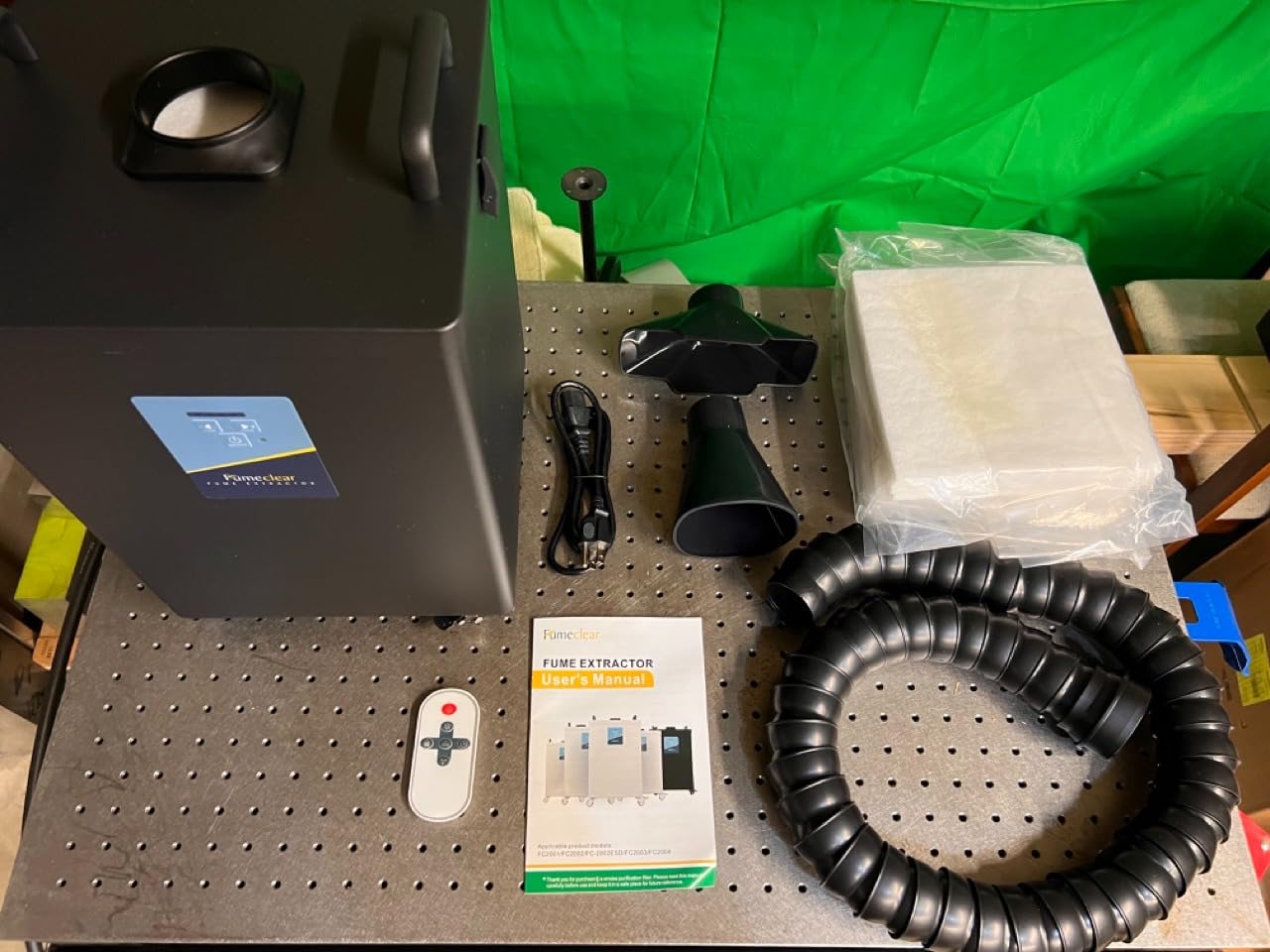
- Ten replacement pre-filters included
- Compact metal body with a small footprint
- Outdoor vent accessory ties you to a fixed setup
- 27 lb weight limits repositioning around a mobile laser
This is the unit we would put in a garage with no exterior wall access and no appetite for ducting. At 260 m3/h, or 153 CFM, it sits in the middle of the range and handles a 20W to 40W CO2 laser cutting job without the hood losing the plume mid-cut. Capture is rated within 15 cm of the hood head, so the arm placement matters more than people expect.
The stack is three stages: pre-filter, HEPA, then a high-iodine coconut shell carbon main filter rated at up to 4000 hours of service life. That carbon figure is the number to look at, because coconut shell grades differ enormously and a low-iodine bed is what makes a cheap unit smell clean for two weeks and then give up. Purification is claimed at 99.97 percent for particles below 0.3 microns.
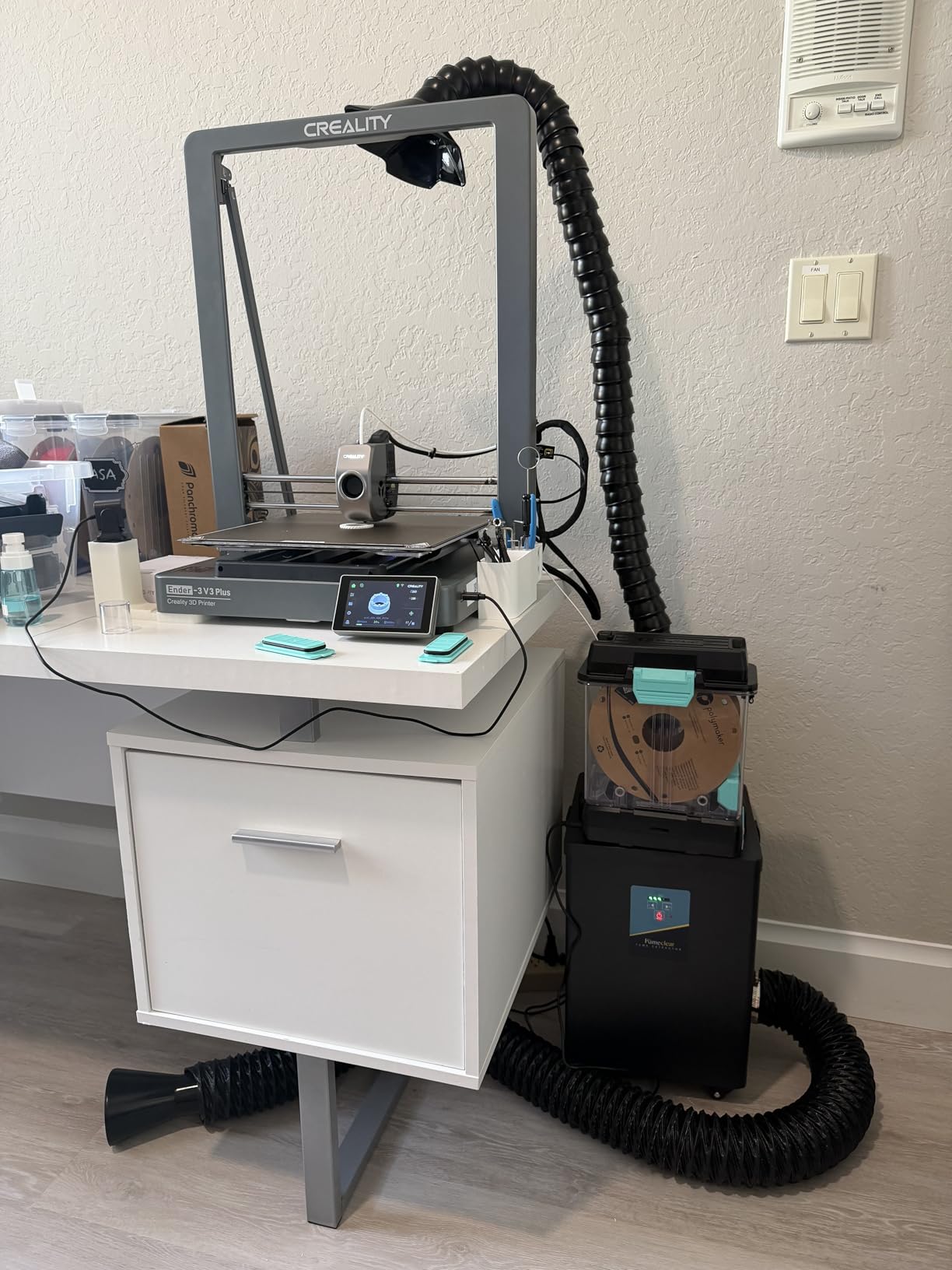
Buyers consistently call it quiet for its airflow class. The noise control is deliberate: an aerospace-grade coating plus sound-absorbing sponge, published under 55 dB. In a small hard-walled garage you will hear it more than the datasheet suggests, but it stays under conversation level at medium settings, and the mid and low speeds deliver most of the useful capture.
Ten replacement pre-filters ship in the box, which is generous, and the unit is metal rather than ABS so it tolerates the temperature swings of an unheated space better than most. It is CE, FCC, ROHS and UKCA certified and runs on 110 volts, which matters in a garage where you are sharing circuits.
Where the 15 cm capture window changes your setup?
Get the hood close. A 153 CFM unit that is six inches from the plume captures far more than the same unit parked across the bench. Plan the arm position around your machine lid opening before you commit to a spot, because this cabinet is heavy at 27 lb and not something you want to shuffle every job.
Check the vent accessory situation early. This unit is sold with an outdoor vent option, which matters if your garage ever houses a machine that has to handle chlorine-containing plastics. It fixes the unit in one place and adds a hose run to your plan.
Where it falls short?
It is not a fiber laser cabinet. If you move to 60W or 100W fiber marking, you will outgrow 260 m3/h quickly and the higher-flow options further down handle that workload with room to spare. The 27 lb weight is also a real constraint if your laser lives on a rolling cart.
Its dimensions are 15.35 by 16.54 by 15.75 inches, so it sits in roughly the footprint of a small laundry hamper. That footprint is one of its quiet strengths in a garage, where floor space is usually spoken for by a car, a bench and a dust collector.
3. Genmitsu 5-Layer Smoke Purifier – Best Budget Pick for a Small Desktop Engraver
- Compact enough to perch beside a small desktop engraver
- Strong suction for its size on visible smoke
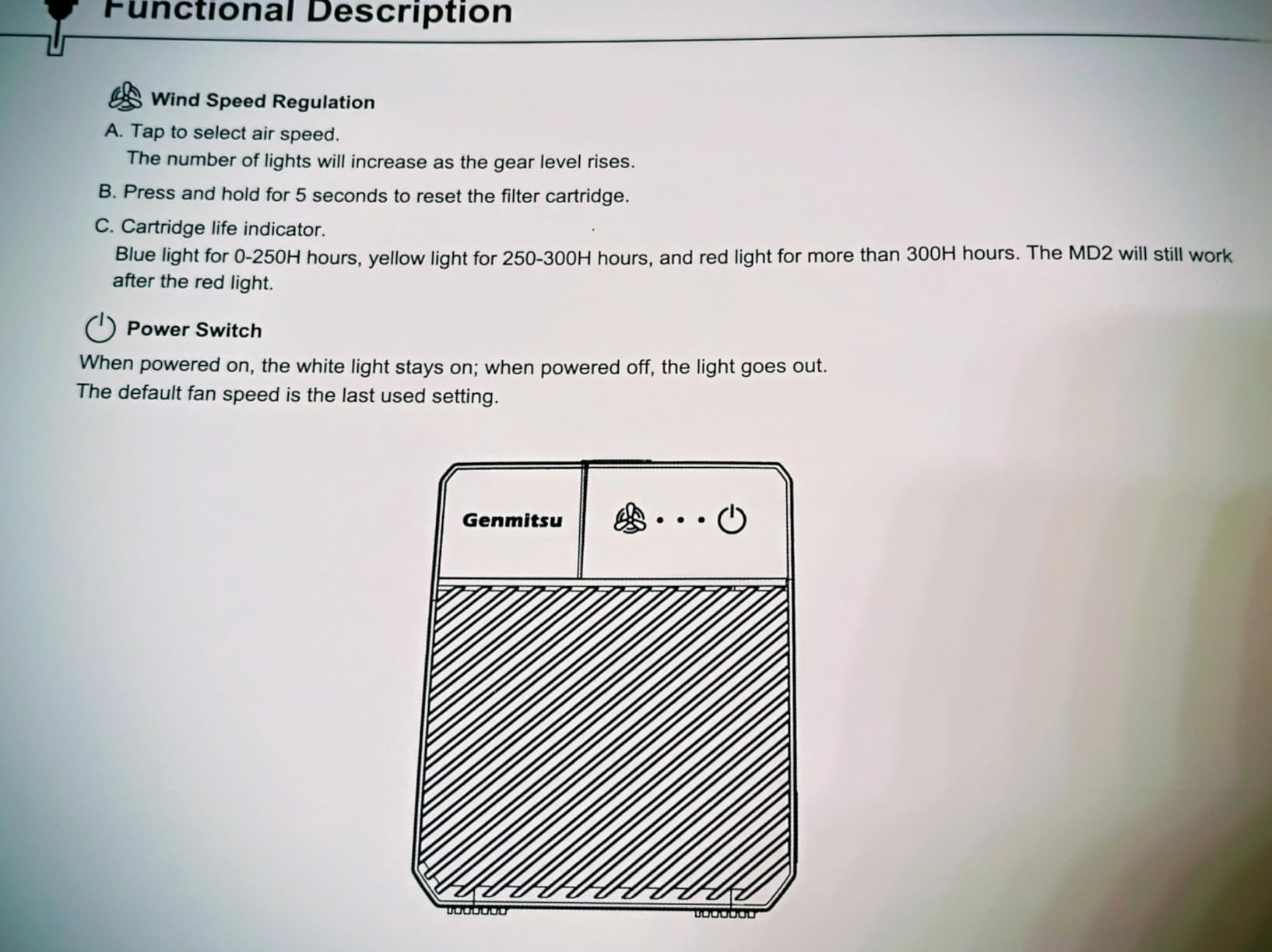
- Three-speed button control with a filter status indicator
- Expandable hose reaches roughly 3 ft with adapters for 2.5 and 3 inch hose
- Light at 1.8 kg so it moves easily between benches
- Does not fully neutralise strong leather and plastic odours
- Little or no airflow reported with the filter installed
- Hose fitting is tight and awkward by hand
- Performance drops on higher-capacity machines
Not every garage machine needs a cabinet. If you own a 10 to 20W diode engraver and cut thin plywood or acrylic, this 5-layer unit at 1.8 kg handles the smoke without taking over the corner of the bench. The footprint is small enough that it sits next to the machine rather than under a table, which matters when you are already out of floor space.
Three fan speeds and a filter status indicator with a reset function are the features that actually earn their keep. Most owners find the low or middle setting is the right one, and running it below maximum extends filter life while cutting noise on a bench you sit next to.
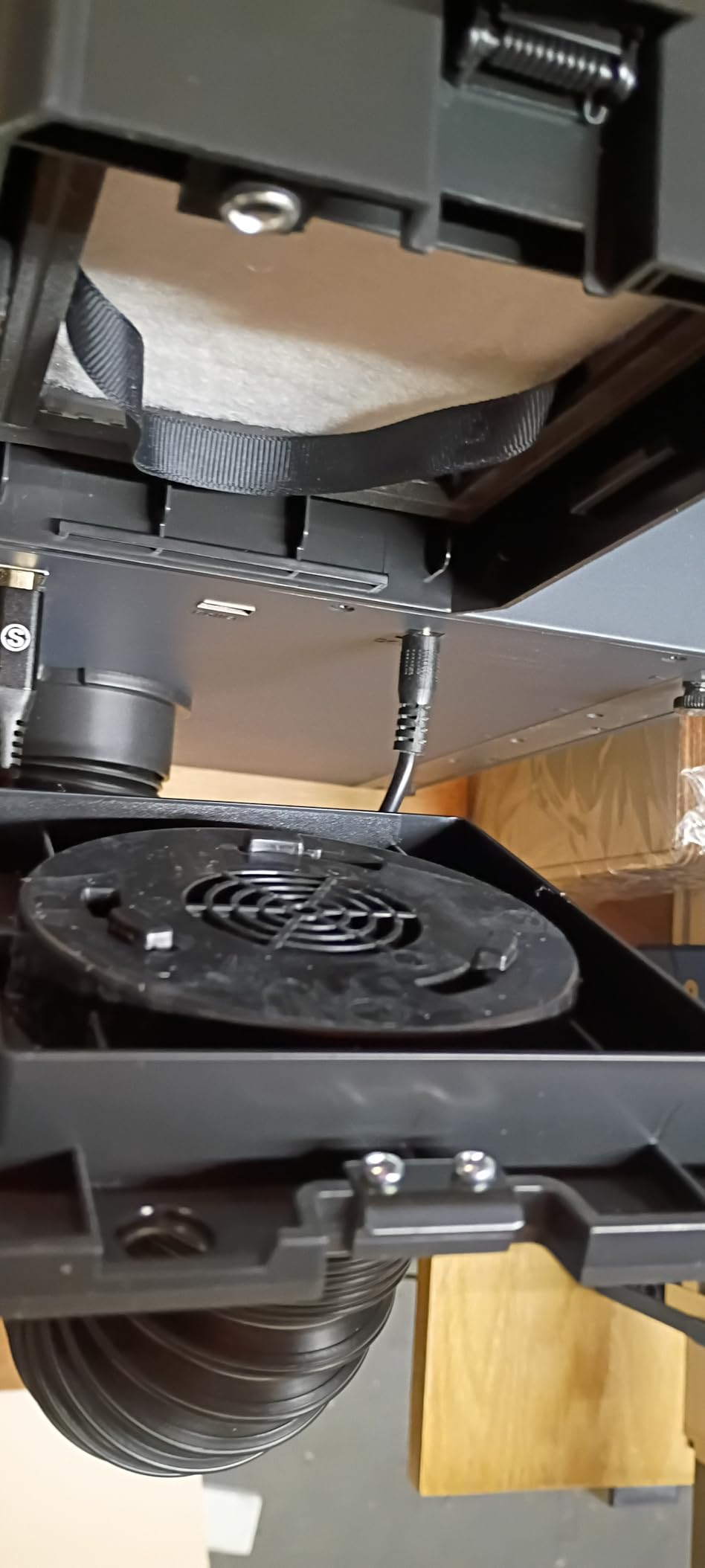
The hose expands to roughly 3 feet and includes adapters for 2.5 inch and 3 inch OD shop vac hose, which covers most desktop machines. It is listed as compatible with Kiosk and Kintix machines, and owners also connect it to xTool M2. The wall-wart power supply keeps the only cable on your bench short, which is a small thing that matters in a cluttered garage.
Be realistic about the limits. This is not a machine for leather, and several reviewers describe it as not fully neutralising strong chemical odours from leather and tougher plastics. A small number of owners also report negligible airflow with the filter fitted, so check suction on arrival rather than assuming. It is loudest on the highest setting, where it is also least useful.
Whether this is enough for your garage setup
Judge it against what you cut, not what you might cut. Engraving wood or thin acrylic on a small diode machine, this is genuinely sufficient. Moving to a 40W CO2 cutter that slices 6mm plywood, you will need something with real headroom, because visible smoke escaping the enclosure mid-cut is the sign you have underpowered it.
The 3-foot hose reach is generous for a desktop unit. Check your machine exhaust port diameter before ordering, because a mismatched port is the single most common reason these get returned.
Where it falls short?
Odor control is the honest weak point. It moves visible smoke well and neutralises light odours, but leather and pungent plastics come through, and in a garage with soft surfaces that residue is what you will keep noticing for months.
It is also a fixed-format unit with no outdoor vent path, so it is not a solution for anyone who intends to cut PVC or vinyl at any point. Keep that material out of the garage entirely rather than trying to make it work here.
4. FumeClear FC-2004 – Best Match for 20W and Up Cutting Jobs
FumeClear FC-2004 Fume Extractor For 20-80W P/S/M/F Laser Engraver & Cutter
- Suction visibly outruns the smoke it is capturing
- Handles heavy brass
- metal and fiber work
- Low and medium settings still give useful suction more quietly
- Small footprint with a freely rotating neck
- Uses standard 120mm filters and includes ten pre-filter cottons
- Loud on the highest setting
- Heavy at 52.9 lb
- Filters clog quickly on deep brass engraving
- Replacement filters are not sold through the Amazon listing
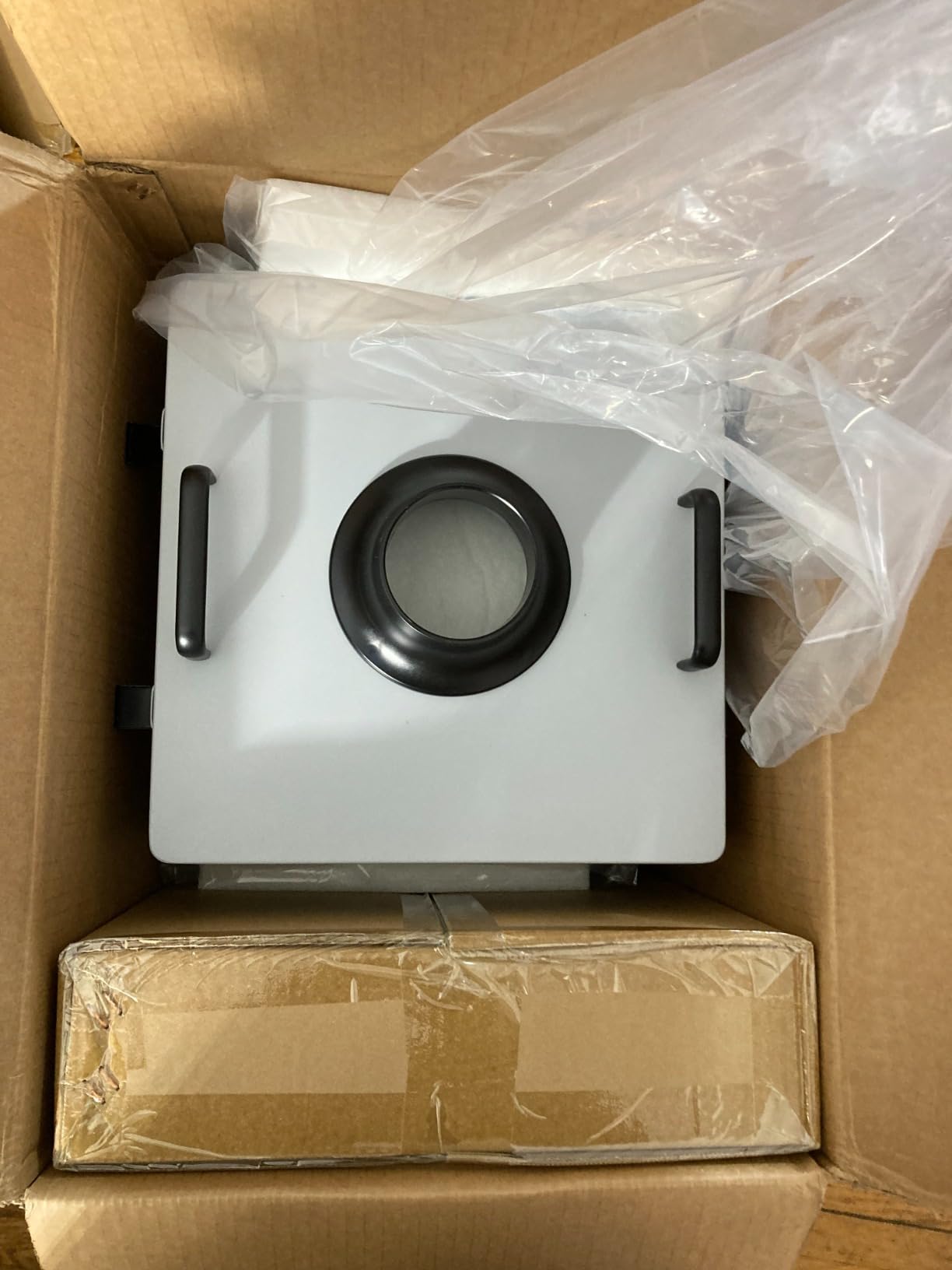
At 420 m3/h this is the highest-flow unit in the roundup and the one built specifically for cutting rather than engraving. The manufacturer states it is designed for machines above 20W, which is the number that matters if you have a 40W CO2 tube or a fiber marker. Multiple owners report it pulls smoke toward the duct faster than the laser produces it, which is the behaviour you want during a long cut.
Filtration is three layers with purification claimed at 99.98 percent for harmful gases and filtration below 0.2 microns. It uses standard 120mm filters, which is a meaningful detail: you are not locked into one proprietary cartridge size, and you can source replacements from more than one seller.
The practical caveat is noise on high. Several owners note that the low and medium settings deliver nearly the same useful suction far more quietly, so treat maximum as a short-term setting for extraction-heavy cuts rather than the default. The adjustable neck rotates freely, which helps you get the hood close without wrestling the unit.
Watch the filters on brass and other metal work. Deep engraving produces a volume of fine particulate that clogs pre-filters and then HEPA quickly, and owners of heavy brass jobs report frequent replacements as the main downside. Also check what arrives in the box; a few reviews mention units turning up without the hose, and resolving that early matters when you are setting up a fixed station.
Why raw airflow matters more for cutting?
Engraving produces a thin plume. Cutting produces a sustained one, and the capture hood has to win the race the whole way through the pass. That is why 420 m3/h here is a real functional difference from 260 m3/h rather than a spec-sheet upgrade: at cutting speeds the plume expands well beyond the 15 cm sweet spot and you need the headroom.
If your garage machine ever moves to a 60W or 100W fiber marker, this is the kind of capacity that gives you room to grow. The dimensions are 21 by 16.2 by 26.2 inches, so measure the bay before you plan the layout.
Where it falls short?
52.9 lb is heavy. It is a two-person move at best, and it needs a permanent footprint against a wall where it will not be bumped by a car door or a shop cart.
Replacement filters are not offered through the Amazon listing, so plan to source them elsewhere and check availability before you commit. For a light hobbyist this is overkill, and the noise at maximum will dominate a small garage.
5. KQZ KQZ-200 – Best Value for Lasers Under 60W
- Genuinely strong vacuum that draws metal particulate into the duct
- Quiet enough that the laser is the louder machine
- Handles wood
- plastic and acrylic effectively
- Steel casing with foam insulation and casters
- Twelve filter pieces plus round and square hoods included
- Some owners report suction fading within roughly six months
- Main filter cartridges are pricey
- Limited direct troubleshooting support
- Heavy 48 lb cabinet-style build
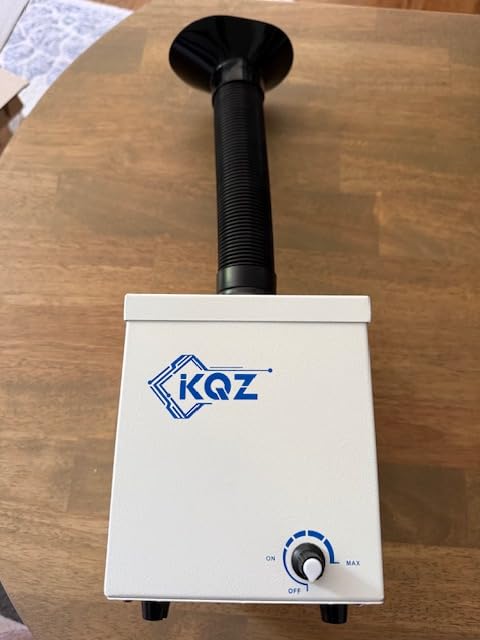
The KQZ-200 sits in the middle of this roundup and punches above its weight on two things garages care about: airflow and acoustics. A 210W brushless motor moves 330 m3/h, and the published noise figure is under 50 dB thanks to an aviation-grade sound-absorbing shell. Owners report the laser being louder than the extractor, which is the clearest practical noise benchmark we found.
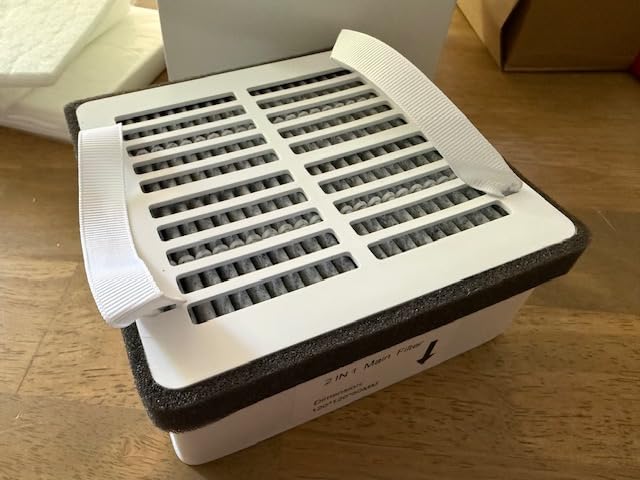
Filtration is three stages capturing 0.3 micron particles at 99.97 percent efficiency, with high-iodine coconut shell carbon for odour. The box includes twelve filter pieces, a bamboo tube, a hose, and both round and square hoods, which is a generous starter kit compared with most competitors.
Compatibility is broad. It is listed for xTool P2S, S1, F1, F1 Ultra, F2, F2 Ultra UV, M1 and M2, plus other lasers under 60W, and owners also use it for soldering, 3D printing, DTF printing and salon work. Several long-term owners say it replaced window venting entirely and stopped smoke alarms from triggering during brass and acrylic jobs, which is exactly the garage outcome we want.
Two things to check. First, the listing specifies 220 volts AC, so confirm the plug and voltage configuration for your garage circuit before ordering. Second, some owners report suction fading after roughly six months of light use even after filter changes, and main filter cartridges are pricey, so factor a replacement into your first-year budget.
Getting the quiet performance people report
The under-50 dB figure is a published lab number, and buyers measuring at the highest setting report closer to 68 dB in practice. Run it on the middle speed for engraving and only step up for cutting passes. On wood and acrylic the middle setting is usually indistinguishable at the hood, and the difference in noise at your ear is large.
Place it away from the hard wall behind your head. Foam insulation inside the shell handles motor noise, but room reflections off bare drywall and concrete are what actually reach you when you are sitting at a bench. A few feet of clearance and rubber casters make more difference than any spec number.
Where it falls short?
The durability reports are worth taking seriously. Multiple reviews describe suction dropping off after several months of light use, and while one owner had the manufacturer replace the unit, that is not a guarantee you should plan around. Support access is also more limited than the larger brands.
At 48 lb it is a cabinet, not a portable unit, and the filter cost will matter more to you than to someone who only cuts acrylic once a month.
6. VEVOR 165 CFM Solder Fume Extractor – Best for a Shared Repair Bench
VEVOR Solder Fume Extractor, 150W 165CFM Soldering Smoke Extractor with 3-Stage Filters, 3 Speed Adjustable Smoke Absorber and Purifier for Soldering, Engraving, DIY Welding, Salon
- Pulls fumes and fine metal particulate effectively even on low speed
- Two flexible arms position the head close to the work
- All-metal build with four wheels and two locking casters
- Compact footprint
- Large accessible filters that are easy to change
- Replacement cartridges are hard to source and cost nearly as much as the unit
- Controls sit at the bottom so you must bend down
- No handle for repositioning
- Does not filter VOCs from silver plating or flux
Most garages eventually become a mixed bench. This unit is built for soldering but the capture performance carries over to engraving and light repair work, and the two flexible gooseneck arms are what make it adaptable. You can point one head at a hot joint and one at a small engraving without repositioning the body.
The 150W brushless motor is rated up to 4500 RPM for 165 CFM, with a claimed 99.91 percent smoke purification rate. The pleated filter design expands the filtration area to 2.1 square metres, which is a large surface for a unit in this class and translates into less frequent changes during steady bench work.
The body is sheet metal with a powder coating, it stands about 10.5 by 10.5 by 18 inches, and it sits on four wheels with two locking casters. That footprint is roughly the size of an A4 sheet, so it fits between a bench and a wall without taking floor space. Published noise is below 63 dB across three speed settings.
The honest problem is consumables. Multiple reviews report that replacement filter cartridges are not sold through normal channels and cost close to what the unit itself costs, which makes the running economics poor for anyone doing heavy daily work. The controls are also mounted low, so if the body sits on the floor you are crouching to change speed.
When a shared bench is the real use case?
If your garage time is split between soldering, small engraving and repair, the flexible arms justify themselves quickly. One head stays parked on your engraver exhaust and the other handles whatever is on the bench, and the large accessible filter means a swap takes under a minute.
For a dedicated cutting setup, look elsewhere. At 165 CFM there is limited headroom for a sustained cut plume, and this unit has no carbon stage rated for the VOC load that metal and plastic work produces.
Where it falls short?
The filter sourcing is the dealbreaker for high-hours users. If you cannot find cartridges for this model through ordinary sellers, a unit with widely available filters is a better long-term purchase even at a higher sticker price.
It also does not handle VOCs from silver plating or flux, so treat it as a particulate and light-odour solution rather than a chemical one. And with no handle, moving it 20 feet across the garage is a two-handed operation.
7. ATOMSTACK D3 – Best for a Tiny Desktop Engraver in a Cold Garage
- Compact cube that fits under or beside a desktop engraver
- Multi-layer HEPA and carbon targets particles and gases
- Tool-free modular filter replacement is straightforward
- Rated for a wide temperature range including unheated garages
- Light at 12 lb
- Lower airflow class limits it to smaller engravers
- Replacement filters sold as a separate variant rather than bundled
- About 16 percent one-star reviews point to inconsistent results
This is the smallest dedicated laser unit here and the only one with a published operating temperature range down to -20C, which is genuinely relevant if your garage is unheated from October through March. Consumer electronics without a cold rating is a common source of early failures, and a rated range removes that variable.
The filter is a multi-layer composite: pre-filter, HEPA and activated carbon, with claimed efficiency up to 99.97 percent. It captures PM2.5 and PM10 particulate and is stated to absorb formaldehyde and TVOCs. Outlet velocity reaches up to 10 m/s through a standard 80 mm exhaust port, and power comes from a 12V DC supply rated at 3A, so it is safe to run off a low-voltage rail near your machine.
Filter life is given as roughly 3 to 6 months at 3 hours per day, or about 200 hours per cycle, and replacement is tool-free and modular. That is a simple maintenance story, which is more than you can say for units with sealed filter doors. The cube measures under 4 inches on each side and weighs 12 lb.
It is purpose-built for laser engraving systems and listed as compatible with ATOMSTACK P1, Atelier and Kraft models. Be realistic about the ceiling: this is a lower airflow class, and about 16 percent of reviews are one-star, mostly from people expecting extraction power of a full cabinet. It is not a cutting solution.
Why the temperature rating matters in a garage?
Cold affects more than comfort. Condensation forms on a cold coil in an unheated space, and a filter media that is damp loses adsorption capacity and can shed dust into the room. A published -20C to 40C range up to 60 percent relative humidity means this unit is specified for exactly the conditions most garage machines run in.
Pair that with the 12V low-voltage supply and you have a unit that is comfortable in a cold bay. Just confirm the outlet velocity is adequate for your cut: it is engineered for engraving and light work on small desktop machines.
Where it falls short?
Replacement filters are sold as a separate variant rather than bundled generously, so budget for a first spare. And the mixed review distribution tells you what to expect: it does what it is designed for, and people hoping for a cabinet-class result feel shortchanged.
If you already know you will grow into cutting thicker stock, spend the extra now on a cabinet. Upgrading from a small unit later means buying both, so this is only the right call if the desktop engraver is where you are staying.
8. FumeClear FC-2003 – Best for Two Machines Sharing One Extractor
FumeClear FC-2003 Dual Ports Fume Extractor for Remote Control Low-Noise
- Dual ports let two machines or stations share one unit
- Highest average rating in this roundup at 4.8 stars
- Long-lived high-iodine carbon main filter
- Remote control when the unit is out of reach
- Per-inlet suction drops to 165 m3/h with both ports in use
- Small review base of 14 ratings so durability is not established
- Heavy 42 lb cabinet build
If you run two machines, buying two extractors is usually the expensive answer. The dual-inlet design here solves it in one cabinet: two air inlets working at the same time, rated at 330 m3/h on a single inlet and 165 m3/h when both are open, with capture within 15 cm of each hood.
That halved figure is the part to think about carefully. Running one 40W CO2 cutter and one small diode engraver at full tilt together gives each port 165 m3/h, which is adequate for engraving on the second machine and marginal for a sustained cut on the first. For intermittent use across two stations, it works well. For two simultaneous cutting jobs, it does not.
Filtration is three layers with 99.97 percent claimed purification below 0.3 microns and ten pre-filter cottons included. The carbon main filter is rated 2000 to 4000 hours, a narrower band than some competitors, and the remote control is a small quality-of-life win when the cabinet is across the room from your hands on the machine.
The honest caveat is evidence. This carries a 4.8 average from 14 ratings, with no ratings below three stars, which is the strongest rating profile in the roundup but also the thinnest sample. Weight is 42 lb, and it is a cabinet rather than a portable unit.
When one cabinet for two machines actually makes sense?
The maths works when your two machines do not run heavy cutting at the same time. A diode engraver running acrylic signage all week alongside a CO2 cutter doing occasional jobs is the ideal case: the dual ports share the filter stack, share the footprint, and share the single point of maintenance.
Multi-machine shops and assembly-line setups are the other clear fit. Just verify the port split before you commit, and remember that capture distance is still 15 cm from each hood, so both machines need to sit close to the cabinet.
Where it falls short?
Fourteen ratings tell you very little about what happens at month 18. The carbon and motor designs are proven in the brand’s other models, but we would want a longer record before depending on it for daily production work.
And if both machines cut heavy material simultaneously, the 165 m3/h per port is the limit that will show up first. Splitting into two dedicated cabinets costs more upfront but removes the ceiling.
9. BlazeX MD2 – Best for xTool M3 and M2 Pro Owners
BlazeX Air Purifier for M3 & M2 Pro Laser Engraver, 3-Stage Filtration Fume Extractor with HEPA & Active Carbon Filter, High-Efficiency Dust & Odor Removal for Indoor Laser Cutting and Engraving
- Compact and light at under 3 lb
- easy to move around a bench
- Brushless motor runs quietly enough for a home studio
- HEPA plus active carbon targets dust and odour
- Tool-free filter replacement
- Designed around one engraver ecosystem rather than universal fit
- Small unit limits it to lighter desktop workloads
- Thin review base of 17 ratings
This is the narrowest recommendation in the roundup and we think it is worth making anyway. If your garage machine is an xTool M3 or M2 Pro, this unit is built around it, measures 7.48 by 4.92 by 6.1 inches, and weighs 2.65 lb, so it lives on the machine rather than beside the garage.
Filtration is three stages with HEPA and active carbon, with claimed 99.97 percent capture of exhaust gases from acrylic engraving and wood cutting. The brushless motor provides suction at low noise output, and filter replacement is tool-free. Owners consistently mention the quiet operation as the standout for a shared room.
It sits at 4.4 stars across 17 ratings with 82 percent five-star, which is a positive sample but a small one. Two of the 17 are one-star, and the theme in the reviews is simple: people happy with it own the targeted machines and use it for engraving and light cutting.
Buying it for anything else means paying for an ecosystem-specific design and accepting a smaller unit than a general-purpose extractor of similar price. Check your machine model before you look at anything else on this list.
Matching the extractor to the machine you already own
The advantage is directness. A purpose-fit unit placed within inches of the machine exhaust captures more of the plume than a general cabinet parked on the other side of the bench, because capture distance matters more than any spec number. At under 3 lb you can reposition it whenever you move the machine.
If your garage machine is not an M3 or M2 Pro, skip this section and read the broader picks instead. The fit advantage only exists for those two machines.
Where it falls short?
It is limited to lighter desktop workloads. There is no airflow class here that would carry a sustained cut plume from a thicker material, and there is no outdoor vent path for any material you might regret cutting.
Seventeen ratings is not enough to make a durability judgment, and two one-star reviews are worth a second look if you are committing a larger budget. Treat this as a purpose-fit accessory rather than the primary safety system for a garage workshop.
10. Zericuf XBY180-1 – Best for Quiet Operation and a Long Warranty
- Stepless speed control lets you dial in exact suction rather than fixed steps
- Quiet even at full speed and easy to talk over
- 320 m3/h handles fiber laser and 3D printer workloads
- Articulated arm holds position without droop
- Four casters with front brakes
- Downward rear exhaust keeps hot air off the bench
- Replacement cartridges were not yet available from the seller at review time
- One unit arrived dead on arrival with the fan never spinning
- Heavy filter consumption on deep embossing work
- 22 lb all-metal body is heavy to move by hand
The distinguishing feature here is stepless speed control. Almost every competitor offers three fixed steps; this one uses a continuous knob, so you can hold the arm 10 cm from the plume instead of overshooting to the next speed. Owners who run mixed work find that far less annoying than the discrete settings on other cabinets.
Airflow is 320 m3/h from a 180W brushless pure copper motor, inside a soundproof chamber with acoustic and damping foam rated below 58 dB. One 60W MOPA fiber owner reports it pulling in more than expected at conversational noise, which is the most demanding use case we saw tested on a unit this size.
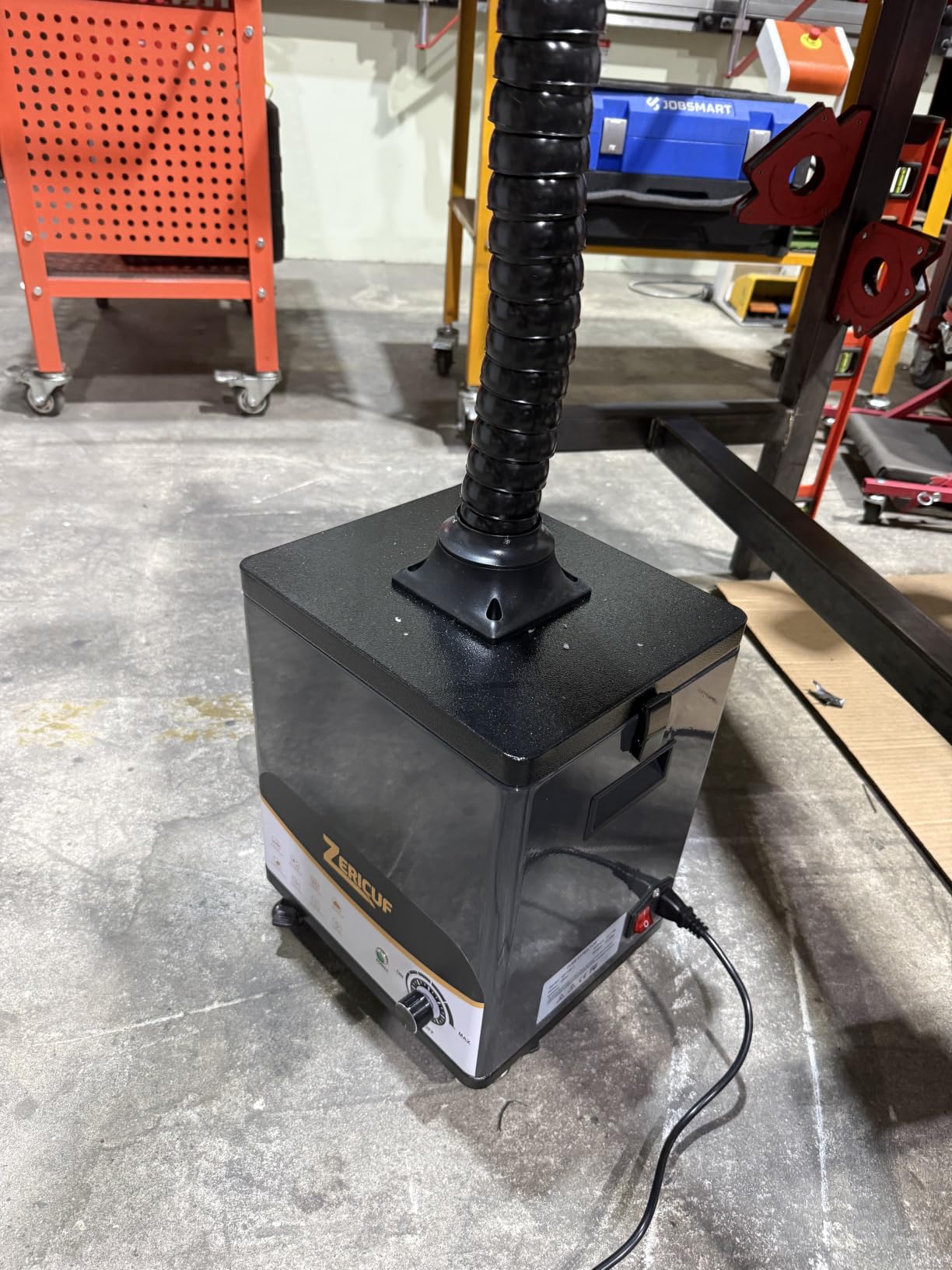
Filtration is three stages: ten double-thickness pre-filter sponges, True H13 HEPA claimed at 99.997 percent for 0.3 micron particles, and high-iodine activated carbon rated 800 to 900 mg/g. A smart buzzer alerts you to a clog before airflow collapses, and the chassis is all metal with a 5-year warranty, the longest coverage in this roundup.
The downward-sloping rear exhaust is a detail we did not expect to care about and then did. It keeps hot exhaust air off your bench surface instead of blowing it at your workpiece. Watch filter consumption on deep embossing, which reviewers flag as heavy, and confirm cartridge availability before buying given the feedback about replacements not yet being listed.
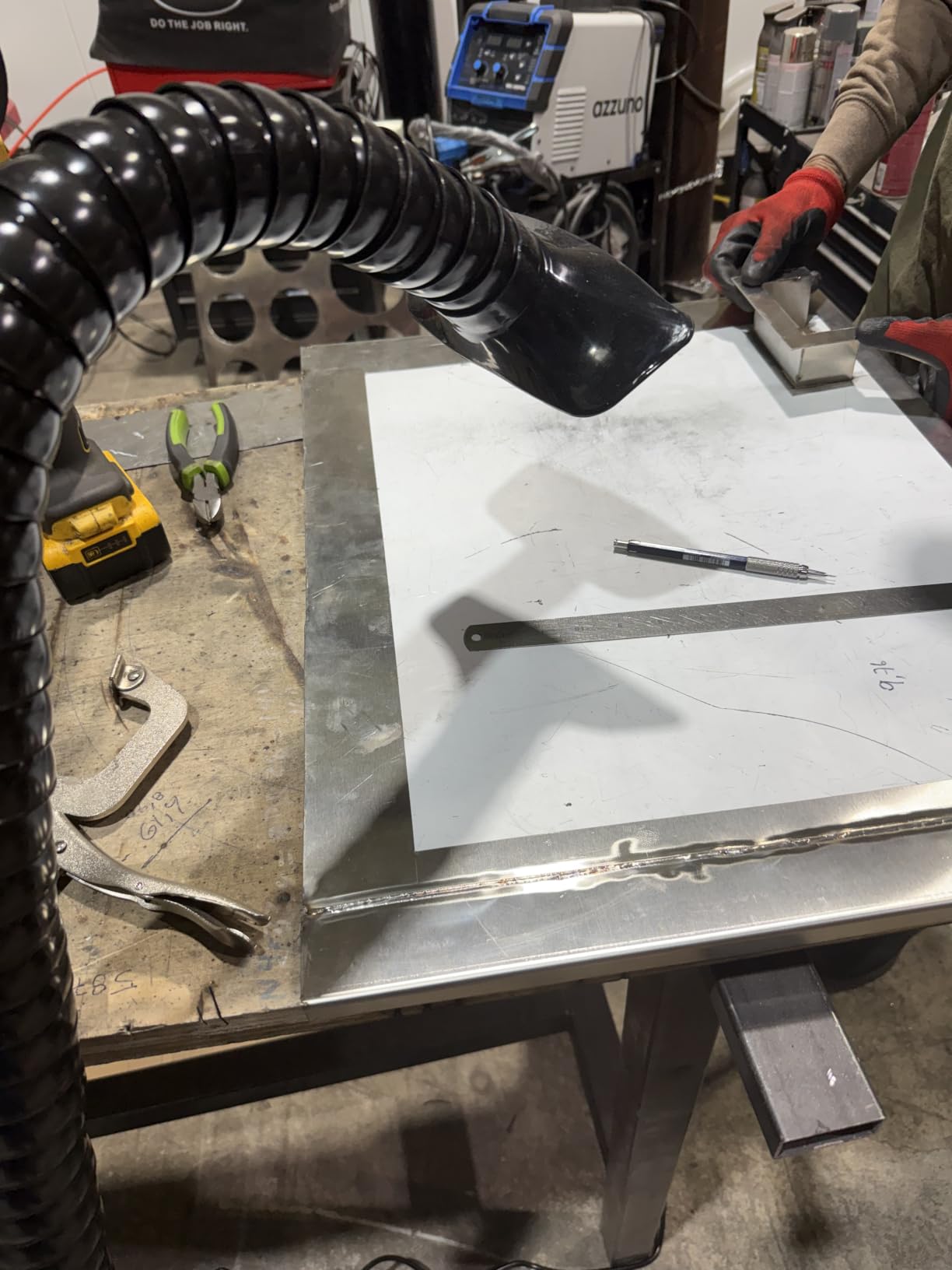
Why quiet matters more in a garage than in a shop?
A garage has no acoustic treatment and usually has a hard concrete floor, so published dB figures understate what reaches your ear. What you actually notice is whether you can hold a conversation next to a two-hour job. Damping foam inside the chamber plus a continuous knob that lets you run at the minimum effective speed is the combination that solves that.
The 360-degree articulated arm holds position without droop, and four swivel casters with front brakes mean you can pull it to a different machine without it rolling away mid-job. At 22 lb it is still a two-handed move.
Where it falls short?
Filter availability is the open question. Several reviews note the replacement cartridges were still forthcoming and that buying them depended on the seller responding, though that support was widely praised when it did. Confirm the part is listed before you commit.
One unit also arrived dead on arrival with the power indicator lit and the fan never spinning, so test it immediately on receipt. The 5-year warranty is the safety net, but the sample of 19 ratings is not large enough to lean on it heavily.
How Many CFM Does a Laser Engraver Need?
Budget 100 to 150 CFM for a 5W to 20W diode engraver, 150 to 200 CFM for a 20W to 40W CO2 laser, and 200 CFM or more for a 60W to 100W fiber laser. Engraving needs roughly half the airflow of cutting the same material, because the plume is thinner and travels a shorter distance before it disperses.
The sizing logic behind those numbers is simple. A capture hood works well within about 15 cm of the plume, so your job is to move enough air through that zone to win the race against the smoke being produced. Cutting a 6mm plywood sheet on a 40W tube produces a plume that expands well past the sweet spot, which is where underpowered extraction shows up as visible smoke escaping the enclosure mid-pass.
Match by laser type like this:
5W to 20W diode, engraving wood or acrylic: 100 to 150 CFM (170 to 255 m3/h). Small desktop units with a short hose work here.
20W to 40W CO2, engraving: 150 to 200 CFM (255 to 340 m3/h).
20W to 40W CO2, cutting wood or acrylic: 200 CFM or more (340 m3/h or more). Look for a hood capture rating and a carbon stage rated in thousands of hours.
60W to 100W fiber, marking metal: 200 CFM or more (340 m3/h or more). Metal particulate is fine and fast-loading, so pre-filter capacity matters as much as airflow.
Two machines sharing one cabinet: check the per-port figure, not the headline number. Dual-inlet units halve airflow when both ports are open.
Brands report airflow inconsistently, which is why comparisons get confusing. Some list CFM, others list cubic meters per hour, and the numbers are not equally generous. For reference, 1 CFM is about 1.7 m3/h, so 153 CFM is roughly 260 m3/h. When a listing gives you one unit, convert it to the other before comparing anything.
Finally, treat the published figure as airflow at the hood, not as room ventilation. A 153 CFM extractor does not clear a 1,200 cubic foot garage on its own, and it does not need to. It captures the plume, and the room air takes care of itself as long as you have a way to bring in replacement air.
What the Filtration Specs Actually Mean?
A three-stage stack of pre-filter, HEPA and activated carbon is the minimum worth buying for a garage, and the order matters. The pre-filter catches bulk debris and protects the layers below it, the HEPA traps fine particulate down to 0.3 microns, and the carbon adsorbs gases and odour. Remove any one of the three and you have a gap that shows up as either dust on your cabinets or a smell that never goes away.
The HEPA claim to check is 99.97 percent at 0.3 microns, which is the standard grading figure. A couple of the cabinets here claim slightly better at a smaller particle size, but the difference in practice is negligible compared to getting the carbon stage right.
Carbon is where cheap units fail. The relevant number is the iodine value in milligrams per gram, and the high-iodine grades used here run in the 800 to 900 mg/g range or are described as high-iodine coconut shell. Low-grade carbon saturates fast, and a saturated bed passes odour straight through while still trapping particles, which is why a unit can look like it is working while the room still smells like burnt plywood.
Two more specs worth understanding. Cyclone pre-separation, marketed under names like SuperCyclone, spins larger particles out of the airstream before they reach the filter media, which is why that design shows markedly better filter longevity on MDF and plywood. And negative pressure, measured in pascals, describes suction at the hood, which is a different number from airflow and is not interchangeable with it.
Filtration effectiveness is high but not permanent. Particle capture depends on the media holding up; odour capture depends on the carbon having unused adsorption capacity. That is why every unit here rates filter life in hours, and why a running hours log tells you more than any single spec.
Setting Up Extraction in a Garage
Measure your bay before you buy, then work out how much make-up air you have. A typical two-car garage is around 1,200 cubic feet. Air entering the room has to come from somewhere, and in most garages it comes through the gap under the garage door, a gap of roughly 8 to 10 square inches. That is enough for a small extractor with a short duct run and marginal for a 300 m3/h cabinet running continuously.
Open the garage door partway during long cutting sessions and the problem solves itself. If you plan to run extraction with the door closed, budget for a make-up air inlet on the opposite wall or a transfer duct, otherwise you will measure low airflow and blame the unit. An extractor pulling from an unventilated room is not doing its rated job no matter what the datasheet says.
Plan for cold. Motors and bearings are fine down to reasonable temperatures, but the real cold-weather issue is condensation on a cold filter bed, and the most reliable fix is simply to let the unit run at low speed for a few minutes before the first job. Units with a published temperature range, like the ATOMSTACK D3 rated down to -20C, remove that guesswork entirely.
Watch the circuit. Laser cutters, extractors and a shop vacuum on one 120V outlet is a common garage mistake, and a compressor kicking in at the wrong moment causes exactly the brownouts that kill control boards. Give the extractor its own circuit if you can, and confirm voltage compatibility: most of these run on 110 or 120 volts, but at least one listing here specifies 220 volts AC.
Acoustics deserve their own paragraph because published decibel figures are measured under lab conditions. A small garage with bare drywall, a concrete floor and a metal garage door reflects sound, and several owners measuring these units in real rooms report figures noticeably above the published number. Three things help: keep the extractor away from the wall behind your head, run the lowest speed that clears the plume, and use the casters or rubber feet so vibration does not travel through the frame.
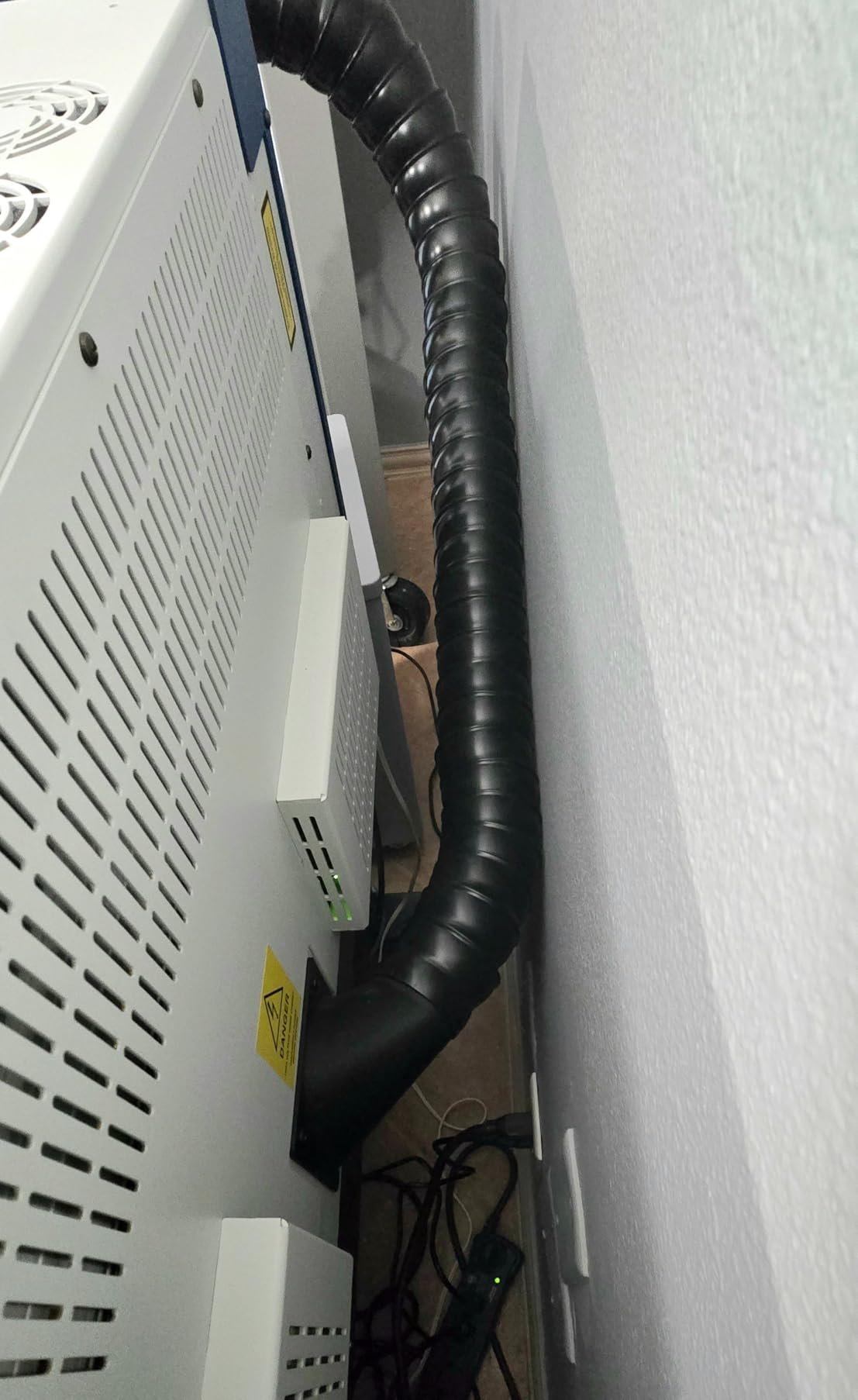
Check exhaust port diameter before you order. Included hoses frequently do not match the port on the machine, and forcing an adapter is a common reason these get returned. Measure the machine port, confirm the hose length will reach from the hood to the unit without a sharp bend, and only then commit to a cabinet position.
Finally, think about where the exhaust goes if you ever cut PVC. Any unit with a vent outlet can be ducted outdoors through a 3 or 4 inch port. A recirculating-only unit cannot, and that is a hard limit rather than a preference. If your garage is an enclosed space with no exterior wall access, plan the garage layout around that constraint early rather than retrofitting later.
While you are planning the bay, our pegboard systems for garages guide covers tool storage above a bench, which is where a lot of people end up putting the extractor when floor space runs out. Just keep the intake clear.
Materials You Should Never Cut With Recirculation
PVC, vinyl and vinyl-clad MDF should never be cut in a recirculating setup, full stop. When a laser vaporises chlorine-containing plastic it releases hydrogen chloride gas along with fine particulate. A HEPA filter traps the particulate completely and does nothing whatsoever for the gas, which means the fumes reach your garage, your cabinets and your lungs with the filter working perfectly.
Vinyl-clad MDF is the trap most people fall into. The board looks and mills like standard MDF, but the melamine or vinyl facing is a plastic skin and the cut edge exposes it. If you have ever had a board labelled MDF without knowing its cladding, treat it as unsafe to cut without outdoor exhaust.
Unknown plastics are the same problem with less information. If you cannot identify a material, do not laser it in an enclosed space. Keep a small labelled bin of known-safe stock and treat anything unlabelled as a future outdoor-vent job.
For everything else, the guidance is simpler: wood, acrylic, cardboard, leather, paper and most metals are fine in a filtered recirculating setup, with leather and some plastics producing the strongest odours that the carbon stage has to work hardest on. Acrylic is worth singling out as the friendliest: it cuts clean, produces less particulate than wood, and does not load the filters nearly as fast.
Wood is the opposite. MDF and plywood are called out repeatedly in buyer reviews as the fastest filter-clogging materials, and repeated plywood jobs are what push people from a small unit to a cabinet. If plywood is your primary material, buy for filtration capacity rather than airflow alone.
Filter Costs and Long-Run Ownership
The running cost of a fume extractor is the filter, not the machine, and proprietary cartridges are where people get caught. Two units in this roundup have the replacement filter problem called out as the dominant complaint: one where cartridges are sold only through the manufacturer, and another where replacements were hard to source and cost close to the price of the unit itself. Both turn a reasonable purchase into a poor one within a year of daily use.
What to look for instead: a standard filter size, a named part number, and at least one seller stocking the replacement outside the brand’s own storefront. The FumeClear FC-2004’s use of standard 120mm filters is a good example of why that detail matters even when the unit itself is not your pick.
Filter life is quoted in hours, and the honest number depends entirely on material. Ratings here range from 100 to 600 hours per stage on a smart-monitoring unit, up to 4000 hours for a high-iodine carbon main filter, and about 200 hours per cycle on a compact unit rated for 3 hours of daily use. If you cut MDF or plywood daily, use the low end of those ranges when you plan your first year.
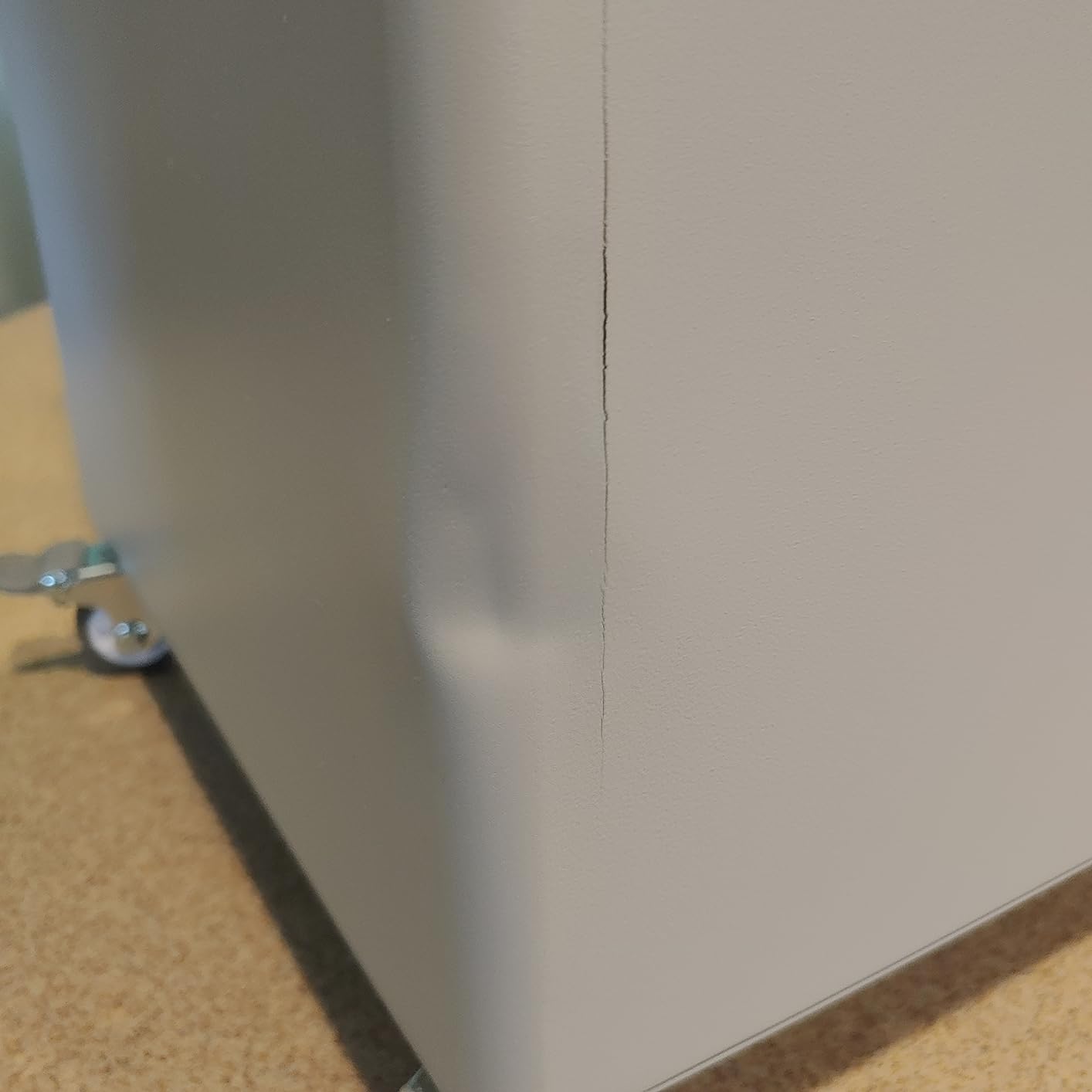
Check for physical damage on arrival. Across reviews of these models you will find mentions of units turning up without a hose, one unit arriving with the fan not spinning despite a lit power indicator, and mixed quality control on filters. Ten minutes of testing on arrival, before you mount anything permanently, avoids finding the problem a week later when you are mid-job.
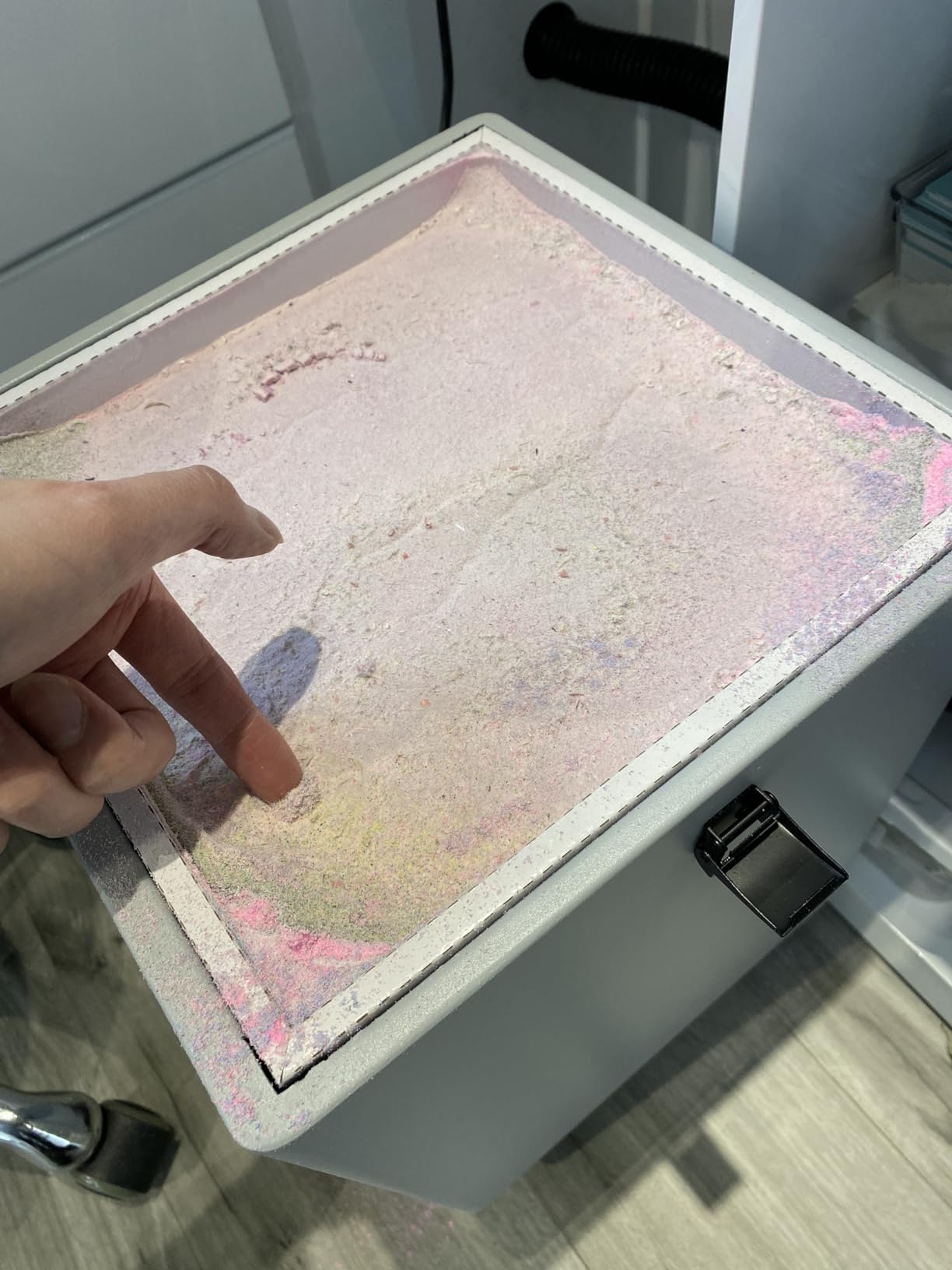
One more garage-specific maintenance note. Washable pre-filters and cyclone chambers should be rinsed on a schedule tied to your material, not to the calendar. A weekly check takes a minute, and a saturated pre-filter quietly reduces airflow across every stage behind it.
Frequently Asked Questions
What is the best fume extractor for a laser engraver?
For most garage setups the best fume extractor is one that moves 150 to 200 CFM, runs under 55 dB, and has a three-stage pre-filter, HEPA and activated carbon stack. That covers a 20W to 40W CO2 laser cutting wood or acrylic. Engraving on a small diode machine needs far less, around 100 to 150 CFM.
Can I run a laser engraver in a garage without drilling through a wall?
Yes, for wood, acrylic, leather, cardboard and metals, a recirculating filtered unit is fine and is what most garage owners use. The limits are that the room still needs make-up air, which usually comes through the garage door gap, and that PVC, vinyl and vinyl-clad MDF must never be cut without exhausting outdoors.
How many CFM do I need for a laser engraver?
Budget 100 to 150 CFM for a 5W to 20W diode engraver, 150 to 200 CFM for a 20W to 40W CO2 laser, and 200 CFM or more for a 60W to 100W fiber laser. Engraving needs about half the airflow of cutting the same material because the plume is thinner and disperses sooner.
How effective are fume extractors at removing laser fumes?
They are very effective on particulate and good on odour when the carbon stage has capacity left. A pre-filter, HEPA and activated carbon stack captures 99.97 percent of particles below 0.3 microns. They are not effective on chlorine gas from PVC or vinyl, which passes straight through any recirculating filter and requires outdoor exhaust.
How often do I need to replace the filters?
It depends on material more than time. Ratings in this roundup range from about 200 hours per cycle on a compact unit to up to 4000 hours for a high-iodine carbon main filter. MDF and plywood clog filters fastest, while acrylic is comparatively gentle. Track running hours rather than calendar months if you cut wood regularly.
Do I need a fume hood to laser cut metal?
You need effective source capture at the machine, but it does not have to be a dedicated fume hood. A cabinet extractor with a capture hood within about 15 cm of the cut handles metal marking and light cutting fine. Metal produces fine, fast-loading particulate, so pre-filter capacity matters as much as airflow.
Final Verdict for Garage Workshops in 2026
The xTool SafetyPro AP2 is our pick among the best laser engraver fume extractors for garages because the 6-layer SuperCyclone stack holds up on the materials that destroy cheap units, and the filter-life monitoring means you replace what is actually spent. If you do not run xTool hardware, the FumeClear FC-2002A gives you the most balanced garage setup: 153 CFM, three stages, under 55 dB and a carbon filter rated in thousands of hours. Go bigger with the FumeClear FC-2004 for 20W and up cutting, or the KQZ KQZ-200 for the best balance of airflow and quiet at 330 m3/h.
Whichever you choose, give it a permanent spot near the machine, keep the hood within 15 cm of the plume, run the lowest speed that clears the smoke, and keep PVC out of the garage entirely. Those four habits matter more than any spec on the list.
If you are still laying out the bay, our floor squeegee guide for garages is for cleanup after the resin and water-based jobs, and it pairs naturally with a solid extraction setup.