
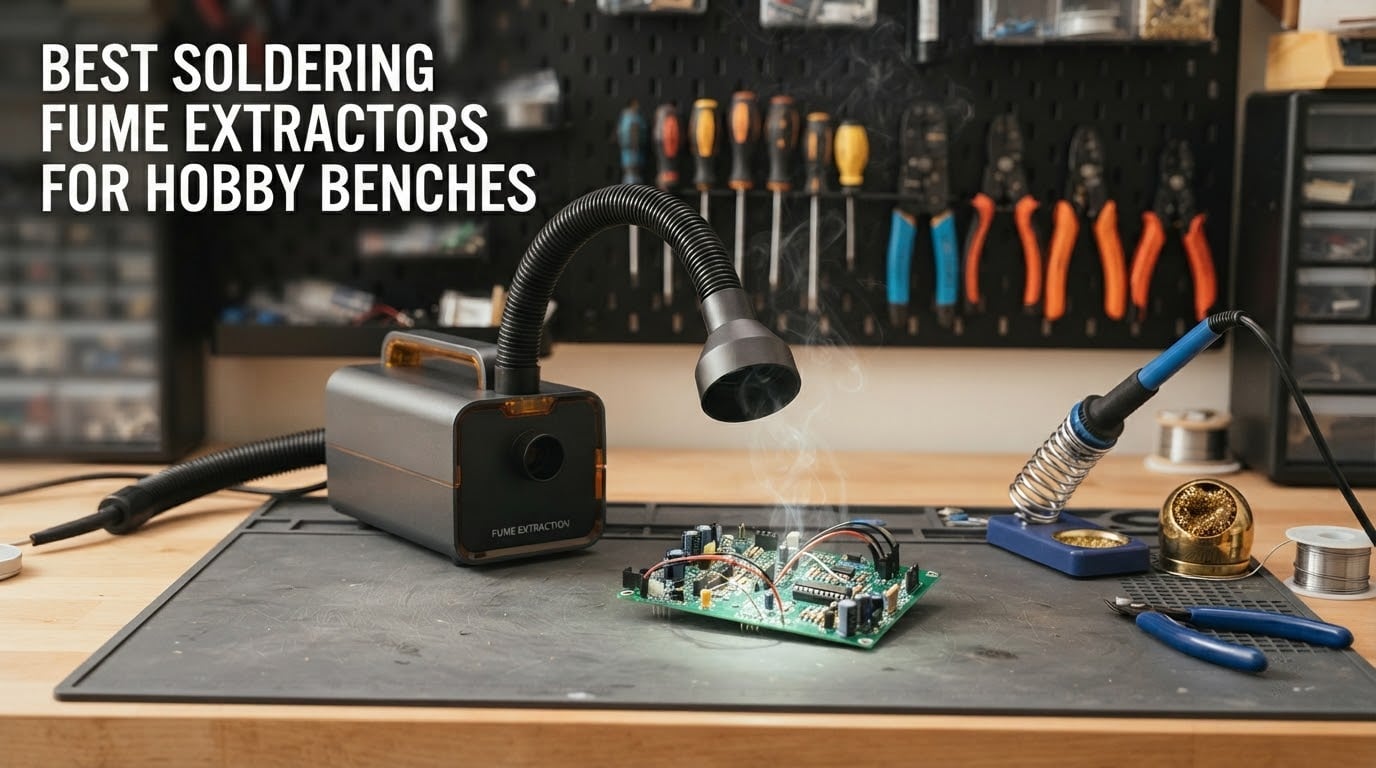
The best soldering fume extractors for hobby benches are the KOTTO Solder Smoke Absorber for most people, the Kulannder Smoke Absorber if you solder only a couple of hours a week, and the FumeClear FC-2001A when you want true H13 HEPA filtration and run long sessions. All three pull fumes away from your face at the source rather than cleaning the whole room.
That distinction matters more than any spec on the box. A solder fume extractor works by capturing fumes at a few inches from the joint and trapping them in a filter stack. It is not an air purifier, and it cannot clean a room. Once you accept that, the buying decision gets much simpler: capture distance, filtration stages, noise at your ear, and how easy it is to buy filters in a year.
Soldering releases fine particles, rosin flux vapour, and metal oxide fumes. Long-term inhalation of that plume is associated with throat and lung irritation, headaches, and occupational asthma, according to the health explainers that rank on this topic. Here is the catch that catches out most beginners: the plume is often invisible and odorless. You cannot smell your way to safety, and you cannot smell a saturated carbon filter either.
Our team compared ten of the most-reviewed solder fume extractors sold for hobby benches, checking airflow, capture distance, filtration stages, noise, and filter logistics for each. We also read what owners actually say after living with these units, because the filter replacement story matters more over two years than the first-hour impression does.
If you are still building the bench itself, our guides to the best hobby workbenches and the best hobby cutting mats cover the surface the extractor will sit on.
Table of Contents
Do Soldering Fume Extractors Actually Work?
Yes, for the specific job of removing solder fumes from your immediate breathing zone, provided you position the intake within a few inches of the joint and keep it running. The airflow does two jobs: it lifts the hot plume off the solder and carries it into the filter stack before it drifts toward your face.
What they do not do is purify a room. A recirculating unit pulls a modest volume of air across a small filter and returns it, so a bench in the corner of a large workshop benefits far less than a bench on a small desk. Several owners on hobby soldering forums make the same point from the other direction, arguing that only extraction to the outdoors is defensible for heavy fume work.
The honest failure mode is filter saturation. A carbon or HEPA media that has been loaded with flux residue stops capturing, and nothing about the unit changes appearance or smell to warn you. That is why filter cost and filter availability belong in the buying decision rather than after it.
One more limitation: a desktop face fan only captures from one side of the board. When the work is on the far side, you either flip the PCB or reposition the unit. Hose-and-arm designs solve this, and we flag that difference in every review below.
Top 3 Soldering Fume Extractors (October 2026)
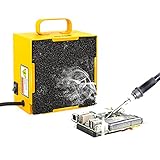
KOTTO Solder Smoke Absorber
- 0.4 inch activated carbon filter
- 3000 RPM low-noise fan
- Capture range 5-6 inches
- One replacement filter included

Kulannder Solder Smoke Absorber
- 110 CFM airflow
- Foam and activated carbon media
- Tool-free filter changes
- Low-noise roller motor
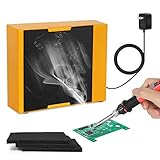
NOEVSBIG 12V Fume Extractor
- ESD-safe materials
- Pure copper motor
- Metal enclosure
- Two spare carbon filters
Our top three share a trait: each one is a compact desk unit that works within inches of the joint. If your bench is a dedicated electronics desk, the KOTTO earns the top spot on the strength of its 4.7 rating across more than 2400 reviews. If you solder occasionally, the Kulannder gives you the same class of capture at the lowest outlay in the group. If your concern is protecting sensitive boards while you work, the NOEVSBIG is the only pick here with a stated ESD-safe build and a metal body.
All 10 Solder Fume Extractors Compared in 2026
| Product | Specifications | Action |
|---|---|---|
| KOTTO Solder Smoke Absorber |
|
Check Latest Price |
| Kulannder Solder Smoke Absorber |
|
Check Latest Price |
| NOEVSBIG 12V Fume Extractor |
|
Check Latest Price |
 MUIN 3 Stage Fume Extractor MUIN 3 Stage Fume Extractor |
|
Check Latest Price |
 YIHUA 948DQ-I YIHUA 948DQ-I |
|
Check Latest Price |
 Aoyue AO486 Benchtop Absorber Aoyue AO486 Benchtop Absorber |
|
Check Latest Price |
 Weller WSA350 Bench Top Weller WSA350 Bench Top |
|
Check Latest Price |
 SainSmart Magnetic Fume Extractor SainSmart Magnetic Fume Extractor |
|
Check Latest Price |
 M-T 80W MT308 M-T 80W MT308 |
|
Check Latest Price |
 FumeClear FC-2001A FumeClear FC-2001A |
|
Check Latest Price |
Two rows deserve a second look. The M-T and FumeClear are the only picks with a stated H13 HEPA stage, and both are also the two largest and noisiest machines in the group. The SainSmart is the only one with a gooseneck that reaches ten inches, which changes how you work rather than just what you paid.
1. KOTTO Solder Smoke Absorber Review: The Best Overall Pick for a Hobby Bench
- Strong suction at 5-6 inches with a quiet 3000 RPM fan
- Thick carbon media absorbs solder and flux fumes well
- Stable non-slip feet and a carry handle for moving the bench
- Tool-free filter swaps and one spare filter in the box
- Small desktop footprint limits the capture zone
- Capture distance falls off quickly past a few inches
- Carbon media needs periodic replacement to stay effective
This is the unit I recommend to anyone building a first electronics bench. It is a 2.2 pound yellow box that measures about 5 by 3 by 5 inches, runs on 30.5 watts, and pulls air with a 3000 RPM fan. Everything about it is modest, and that is exactly why it works: it sits within inches of the joint and stays there.
The capture figure of 5-6 inches is the number that matters. Set the unit on the same side of the board as your face and the plume goes into the carbon instead of up your nose. Owners consistently describe the suction as strong at close range and the 3000 RPM fan as quiet enough to run through a long session.
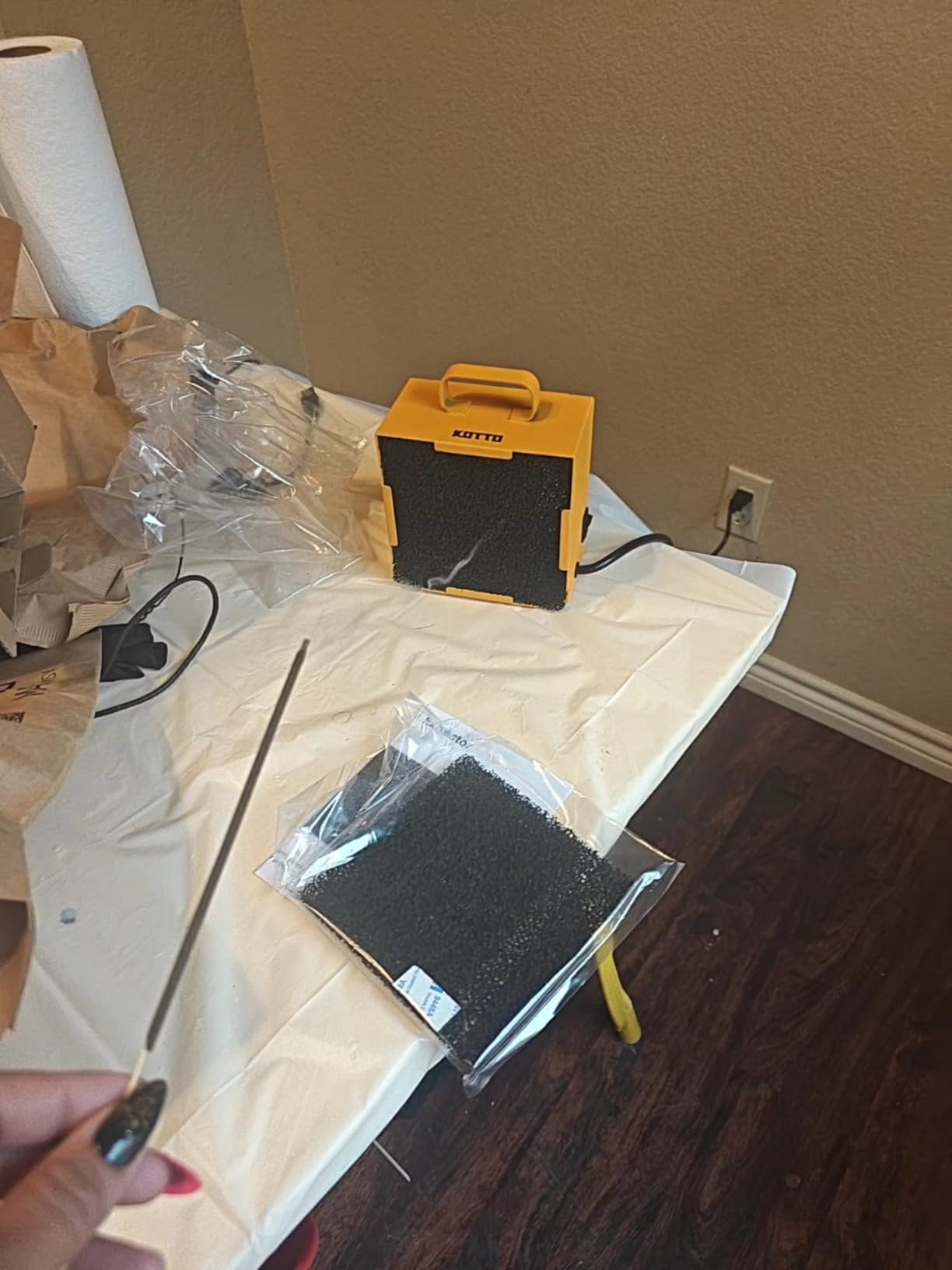
The build is a metal-housed desktop unit with four non-slip heavy duty rubber feet and a carry handle, which matters more than it sounds when your bench mat is the only thing protecting the surface. The 0.4 inch thick activated carbon filter is the thickest single-stage carbon media in this roundup, and the box includes one replacement filter so you are not stuck before your second session.
There is no filter-life indicator and no speed control. Those are the trade-offs you accept with a compact face fan, and they are why this is a hobby-bench unit rather than a workshop solution.
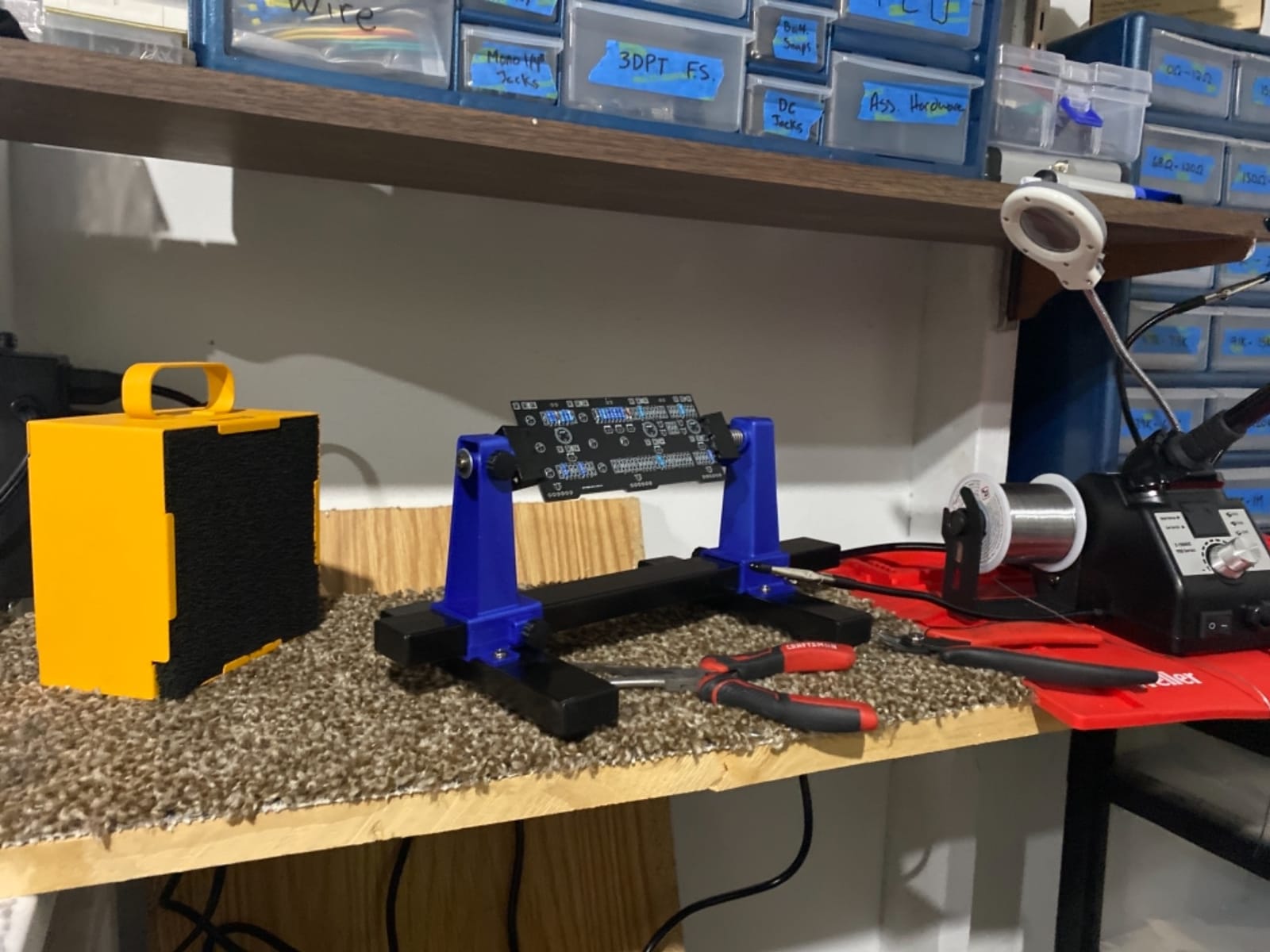
When the KOTTO is the right call for your bench?
Choose it if you solder one to three hours at a stretch on a desk, repair phone and laptop boards, or do light PCB rework. The high rating across a large review base suggests the capture is dependable rather than occasionally impressive, and at this size it leaves the rest of the desk usable.
It also suits beginners who have never used an extractor, because there is nothing to set up. Plug it in, place it 4 inches from the joint, done. Filter swaps are tool-free and the spare is already in the box.
When the KOTTO will disappoint you?
Skip it if your work involves large joints, stained glass, or wood burning that produces heavy visible smoke, because the capture zone is measured in inches and carbon alone is working hard. It is also the wrong shape for anyone who needs to pull fumes from under a bench or from the far side of a large board.
Expect to buy replacement carbon media on a schedule. Nobody publishes a fixed interval, so budget for periodic changes and treat that cost as part of the purchase rather than a surprise.
2. Kulannder Solder Smoke Absorber Review: The Budget Pick for Occasional Soldering
- Real airflow figure of 110 CFM for the size
- Quiet double roller motor
- Light enough to reposition with one hand
- Tool-free disassembly with a spare filter included
- 110V only motor
- Some early motor failure reports
- Only effective within 4-6 inches of the joint
- Not built for continuous all-day duty
The Kulannder is the pick for someone who owns a temperature-controlled soldering iron, patches a few boards a month, and does not want to spend heavily on a machine that will sit idle. It measures about 4.7 inches square, weighs 0.93 kg, and runs at 110 volts.
The published airflow of 110 CFM is unusually honest for a budget unit, and reviewers back it up by saying it pulls fumes from several inches away. The double roller bearing design is what keeps it quiet, and an anti-slip cotton base pad damps the vibration noise that would otherwise travel through a wooden desk.
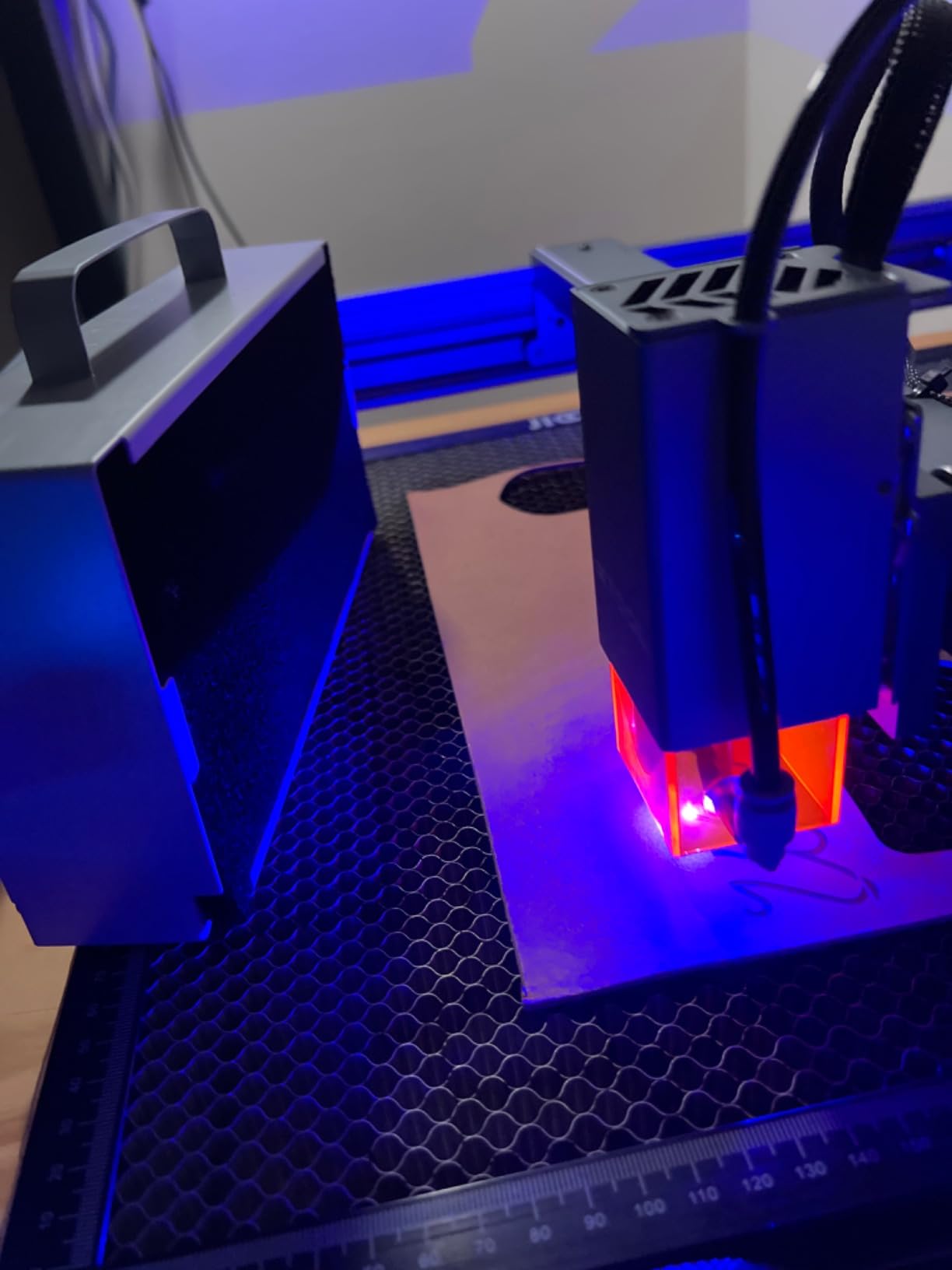
Filter changes need no tools at all. The whole housing comes apart, the foam and carbon cartridge lifts out, and a spare is included. That design matters more than the spec sheet suggests, because the moment a filter change is annoying, people stop doing it and then wonder why capture has quietly dropped.
Its weakness is duty cycle. A compact face-velocity fan like this is built for intermittent work, and reviewers are candid that it is not a machine for long continuous sessions.
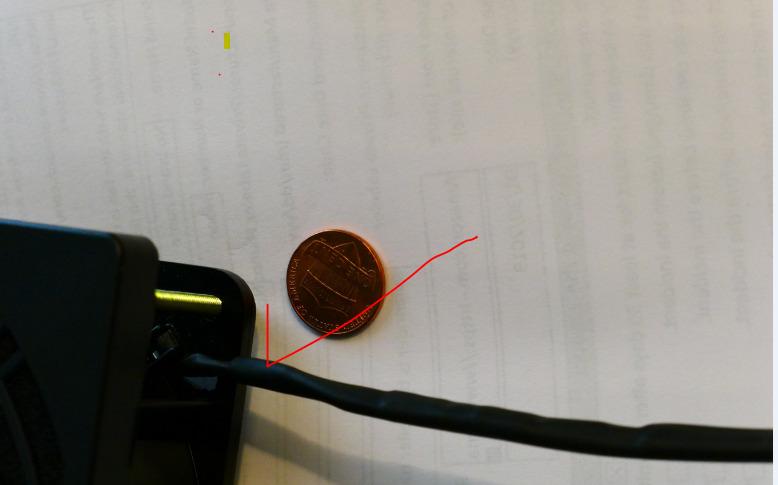
Where the Kulannder earns its place?
It suits a student, a first kit build, or a hobbyist soldering one evening a week. At this airflow figure it captures fine-detail joints without pushing air across the board hard enough to move small components, which some faster fans do.
It is also a good first unit to learn from. You get the feel for placement and capture distance without a large commitment, then you know what you actually need from a bigger machine.
Where the Kulannder falls short?
If you are outside the US, note that the motor is 110V only and will not run on a 220V circuit without a converter. A small share of owners also report early burnout or motor failure within months, so the warranty path matters if you buy it.
The 4-6 inch working distance rules it out for large assemblies and for any task where you cannot keep your head on the same side as the intake.
3. NOEVSBIG 12V Solder Fume Extractor Review: Best for an ESD-Safe Electronics Bench
- Metal enclosure and copper motor feel more durable than plastic rivals
- ESD-safe build suits electronics benches
- Two spare carbon filters included
- Stable feet and an easy-to-grab carry handle
- 2800 RPM fan gives a smaller capture zone
- Compact face-velocity style limits heavy duty use
- Narrower replacement filter availability than major brands
This is the one to buy if your bench is dedicated to electronics and you are handling boards you care about. The manufacturer states ESD-safe construction materials, and the enclosure is metal rather than the ABS used by several rivals at similar prices.
The motor is pure copper and the fan turns at 2800 RPM with low noise output. Dimensions are about 5.3 by 2 by 6.3 inches at 1.72 pounds, which is slim enough to sit at the back edge of a bench without taking working room.
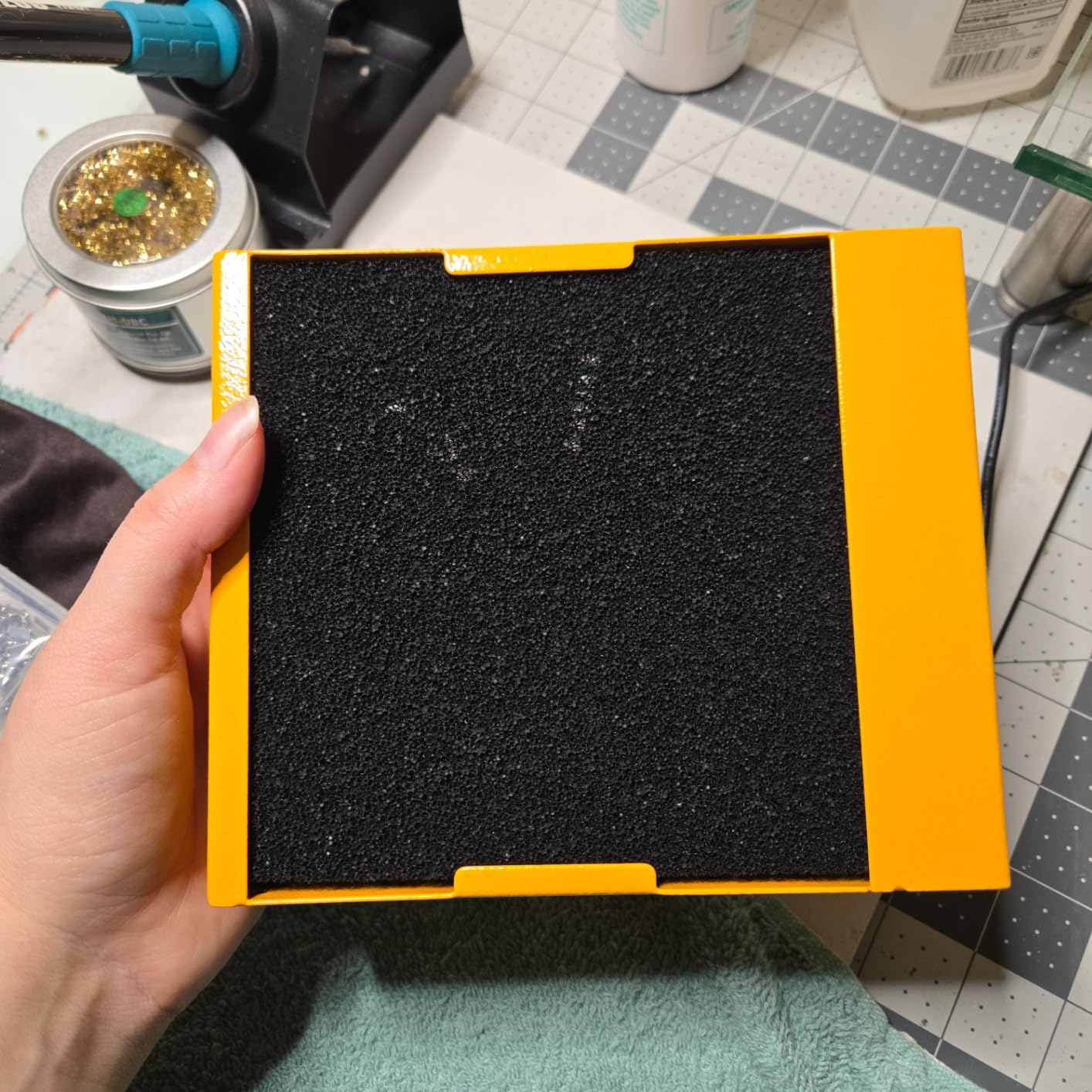
Two replacement carbon filters ship in the box. On a compact unit that is a generous supply, and it removes the most common complaint hobbyists have about budget extractors, which is having no spare media in hand before you can keep working.
The 2800 RPM fan is the reason capture feels more modest than the KOTTO. You position it closer and keep it there, and for fine-detail board work that positioning is easy anyway.
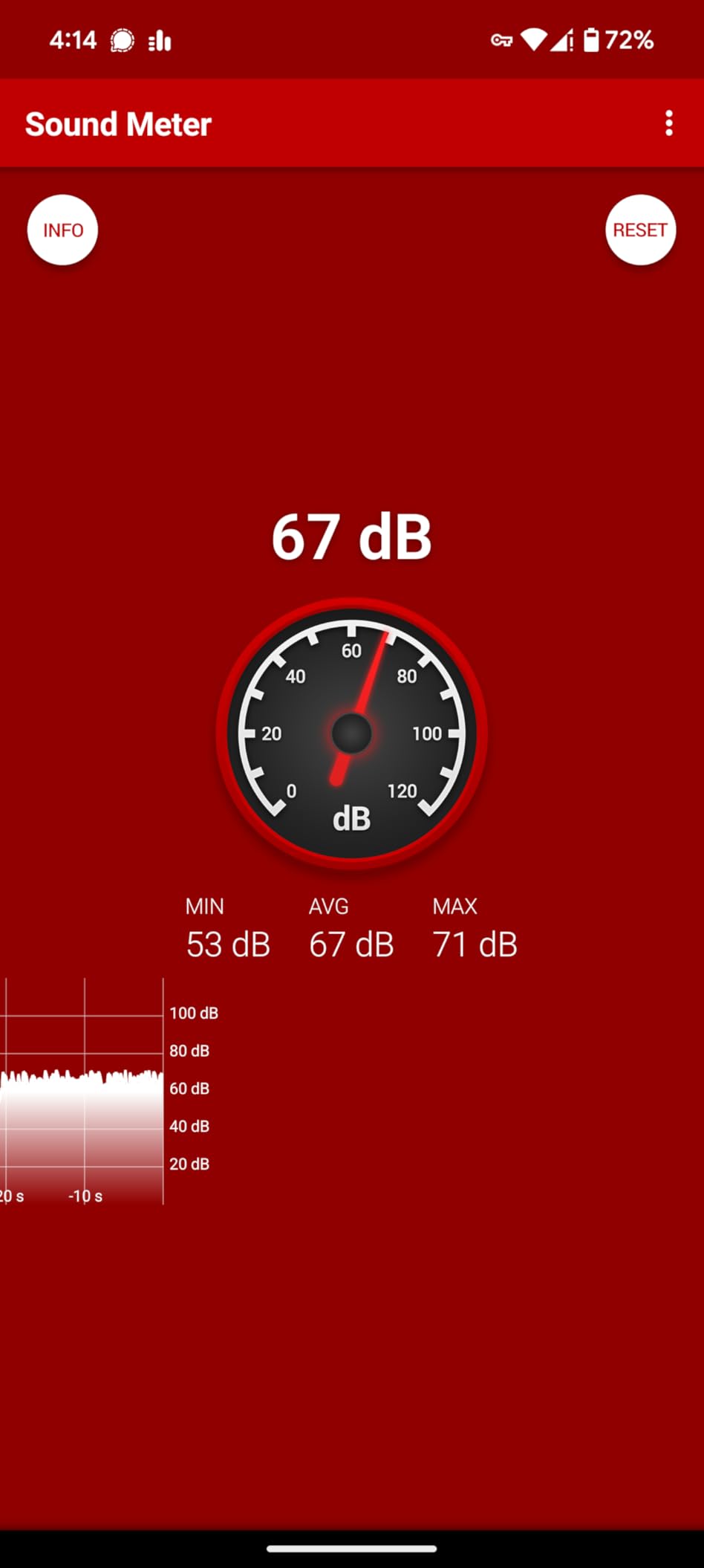
Why the NOEVSBIG suits sensitive board work?
If you repair phones, laptops, or anything with a populated board, a stated ESD-safe build and a metal case are meaningful. Metal also dissipates heat better than plastic, which is why owners describe it as feeling more durable than the plastic competitors in the same bracket.
The included spare filters make it a good first purchase too, since a beginner will saturate the carbon faster through trial and error than a steady user will.
What the NOEVSBIG cannot do?
It will not serve heavy or continuous fume loads, and the narrower replacement filter selection means you should confirm what is available for it before committing to it as your only unit. Nothing here indicates a long supply of consumables.
Like its face-fan peers, it captures from one side only, so large boards still need repositioning.
4. MUIN 3 Stage Fume Extractor Review: Best Multi-Craft Unit for Soldering, Pyrography and More
- 115 CFM airflow and 45 dB are strong figures for this tier
- Three stage system handles solder fumes and wood burning odors
- Compact footprint suits crowded hobby benches
- Useful across many craft tasks
- ABS plastic housing is less durable than metal
- Short 4-5 inch capture distance
- Smaller filter capacity than the larger units
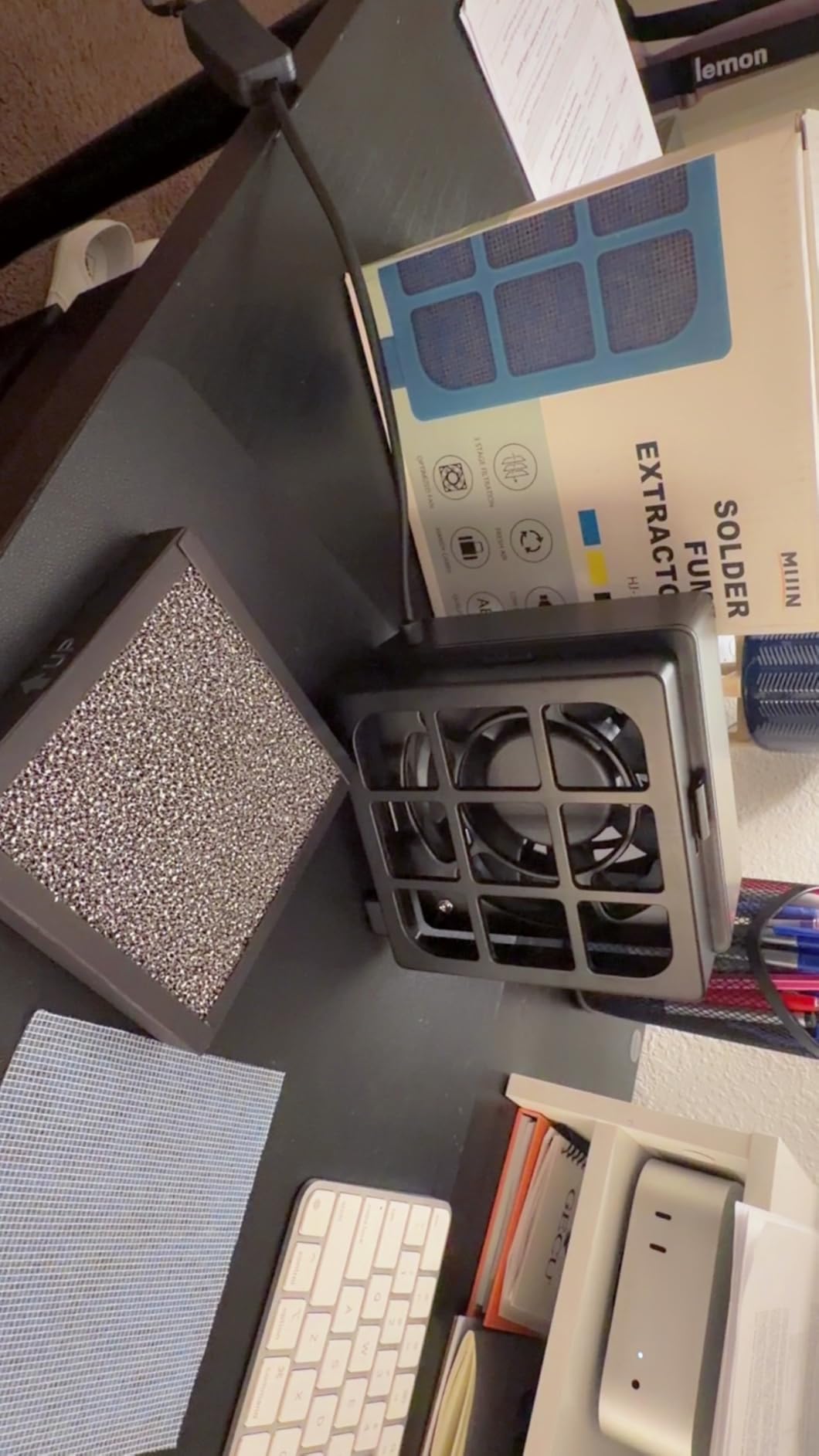
The MUIN is the one to pick if the soldering iron is only half of what you do at the bench. Wood burning, stained glass, 3D printing, and general crafting all push different contaminants, and the three stage filter system is the reason this unit handles them in one box.
Its published figures are the strongest in the compact tier: 115 CFM airflow at 45 dB sound level, with effective fume removal at 4-5 inches. That 45 dB rating makes it a sensible choice in a shared room where a louder machine would become the thing you turn off.
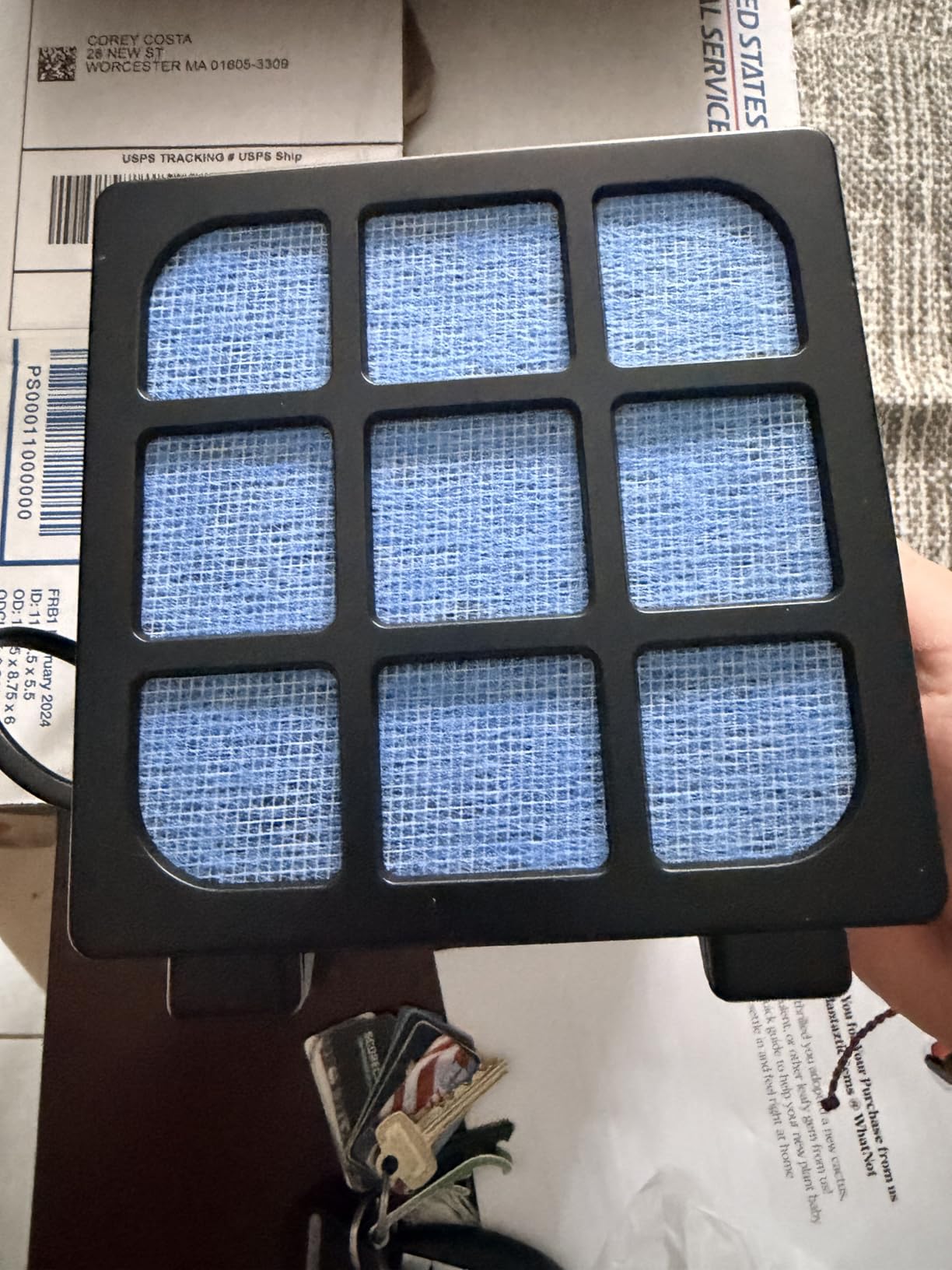
Physically it is about 5 by 2.8 by 5.5 inches at 1.43 pounds, in a space-saving rectangular profile that sits flat against the back of a bench. Owners like the footprint more than anything else, because most hobby benches are already crowded.
The honest trade is the ABS plastic housing. It is lighter and cheaper than the metal options, but it scuffs and cracks sooner if you knock it around, and the filter capacity is smaller than the larger machines hold.
Who should buy the MUIN?
Buy it if pyrography, stained glass, or craft fumes join soldering in your sessions, or if noise is a real constraint in a shared apartment or home office. The 45 dB figure is the standout number in this group.
It also works well for stained glass work at a hobby level, where the glass sits flat and the intake can be placed close to the seam.
Who should look elsewhere?
If you work on large assemblies where your head cannot get close, the 4-5 inch capture distance forces constant repositioning. And if your bench doubles as a repair bench where the unit gets bumped regularly, a metal-bodied pick will outlast it.
Long-term filtration capacity is the other limit; the smaller cartridge saturates sooner than the filters in the larger machines.
5. YIHUA 948DQ-I Review: Most Spare Filters and the Best Angled Capture
YIHUA 948DQ-I Solder Fume Extractor with Tiltable Angle, Dual-filtering
- Tiltable stand angles the intake into the fume plume
- Side fenders cut cross-drafts meaningfully
- Eight spare adsorbers included
- Very low 5 watt draw for continuous running
- Very short 10 cm capture distance
- Only 5 watts so heavy loads overwhelm it
- Plastic housing is less rugged than metal rivals
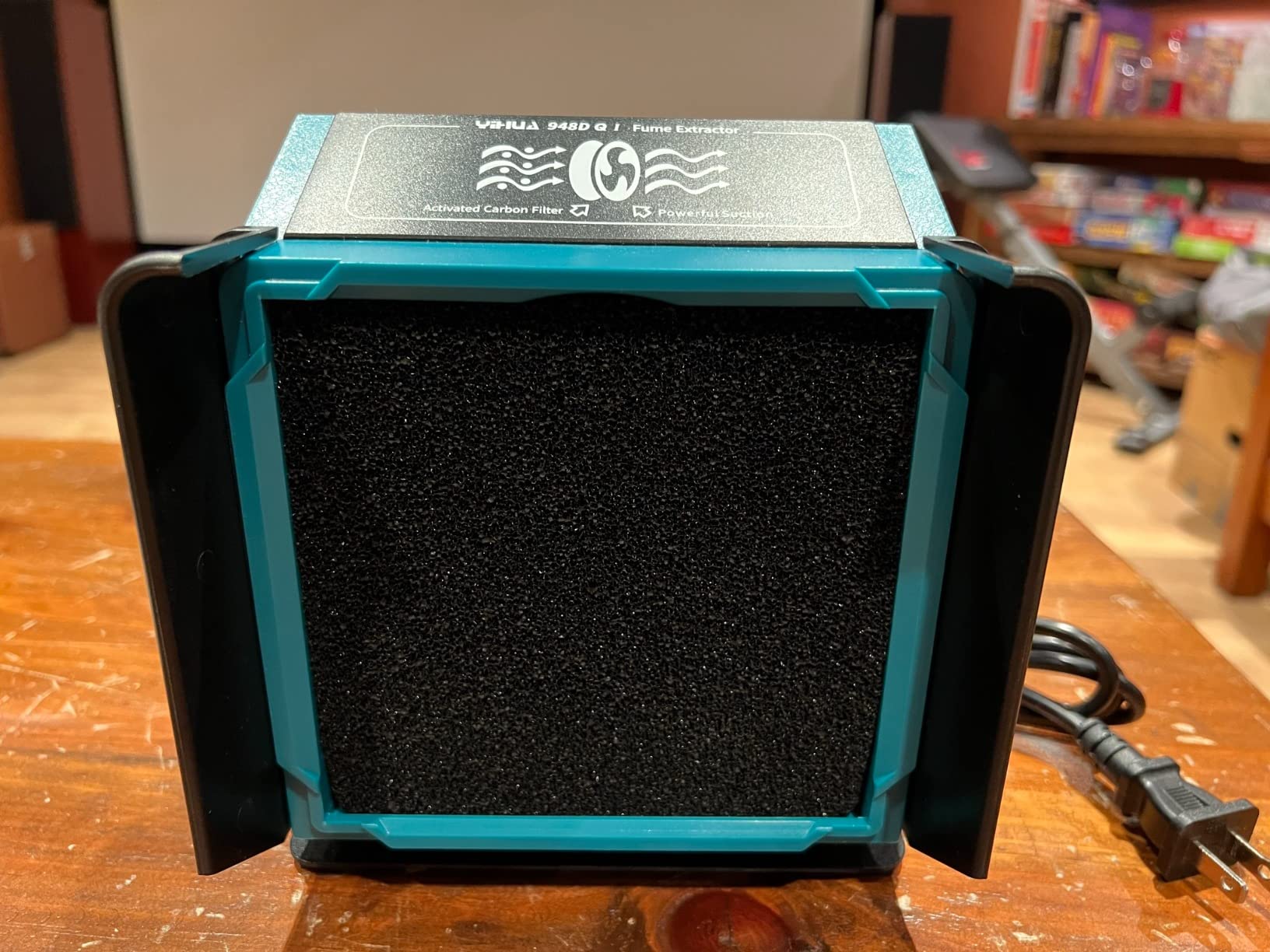
The YIHUA solves a specific problem well: getting the intake exactly where the plume rises. The 30-degree tiltable stand plus the two side fenders let you aim the unit and stop cross-drafts from pushing fumes back across the bench, which is a complaint that surfaces constantly about face fans.
Dual adsorption is the other name feature, with adsorbers at the front and rear of the unit rather than a single face. A five-blade fan moves the air with a longer operating lifespan and relatively low noise.
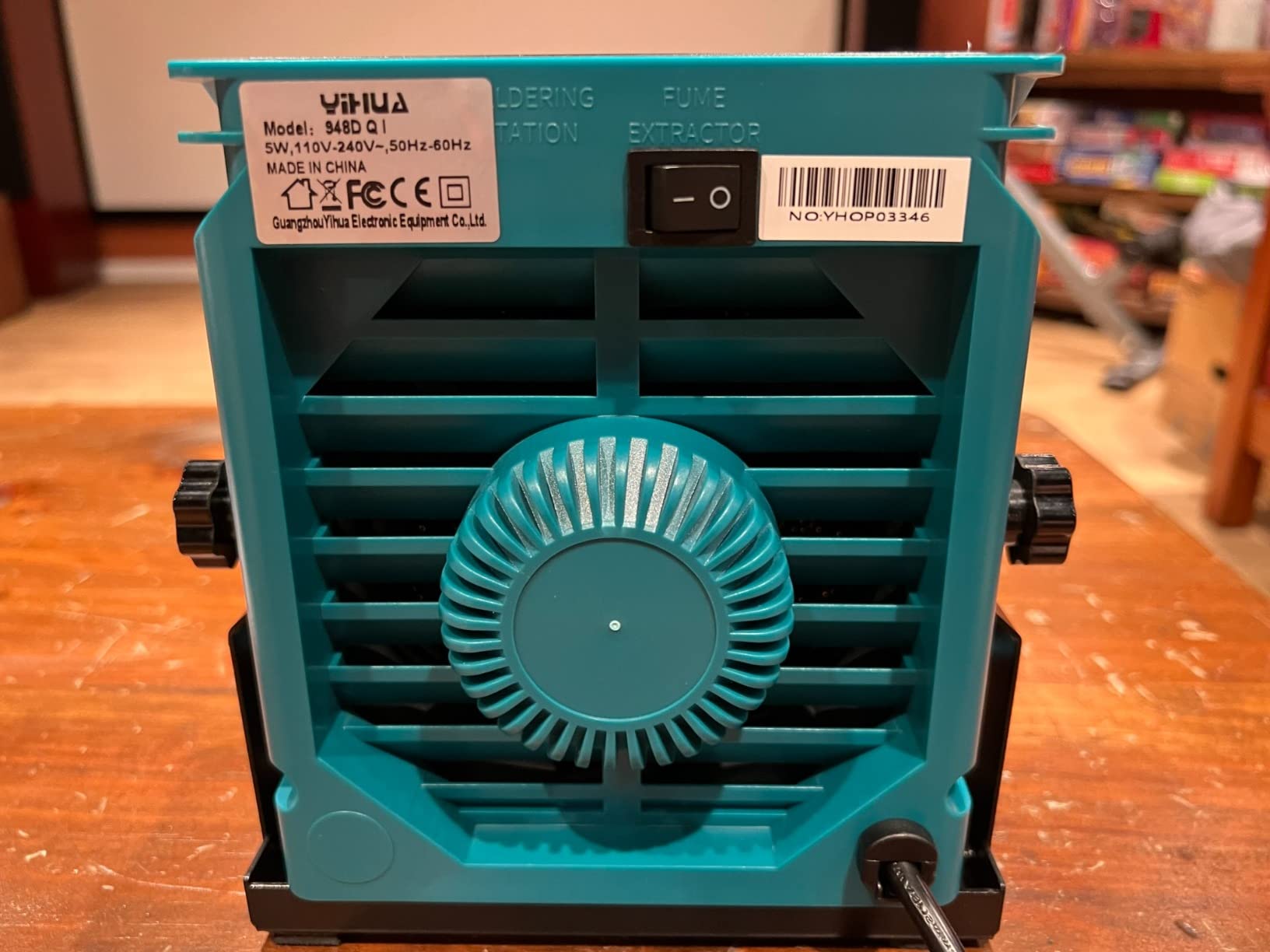
Then there is the supply. Eight extra filtration adsorbers ship in the box, more than any other pick here, and the box also includes two fenders and the tiltable stand. If filters are the thing that stops you maintaining a unit, this removes the excuse entirely.
The 5 watt draw is genuinely low, so leaving it running through a session costs almost nothing and does not add heat near your hands.
Where the YIHUA makes life easier?
It suits fine-detail soldering, jewellery work, and small assemblies where you can hold the board within 10 cm of the intake. The tilt is the quiet hero feature, since it lets you follow the joint as your hands move instead of chasing the bench with the whole unit.
It is also the pick if you solder at an irregular pace and want filters on hand without planning ahead.
Where the YIHUA will not keep up?
At 5 watts it cannot handle heavy or sustained fume loads, and the 10 cm capture distance is the shortest of any unit in this roundup. Large joints, wood burning, and anything producing visible smoke will overwhelm it quickly.
The housing is plastic and the listed material is wood, so it is a light-duty machine for a light-duty bench. It is not the choice for a shared workshop.
6. Aoyue AO486 Benchtop Absorber Review: A Proven Cabinet for Stained Glass and Crafts
- Contained cabinet keeps fan and filter assembly together
- Quiet operation suits an electronics workspace
- ESD-safe build protects sensitive boards
- Long-standing model from an established bench tool maker
- Largest footprint in the group at 11 x 6 x 8 inches
- Lowest average rating here with 13 percent three-star reviews
- Bulky cabinet takes more bench space than compact fans
The Aoyue AO486 has been around since 2009 and comes from a brand that already makes soldering stations, repair tools, and microscopes. That history shows in one respect that matters here: the cabinet form keeps the fan and filter assembly contained on the desk instead of scattered across the bench.
It is specified as ESD-safe, uses an activated carbon filter, and the manufacturer positions it for electronics, arts and crafts, and stained glass work. A 9V battery is included, which powers the small controls without mains sitting loose on the bench.
Operation is described as quiet yet powerful, and owners tend to agree on the quiet part. At 11 by 6 by 8 inches and 2.23 pounds, this is the largest footprint in the roundup by a wide margin.
Why the Aoyue still makes sense in 2026?
If you work stained glass or craft projects alongside electronics, the cabinet format keeps the intake pointed at the work and the filter contained. The AO486 is also a familiar unit that has been sold for years, so replacement carbon media is an understood part of ownership rather than a gamble.
For anyone who likes a proper benchtop appliance instead of a compact fan, the enclosed design simply feels more deliberate.
Why it does not lead the list?
The size is the first problem. On a hobby desk, 11 by 6 by 8 inches is a quarter of the working surface, and that is the single most common complaint from owners.
The satisfaction data is also the softest in this group, with 13 percent three-star reviews, which points to a unit that works adequately rather than impressively. If desk space matters, one of the compact picks is a better fit.
7. Weller WSA350 Review: Built for the Heavier Fluxes Hobby Kits Hide
- Purpose-built for active fluxes that defeat simple carbon fans
- Very quiet 20 watt fan suits shared workspaces
- ESD-safe and made by an established soldering tool maker
- Genuine replacement filter included
- Highest cost among the compact benchtop units
- Fixed cabinet form with no tilt or capture hose
- Older 120V design with no speed or filter life controls
Most hobby kits ship with a mildly active flux and you will never notice the difference between filter types. Some solder, however, is specified for more active fluxes, and that is exactly where the Weller WSA350 is aimed. The manufacturer positions it for workspaces using those heavier fluxes.
The filter is a replaceable carbon-activated cartridge rather than a bonded carbon sheet, and one WSA350F replacement is included. A replaceable cartridge is a genuine service-life advantage, because you can change the carbon without replacing anything else.
The fan draws 20 watts and is described by the manufacturer as quiet enough not to add significant noise to the workspace, and owners echo that. The unit is ESD-safe and weighs 2 pounds on a 120V benchtop format.
What you give up is modern convenience. There is no tilt adjustment, no capture hose, no fan speed control, and no filter-life indicator. It is a fixed-format appliance from an earlier design era.
When the Weller is the right buy?
Pick it when your solder datasheet specifies an active flux, when you work on stained glass or jeweller flux alongside electronics, or when you want a machine from a soldering tool maker rather than a generalist. The replaceable carbon cartridge means long-term ownership stays straightforward.
Its quiet 20 watt fan also suits a shared studio bench where a louder extractor would be turned off.
When the Weller is the wrong buy?
It costs more than every compact pick in this roundup while delivering similar capture distance, so if you solder standard hobby kit solder you are paying for capability you will not use. The fixed cabinet form also means no reach when the board is on the far side.
At 120V only, with no speed control, it is not a machine you can tune to your bench.
8. SainSmart Magnetic Fume Extractor Review: The Only Pick With an Adjustable Gooseneck and Work Lamp
SainSmart Portable Fume Extractor Fan, Magnetic Solder Smoke Absorber
- Only unit here with an adjustable LED work lamp in three colour temperatures
- Magnetic base and clamp free up bench surface
- Memory gooseneck holds position without sagging
- Longest reach of the compact group at 10 inches
- 12V powered so it needs an external adapter
- Activated carbon only with no HEPA stage
- Carbon consumables may be harder to source
The SainSmart changes how you work rather than adding another spec. Instead of a box you slide around, the intake sits on a 400 mm memory stainless steel gooseneck, 12 mm in diameter, that holds its shape without sagging. That is the closest thing to an articulated arm in this roundup.
Its fan runs at 3700 RPM with up to 10 inch effective absorption distance, the longest reach among the compact machines here. You can bring the intake over the joint rather than bringing your head to the intake.
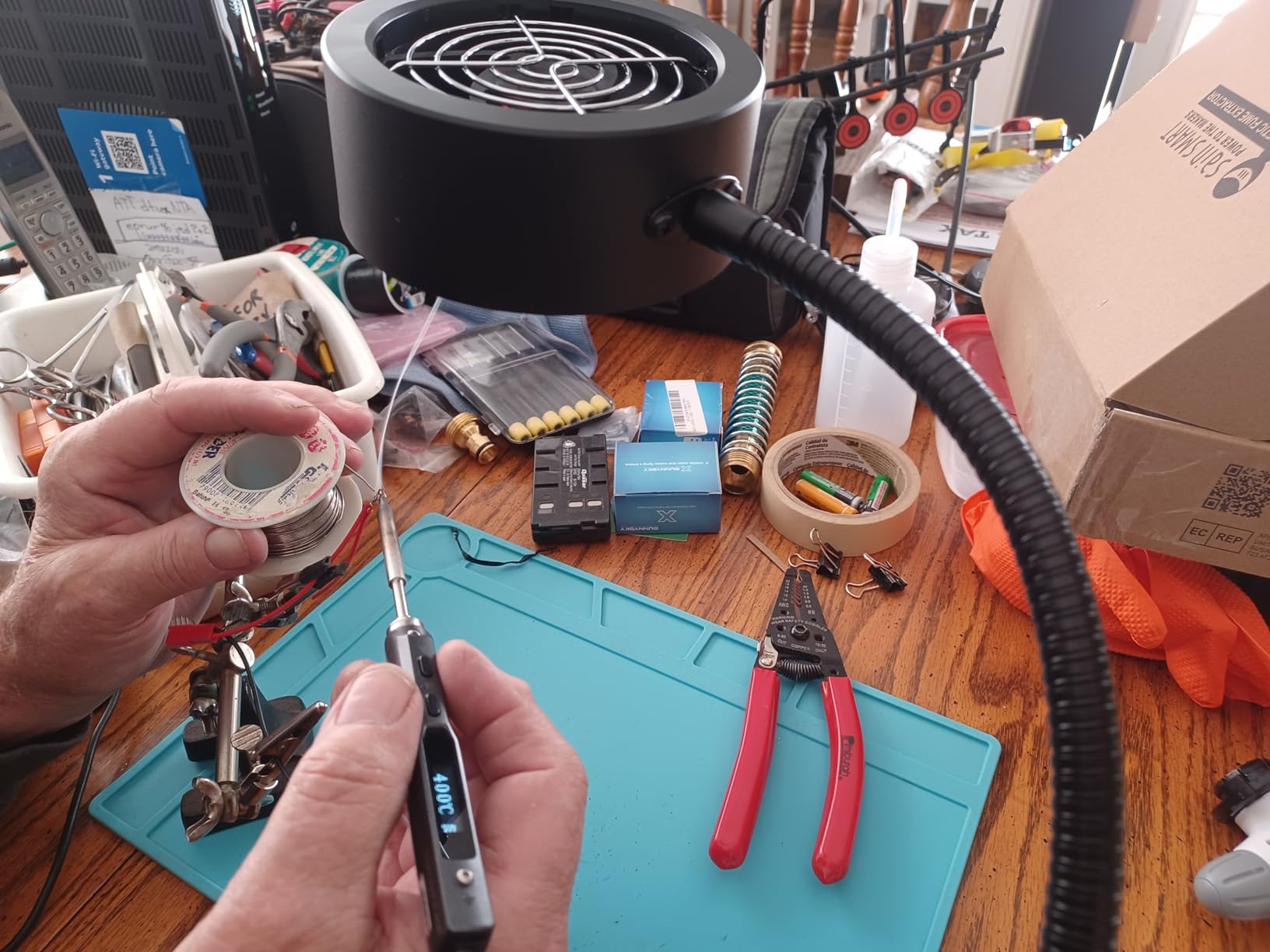
The mounting is the second differentiator. A magnetic cone base attaches to a vertical metal surface, and an extra clamp handles non-metal desks, so the unit itself does not occupy bench space. That is genuinely useful on the crowded desks most hobbyists solder on.
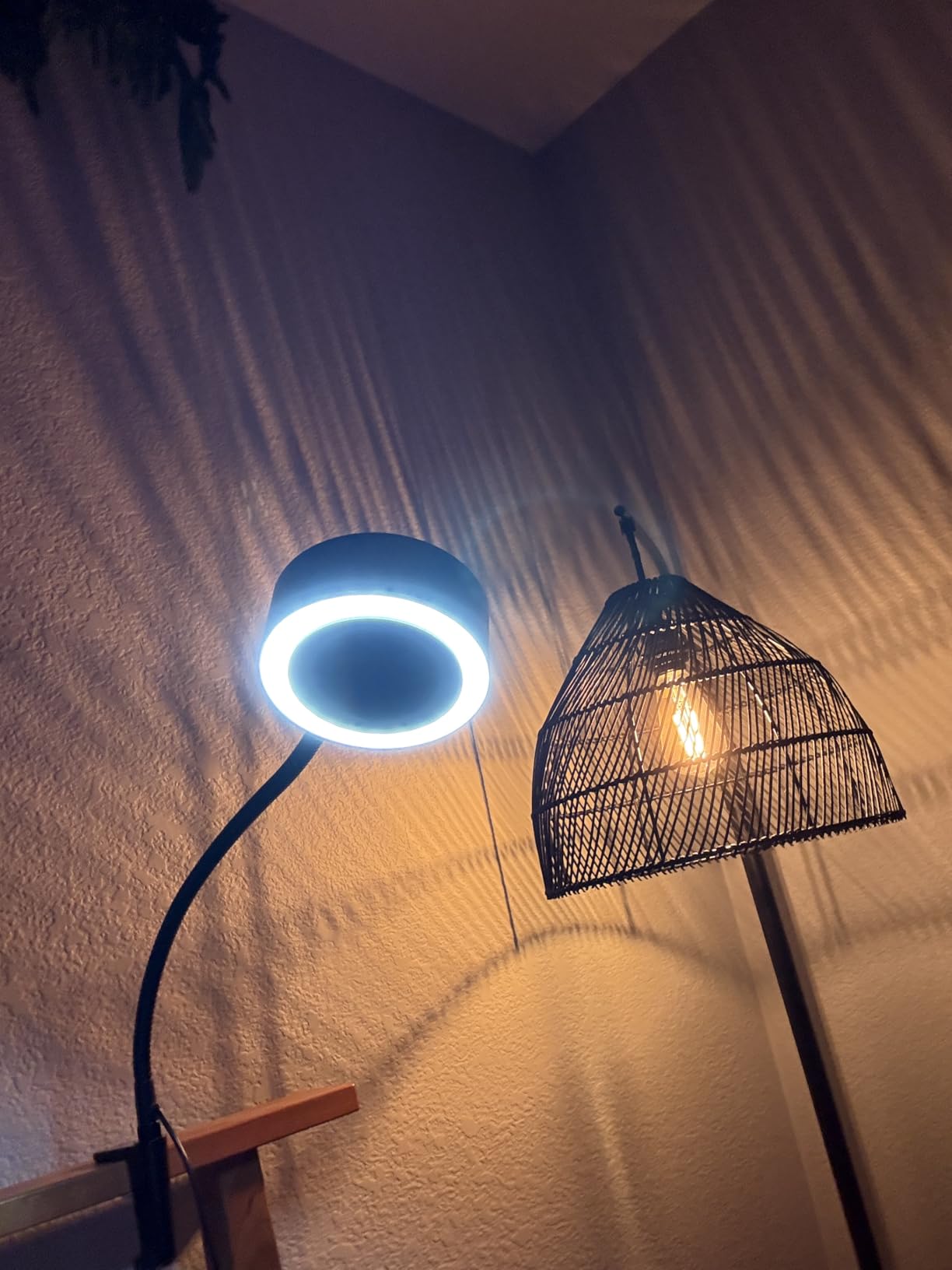
The multifunctional LED lamp offers three colour temperatures at 3000K, 4500K, and 6000K, which is unusual at this tier and useful when you need to see a joint shadow or read silkscreen.
Who benefits most from the gooseneck?
If you work on boards larger than your head can easily cover, or if you alternate between fine detail and larger joints, holding the intake over the work beats repositioning the unit. Stained glass and jewellery work also suit it, since you can bring the intake to the seam.
Benches with limited back edge also benefit, since the body mounts out of the way rather than sitting in the working area.
What to know before buying it?
It runs on 12V, so you need an external adapter and a free outlet, and the unit weighs 38.4 ounces with dimensions around 10 by 2.4 by 7.5 inches. Filtration is activated carbon cotton only, with no HEPA stage, so fine dust from cutting or grinding passes through.
It also carries the highest share of three-star and below reviews among the mid-priced machines here, so set expectations accordingly and confirm filter availability.
9. M-T MT308 80W Review: True HEPA Filtration on a Flexible Hose
M-T Solder Fume Extractor, 80W 168m³/h Strong Suction Smoke Absorber with Carbon or HEPA Filter, 3-speed Adjustment for Soldering, Welding, 3D Printing
- Only compact pick with a true H13 HEPA stage alongside carbon
- Flexible hose pulls the intake to the source
- Three speed adjustment trades noise for airflow
- Metal body and a three year warranty
- Three filter layers in the box
- Hose to housing joint is cross threaded and jams
- Bottom exhaust vents blow air back across the bench
- Loud at full speed with fan rub against housing
- Difficult to source filter consumables
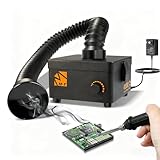
The M-T is where the roundup shifts from desk fans to something closer to a small extraction machine. An 80 watt metal housing drives a 15,000 RPM motor delivering 168 m3/h of airflow, absorbing gases within 5 inches, with a stated sound level under 60 dB.
Filtration is the headline. The stack combines high-density fiber, carbon cotton, and an H13 HEPA stage with activated carbon, and the manufacturer claims 99.99 percent removal of dust, mold, bacteria, chlorine, heavy metals and gases. Among the picks reviewed here, only two offer a stated H13 stage.
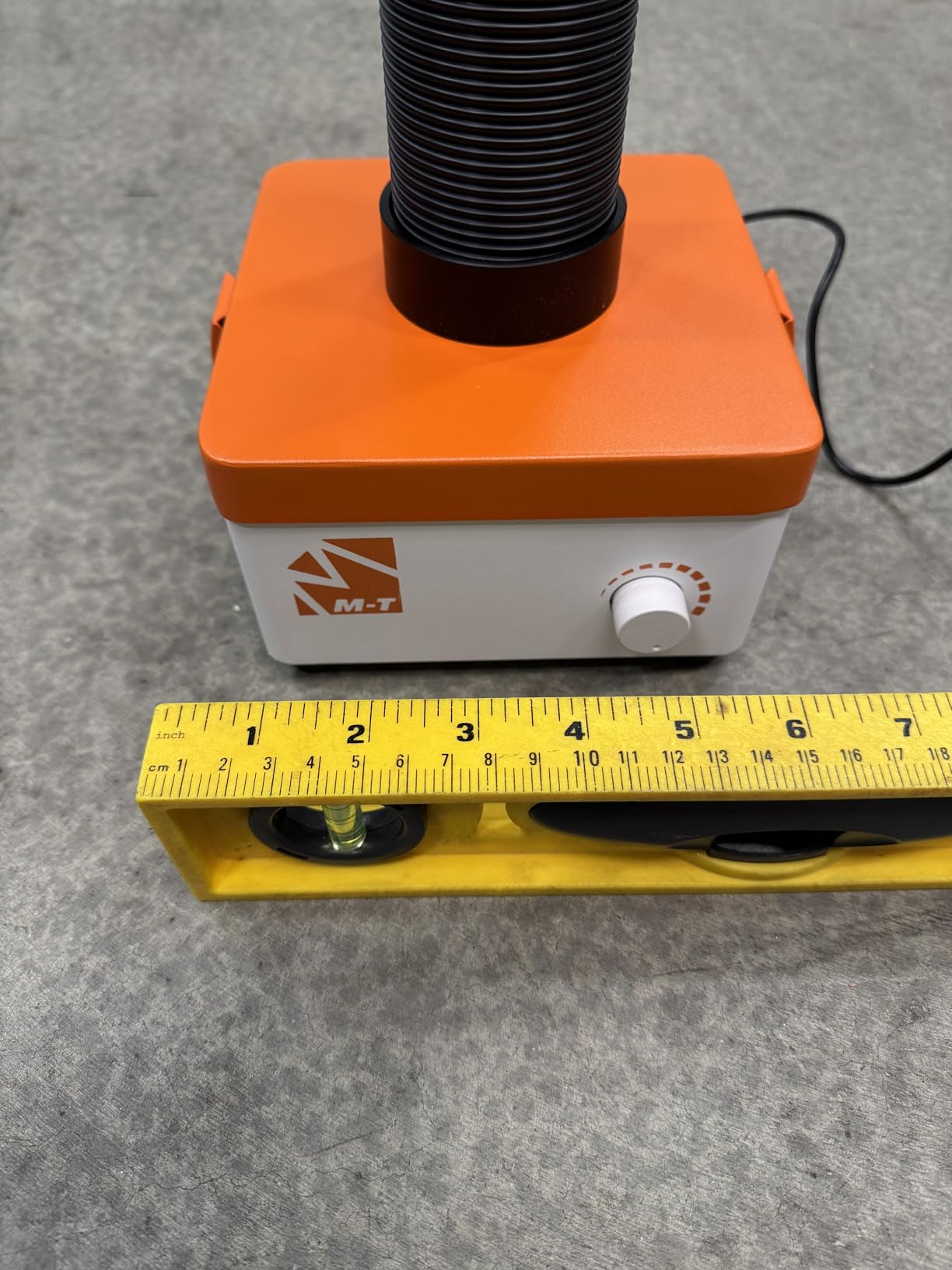
A 360 degree adjustable hose spanning 7 to 25 inches brings the intake to the joint, which resolves the one-sided capture problem that limits every face fan. Three speed adjustment lets you trade airflow against noise depending on the task, and a universal 100-240V adapter with surge protection removes the voltage guesswork.
The box includes the main unit, triple-layer filters, the hose, a 5 ft power adapter and a manual, backed by a three year warranty.
When the M-T earns its price?
It suits people whose bench handles more than one fume source, such as soldering alongside 3D printing or light machining, where the HEPA stage earns its place. The hose reach is the deciding factor if your board is larger than your head, and the three speed settings help when the unit is running beside you all day.
The metal body and three year warranty give it more long-term confidence than typical compact machines.
When the M-T is not for you?
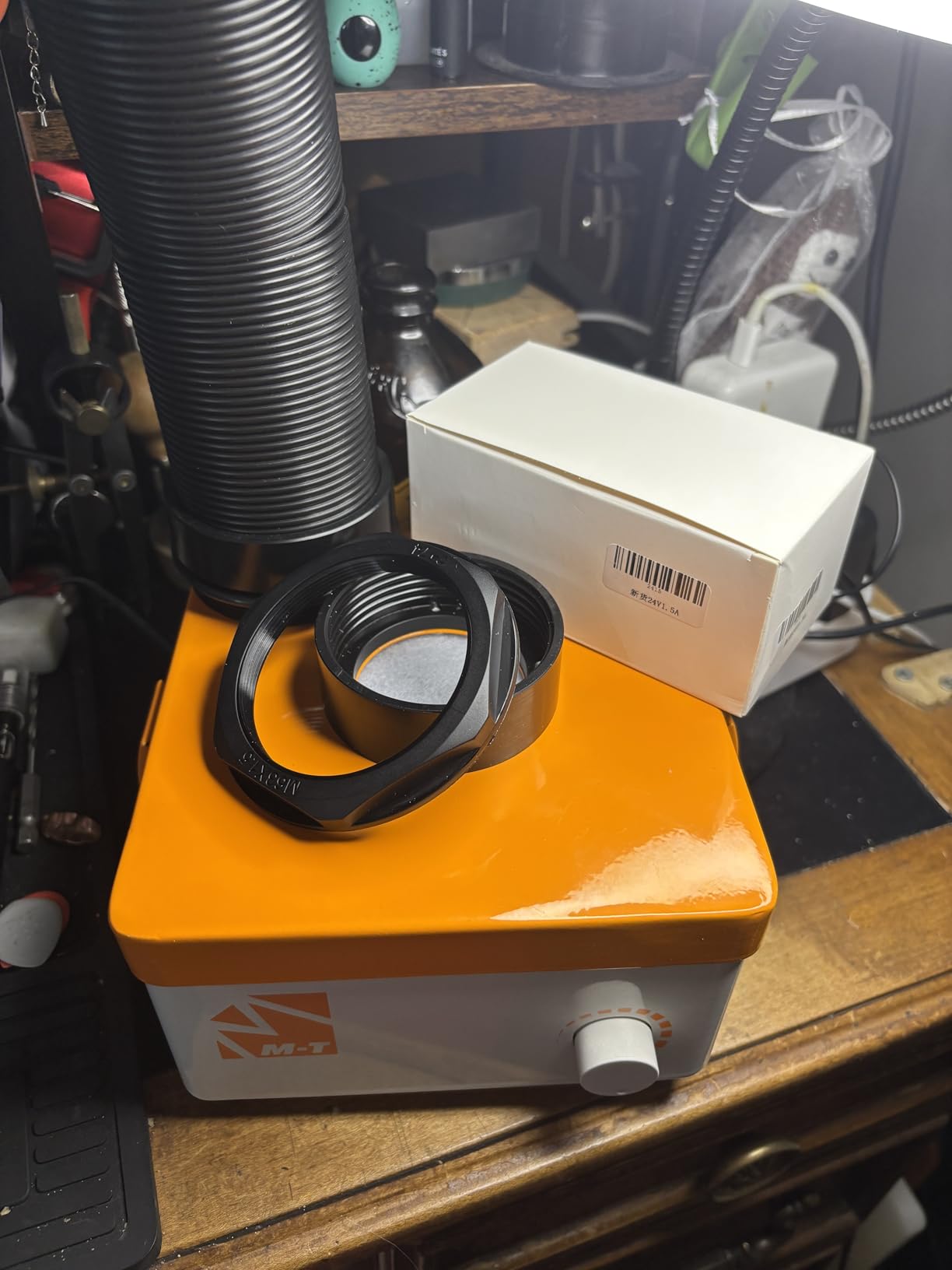
The design flaws owners report are real. The hose to housing joint is cross threaded and jams rather than threading in cleanly, and the bottom exhaust vents air back across the work toward the user unless you block or raise them.
It also runs loud at full speed, sometimes with the fan rubbing the housing, and the filter consumables are hard to find and do not last long. The rating reflects that: it is the lowest average in the group with 18 percent two-star and one-star reviews.
10. FumeClear FC-2001A Review: The Strongest Filtration in the Group
FumeClear FC-2001A Solder Fume Extractor, 2-in-1 H13 HEPA Activated Carbon
- True H13 HEPA with 600-800 mg/g iodine value carbon
- All metal housing feels solidly built
- Handles dust heavy work as well as soldering
- Filter lasts longer than compact units and cuts replacement cost
- Universal 110V and 220V support
- Loudest of the group with noise above the claimed figure
- Heaviest and largest unit here at 9.03 pounds
- Included hose is shorter than advertised
- Bottom exhaust can blow air back across the work
If filtration specification is the deciding factor, this is the strongest machine in the roundup. It combines a true H13 HEPA filter with activated carbon rated at 600-800 mg/g iodine value in a single 2-in-1 cartridge, and the all-metal housing contains fumes inside the machine for purification rather than venting them at the bench.
A high-speed brushless motor extends the effective working range to 15 cm, with air purification capacity of 120-180 m3/h and three speed adjustment. It runs on both 110V and 220V grids without an external converter.
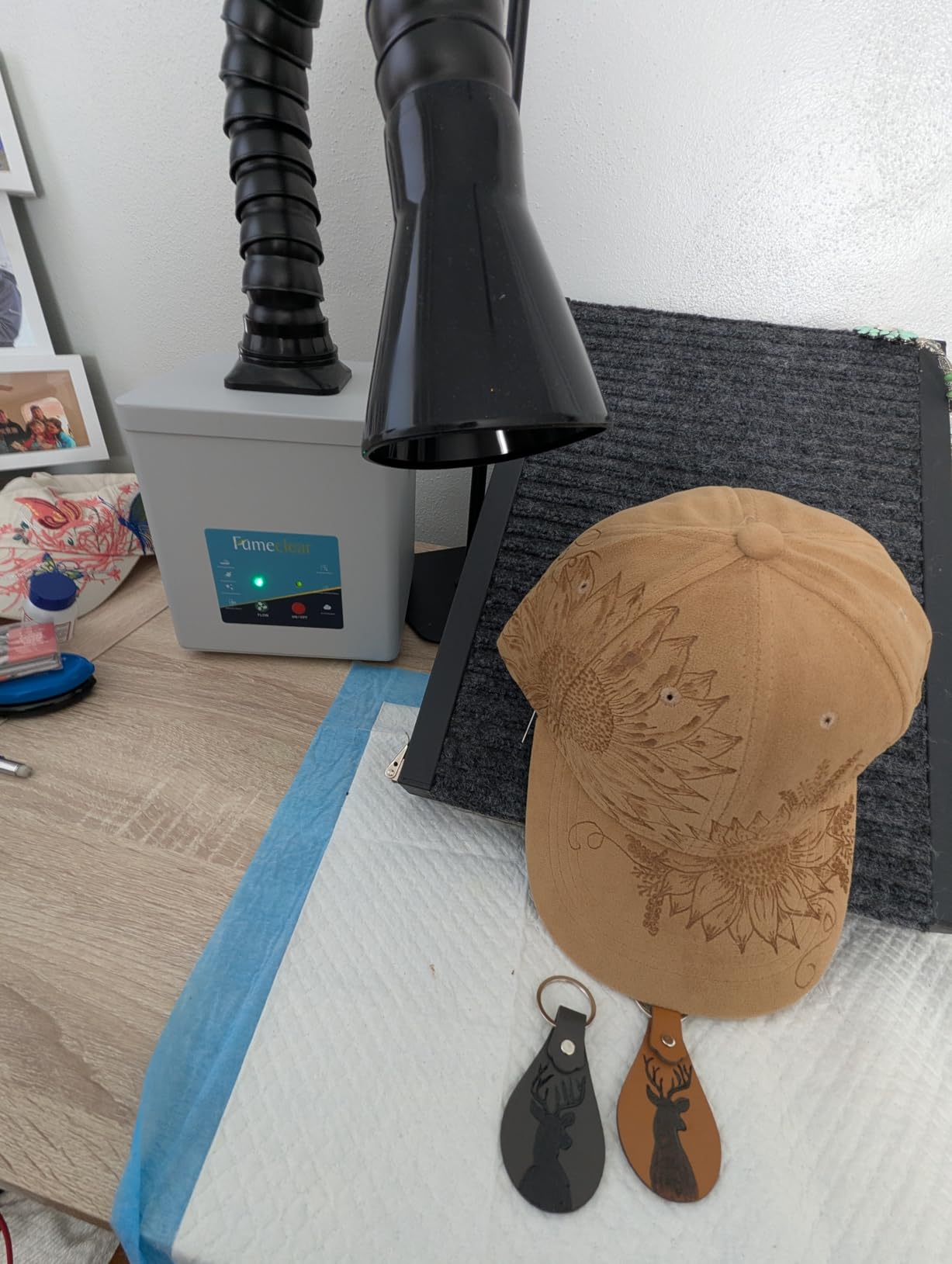
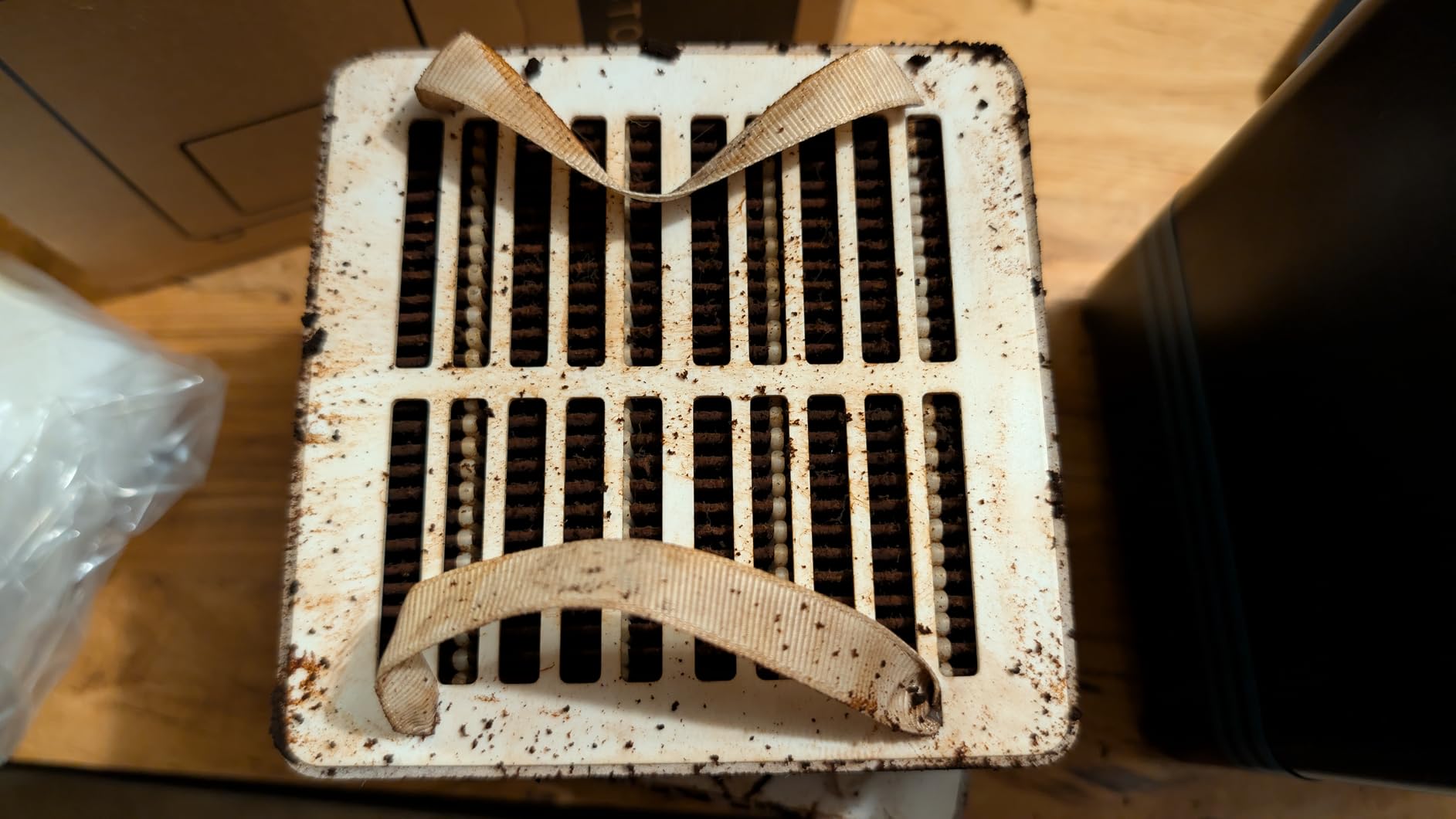
Owners single out filter longevity as the practical win. The dust-holding capacity is claimed to last three times longer than compact units, and that is the number that changes your two-year cost of ownership more than any airflow figure.
It also handles dust-heavy work beyond soldering, including DTF printing, frit work and wood burning, which is where an H13 stage starts to matter. Five pre-filters are in the box alongside the main cartridge, a bamboo pipe and a hood.
Who this machine is built for?
Buy it if you solder in a shared workshop, run multiple fume-producing tasks through one unit, or want the lowest ongoing filter cost per year. The all-metal body holds its position and does not shift when you bump the bench, and vendors respond quickly when something goes wrong.
Universal voltage also makes it the simplest pick to own across regions.
Where it falls short?
It is the loudest machine here, with measured noise running well above the stated figure, and at 9.03 pounds with dimensions of about 11.8 by 10.4 by 12.8 inches it is also the heaviest and takes the most bench space. Neither is a problem in a workshop and both are a problem in a small room.
The included hose is shorter than advertised and assembles from snap-together sections, and the bottom exhaust can blow air back across your work unless you block or raise it. It also carries the smallest review base of the group, which is worth weighing against a thinner spec sheet.
How to Choose a Solder Fume Extractor: Six Criteria That Decide It?
Almost every roundup on this topic lists the same six criteria and then ranks products on wattage. Wattage is the weakest of the six, so we use it only as a rough floor. Here is the order we would actually decide in.
1. Capture distance before anything else. Look for a stated effective capture distance and check it against how you work. Machines in the compact tier capture at 4-6 inches, the tiltable models at 10 cm, the gooseneck model at 10 inches, and the hose models at 5 inches from the intake with reach of up to 25 inches. If your head cannot get close to the joint, a face fan will not save you.
2. Airflow, and why wattage misleads. Airflow is quoted either as CFM or as m3/h, and the two compact picks that publish CFM figures quote 110 CFM and 115 CFM at 45 dB. The larger machines quote 120-180 m3/h. Wattage does not predict either, because fan diameter and motor design matter more. A 5 watt unit can feel weak and an 80 watt unit can still be loud without being strong.
3. Filtration stages, in order. A pre-filter catches loose flux particulate and protects the finer layers. A HEPA filter catches particles down to the 0.3 micron range. Activated carbon adsorbs rosin vapour and the odour that goes with it. Carbon without HEPA handles odour well and fine dust poorly; HEPA without carbon handles dust well and odour poorly. Solder needs both, in that order.
4. Noise at your ear. This is the number hobbyists care about most and competitors report least. The MUIN states 45 dB, the M-T states under 60 dB, and the Weller and Aoyue describe their fans as quiet without giving a figure. Anything above 60 dB at the bench becomes the reason you switch it off, and a unit you switch off captures nothing.
5. Filter cost and availability. This is the loudest complaint across hobby soldering forums, and it is justified. A unit whose replacement media is proprietary, thin on supply, or unclear about the part number is a dead end in year two. Prefer picks with spare media in the box: the KOTTO includes one, the Kulannder includes one, the NOEVSBIG includes two, and the YIHUA includes eight adsorbers. The YIHUA and M-T hold the opposite reputation, with narrow or hard-to-source consumables.
6. Form factor and reach. Under-bench mounting clears the desk entirely but needs plumbing or a routed hose. Desktop units are portable and cheap but occupy working space and capture from one side. Arm and gooseneck designs solve the reach problem at the cost of desk space and clamp hardware. Choose based on where your board sits, not on which looks tidier in a photo.
Certification matters less than the six above, though CE, FCC and RoHS markings are worth preferring when two units are otherwise identical.
How much airflow do you actually need?
For a single hobby bench with one person soldering intermittent sessions, anything in the compact tier is sufficient. The honest thresholds are about distance and noise, not volume.
For two irons running at once, or a board too large to keep close, step up to a hose or gooseneck design so the intake reaches the joint. For a shared workshop running long sessions, or a bench that also handles laser engraving, 3D printing or stained glass, choose a unit with a stated HEPA stage and a replaceable cartridge, because filter cost dominates over that timescale.
When a Fume Extractor Is Not Enough?
A fume extractor is a source capture tool, not a room ventilation system. If your bench is in a large open workshop, the extracted air is a fraction of the room volume, and dilution is doing most of the work. There is a vocal minority on hobby electronics forums who argue small extractors are largely theatre for exactly this reason.
Extracting outdoors is the more defensible setup, and hobbyists who do it use rigid ducting or a hose kit to route the arm out of frame. The trade-off is real though. In winter you pull cold outside air in, you may bring in dust and pollen, and a window fan alone under negative pressure moves less air than people expect and often reverses direction.
A window fan is an acceptable stopgap for light hobby use, and it is better than nothing. It is not equivalent, because it moves a large volume of room air slowly while an extractor moves a small volume of contaminated air quickly.
Lead-free solder is not a reason to skip extraction. The lead is gone, but the flux still vaporises, and lead-free alloys generally run at higher temperatures. Owners on electronics forums consistently report symptoms after lead-free work, which is why the general safety advice stays the same.
The most defensible combination for a hobbyist is an extractor for source capture plus room ventilation for the rest of the space. That way you get the capture at the joint and the dilution you need in the room.
Filter Maintenance and the Real Cost of Ownership
No published source gives a fixed filter change interval for these units, and that is the honest position. Service life depends on flux type, how close the intake runs, and how many hours a week you solder. Treat the media as a consumable with a review cadence rather than a part with a schedule.
Use smell and airflow as your only practical cues, and treat both as unreliable. Inspect the carbon every few months at the intake grille. If the fan sounds like it is working harder at the same speed setting, or capture visibly drops at the same working distance, the media is loaded.
Keep a spare on the shelf. The picks that include spare media are the cheapest to own over two years, because you are not paying rush costs or waiting before you can work again. For units with replaceable cartridges such as the Weller WSA350F, cartridge swaps cost you only the cartridge.
One honest reality: several picks in this roundup carry narrow or difficult-to-source consumables. Before you commit to a unit, confirm the replacement media part number and check that you can get it again later. A cheaper extractor with a hard-to-source filter is the more expensive purchase over time.
Replace pre-filters and carbon together when you do it, and wipe the housing while it is open. Dust on the intake grille quietly reduces airflow, and it is the easiest performance loss to fix.
Frequently Asked Questions
What is the best solder fume extractor?
For most hobby benches, the KOTTO Solder Smoke Absorber is the best overall pick, with a 4.7 rating across more than 2400 reviews, a 0.4 inch activated carbon filter and a 3000 RPM fan that captures fumes at 5-6 inches. Choose the Kulannder for occasional soldering and the FumeClear FC-2001A when you need true H13 HEPA filtration and long sessions.
Do soldering fume extractors work?
They work for one specific job: capturing fumes at the source, within a few inches of the joint. They are not air purifiers and do not clean a room. Their real failure mode is a saturated carbon or HEPA filter, which captures nothing and gives no smell or visible warning that it has stopped working.
How many CFM do I need for a fume extractor?
For a single hobby bench, the compact tier is enough, and the published figures there run 110 to 115 CFM at 45 dB. Step up to a hose or gooseneck design, quoted around 168 m3/h, if you run two irons at once or cannot get your head close to the joint. Wattage is a poor proxy for either figure.
What is the lifespan of a fume extractor?
There is no fixed published interval, because service life depends on flux type, working distance and weekly hours. The more useful figure is filter longevity, and that varies sharply: the FumeClear FC-2001A claims filter capacity lasting three times longer than compact units, while narrow-consumable models are the ones that become expensive over time.
Can I use a window fan instead of a fume extractor?
A window fan is a reasonable stopgap for light hobby use but is not equivalent. It moves a large volume of room air slowly, while an extractor moves a small volume of contaminated air quickly at the source. A window fan alone under negative pressure also moves less air than expected and can reverse direction. Best practice is an extractor for source capture plus room ventilation for dilution.
Final Verdict: The Best Soldering Fume Extractor for Hobby Benches in 2026
The KOTTO Solder Smoke Absorber is the best soldering fume extractor for hobby benches in 2026 because it does the one job that matters, capture at 5-6 inches, quietly and consistently, and it holds a 4.7 rating across the largest review base in this roundup. It is the one we would put on a first electronics bench in 2026.
Pick the Kulannder if you solder lightly and want the lowest outlay with a genuine published airflow figure. Pick the NOEVSBIG if ESD-safe construction and a metal body matter to your board work. Pick the MUIN if pyrography or stained glass joins soldering in your sessions, or if 45 dB matters in a shared room.
Pick the SainSmart when you need the intake to reach over the joint rather than bring your head to the intake. Pick the Weller WSA350 for active fluxes and replaceable cartridges. Pick the M-T or FumeClear when you run multiple fume sources or a shared workshop and want a real H13 HEPA stage.
Whichever you choose, the habits matter as much as the machine. Keep the intake within its stated capture distance, change the filter before performance drops rather than after, and pair it with room ventilation. For the rest of the bench, our hobby display cabinet guide and hobby saw picks cover the tools that share the same shelf space.