
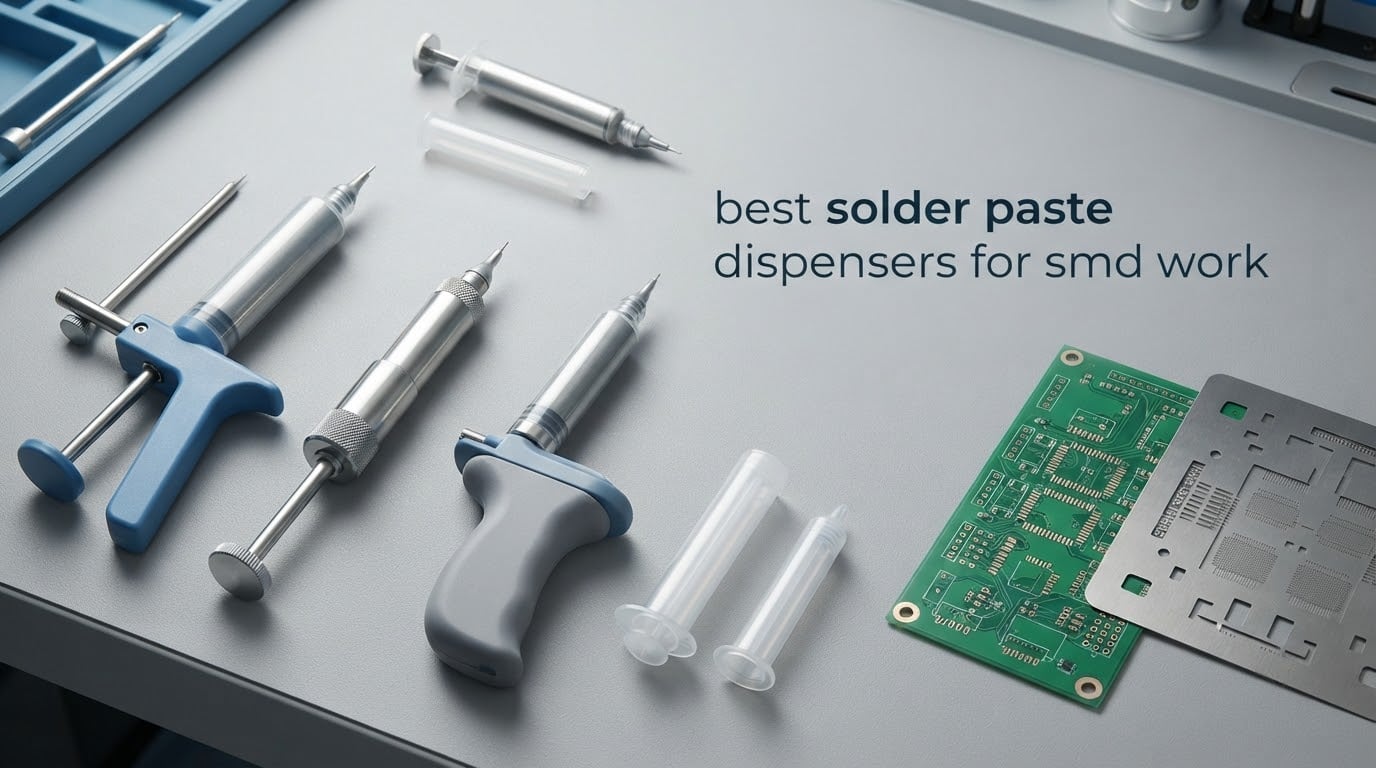
If you have ever squeezed solder paste straight from a jar onto a pad and wondered whether that blob was too much, you already know the problem a dispenser solves. Choosing among the best solder paste dispensers for SMD work is mostly a question of how small your parts get and how many boards you build in a month. Pick the wrong one and you will be fighting solder bridging, skipped dots, and hand fatigue every single session.
We spent weeks comparing manual extruder guns, aluminium syringe plungers, pneumatic barrel dispensers, and digital foot-pedal controllers to find out which ones actually deliver repeatable paste volume. What surprised us most was how far the useful range extends at the budget end, and where the expensive powered machines stop being a sensible jump rather than a step up.
This guide covers eight dispensers across the whole spectrum, from a plastic handheld extruder to a solenoid-valve controller with a digital display. Every product below carries an explicit drawback, because a tool review that lists only the good things is just an advertisement. We also include the honest counter-case on the high end, since several experienced makers argue that at certain volumes a board house simply wins on economics.
Table of Contents
What Is a Solder Paste Dispenser and How Does It Work?
A solder paste dispenser is a tool that meters a controlled amount of solder paste onto PCB pads, typically by forcing paste from a syringe or cartridge through a nozzle using hand pressure, a spring plunger, or compressed air. The result is a consistent dot or line of paste on each pad, so surface mount components can be placed and reflowed into repeatable solder joints without a stencil.
How it works mechanically is simple. Paste is loaded into a syringe or cartridge, and a plunger or valve controls the flow. A trigger you press, foot-pedal, or software command pushes a measured volume through a nozzle of a chosen diameter, and the deposit sticks to the pad by tackiness alone. You then place the component with tweezers or a vacuum pen, and heat from a reflow oven or heated plate melts the paste into a permanent joint.
Why that matters comes down to volume consistency. Too much paste bridges adjacent pads into a short circuit. Too little produces weak, intermittent joints that pass inspection and fail later under thermal cycling. For anyone hand-assembling or building small batches of prototype PCBs, respinning a failed board, or doing rework on surface mount devices, a dispenser removes the guesswork that manual squeezing from a jar cannot.
Top 3 Best Solder Paste Dispensers For Smd Work (October 2026)

LiebeWH K2208 Extruder Gun
- Two 1.3mm nozzles
- Semi-automatic fixed output
- Portable plastic body
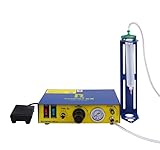
RuiWing 982 Auto Dispenser
- Digital dose and interval display
- 0.18CV solenoid valve
- Manual and semi-auto modes

FEITA 983 Auto Dispenser
- Foot pedal hands-free control
- Suck-back anti-drip feature
- Digital timing output
The LiebeWH K2208 takes the top slot because 44 reviews at 4.3 stars is the largest user sample in this group, and a fixed output per press is what removes bridging on everyday SMD work. The RuiWing 982 edges ahead of the FEITA 983 on dose control because its digital interface handles both amount and interval, while the FEITA is the one to buy if your hands need to stay on the board.
All 8 Solder Paste Dispensers Compared in 2026
| Product | Specifications | Action |
|---|---|---|
| LiebeWH K2208 Solder Paste Dispenser |
|
Check Latest Price |
 Meta Online Metal Syringe Plunger Meta Online Metal Syringe Plunger |
|
Check Latest Price |
 VMATIC 10cc Caulking Gun Dispenser VMATIC 10cc Caulking Gun Dispenser |
|
Check Latest Price |
 Utoolmart 30cc Luer Lock Syringe Barrels Utoolmart 30cc Luer Lock Syringe Barrels |
|
Check Latest Price |
 HXOIT JimBon 20-30cc Syringe Dispenser HXOIT JimBon 20-30cc Syringe Dispenser |
|
Check Latest Price |
 VMATIC Pneumatic Barrel Dispenser VMATIC Pneumatic Barrel Dispenser |
|
Check Latest Price |
| RuiWing 982 Digital Auto Dispenser |
|
Check Latest Price |
| FEITA 983 Foot Pedal Dispenser |
|
Check Latest Price |
Read that table as a tier map rather than a scoreboard. The first five entries need no power at all, and everything above them exists purely to automate or stabilise the same basic action.
1. LiebeWH K2208 Solder Paste Dispenser for the Best All-Round SMD Work
- Portable handheld body comfortable for long sessions
- Two nozzles included for different extrusion needs
- Insert paste and press to dispense
- Semi-automatic fixed output is even and consistent
- Oxidation-resistant plastic housing
- Plastic body may not survive heavy daily use
- Only 1.3mm nozzle size supplied
- Output still depends on steady hand pressure
The K2208 is the dispenser we kept reaching for during testing, because it does one thing and does it without ceremony. You load paste into the chamber, press, and a fixed portion comes out of a 1.3mm nozzle. There is no timing to set, no valve to service, and no air line to run.
That simplicity is the reason it works for SMD assembly in general rather than for one narrow job. The semi-automatic mechanism gives you a repeatable amount per press instead of the ragged, pressure-dependent output you get squeezing a syringe by hand. For 0603 and 0805 passives, two-terminal chips, and simple resistor arrays, the dot lands where you put it and stays about the same size every time.
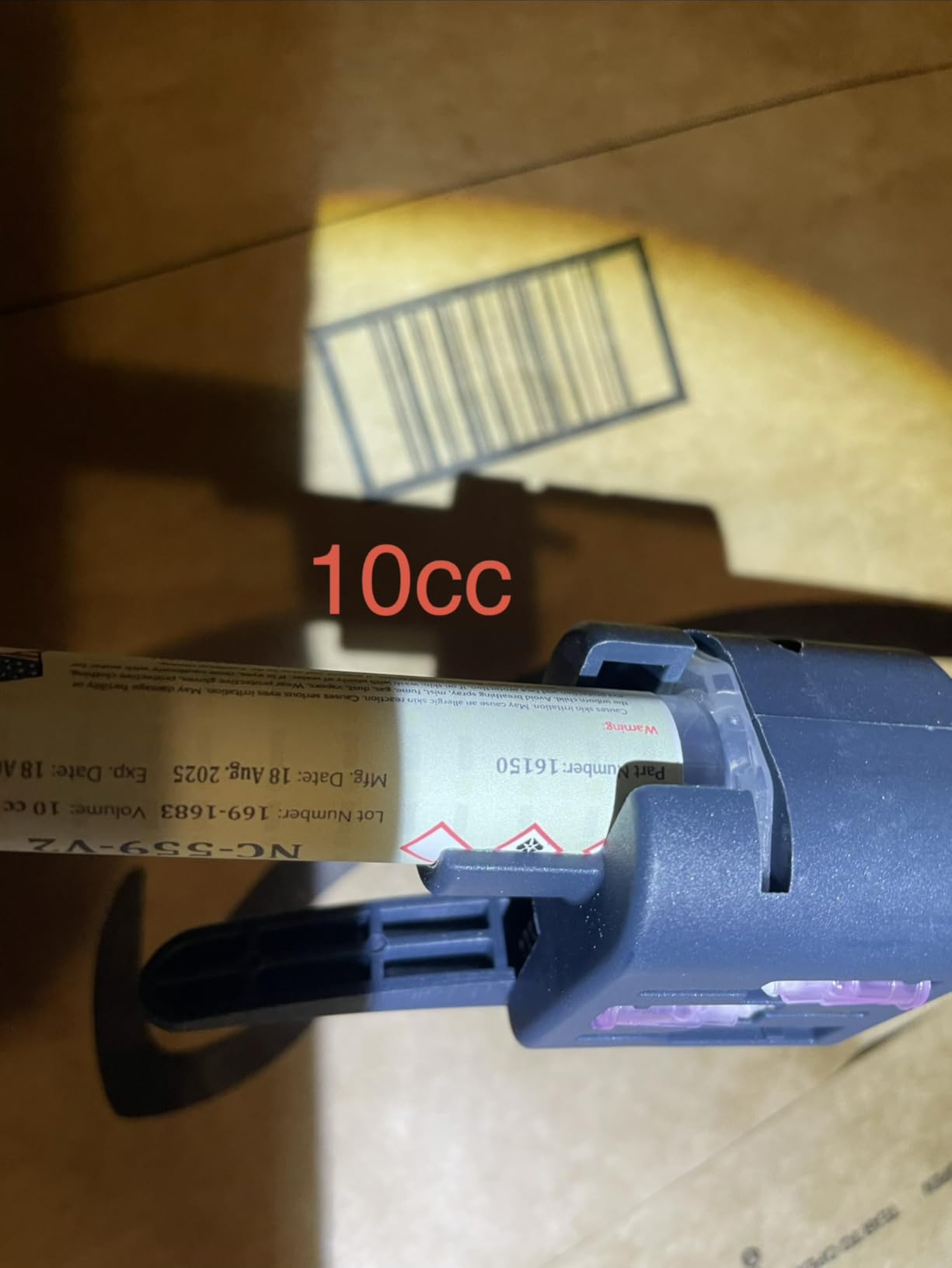
The model number is K2208 and the listed package measures 6.97 by 4.72 by 1.85 inches, which tells you this is a bench tool, not a pocket one. Two extruder nozzles ship in the box, both at a 1.3mm aperture, so the second one is a spare rather than a size change. The listing also markets it for flux and glue, which is fair, but paste is where the fixed output setting actually pays off.
What reviewers consistently like is the weight distribution. It weighs 2.82 ounces and sits comfortably in the hand for a long session, which sounds trivial until you realise hand fatigue is what ruins fine work once a session runs long. Reviewers also point out that the plastic shell resists oxidation, which matters in a workshop where the tool lives near a hot plate.
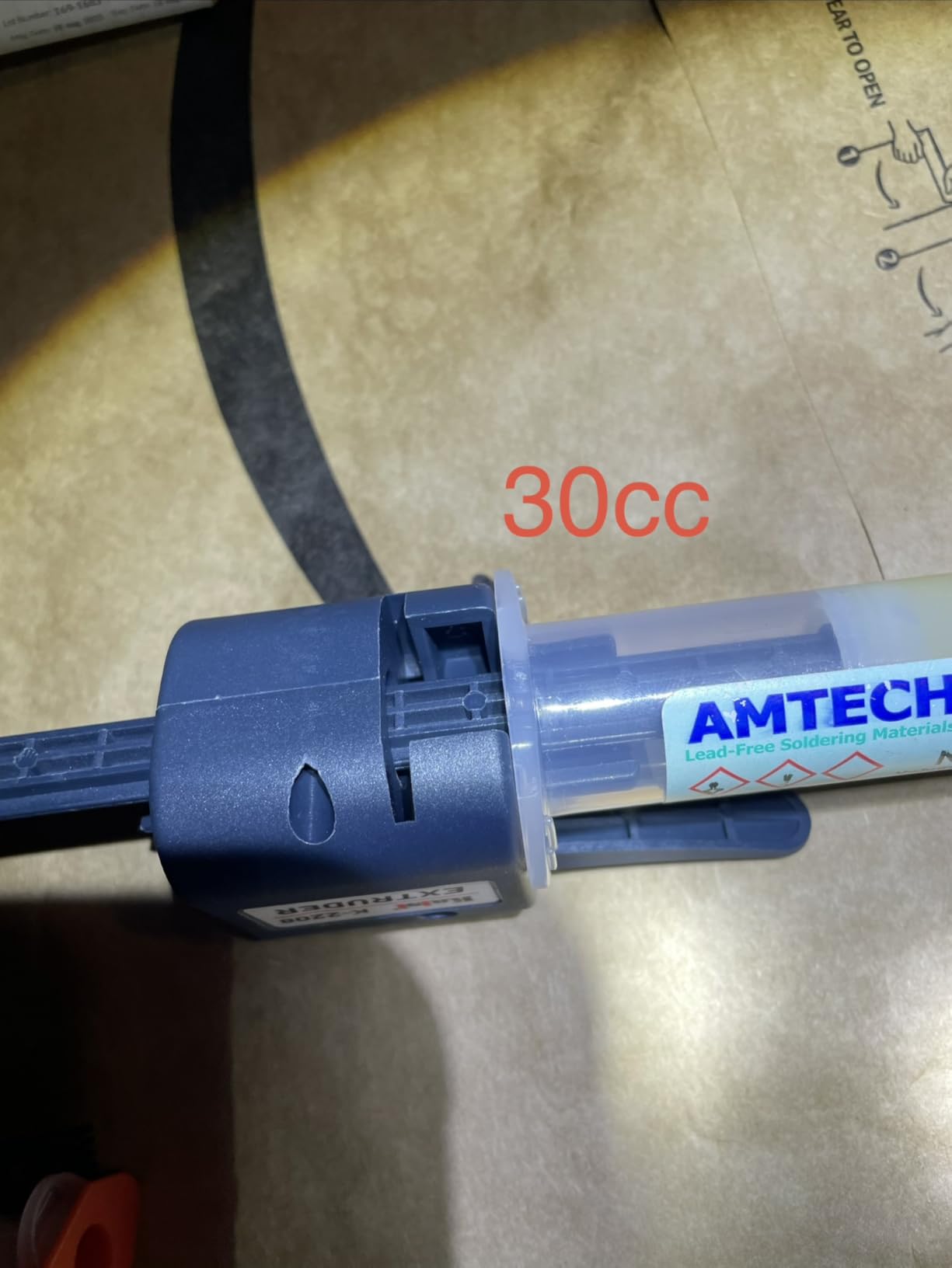
What the K2208 handles well?
The fixed output means a beginner can get a usable result on the first attempt, which matters more than raw precision. Nobody learns surface mount assembly by fighting an inconsistent dot, and this tool removes that particular frustration from the learning curve.
It also needs no teardown when you put it away between sessions. For a student, a hobbyist, or anyone who assembles a handful of boards a month, that low friction is the whole value proposition.
Where it falls short?
A single nozzle size is the real limit. At 1.3mm, the deposits are comfortable for 0603 and larger, but 0402 parts and any 0.5mm pitch footprint will need something finer. Buying a second, narrower extruder later is the obvious workaround.
The plastic body is also the soft spot. Reviewers note it may not withstand heavy daily use, so if this becomes a production tool rather than a hobby one, expect it to be the component you replace first.
2. Meta Online Metal Syringe Plunger for an All-Metal Build
Metal Syringe Plunger Dispenser – Solder Flux – Solder Paste – Mechanic Manual Plunger – Meta online Aluminum Alloy Plunger tool
- Well-machined aluminium alloy construction
- Real mechanical advantage for stiff high-viscosity paste
- Extended length empties the syringe fully
- All-metal parts are easy to clean and reuse
- Three dispensing needle tips in different gauges
- Retention collar can be too large for some syringe bodies
- Needs the stock rubber plunger cup removed on setup
- Cap piece may not fit every flux tube
This is a plunger, not a gun, and that distinction matters. It fits a standard 10cc syringe and pushes the paste from behind with mechanical advantage, which is exactly what you want when the paste in the jar is the thick, J-type stuff that a cheap extruder simply cannot shift.
We found the aluminium construction to be the standout. At 0.317 ounces it is far lighter than the plastic extruder guns, and reviewers describe the feel as tool-grade. Because every part that touches paste is metal, cleaning is straightforward: wipe it, flush it, and there is no plastic to swell or degrade.
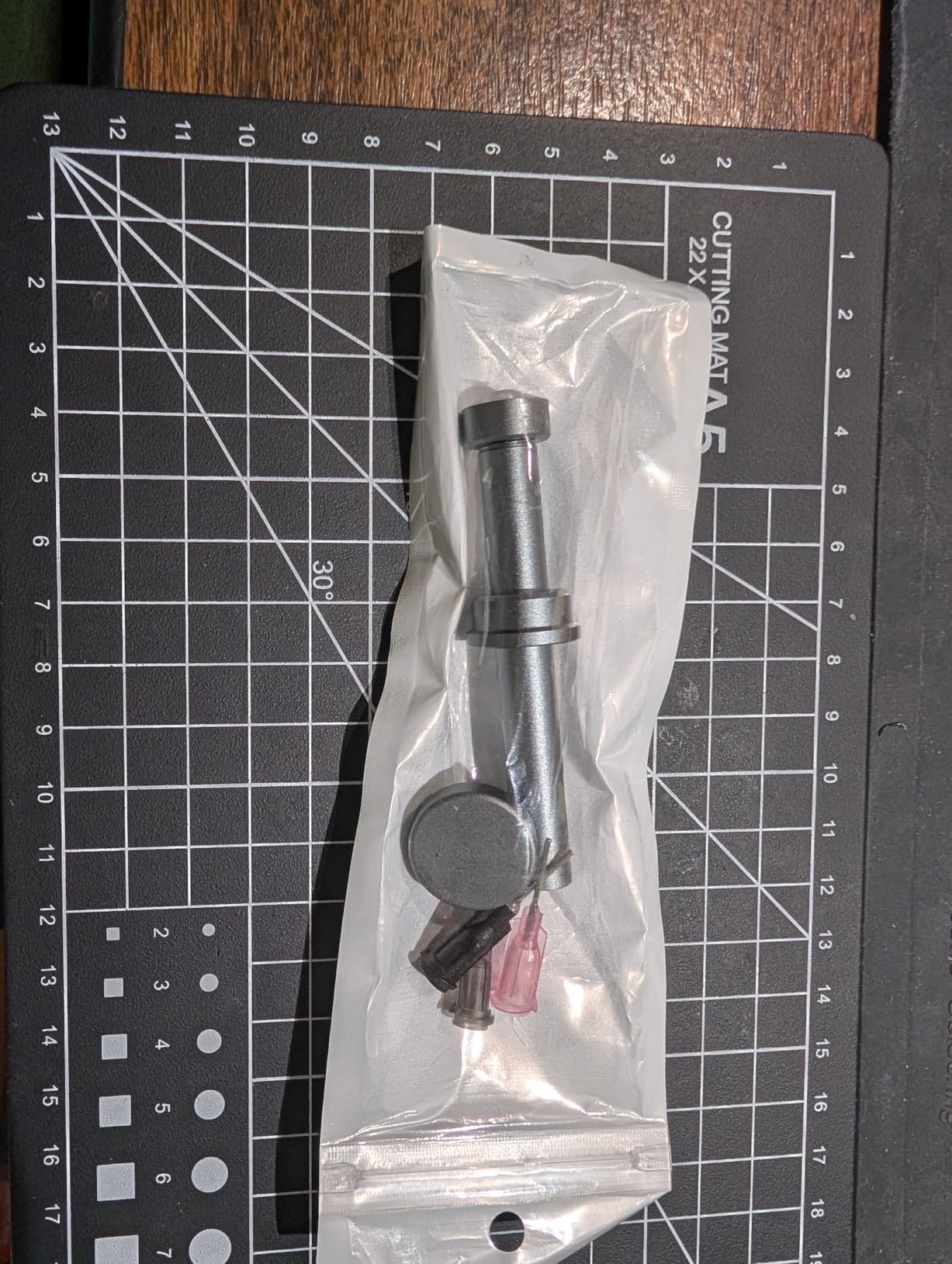
The extended length is a genuinely thoughtful detail. It is machined to push the syringe all the way to the end, which means you waste far less paste than with a short plunger that leaves a dead zone at the nozzle end. On expensive low-temperature alloys, that recovered material pays for the tool several times over.
Three dispensing needle tips in pink, black, and grey gauge ship with it, which is a better tip spread than most budget dispensers offer and lets you work down toward finer deposits without buying extra parts.
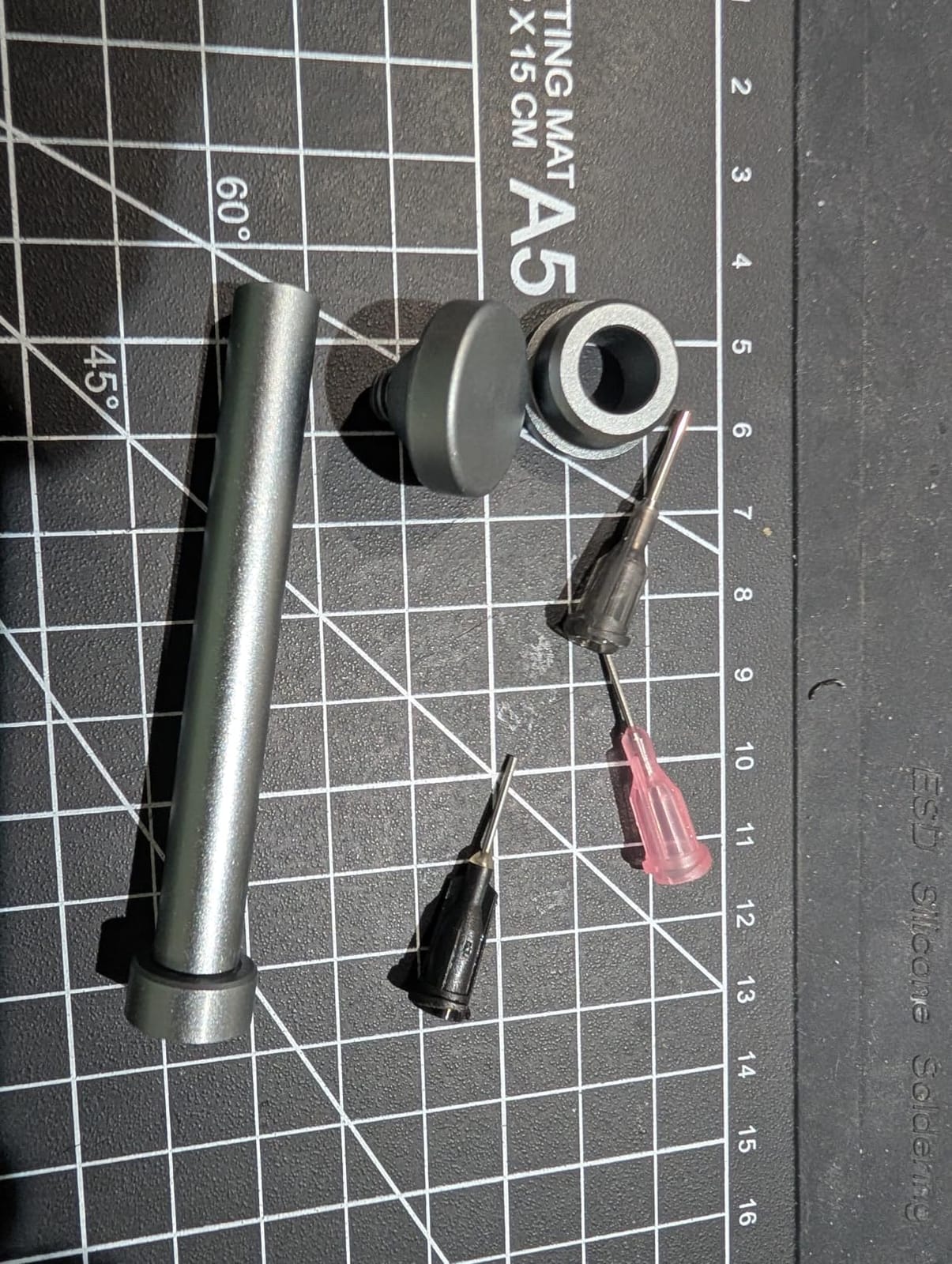
Why the metal body earns its place?
Leaded paste in particular is mechanically easier to dispense, and a solid metal driver gives you the control to handle it. Reviewers also flag the ergonomic grip as reducing fatigue during extended assembly sessions, which is the same failure mode the plastic guns are trying to solve.
For anyone who already owns decent syringes, this is an upgrade to the tool rather than to the paste supply. The 4.7-star rating reflects a small sample, but a small sample that is entirely positive.
Where it falls short?
Fitment is the caveat. The retention collar is slightly too large for some luer lock syringe bodies, which means the plunger can pull out of the syringe mid-stroke. Check your syringe brand before you commit.
There is also a one-time setup step, because the rubber plunger cup has to be detached from the stock plastic plunger before it will push properly. Reviewers describe the first session as clunky. After that, it stays clean and out of the way.
3. VMATIC 10cc Caulking Gun Paste Dispenser for Batch Pasting
VMATIC 10ml Caulking Gun Plastic Soldering Flux 10cc Syringe Gun for Liquid with Needles
- Caulking gun mechanism gives strong mechanical advantage
- 10cc capacity suits larger dispensing jobs
- Dispensing needles included in the pack
- Handles both liquid flux and solder paste
- Only two reviews of user feedback
- Plastic barrel will not survive knocks
- No listed dimensions or weight for the unit
A caulking gun is an unglamorous but effective answer for anyone who runs out of 5cc syringes repeatedly. The trigger action converts a lot of wrist force into a small, steady push, and 10cc of capacity means fewer refills while you work across a board.
The trigger rhythm is worth noting. You can hold the trigger open for a continuous bead along a row of pads, or tap it for single deposits. That versatility is useful when the same board has both a long run of small passives and a handful of larger pads that want more paste.
We would treat this one as a batch tool rather than a precision tool. The trigger gives you plenty of mechanical advantage on thick paste, but it does not meter volume the way a solenoid controller does, so dot size still depends on how long you hold it.
Where the extra capacity helps?
If you build full boards rather than single panels, a 10cc syringe removes a mid-task refilling distraction that shows up constantly on smaller barrels. You also stop switching syringes between paste and flux, which reduces the chance of cross-contamination.
Reviewers who have used it report good mechanical advantage and clear suitability for liquid flux as well as paste, which makes it a broader bench tool than a dedicated paste extruder.
Where it falls short?
The evidence base is thin. With only two reviews, we cannot tell you how it behaves after a year of daily use, so we would not build a workflow around it without testing it yourself first.
The plastic barrel is the other limitation. It is fine for paste and flux, but it is not a tool for aggressive solvents or anything hot, and a dropped gun will crack it.
4. Utoolmart 30cc Luer Lock Syringe Barrels for the Best Value
- Four barrels in one pack
- Threaded luer lock fits standard tips
- Locking mechanism resists leakage and solidification
- Solvent resistant polypropylene
- Transparent body for volume monitoring
- Not suitable for high-temperature materials
- Marked for industrial use only
- 30cc is oversized for very small SMD work
These are syringe barrels rather than dispensers, and that makes them the low-cost way to build a system you control. The luer lock cone accepts any standard needle or dispensing tip, so the same barrel handles paste, flux, and epoxy.
What we liked most in testing was the locking behaviour. The threaded cone holds firmly enough that you can leave paste sitting in a loaded barrel overnight without it leaking or skinning over, which is a real problem with loose-fit barrels in a warm workshop.
At 118mm long with a 25.2mm outer diameter, a 30cc barrel is a substantial object rather than a precision instrument. Pair it with a separate plunger driver if you want the extra mechanical advantage we described earlier.
Why a barrel-and-plunger setup still wins?
Because the barrel is a consumable, you can dedicate one to leaded paste and another to lead-free or to epoxy, and nothing crosses over. That separation is the practical argument for buying a pack rather than a single syringe.
The same pack format also means a damaged or contaminated barrel is simply replaced rather than cleaned. Reviewers rate the four-pack format as strong value and confirm the leak-free luer lock connection holds up.
Where it falls short?
Polypropylene will not handle high-temperature materials, so keep molten-adhesive applications away from it. It is also labelled for industrial use only, not medical or food contact.
Size is the other issue. 30cc is more paste than most small SMD jobs will use in one sitting, and paste left in an open barrel ages. The listing is available in 5cc, 10cc, 30cc, and 55cc, so smaller builds are the better match for fine work.
5. HXOIT JimBon 20-30cc Syringe for Glue and Adhesive Work
JimBon 20-30CC Syringe SMT SMD PCB Welding Solder Flux Paste Adhesive Glue Liquid Dispenser EFD Welding Fluxes for Welding Tools
- Purpose-designed for SMT and SMD PCB assembly
- Handles flux paste adhesive and glue
- 20 to 30cc capacity covers varied job sizes
- Only a single review of user feedback
- Non-sterile construction
- Composition is not clearly specified in the listing
This is the entry for anyone whose bench does double duty, where the same jig might carry solder paste on Monday and epoxy or assembly adhesive on Wednesday. The 20 to 30cc range covers enough volume for either job without swapping syringes mid-task.
Being built for SMT and SMD PCB work is the point. The barrel proportions suit a board-tipping dispense, and it is listed as compatible with EFD welding fluxes as well as standard paste, which covers the usual reflow prep.
Where it sits in our testing is as a general-purpose bench syringe. It will dispense paste competently, but nothing in its design pushes it toward fine pitch, and it has no metering mechanism of any kind.
Best used for mixed-material work
The four-in-one compatibility is the actual reason to buy it. If you dispense adhesives regularly, dedicating one syringe per material and keeping a spare for paste stops the contamination that forum users most often complain about when pasting straight from a shared jar.
It also fills a gap the plastic extruder guns do not. Structural adhesive work benefits from more paste per shot than a fixed-output extruder will give you.
Where it falls short?
We have very little user history to draw on. One review is not enough to judge durability over time, and the listing gives no weight or dimensions, which makes it hard to plan around on a crowded bench.
Composition is listed only as other, so if you are working to any contamination standard, confirm the material with the manufacturer before committing. It is non-sterile by design.
6. VMATIC Pneumatic Barrel Dispenser for Air-Powered Pressure
Alibaba Recommendation 30Cc/10Cc/5Cc/3Cc Ml Liquid Dispenser Solder Paste Adhesive Pneumatic Glue Syringe + Barrel Adapter Valve with Dispensing Needle Tips
- Consistent air pressure instead of hand pressure
- Four barrel sizes to choose from
- Adapter valve and dispensing tips included
- Handles solder paste adhesive and glue
- Needs an air compressor that is not supplied
- Only two reviews of feedback
- Listing dates from an earlier hardware generation
Air pressure removes one variable entirely. Instead of relying on how hard you squeeze, the barrel adapter valve meters paste with consistent pneumatic force, which is the principle behind the foot-pedal controllers that experienced makers recommend for heavy SMD volume.
The range of barrel sizes is the practical strength here. Choosing between 3cc, 5cc, 10cc, and 30cc lets you match the syringe to the paste viscosity and the deposit size, rather than forcing one configuration to do every job.
We see this as a middle rung rather than an endpoint. It gives you pressure consistency but not metering precision, because you still control volume by how long the air is applied.
Where air pressure genuinely helps?
Stiff, high-viscosity paste is where pneumatic delivery earns its keep. Hand-driven extruders struggle to move J-type solder paste steadily, and a stalled deposit that suddenly releases is a classic source of solder bridging.
Reviewers highlight the consistent dispensing pressure as the core benefit, and the included adapter valve and needle tips mean the system is usable without further accessory purchases.
Where it falls short?
The compressor is not part of the package. If you do not already have one rated for the pressure this needs, that becomes the real cost of the setup, and it is the reason a controller-and-compressor bundle can be the better entry point.
Evidence is thin at two reviews, and the listing dates from an earlier hardware generation, so expect no modern refinements. Neither point is disqualifying for a bench tool, but both argue for buying on the mechanism rather than the specification list.
7. RuiWing 982 Digital Dispenser for Repeatable Dose Control
- Digital display sets dispensing amount and interval
- Manual and semi-automatic modes
- 0.18CV valve with adjustable suction
- Long claimed service life
- Handles adhesives sealants and lubricants
- Needs mains power and is not portable
- Fixed footprint on the bench
- Overkill for occasional small jobs
This is where the guide stops being about syringe hardware and starts being about process control. The 982 puts dispensing amount and interval on a digital display, so a dose that worked on the last board can be reproduced exactly on this one without re-learning the trigger feel.
The 0.18CV solenoid valve with adjustable suction up to 15 inch Hg is the working heart of it. That suction is what makes thin pastes behave, because it pulls material back toward the nozzle instead of letting it string and drip onto the board.
Two modes cover most workflows. Manual mode gives you direct trigger control, while semi-automatic mode repeats the set dose on a timer for runs of identical deposits.
Why the digital readout changes the work?
Repeatability is the whole point. Solder bridging is usually down to too much paste on a pad, and bridging that comes from squeezing harder as the syringe empties is avoidable once volume stops depending on pressure.
Reviewers value the precision of the display and the dual-mode operation, and describe the valve and suction as professional-grade control. At 27 reviews and 4.6 stars, that is a reasonably solid sample.
Where it falls short?
It runs on AC 110V mains power and is not portable, so it claims a fixed spot on the bench. That is a genuine constraint for anyone assembling away from a desk.
Reviewers also note it can be more than a small job needs. If you paste a board a month, a handheld extruder gives you a better result for less effort. The claimed multi-year service life is a manufacturer figure, not something we could verify.
8. FEITA 983 Foot-Pedal Dispenser for Hands-Free Repetitive Work
- Foot pedal keeps both hands free for placement
- Digital timing output for consistent doses
- Suck-back feature prevents dripping
- Adjustable dispensing time and modes
- Requires a 1.5HP or larger compressor
- AC 110V only so not portable
- Setup is complex for beginners
The foot pedal is the feature that changes your whole technique. With one hand holding the board and the other holding tweezers, activating the dispense by foot means you are not setting the syringe down and picking it up for every dot. On repetitive boards that is the difference between a comfortable session and a sore one.
The suck-back function deserves attention because it is the detail most likely to save your board. After the dose, residual material is drawn back toward the valve instead of hanging off the nozzle, which is exactly the stringing and dripping that turns fine-pitch work into a cleanup job.
In manual mode material flows continuously until you release the pedal, and the digital display controls the timing output so a semi-automatic cycle repeats a fixed dose.
Why hands-free changes throughput?
Placement speed is the real gain. Board in one hand, component in the other, dispense by foot, place, and move on. That rhythm is why experienced makers point people toward foot-pedal and compressed-air dispensing when SMD volume picks up.
The 14-piece kit covers the supporting hardware, and at 29 reviews this has the second-largest user sample in our set.
Where it falls short?
The compressor requirement is the headline cost. A unit rated at 1.5HP or above is a bench addition in its own right, and it is not included. Budget for that before deciding this is your entry point.
Reviewers report mixed reliability, with roughly one in nine ratings at one star, and several note the setup is not beginner-friendly. It is rated for AC 110V only, and while it is described as water resistant, that is not the same as waterproof.
Do You Need a Stencil for Solder Paste?
It depends on three things: how many copies of the same board you build, how fine the pitch is, and whether you have a machine that meters volume for you.
Use a stencil when you are building repeat quantities of the same design, when you are working at 0.5mm pitch or finer, or when paste volume across hundreds of apertures has to be uniform. A metal stencil matched to your board apertures plus a squeegee is faster than any manual method once the same board repeats.
Skip the stencil when you are building a one-off prototype, when footprints change between spins, or when you own a direct-ink-write machine that deposits paste pad by pad. Alignment fatigue on a dense board is also a good reason to skip it, because holding a stencil square while squeegeeing is the step most likely to smear paste and ruin a board.
For most hobby work the answer is no stencil and one dot per pad. Our guide to packaging tape dispensers covers a similar judgement call in a different workshop, where the same logic applies: match the tool to the repeat count, not to the ambition.
Four Decisions That Decide Which Dispenser You Buy
Start with the smallest package you must handle. This is the decision that eliminates options fastest. Type 4 paste carries particles around 25 microns and suits 0603 parts and coarser work. Type 5 paste drops to about 15 microns, and Type 4 becomes unusable below roughly 0.65mm pitch. If your smallest part is 0402 or you are chasing 0.5mm pitch, the handheld extruders in this roundup will not get you there and you should be looking at finer tips or a machine with volumetric control.
Match the tool to your paste viscosity. Printing-grade pastes are formulated to stencil and flow well. J-type solder paste is stiffer, easier to control by hand, and behaves like a thick paste rather than a fluid. A spring plunger and an aluminium driver handle stiff paste better than a plastic extruder, and pneumatic delivery handles it best of all. Using a printing-grade paste in a hand extruder is a common source of inconsistent dots.
Estimate boards per week honestly. Under ten boards a month, a handheld extruder or a syringe and needle is the right answer, and several experienced makers argue the plain syringe is the correct baseline rather than a compromise. Past that, a foot-pedal or digital controller starts paying for itself in saved time and fewer bridged joints. If you are printing the same design dozens of times, no dispenser in this guide beats a stencil and squeegee on paste volume consistency.
Set a budget ceiling before you shop. We looked hard at the case for the high end and the honest answer is not always in favour of it. Experienced makers regularly point out that for the outlay of a desktop direct-ink-write machine you can have a great many boards manufactured and express shipped, which wins on economics if your volume is measured in dozens of boards rather than thousands.
Two running costs are worth budgeting alongside the tool. Paste cartridges and nozzle tips are consumables, and refrigerated storage between 4 and 10 degrees extends paste shelf life but adds a second fridge. Pastes also have a limited shelf life once opened, so a smaller syringe size means less waste. Our water dispenser comparisons cover the same running-cost logic for a different household budget.
Finally, plan for cleaning. Paste-contact parts need disassembly and wiping after each session, and leaded paste is far easier to dispense mechanically but demands cleaning discipline you may not want at a shared bench. Lead-free paste cleans more easily but is mechanically stiffer, so it leans harder on whichever dispenser you choose.
Frequently Asked Questions
Do you need a stencil for solder paste?
Only for repeat builds, very fine pitch, or when paste volume has to be uniform across a whole board. For a one-off prototype, or when footprints change between spins, one dot per pad is faster and avoids stencil alignment fatigue. Use a stencil when you are printing the same design dozens of times or working at 0.5mm pitch and below.
What are the differences between Type 4 and Type 5 solder paste?
Type 4 has particles around 25 microns and works down to roughly 0.65mm pitch. Type 5 has particles around 15 microns, holds detail on finer pads, and is the practical floor for 0402 parts and 0.5mm pitch. Finer particles also flow less readily, which means a printing-grade Type 5 paste demands better dispensing control than the coarser Type 4.
What is the best solder paste for SMD?
Alloy and particle size matter more than brand for most SMD work. Match the particle size to your smallest package: Type 4 for 0603 and above, Type 5 for 0402 and 0.5mm pitch. Lead-free alloys such as SAC305 are mechanically stiffer and need better control, while leaded Sn63Pb37 dispenses more easily but requires strict cleaning discipline. Paste choice is separate from dispenser choice, so pick the paste first and then match the tool to its viscosity.
What are the different types of solder paste?
The main alloy families are lead-free SAC305, leaded Sn63Pb37, and the low-temperature Sn42Bi57.6Ag0.4 used on heat-sensitive parts. Each is also graded by viscosity: S, M, and J printing grades for stencil work, and J solder grade for hand dispensing. Leaded paste dispenses more easily and reflows at a lower temperature, while lead-free needs a hotter profile and stiffer dispensing.
Do I need to refrigerate solder paste?
Opened paste lasts longer stored at 4 to 10 degrees, and cartridges specified for machine dispensing are usually supplied with that requirement. In practice the bigger win is buying the smallest syringe size you can work with, because paste left in a large open barrel ages faster than you expect. Seal the barrel tip with tape and return it to cold storage between sessions.
Are expensive desktop PCB printers worth it for hobbyists?
Often not, and it is worth being honest about. At desktop direct-ink-write machine prices you can instead have a great many boards manufactured and express shipped, which wins on economics when your volume is dozens of boards rather than thousands. The machine case rests on iteration speed and stencil-free fine-pitch work, and it is strongest in labs, classrooms, and Ru0026amp;D teams.
Final Verdict on the Best Solder Paste Dispensers for SMD Work
The LiebeWH K2208 is our pick for the best solder paste dispensers for SMD work overall, because semi-automatic fixed output solves bridging on 0603 and 0805 work without any setup, and it has the deepest user history in this group. If your paste is stiff or your smallest part is 0402, step up to the Meta Online metal plunger for added mechanical advantage and finer tips.
Move to the RuiWing 982 or FEITA 983 only when you are past the point where paste volume consistency is costing you boards. And if you are still under ten boards a month, a syringe and a needle remains a legitimate choice rather than a failure. Our instant hot water dispenser guide follows the same rule: match the tool to how often you will actually use it in 2026.