
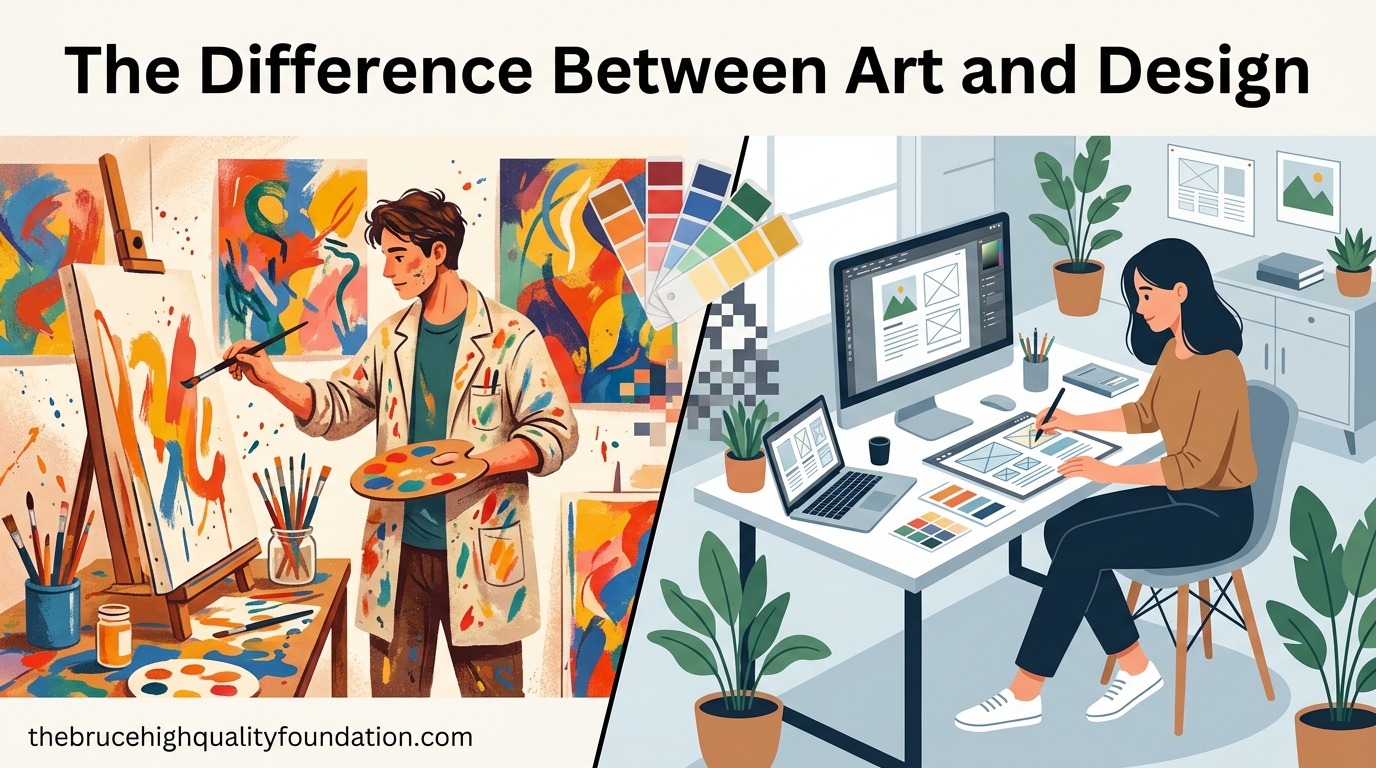
If you have ever wondered what separates art from design, you are not alone. I have spent years working alongside artists and designers, and the question still sparks debates in studios, classrooms, and online forums. This guide breaks down everything you need to understand about the difference between art and design.
By the end, you will have a clear picture of how these two creative disciplines differ in purpose, process, and outcome. Whether you are a student choosing a path, a client working with creative professionals, or simply curious, this article is for you.
Table of Contents
What Is Art?
Art is creative self-expression. It exists to communicate meaning, evoke emotion, and explore ideas that live inside the artist’s mind. When someone creates art, the primary goal is rarely to solve an external problem.
Instead, art asks questions. It challenges conventions. A painter might pour their grief onto canvas. A sculptor could channel political frustration into bronze. The measure of success is whether the work carries meaning, not whether it completes a task.
Art invites interpretation. Two viewers might see entirely different things in the same painting, and both could be right. This openness is a feature, not a flaw. If you want to explore this further, my team has written about conceptual art and how meaning takes precedence over visual beauty.
What Is Design?
Design is functional problem-solving. It exists to address a specific need, improve usability, or guide someone toward an action. Every design decision traces back to a practical goal.
When a designer creates a logo, they ask: Does this mark communicate the right brand personality? Can someone recall it after seeing it once? Will it work across business cards, websites, and billboards? The measure of success is whether the design accomplishes its intended purpose.
Design directs attention. It uses art as a tool to lead the audience to feel a certain way or do a certain thing. This is why designers talk so much about user needs, readability, and conversion. If you are curious about where commercial goals meet creative expression, my colleague explored this in our piece on appropriation art.
Purpose and Intent: The Core Difference
The fundamental difference between art and design lies in their starting intentions. Art begins with something the creator wants to express. Design begins with something the audience needs to understand or do.
I find that this distinction explains most of the tension between the two fields. Designers often feel that their work should be recognized as creative, while artists sometimes worry that commercial constraints dilute authenticity. Both concerns stem from misaligned expectations about intent.
Art prioritizes meaning above all else. Design prioritizes function above all else. Neither is superior. They simply serve different masters. Our team has also examined how art criticism helps us evaluate artistic intent and success.
Process: Instinct Versus Method
Artists primarily work off instinct. They follow hunches, chase unexpected inspiration, and allow the work to evolve organically. This does not mean artists lack discipline. It means their discipline serves the mysterious process of creative discovery.
Designers employ a methodical, data-driven process. They research user behavior, test multiple concepts, and refine based on feedback. Each decision traces back to reasoning that can be articulated and defended.
One designer told me that she approaches every project like a puzzle: gather the constraints, identify the problem, test solutions, repeat until it works. An artist might find this approach soul-crushing. A designer might find artistic spontaneity irresponsible. Both perspectives have merit.
Functionality: Expression Versus Practicality
Art does not need to be functional in any practical sense. A poem does not help you navigate a city. A sculpture does not organize your desk. Beauty and meaning are their own rewards.
Design must function. If a website is stunning but impossible to use, it has failed. If a chair looks like art but collapses when you sit on it, it has failed. Practical success is non-negotiable, even if aesthetics matter too.
This is why we describe art as aesthetic-first and design as functional-first. The best design achieves both, but when forced to choose, art chooses beauty and design chooses usability.
Audience: Open Interpretation Versus User Needs
Art invites open interpretation. The viewer’s response is part of the work. A gallery visitor might cry at a painting the artist created while feeling nothing. That visitor is not wrong. They have simply brought their own experiences to bear on the piece.
Design serves defined user needs. A designer’s success depends on whether the target audience understands, remembers, and acts on the intended message. Interpretation is controlled and directed, not open-ended.
One way to think about this: art speaks to the individual’s inner life. Design speaks to the individual’s role as a user, customer, or audience member in the world.
Historical Context: The Bauhaus Legacy
The twentieth century forced these two disciplines into explicit conversation. Before the Bauhaus school emerged in Germany, the line between fine art and applied art was sharper. Bauhaus founders believed that design should serve practical purposes while embracing aesthetic principles.
This merger created modern graphic design, industrial design, and interior design as we know them. It also raised enduring questions about whether functional design could be considered art. The debate continues today, but we now accept that many objects can be both beautiful and useful.
Understanding this history helps explain why so many designers now hold art degrees and why so many artists work in commercial contexts. The old boundaries have blurred.
Where Art and Design Overlap
The distinction between art and design is not a wall. It is more like a gradient with significant overlap. Graphic designers create posters that some people consider art. Artists create commercial work that pays the bills.
Some of the most interesting creative work lives in this gray area. Street art transforms public spaces with images that are both artistic expression and designed communication. Our comparison of street art vs gallery art explores this tension further.
The overlap expands when we consider that design uses art as its raw material. Every designed interface relies on color theory, typography, and composition principles that originated in fine art. The disciplines are more intertwined than their practitioners often admit.
Career Considerations
If you are deciding between art and design as a career path, a few practical questions can help clarify which direction fits.
Ask yourself: Do you want to express your own vision, or solve someone else’s problems? Do you want to invite interpretation, or guide behavior? Do you want to explore questions without known answers, or implement known solutions efficiently?
Artists often struggle with commercial viability because their work does not serve external purposes. Designers sometimes feel their creativity is constrained by functional requirements. Neither path is easier or harder. They simply require different kinds of motivation.
Many creative professionals move between both worlds throughout their careers. A graphic designer might create personal art on weekends. An artist might take commercial commissions to fund their studio practice. The choice does not have to be permanent.
Frequently Asked Questions
What is the main difference between art and design?
Art is creative self-expression focused on meaning and emotion, while design is functional problem-solving focused on meeting user needs. Art asks questions; design solves problems.
Is design considered art?
This depends on your definition. By traditional definitions, design focused on function may not qualify as art. But many contemporary critics argue that skilled, intentional creative work in any medium deserves the art designation. The boundary is debated rather than fixed.
Can something be both art and design?
Yes. Many designed objects are considered art, and many artists create work with functional purposes. The distinction is more about primary intent than absolute categories. Works like logos, posters, and product designs often occupy the overlap zone.
What was Paul Rand’s design style?
Paul Rand was a mid-century American graphic designer known for his clean, modernist logos for companies like IBM, ABC, and UPS. His work exemplifies how functional design can achieve timeless aesthetic appeal. He believed design should be clear, memorable, and universal.
Conclusion
Understanding the difference between art and design helps clarify what you are looking at, what you are creating, and what you should expect from creative work.
Art asks: What does this mean? Design asks: What does this do? Art expresses. Design solves. Art invites interpretation. Design guides behavior. Neither is better than the other. They simply serve different purposes and require different mindsets.
The next time you look at a painting or use a designed product, see if you can identify which discipline is leading. You might find that the best work blends both, creating meaning while serving purpose. That is where the most interesting creative territory lives.