
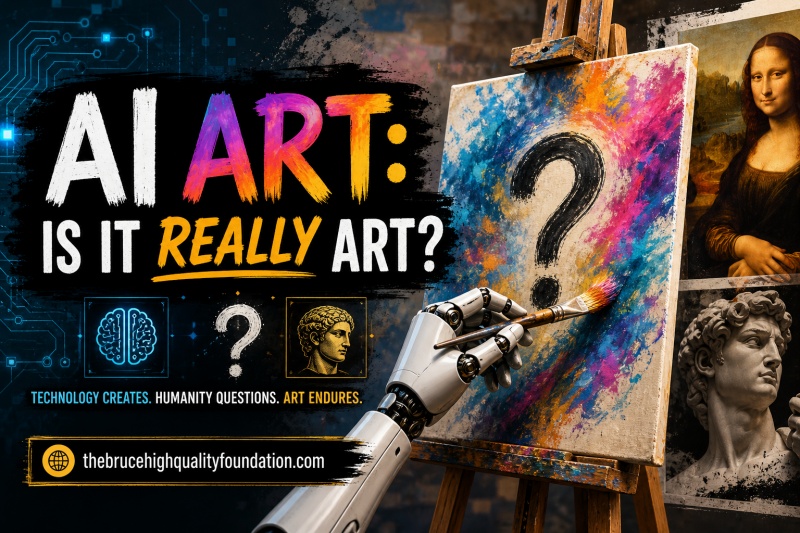
When an AI-generated portrait won first place at the Colorado State Fair art competition in 2026, the art world erupted. Traditional artists cried foul. AI enthusiasts celebrated. And millions of people asked the same question: AI art: is it really art?
This question has sparked one of the most heated debates in creative communities. The controversy touches on fundamental questions about creativity, authorship, and what it means to create something meaningful. I’ve spent months following this debate across artist forums, academic papers, and gallery discussions to bring you a complete picture of both sides.
By the end of this article, you’ll understand the technical reality of how AI art works, the philosophical arguments for and against its legitimacy, and why the answer might be more complicated than a simple yes or no.
Table of Contents
What Is AI Art and How Does It Work?
AI art refers to images, illustrations, or visual compositions created using artificial intelligence systems. These aren’t simple filters or effects applied to photos. Modern AI art generators like Midjourney, DALL-E, and Stable Diffusion create entirely new images from text descriptions called prompts.
The technology behind these systems is called generative AI, specifically diffusion models. During a months-long training process, these systems analyze billions of image-text pairs from across the internet. They learn patterns, styles, composition rules, and the relationships between visual elements and descriptive words.
When you type “a cyberpunk cat wearing sunglasses in neon Tokyo,” the AI doesn’t copy existing images of cats or Tokyo. Instead, it generates a completely new image by predicting what pixels should appear based on everything it learned during training. The result is original in a technical sense, though built upon the visual knowledge of countless human-created artworks it analyzed.
This distinction between training and copying matters enormously in the AI generated art debate. Understanding that AI systems learn patterns rather than store specific images helps clarify what these tools actually do. But it doesn’t resolve the deeper questions about creativity and authorship.
Arguments That AI Art IS Real Art
Proponents of AI art argue that these tools represent a natural evolution in artistic technology. Their case rests on several compelling points that deserve serious consideration.
First, consider the history of artistic tools. Photography was once dismissed as mere mechanical reproduction, not real art. Digital art faced similar skepticism. Critics argued that using software meant the computer was doing the creating. Today, both photography and digital art are fully accepted as legitimate art forms. AI advocates argue we’re witnessing the same pattern repeat.
The creative effort in AI art isn’t about brushstrokes or pixel-pushing. It’s about vision, curation, and conceptual thinking. A skilled AI artist might spend hours crafting the perfect prompt, running dozens of generations, selecting the best result, and post-processing the final image. This process involves aesthetic judgment, technical knowledge, and creative decision-making at every stage.
Prompt engineering has become its own craft. The difference between a generic output and a stunning image often comes down to the artist’s ability to describe lighting, composition, style references, and emotional tone. This is not unlike a traditional artist choosing their medium, palette, and technique.
Democratization represents another powerful argument. AI tools allow people without formal training or expensive equipment to express visual ideas. A writer can visualize their characters. A designer can quickly prototype concepts. Someone with physical disabilities that prevent traditional art-making can finally create visual art. Expanding who gets to participate in creative expression has inherent value.
Perhaps most philosophically, AI art opens entirely new aesthetic possibilities. Humans can now create images that would be physically impossible to paint or photograph. The collaboration between human imagination and machine capability produces art forms that couldn’t exist otherwise. New art movements have always faced resistance before eventual acceptance.
Is AI art real art? From this perspective, the answer is clearly yes. The human element of conception, selection, and intention remains central. The AI is simply a sophisticated brush.
Arguments Against AI Art Being Real Art
The opposition to AI art rests on concerns that go beyond simple resistance to change. Many professional artists have raised substantive objections that challenge fundamental assumptions about creativity and value.
The training data issue sits at the heart of the ethical controversy. Current AI systems were trained on billions of copyrighted images scraped from the internet without artists’ consent. Many artists discovered their distinctive styles being replicated by AI systems that had ingested their work without permission or compensation. This feels like theft to creators who spent years developing their visual voice.
Intent and consciousness present deeper philosophical objections. When a human artist creates, they bring emotional experience, cultural context, and personal meaning to their work. Art historians have long emphasized that art communicates something about the human condition. An AI has no inner life, no emotions, no lived experience to draw upon. It generates based on statistical patterns, not genuine expression.
The skill argument resonates strongly with traditional artists. Years of practice, failure, and incremental improvement shaped their craft. They learned anatomy, color theory, composition, and technique through dedicated effort. Watching someone type a sentence and receive a polished image in seconds feels like a dismissal of that entire journey. The process matters as much as the product.
Originality concerns also emerge. While AI outputs are technically unique combinations, they’re fundamentally remixes of existing human creativity. Nothing in an AI-generated image comes from lived experience or genuine insight. Every element traces back to human art the system analyzed. True creativity, critics argue, requires breaking patterns and introducing genuinely new ideas, not rearranging existing ones.
Market impact adds economic weight to artistic objections. Commission rates for illustrators and concept artists have dropped as clients turn to cheaper AI alternatives. Artists who spent decades building careers now compete with tools trained partially on their own work. The AI art ethics questions extend beyond philosophy into real livelihoods.
Copyright, Consent, and the Ethics of AI Art
Legal frameworks are scrambling to catch up with generative AI technology. The AI art ethics landscape shifts almost monthly as lawsuits proceed and new regulations emerge.
Current copyright law offers ambiguous guidance on AI-generated works. In the United States, the Copyright Office has ruled that purely AI-generated images cannot be copyrighted because they lack human authorship. However, images with substantial human modification or creative input may qualify for protection. The exact threshold remains unclear and will likely be settled through court cases over the coming years.
The training data lawsuits represent a more significant legal battle. Artists have filed class-action lawsuits against major AI companies alleging that training on copyrighted works without permission constitutes copyright infringement. These cases could reshape the entire industry. If courts rule that training requires licensing, AI companies would owe billions in compensation or rebuild their systems from properly licensed data.
Opt-out mechanisms have emerged as a compromise. Some AI companies now allow artists to request their work be excluded from future training datasets. However, this places the burden on individual artists to monitor and protect their work across dozens of platforms. It’s a partial solution that doesn’t address the billions of images already incorporated without consent.
Consent and compensation frameworks remain the holy grail for ethical AI art. Proposals range from collective licensing schemes similar to music royalties to technical solutions that track which training images influenced specific outputs. None have achieved widespread adoption yet, but the pressure for ethical solutions continues growing.
AI vs Human Art: What Sets Them Apart?
Comparing AI vs human art reveals fundamental differences that persist regardless of how sophisticated the technology becomes.
The creative process diverges dramatically. Human artists draw from lived experience, emotions, cultural context, and personal history. A painting might capture grief after loss, joy in new love, or commentary on social injustice. These meanings emerge from genuine human experience. AI generates images based on probability distributions learned from data, with no understanding of what the image represents.
Originality manifests differently as well. Human artists can introduce genuinely new concepts, styles, and approaches that don’t exist in prior art. They can be influenced by unrelated fields, personal dreams, or abstract philosophy. AI systems are fundamentally limited to recombining what they’ve already seen. They cannot conceive of visual ideas outside their training distribution.
Intentionality creates another crucial distinction. When a human artist chooses a color, they do so with emotional and aesthetic purpose. Every brushstroke reflects a decision about what the artwork should communicate. AI has no intention behind its choices. It selects pixels based on statistical likelihood, not meaning. The resulting image may resemble intentional art, but nothing guided it toward specific communicative goals.
However, collaboration models complicate this comparison. When humans thoughtfully use AI as one tool among many, adding their own creative decisions throughout the process, the line blurs. A digital artist might sketch a composition, generate textures with AI, paint over elements manually, and adjust colors in Photoshop. Is the final piece AI art or human art with AI assistance?
The AI vs human art distinction increasingly looks like a spectrum rather than a binary. Pure AI generation sits at one end, traditional handmade art at the other, with endless hybrid approaches between them.
Finding the Middle Ground
The most thoughtful voices in the AI generated art debate increasingly reject the simple yes-or-no framing. The answer to whether AI art is real art depends entirely on how we define art, creativity, and authorship.
One productive framework distinguishes between AI as a tool and AI as a creator. When a human uses AI as one component in a larger creative process involving judgment, selection, and manual refinement, they’re making art with new tools. When someone enters a prompt and presents the raw output as finished artwork, the human creative contribution is minimal.
Context also matters enormously. An AI image generated for personal enjoyment, shared among friends, serves a different purpose than one entered in a traditional art competition against human artists. The ethics and categorization shift based on where and how the work appears.
Transparency emerges as a key ethical principle. Artists using AI tools in their process should disclose this fact when showing work in contexts where viewers assume human creation. Competitions, galleries, and publications need clear categories that distinguish between human-made, AI-assisted, and AI-generated work.
The technology will continue evolving. Today’s arguments address current capabilities, but future AI systems may develop in unexpected directions. The debate itself is valuable, forcing us to articulate what we value in art and why creativity matters to the human experience.
Perhaps the most honest answer to whether AI art is real art is simply: some of it is, some of it isn’t, and the distinction depends on factors more complex than the tool used to create it.
Frequently Asked Questions
Can AI-generated art be copyrighted?
Currently, purely AI-generated images cannot be copyrighted in the United States because they lack human authorship. However, images with substantial human modification or creative input may qualify for copyright protection. The legal landscape continues evolving as courts address new cases.
Why do many artists oppose AI art?
Artists oppose AI art for several reasons: training data was often collected without consent from copyrighted works, AI threatens their livelihoods by undercutting commission rates, and many feel that AI generation devalues the years of skill development required for traditional art. The sense that AI systems learned from their work without permission or compensation particularly stings.
Is using AI tools for art considered cheating?
Whether AI use constitutes cheating depends entirely on context. In a traditional art competition advertised for human artists, undisclosed AI use would be deceptive. For personal projects, commercial illustration, or competitions with AI categories, using AI tools is simply employing available technology. Transparency about methods matters more than the specific tools used.
Can AI art ever have emotional meaning?
AI-generated images can evoke emotional responses in viewers, but they don’t carry emotional meaning from the creator because AI lacks consciousness and lived experience. The meaning comes from the viewer’s interpretation. Human-created art, by contrast, often embeds the artist’s genuine emotional state and intended communication.
Will AI replace human artists?
AI will likely replace some types of commercial illustration work, particularly generic stock imagery and simple commissions. However, artists who develop unique styles, build personal brands, and create work with genuine conceptual depth will remain valued. The art world has always adapted to new technologies, and human creativity finds ways to differentiate itself from automation.
What makes art ‘real’ art anyway?
Definitions of art vary across cultures and time periods. Common criteria include human intentionality, creative decision-making, skill or craft, emotional or conceptual content, and cultural context. The debate over AI art forces us to prioritize which criteria matter most. There’s no universal answer that satisfies everyone.
The Verdict: Is AI Art Really Art?
After exploring both sides of the AI generated art debate, the honest answer is: it depends.
Some AI-generated outputs qualify as art because they involve substantial human creative direction, curation, and intention. Others are simply algorithmic outputs with minimal human input that most people wouldn’t consider art in any meaningful sense. The spectrum between these extremes is vast and growing more complex as artists develop sophisticated workflows combining AI with traditional techniques.
The more interesting question isn’t whether AI art is real art, but what we want art to be. Do we value technical skill most highly? Then traditional handmade art will always hold special status. Do we value conceptual vision and creative ideas? Then AI tools become legitimate instruments for expression. Do we value emotional authenticity and human connection? Then art requires human creators with something genuine to communicate.
The debate will continue evolving as the technology improves and cultural norms shift. What matters now is engaging with the questions honestly, respecting the concerns of working artists, and recognizing that reasonable people can disagree about where lines should be drawn.
Your answer to whether AI art is really art ultimately reflects what you value most in creative work. The conversation itself might be more important than any definitive conclusion.