
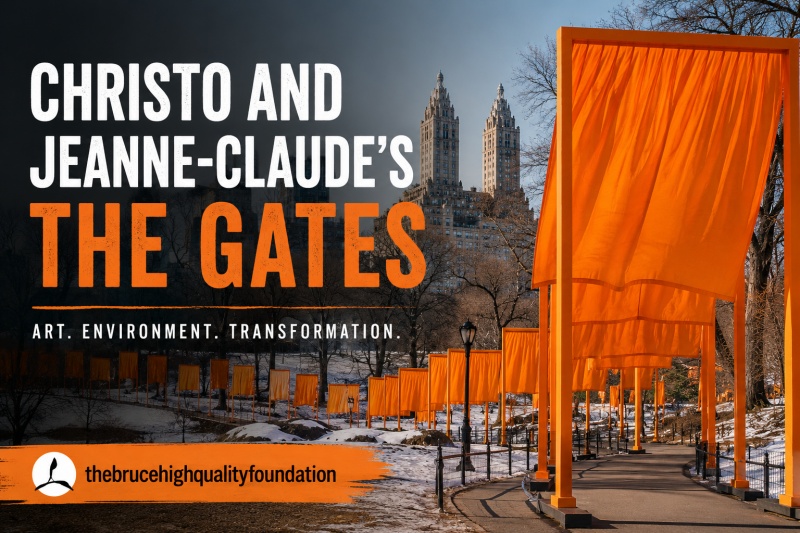
Imagine walking through Central Park on a crisp February morning in 2005. You turn a corner and suddenly see miles of shimmering saffron fabric flowing in the wind, 7,503 gates lining every pathway as far as the eye can see. This was the reality for millions of New Yorkers and visitors during those 16 extraordinary days when Christo and Jeanne-Claude transformed America’s most famous urban park into a site-specific installation that would spark one of the most passionate debates in public art history. How Christo and Jeanne-Claude’s The Gates Divided New York remains one of the most fascinating case studies in how temporary art can provoke permanent conversation about who owns public space and what art should do for a community.
The installation did not simply appear overnight. It represented the culmination of a 26-year battle with bureaucracy, neighborhood opposition, and shifting political winds. What began as a bold vision in 1979 finally materialized as a cultural phenomenon that would draw over 4 million visitors and generate an estimated $254 million in economic activity for the city.
Yet for every admirer who found poetry in the billowing fabric, there was a critic who saw visual pollution. For every visitor who experienced healing in the wake of September 11, there was a taxpayer questioning the $21 million price tag. The Gates did not just decorate Central Park. It forced New Yorkers to confront fundamental questions about art, democracy, and the soul of their city.
Table of Contents
A 26-Year Journey: From Vision to Reality
The story begins in 1979 when Christo and Jeanne-Claude first proposed The Gates to the New York City Parks Department. The artists envisioned 7,503 gates lining the 23 miles of pathways that meander through Central Park, creating what they called a “golden river” visible from the sky and an intimate experience at ground level.
Parks Commissioner Gordon Davis rejected the proposal immediately. He cited environmental concerns, arguing that the installation would damage the park’s landscape and set a dangerous precedent for commercializing public space. The rejection marked the beginning of a two-and-a-half-decade odyssey through New York’s bureaucratic labyrinth.
The artists did not give up. They spent the 1980s and 1990s refining their proposal, conducting environmental studies, and building support within the art community. They completed other major projects during this waiting period, including the legendary Wrapped Reichstag in Berlin in 1995, which covered the German parliament building in silver fabric and demonstrated their ability to execute monumental temporary works.
Everything changed after September 11, 2001. The terrorist attacks shifted the city’s priorities, and for a time, the project seemed impossible. Yet the tragedy also created an unexpected opening. New York needed healing, and Mayor Michael Bloomberg saw The Gates as a way to bring joy back to a grieving city.
In January 2003, Mayor Bloomberg announced his support for the project. The Central Park Conservancy, which had previously opposed the installation, came on board after rigorous environmental review. The artists agreed to fund the entire project themselves at a cost of $21 million, ensuring no taxpayer money would be spent.
Final approval came in 2004, setting the stage for the February 2005 unveiling. The 26-year journey from proposal to reality remains one of the longest approval processes for any public art project in American history.
What Were The Gates? A Visual Description
The installation consisted of 7,503 gates, each standing 16 feet tall, positioned at 12-foot intervals along every pedestrian pathway in Central Park. Each gate featured two vinyl frames supporting a free-hanging panel of saffron-colored woven nylon fabric that swayed with the wind.
The color was deliberate and significant. Christo and Jeanne-Claude chose saffron because it glowed against the winter landscape of bare trees and gray February skies. The hue shifted throughout the day, appearing golden in morning light, amber at noon, and almost red at sunset.
Walking through The Gates created a meditative experience. The pathways became corridors of color, framing views of the park’s natural features while adding a human-scaled architectural element to the landscape. The fabric moved constantly, creating a living, breathing quality that static sculpture cannot achieve.
The engineering was remarkable. Each gate stood independently without drilling into the ground, respecting the park’s protected soil. Steel bases weighted with concrete blocks provided stability while allowing removal without a trace. The vinyl tubing frames could flex in wind up to 60 miles per hour.
The installation covered 23 miles of pathways, transforming familiar routes into something unrecognizable and magical. Visitors reported getting lost in the park they thought they knew, disoriented by the new visual logic of saffron corridors guiding their movement.
At night, the effect changed entirely. The park’s existing lighting created pools of illumination among the gates, turning the installation into a constellation of glowing portals against the dark winter evenings. Nighttime visitors described the experience as otherworldly, like walking through a dream.
How Christo and Jeanne-Claude’s The Gates Divided New York: The Great Debate
The Gates did not simply arrive in Central Park. It exploded into public consciousness, immediately splitting New Yorkers into passionate camps. The division ran along unexpected lines, crossing political, artistic, and socioeconomic boundaries in ways that defied easy categorization.
Supporters saw The Gates as democratic art at its finest. Here was an installation free to all, requiring no museum ticket, no art education, no cultural gatekeeping. Anyone could walk through, touch the fabric, take photographs, and form their own opinion. For advocates, this accessibility represented everything public art should be.
Critics viewed the same installation as an intrusion, a privatization of public space by wealthy artists who had purchased access to the city’s most treasured commons. They questioned why one artistic vision should dominate 843 acres of shared parkland for 16 days. Some argued the money could have funded dozens of smaller community art projects rather than one monumental spectacle.
The media amplified the debate. Newspapers published dueling op-eds daily. Television crews interviewed visitors at the park gates, capturing genuine wonder on some faces and visible irritation on others. The controversy itself became part of the artwork, with the installation serving as a mirror reflecting the city’s values and anxieties.
Visitor statistics told part of the story. Over 4 million people came to see The Gates during its 16-day run, with peak days seeing over 200,000 visitors. Hotel occupancy in Manhattan increased significantly. Local restaurants reported record traffic. Whether people came to admire or mock, they came in unprecedented numbers.
The division was not simply about aesthetics. It touched on deeper questions about who decides what happens in public spaces, how art should function in a democracy, and whether temporary beauty justifies significant expenditure even when privately funded. The Gates forced New Yorkers to vote with their feet, their words, and their hearts.
Supporters: Art for the People
The supporters of The Gates came from diverse backgrounds, united by a shared belief in the project’s power to transform public space into something magical. Art historians praised the installation as a masterwork of environmental art. Regular New Yorkers discovered unexpected beauty in their daily commute through the park.
The accessibility argument resonated most strongly. Unlike museum exhibitions that require tickets and cultivated taste, The Gates welcomed everyone. Children ran laughing through the gates. Couples held hands beneath the flowing fabric. Tourists and locals alike found themselves sharing the experience, creating spontaneous community in the corridors of saffron.
Many supporters connected The Gates to the city’s healing after September 11, 2001. The installation arrived at a moment when New York needed joy, color, and collective experience. Visitors described crying with happiness while walking through the gates, feeling a sense of wonder they thought they had lost. The artwork became a form of public therapy, a shared celebration of survival and resilience.
The economic argument carried weight as well. Local businesses saw measurable increases in foot traffic. Hotels reported visitors coming specifically to see The Gates. The $254 million estimated economic impact demonstrated that public art could generate real returns for the community.
Artists and critics who supported the project emphasized its democratic spirit. Here was art that refused to stay in galleries or serve elite collectors. It demanded attention from everyone who entered the park, creating what supporters called “the most visited art exhibition in history.”
Critics: Visual Pollution or Elitist Waste?
The opposition to The Gates was equally passionate and rooted in legitimate concerns about public space, environmental impact, and artistic privilege. Critics questioned whether any temporary installation, however beautiful, should dominate Central Park for over two weeks.
The $21 million cost became a flashpoint for debate. Though entirely self-financed by the artists through sales of preparatory drawings and earlier works, critics argued the money represented resources that could have supported community centers, schools, or permanent public art. Some called it the most expensive vanity project in art history.
Environmental concerns, first raised by Gordon Davis in 1979, persisted. Opponents worried about soil compaction, damage to tree roots, and the carbon footprint of manufacturing and transporting materials for a temporary installation. The park’s delicate ecology, they argued, should not serve as a canvas even for well-intentioned art.
The privatization argument struck deepest for many critics. They saw The Gates as wealthy artists purchasing temporary ownership of public commons. The installation required extensive park modification, hundreds of workers, and police presence. For critics, this represented a troubling precedent where private vision could reshape shared space.
Some simply found the installation ugly. They called it visual clutter, comparing the saffron gates to construction barriers or carnival decorations. Traditionalists argued that Central Park’s Olmsted design needed no embellishment, that Frederick Law Olmsted’s vision of naturalistic landscape was art enough.
The Workforce: Building a Temporary Dream
Behind the magic of The Gates stood an army of workers who made the impossible possible. Over 600 people participated in the installation, from engineers and fabricators to volunteer “gateskeepers” who staffed the park during the exhibition.
The construction process took months. Workers fabricated gates at a Queens warehouse, assembling the steel frames, attaching the vinyl tubing, and testing the fabric panels. Each gate had to meet exacting specifications to ensure uniformity across the 7,503-unit installation.
Installation in the park began in early January 2005, during some of winter’s harshest weather. Workers endured freezing temperatures, snowstorms, and the physical challenge of positioning thousands of gates along 23 miles of pathways. They worked in teams, each responsible for specific zones of the park.
The volunteer gateskeepers program brought art lovers, students, and curious New Yorkers into the project. These volunteers stood at key points throughout the park, answering questions, providing directions, and ensuring visitor safety. Many described the experience as transformative, a chance to participate in art history.
Dismantling began immediately after the February 27 closing, proceeding with the same precision as installation. Workers removed gates in reverse order, leaving the park exactly as they found it. All materials were recycled, the steel melted down, the fabric repurposed. Nothing remained but memories and photographs, exactly as Christo and Jeanne-Claude intended.
Artistic Context: Christo and Jeanne-Claude’s Philosophy
To understand The Gates, one must understand the artistic philosophy that drove Christo and Jeanne-Claude throughout their five-decade collaboration. They were not simply creating objects but experiences, temporary interventions that transformed how people saw familiar spaces.
The Running Fence project in California (1976) established their reputation for monumental temporary works. That installation stretched 24.5 miles across Sonoma and Marin counties, using white nylon fencing to trace the rolling landscape. Like The Gates, it generated controversy, required years of permit battles, and existed for just two weeks before disappearing forever.
Wrapped Reichstag (1995) demonstrated their international reach and ability to work with politically charged sites. Covering the German parliament building in silver fabric required 24 years of lobbying and planning. The result transformed a symbol of German history into something ethereal and new, forcing viewers to see architecture they thought they knew in fresh ways.
The artists’ commitment to self-financing set them apart in the art world. They refused corporate sponsorship, government grants, or foundation support for their installations. Instead, they sold preparatory drawings, collages, and earlier works to fund each new project. This independence ensured complete artistic control and freedom from institutional influence.
The temporary nature was philosophical, not practical. Christo and Jeanne-Claude believed that temporary art created intensity of experience impossible with permanent works. Knowing The Gates would disappear in 16 days made each visit precious. The ephemerality demanded presence, attention, and memory in ways that static monuments cannot.
Their collaborative partnership defined every project until Jeanne-Claude’s death in 2009. Christo typically handled visual conception and design while Jeanne-Claude managed logistics, permitting, and implementation. Together they created a body of work that redefined what public art could be and do.
The Gates 20th Anniversary: Lasting Legacy in 2026
Twenty years after those saffron gates first appeared in Central Park, the legacy of Christo and Jeanne-Claude’s controversial masterpiece continues shaping public art discourse. The 2026 anniversary has sparked renewed interest, exhibitions, and reflection on what temporary art means for permanent cities.
The Shed museum in Hudson Yards opened a major exhibition in February 2025 titled “Christo and Jeanne-Claude: The Gates and Unrealized Projects for New York City.” The show features original drawings, models, photographs, and documentation of the 26-year approval process, giving visitors insight into the bureaucratic and artistic journey behind the installation.
The anniversary reminds us that The Gates changed how cities approach temporary public art. Projects that once seemed impossible, like large-scale park installations, now find more welcoming reception. The precedent of private funding for public art, controversial in 2005, has become more accepted as municipalities face budget constraints.
Christo continued creating after Jeanne-Claude’s death and The Gates, completing projects like The London Mastaba on the Serpentine Lake in 2018. His death in 2020 marked the end of an era, but their collaborative vision lives in every artist who dares to imagine transforming public space.
The division that The Gates created in 2005 has softened into appreciation. Many who opposed the project now speak of it with fondness. The controversy itself became part of the artwork’s meaning, a demonstration that art should provoke, question, and challenge. Twenty years later, New Yorkers can finally agree that The Gates mattered, even if they still disagree about why.
FAQ
How did Christo and Jeanne-Claude finance The Gates?
The Gates was entirely self-financed by Christo and Jeanne-Claude at a cost of $21 million. The artists sold preparatory drawings, collages, and early works from their fifty-year career to fund the project. This self-financing principle was fundamental to their artistic philosophy, maintaining complete independence without corporate sponsorship or government funding.
Why did it take 26 years for The Gates to be approved?
The approval process spanned 1979 to 2005 due to several factors: 1) Initial rejection by Parks Commissioner Gordon Davis citing environmental concerns, 2) Extensive environmental impact studies required, 3) Changes in park administration and city government, 4) The September 11 attacks shifting city priorities, and 5) Final approval under Mayor Bloomberg in 2003 after rigorous review.
How long were The Gates up in Central Park?
The Gates were on display for 16 days, from February 12 to February 27, 2005. The temporary nature was fundamental to Christo and Jeanne-Claude’s artistic philosophy of creating ephemeral artworks that demand presence and attention while they exist, then live only in memory and documentation.
What happened to The Gates after the project ended?
All materials were dismantled and recycled. The steel frames were melted down, and the saffron-colored nylon fabric was repurposed for other uses. Nothing remained in Central Park, consistent with the artists’ commitment to temporary, non-permanent installations that leave no trace after completion.
Are Christo’s works still on display?
Since Christo and Jeanne-Claude’s works are temporary by design, none remain permanently on display. However, documentation exhibitions like the 2025 show at The Shed, and permanent collections of preparatory drawings at museums like the Guggenheim, preserve the history and legacy of their work.
Did Christo work alone?
No. Christo worked collaboratively with his wife Jeanne-Claude on all major projects from 1961 until her death in 2009. They functioned as an artistic duo, with Christo typically handling visual conception and Jeanne-Claude managing logistics, permitting, and implementation. Christo continued working alone after 2009 until his death in 2020.
How long did Christo’s installations last?
Christo and Jeanne-Claude’s installations were deliberately temporary, typically lasting between 7 and 16 days. The Gates lasted 16 days, Wrapped Reichstag lasted 14 days, and The London Mastaba lasted 16 days. The temporary nature was central to their artistic philosophy of creating intense, ephemeral experiences.
Conclusion
How Christo and Jeanne-Claude’s The Gates Divided New York stands as more than an art history footnote. It represents a moment when a city confronted its own values about public space, artistic expression, and community identity. The 16 days of saffron-colored gates created conversations that continue echoing in 2026, twenty years later.
The division that The Gates provoked was its greatest gift to the city. Art that pleases everyone pleases no one deeply. By forcing New Yorkers to choose sides, to debate, to engage, Christo and Jeanne-Claude created something more lasting than fabric and steel. They created a shared memory of wonder and argument, beauty and controversy, that defines what public art at its best can achieve.
The gates themselves are gone, recycled into other forms, existing now only in photographs and memories. But the questions they raised remain as relevant as ever. Who owns public space? What is art for? How do we share our cities? The Gates did not answer these questions, but it asked them with a visual power that still demands our attention, our thought, and our response.