
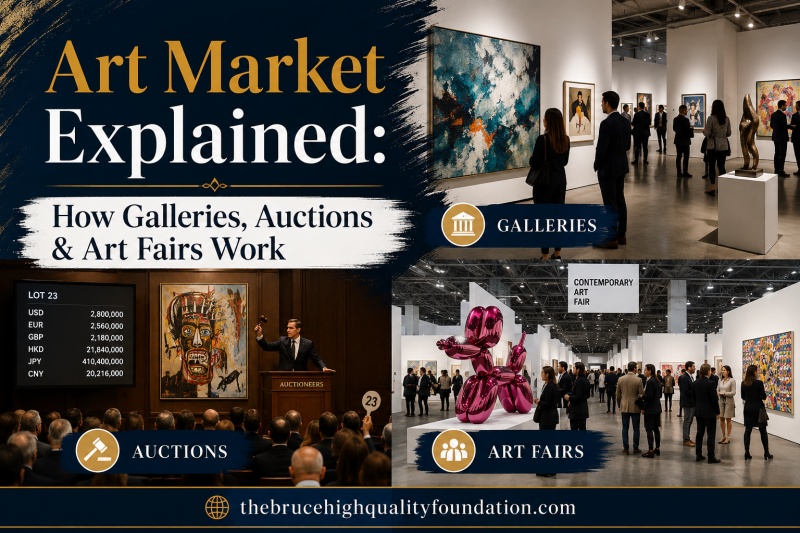
The global art market operates as a complex ecosystem where culture and commerce intersect, generating over $65 billion in annual sales across galleries, auction houses, and art fairs. Understanding how these three channels function is essential for artists seeking representation, collectors making their first purchase, and anyone curious about how cultural value translates to financial value. The art market explained reveals a world that often appears opaque from the outside but follows predictable patterns once you understand its underlying mechanics.
In this guide, we will break down exactly how galleries, auctions, and art fairs work. You will learn the difference between the primary and secondary markets, understand typical commission structures, and discover practical strategies for navigating each channel. Whether you are an emerging artist approaching your first gallery or a new collector attending your first auction, this comprehensive overview will give you the knowledge you need to participate with confidence.
Table of Contents
How Art Galleries Work
Art galleries serve as the foundation of the primary market, representing living artists and introducing their work to collectors for the first time. Unlike retail stores that purchase inventory outright, galleries typically operate on a consignment model. This means the artist retains ownership of the artwork until it sells, at which point the gallery takes a commission and passes the remainder to the artist.
Gallery Representation and Consignment
Getting gallery representation typically begins with studio visits, where gallerists evaluate an artist’s body of work, career trajectory, and market potential. The relationship develops gradually, often starting with inclusion in group exhibitions before advancing to solo shows. Once a gallery commits to representing an artist, both parties sign a consignment agreement that specifies the commission split, payment terms, and responsibilities for shipping, insurance, and marketing.
These consignment agreements are legally binding contracts that protect both artist and gallery. Standard terms specify how long the gallery has exclusive rights to sell the work, what geographic territory they cover, and how quickly the artist gets paid after a sale. Most galleries pay artists within 30 days of receiving payment from the collector, though some contracts specify 45 or 60 days.
From the artist’s perspective, gallery representation feels similar to dating. It starts with casual interactions and studio visits, progresses to group shows where the gallery tests how collectors respond to the work, and eventually leads to a committed relationship with solo exhibitions and ongoing representation. Many artists do not fit the commercial gallery model, which is why alternative spaces, artist-run galleries, and direct-to-collector sales have become increasingly important.
The Commission Structure
The most common question artists ask is what percentage galleries take from sales. Based on our research of gallery practices and forum discussions with working artists, the standard commission split ranges from 40 to 50 percent. Most contemporary galleries take 50 percent, though some tier their commissions based on the price point, taking 40 percent for works over a certain threshold.
Some variations exist in this structure. If a gallery is merely exhibiting work that another gallery represents, the exhibiting gallery typically takes 10 to 30 percent as a referral fee, while the representing gallery takes their standard commission. For prints and multiples, commissions might be lower, around 30 to 40 percent, because these works sell at lower price points and higher volumes.
Understanding these numbers is crucial for artists calculating their income potential. If you price a painting at $10,000 and your gallery takes 50 percent, you receive $5,000. However, you may also be responsible for production costs, framing, and shipping, which reduces your net further. Smart artists factor these costs into their pricing strategy from the beginning.
Primary Market Functions
Galleries serve multiple functions beyond simple sales. They provide exhibition space, often spending thousands on professional installation, lighting, and opening receptions. They produce marketing materials including press releases, catalogues, and digital content. They build relationships with critics, curators, and collectors to advance their artists’ careers.
Are artists paid to produce work for galleries? Generally, no. The gallery invests in the artist’s career through exhibitions and promotion, hoping to recoup that investment through sales commissions. Some established galleries provide stipends or production grants to their top artists, but emerging artists typically fund their own materials and studio time.
The primary market is where prices get established. When an artist has their first solo show, the gallery and artist collaborate on pricing based on factors like size, medium, complexity, and comparable sales by similar artists. Once a price point is set and works sell at that level, the artist can gradually increase prices as their career advances. This price history becomes important when works eventually enter the secondary market.
Artist Development and Career Building
Good galleries act as long-term stewards of their artists’ careers, not just sales agents. They advise on which museum shows to pursue, which residencies to apply for, and how to position the work in the market. They introduce artists to important collectors who can become long-term supporters. They sometimes fund catalogue production or travel for research.
This developmental role distinguishes galleries from auction houses. While auctions offer spectacle and immediate liquidity, galleries provide the sustained relationship-building that builds lasting value. Collectors who buy from galleries often develop multi-year relationships with both the gallerist and the artist, gaining access to new works before they become publicly available.
How Art Auctions Work
If galleries are the stewards of artists’ careers, auction houses are the engines of the secondary market, reselling works that have already been sold at least once. Major auction houses like Christie’s and Sotheby’s operate globally, hosting sales that range from $1,000 prints to $100 million paintings. Understanding the auction process demystifies what can seem like an intimidating experience for newcomers.
The Bidding Process
Buying art at auction follows a specific sequence that begins well before the actual sale. First, you register with the auction house, providing identification and financial references. You receive a paddle with a number that identifies you during bidding. You can attend the sale in person, bid by phone, bid online, or leave an absentee bid that the auctioneer executes on your behalf up to your maximum.
During the auction, the auctioneer calls out lot numbers and opens bidding at a level below the low estimate. Bidding typically advances in predetermined increments, which get larger as the price rises. For example, bidding might advance by $500 increments up to $5,000, then by $1,000 increments up to $20,000, and by larger jumps beyond that. When no one bids higher, the auctioneer brings down the hammer, establishing the hammer price.
First-time auction bidders often feel confused by the rapid pace and specific terminology. The paddle system keeps bids anonymous to other attendees, though auction house staff track who is bidding. Online bidding platforms have made participation easier but removed some of the theatrical excitement that defines the live auction experience.
Estimates, Reserves, and Hammer Prices
Before each auction, the house publishes a catalogue with pre-sale estimates for each lot. These estimates, typically expressed as a range (e.g., $50,000-$70,000), reflect the auction house’s prediction of where bidding will land. They are based on comparable sales, the artist’s market trajectory, and the specific work’s quality and provenance.
Every lot also has a confidential reserve price, which is the minimum the seller will accept. If bidding does not reach the reserve, the lot is “passed” or “bought-in,” meaning it goes unsold. Reserve prices typically start at about 80 percent of the low estimate and can be adjusted during the sale if a work is struggling to attract bids.
The hammer price is the winning bid announced when the auctioneer drops the gavel. However, this is not the final price the buyer pays. Auction houses add a buyer’s premium on top of the hammer price, which significantly increases the total cost. Understanding this distinction is crucial for budgeting.
Buyer’s Premium and Fees
The buyer’s premium is the fee auction houses charge purchasers on top of the hammer price. In 2026, major houses like Christie’s and Sotheby’s typically charge 25 percent on the first $400,000 of hammer price, 20 percent on the amount between $400,000 and $4 million, and 13.9 percent on amounts above $4 million. Some houses have slightly different tier structures, but the effective rate usually falls between 20 and 25 percent for most purchases.
Sellers also pay fees, typically called seller’s commission or vendor’s commission. This usually runs about 10 percent of the hammer price, though it can vary based on the value of the work and the seller’s relationship with the house. High-value consignments often negotiate lower rates, while difficult-to-sell works might incur higher fees.
For buyers, these fees mean a work with a $10,000 hammer price actually costs $12,500 after the 25 percent buyer’s premium. First-time auction participants frequently underestimate their total cost by forgetting to factor in this additional charge. Always calculate the total with premium when setting your maximum bid.
Secondary Market Dynamics
The secondary market serves a different function than the primary market. While galleries introduce new work and build artists’ careers, auctions provide price transparency and liquidity for existing works. When a painting sells at auction, that price becomes public data that affects the artist’s entire market. This transparency benefits collectors who want to verify fair pricing but can create volatility.
What happens to the living artist when artworks get into auction? Typically, nothing financially unless the artist has negotiated a resale royalty, which is not standard practice in the United States. The seller (who might be a collector who bought from a gallery years ago) and the auction house split the proceeds. However, auction results significantly impact the artist’s gallery prices. A strong auction result can justify price increases, while a weak result or a bought-in lot can damage market confidence.
Some galleries actively work to keep their artists’ work out of auction until their careers are sufficiently established. Early auction appearances can be risky if a work fails to sell or sells below expectations. This tension between galleries and auction houses represents one of the central dynamics of the art market.
How Art Fairs Function
Art fairs have transformed the art market over the past two decades, creating temporary marketplaces where dozens or hundreds of galleries gather under one roof. Unlike galleries or auctions, which operate year-round in fixed locations, art fairs concentrate selling activity into intense multi-day events that attract collectors from around the world.
Fair Structure and Tiers
Art fairs operate in distinct tiers that serve different market segments. At the top level are A-list fairs like Art Basel in Switzerland, Miami, and Hong Kong, and Frieze in London and Los Angeles. These fairs accept only established galleries with strong programmes and charge booth fees ranging from $50,000 to over $100,000 for prime locations. Admission is selective, and being accepted signals gallery prestige.
The second tier includes strong regional fairs like The Armory Show in New York, Art Toronto, and Paris+. These fairs attract serious collectors but with a more regional focus and lower booth costs. The third tier encompasses satellite fairs that run concurrently with major events, often featuring younger galleries and more experimental programming at lower price points.
Galleries pay significant costs to participate in fairs beyond booth fees. They must ship art internationally, pay for travel and accommodation for staff, and often produce special presentations or publications. A single fair participation can cost a mid-sized gallery $100,000 or more. They need to sell substantially during the fair just to break even.
Buying at Fairs vs Galleries
Should you buy art from an art fair? The answer depends on your collecting goals. Fairs offer the opportunity to compare hundreds of artists and galleries in a single venue, making them efficient for discovering new work. However, the high-pressure environment can lead to hasty decisions. Gallery relationships, by contrast, provide ongoing dialogue and access to better works over time.
Fairs excel for collectors who know what they want and are ready to buy immediately. The best works often sell during VIP preview days before the fair opens to the public. Serious collectors maintain relationships with galleries who notify them of available works at fairs. First-time collectors can use fairs to educate themselves, seeing wide ranges of quality and price in one place.
Fair fatigue, sometimes called “fair-tigue,” is a real phenomenon. Walking miles of booths, absorbing thousands of artworks, and making social conversation exhausts even experienced collectors. Successful fair visitors plan their routes, take breaks, and focus on specific sections rather than trying to see everything.
Major Art Fairs Worldwide
The art fair calendar runs year-round across the globe. Art Basel’s three editions (June in Switzerland, December in Miami Beach, March in Hong Kong) anchor the international schedule. Frieze operates fairs in London, Los Angeles, and New York. EXPO Chicago, FIAC in Paris, and TEFAF in Maastricht and New York serve important regional markets.
Each fair develops its own character. Miami Art Week in December has become as much about social spectacle as art sales. Art Basel Hong Kong focuses heavily on Asian galleries and collectors. TEFAF specializes in historical work and antiques alongside contemporary art. Understanding these distinctions helps collectors choose which fairs to attend.
The Art Market Ecosystem: How It All Connects
The art market functions as an interconnected ecosystem where galleries, auction houses, and art fairs each play distinct but overlapping roles. Understanding how these channels interact helps explain market dynamics that can seem mysterious from the outside.
| Channel | Market Type | Typical Pricing | Relationship Style | Best For |
|---|---|---|---|---|
| Galleries | Primary | Set by artist/gallery | Long-term, relational | New work, emerging artists |
| Auctions | Secondary | Determined by bidding | Transactional | Established artists, price transparency |
| Art Fairs | Both | Gallery list prices | Intensive, time-limited | Comparison shopping, discovery |
Works typically flow through these channels in a predictable pattern. An artist creates work and shows it with their gallery. Collectors purchase from the gallery, often developing relationships that provide early access to new pieces. After some years, collectors might consign works to auction, either to liquidate their collection or because the artist’s market has risen and they want to realize gains. Meanwhile, art fairs provide concentrated selling opportunities that complement gallery programming.
This ecosystem includes additional players who facilitate transactions. Art advisors help collectors navigate the market for a fee, typically 10 percent of purchase price or an hourly rate. Art lawyers handle disputes and contract reviews. Art shippers and insurers manage logistics. Online platforms like Artsy and Artnet provide discovery tools and market data. Together, these players form the infrastructure that keeps the market functioning.
Primary vs Secondary Market Explained
The distinction between primary and secondary markets represents the most fundamental division in the art market. Understanding this difference clarifies how prices get established and how value changes over time.
| Aspect | Primary Market | Secondary Market |
|---|---|---|
| Definition | First sale of a new work | Resale of previously sold work |
| Primary Sellers | Galleries, artists | Auction houses, dealers, collectors |
| Price Setting | Artist/gallery collaboration | Market demand and comparable sales |
| Price Transparency | Often opaque | Public at auction |
| Artist Compensation | Yes, via gallery commission | Generally no (US market) |
The primary market is where an artwork enters the commercial world for the first time. When a painter creates a canvas and their gallery sells it to a collector, that is a primary market transaction. The gallery and artist together determine the price based on factors like size, medium, the artist’s career stage, and comparable sales by similar artists.
The secondary market involves resale of works that have already been sold at least once. When a collector who bought that painting five years ago decides to sell it through Sotheby’s, that becomes a secondary market transaction. The price depends on what bidders are willing to pay, informed by the artist’s auction history, the work’s condition and provenance, and current market trends.
This distinction matters because it affects pricing power, transparency, and artist compensation. In the primary market, artists and galleries control pricing but face opacity about whether prices are fair. In the secondary market, prices become transparent through auction results but can be volatile and unpredictable. Artists rarely benefit financially from secondary sales in the United States, unlike in some European countries that mandate resale royalties.
Pricing and Transparency
How are art prices determined? This question frustrates newcomers because the art market notoriously lacks the transparency of other markets like stocks or real estate. However, pricing follows logical patterns once you understand the factors involved.
Primary market pricing starts with objective factors: size, medium, and production costs. A large oil painting costs more than a small drawing partly because materials and studio time cost more. Beyond these basics, pricing reflects the artist’s career stage, exhibition history, institutional support (museum shows, critical reviews), and comparable sales by similar artists.
Secondary market pricing responds to supply and demand dynamics. If an artist has limited auction history and high demand, prices can spike quickly. If an artist produces prolifically or market interest wanes, prices can decline. Auction results provide the most visible pricing data, but private sales through dealers also influence the market without becoming public.
Several resources help collectors research prices. Artnet and Artprice maintain databases of auction results. ArtFacts tracks exhibition history. Artsy provides price information for works available through galleries. However, gallery prices for primary market work remain private unless galleries choose to publish them, which many do not. This opacity gives galleries negotiating flexibility but frustrates collectors seeking to compare options.
Navigating the Market: Tips for Different Audiences
Different participants in the art market need different strategies. Whether you are an artist seeking representation, a first-time collector, or an investor approaching art as an asset class, understanding your position helps you make better decisions.
For Artists
Getting gallery representation requires preparation and persistence. Develop a cohesive body of work with a clear vision before approaching galleries. Research which galleries represent artists at similar career stages and with similar aesthetics. Attend their exhibitions, understand their programme, and determine if your work fits. When ready, reach out with a professional presentation including high-quality images, an artist statement, and a CV.
Understand that gallery relationships take time to develop. A gallerist who rejects you today might be interested in two years after you have built your exhibition history. Maintain professional communication, and remember that galleries review hundreds of submissions. Standing out requires both excellent work and a professional approach.
Read consignment agreements carefully before signing. Understand the commission split, payment timeline, and what happens if the gallery closes or you want to end the relationship. Negotiate terms that protect your interests while recognizing that galleries take significant financial risks representing new artists.
For First-Time Collectors
How do you enter the art market as a buyer? Start by looking extensively before buying anything. Visit galleries, attend local art school shows, browse online platforms, and develop your eye. Figure out what resonates with you personally rather than chasing investment potential or trendy names.
When you are ready to buy, start modestly. Works on paper, prints, and photographs often cost less than paintings or sculptures but can be equally meaningful. Build relationships with galleries by attending openings, asking thoughtful questions, and expressing genuine interest. Over time, these relationships provide access to better works and advance notice of new arrivals.
Do not be intimidated by gallery environments. Staff understand that today’s curious visitor might be tomorrow’s serious collector. Ask about prices, payment plans, and installation advice. Most galleries offer trial periods that let you live with work before committing. Take advantage of these services.
For Investors
If you approach art primarily as an investment, exercise caution. The art market is less liquid, more volatile, and more opaque than traditional investments. Works by blue-chip artists with long auction histories offer more predictable returns but require substantial capital. Emerging artists offer lower entry points but higher risk.
Research provenance thoroughly before buying. A clear ownership history increases value and reduces authenticity risks. Consider insurance, conservation costs, and storage when calculating total cost. Work with reputable advisors who charge transparent fees rather than taking hidden commissions from sellers.
Remember that art markets experience cycles like any other market. Prices that rise quickly can fall just as fast. The most successful art collectors buy work they love, ensuring that even if financial returns disappoint, they own something meaningful.
Frequently Asked Questions
How do gallery shows typically work?
Gallery shows typically operate on a consignment model where the artist retains ownership until sale. The gallery provides exhibition space, marketing, and sales services in exchange for a commission, usually 40-50 percent of the sale price. Shows run for 4-8 weeks with opening receptions to attract collectors and press.
Are artists paid to produce work for galleries?
Generally, artists are not paid upfront to produce work for galleries. The gallery invests in exhibition costs and promotion, earning income only if works sell. Some established galleries provide production grants or stipends to major artists, but emerging artists typically fund their own materials and studio time.
How does the art auction process work?
The auction process involves: 1) Registering with the auction house and receiving a paddle number, 2) Reviewing the catalogue with estimates and condition reports, 3) Attending preview to examine works in person, 4) Bidding in person, by phone, online, or via absentee bid, 5) Paying hammer price plus buyer’s premium (typically 20-25%) if you win.
What percentage do galleries take from artists?
Galleries typically take 40-50 percent commission on sales, with 50 percent being the most common split for contemporary art. Some galleries use tiered structures, taking 40 percent for higher-priced works. Print and multiple sales sometimes have lower commissions of 30-40 percent due to different volume dynamics.
What is the difference between primary and secondary art market?
The primary market involves first-time sales of new works, typically through galleries representing living artists. The secondary market involves resale of previously owned works, primarily through auction houses and dealers. Primary market prices are set by artists and galleries, while secondary prices are determined by bidding and comparable sales data.
Should I buy art from an art fair?
Art fairs offer efficient comparison shopping and discovery opportunities, with hundreds of galleries in one venue. They are excellent for finding new artists and making immediate purchases. However, gallery relationships provide better long-term access and advice. The high-pressure fair environment can lead to hasty decisions, so research beforehand and take your time.
How are art prices determined?
Art prices depend on factors including the artist’s career stage, exhibition history, institutional support, comparable sales, work size and medium, and current market demand. Primary market prices are set collaboratively by artists and galleries. Secondary market prices are determined by auction results and private sales data tracked by services like Artnet and Artprice.
What happens to the living artist when artworks get into auction?
When living artists’ works sell at auction, they typically receive no financial benefit in the US market. The seller (a collector or dealer) and auction house split the proceeds. However, auction results significantly impact the artist’s market: strong sales can justify gallery price increases, while weak results or bought-in lots can damage market confidence and future pricing.
How do you enter the art market as a buyer?
Enter the art market by first looking extensively at galleries, museums, and online platforms to develop your eye. Attend openings and art fairs to learn what resonates with you. Start modestly with works on paper, prints, or photographs. Build relationships with galleries through genuine engagement. Ask questions about pricing, payment plans, and trial periods. Buy work you love, not just what seems trendy.
Conclusion
The art market explained reveals a complex but navigable ecosystem where galleries, auction houses, and art fairs each serve distinct functions. Galleries steward artists’ careers in the primary market, typically taking 40 to 50 percent commission while providing essential services like exhibition space and collector relationships. Auction houses drive the secondary market with transparent pricing but complex fee structures including the buyer’s premium that adds 20 to 25 percent on top of hammer prices. Art fairs provide concentrated marketplaces that complement both channels.
Understanding the difference between primary and secondary markets, knowing typical commission structures, and recognizing how prices get established empowers you to participate effectively. Whether you are an artist seeking representation, a collector making your first purchase, or simply curious about how the art world operates, this knowledge transforms the market from an intimidating mystery into an accessible system.
The art market continues evolving in 2026, with digital platforms offering new discovery tools and online sales channels supplementing traditional galleries and auction houses. Yet the fundamental dynamics remain constant: relationships matter, transparency varies by channel, and the best participants approach the market with both financial awareness and genuine passion for art. Armed with the insights from this guide, you can navigate galleries, auctions, and art fairs with confidence and clarity.