
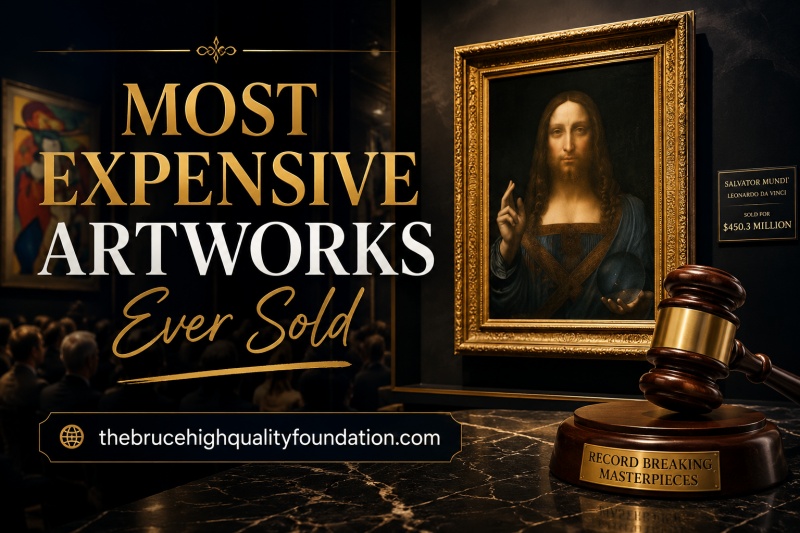
When Leonardo da Vinci’s Salvator Mundi changed hands for $450.3 million at Christie’s in November 2017, the art world stood still. That single transaction shattered all previous records and redefined what the global elite would pay to own a piece of human history. It also sparked a debate about authenticity, value, and the intersection of art and wealth that continues to resonate in 2026.
The market for trophy artworks has transformed dramatically over the past two decades. Billionaires, sovereign wealth funds, and museum foundations now compete aggressively for the rarest masterpieces. These are not mere decorative objects but strategic assets, cultural statements, and historical artifacts rolled into one.
This comprehensive guide presents the most expensive artworks ever sold, from Old Masters to Abstract Expressionists. Each entry includes verified sale prices, buyer information where available, and the stories behind these remarkable transactions. Whether you are an art collector, investor, or simply fascinated by how human creativity commands astronomical value, this list tells the story of our shared cultural heritage.
Table of Contents
25. Nude, Green Leaves and Bust – $106.5 Million (2010)
Pablo Picasso painted Nude, Green Leaves and Bust in 1932 during a pivotal year when he produced some of his most celebrated works. The painting depicts his young mistress Marie-Thérèse Walter reclining against a background of green leaves with a classical bust sculpture nearby. This 5-foot canvas showcases Picasso’s ability to merge classical figuration with modernist distortion.
The sale at Christie’s in 2010 represented a watershed moment. It became the most expensive artwork ever sold at auction at that time, surpassing the previous record held by Giacometti’s Walking Man I. The winning bidder remained anonymous, though art world speculation pointed toward several prominent collectors seeking to add a blue-chip Picasso to their holdings.
What makes this painting particularly significant is how it captures Picasso at the height of his powers. The artist had just turned fifty and was producing masterpieces at a remarkable pace. The Marie-Thérèse period works remain among the most sought-after Picassos in the market.
24. Untitled (Skull) – $110.5 Million (2017)
Jean-Michel Basquiat’s Untitled (Skull) represents the pinnacle of the neo-expressionist movement and the highest price ever paid for an American artist’s work. Painted in 1982 when Basquiat was just 21 years old, the massive canvas depicts a skull rendered in frenzied brushstrokes and layered imagery that draws from graffiti, anatomy textbooks, and African art.
Yusaku Maezawa, the Japanese e-commerce billionaire, acquired this piece at Sotheby’s contemporary art evening sale. His purchase signaled the growing importance of Asian collectors in the Western art market. Maezawa famously announced he would loan the painting to museums before eventually donating it to a public institution.
The skull motif appears frequently in Basquiat’s work, serving as both memento mori and raw expression of urban anxiety. This particular canvas measures over 6 feet tall and represents the artist’s fully developed style. The painting had previously sold for $93,000 in 1984, demonstrating the extraordinary appreciation of Basquiat’s market over three decades.
23. Meules (Haystacks) – $110.7 Million (2019)
Claude Monet’s Meules belongs to his famous Haystacks series, twenty-five canvases painted between 1890 and 1891 that captured the same subject under varying light conditions. This particular example depicts the grainstacks in late afternoon light with vibrant orange and purple tones that demonstrate Monet’s revolutionary approach to color and atmosphere.
Sotheby’s Impressionist and Modern Art evening sale saw competitive bidding that drove the final price well beyond its $55 million estimate. The painting came from the collection of Nancy Lee and Perry R. Bass, Fort Worth philanthropists who had acquired it in 1986. The buyer chose to remain anonymous.
The Haystacks series fundamentally changed how artists approached serial subjects. Monet painted the same stacks repeatedly to study how light transformed perception. His commitment to painting en plein air and his scientific approach to color theory influenced generations of artists who followed.
22. The Scream – $119.9 Million (2012)
Edvard Munch’s The Scream stands as the ultimate icon of existential anxiety and one of the most recognizable images in art history. The pastel-on-board version sold at Sotheby’s represents one of only four versions the Norwegian artist created, and the only one remaining in private hands. Its haunting depiction of a figure against a blood-red sky captures universal human emotion.
Petter Olsen sold the work to benefit his foundation dedicated to Munch’s legacy. The buyer remained anonymous, though subsequent reports suggested an American private collector acquired it. The sale price more than quadrupled the previous record for a Munch at auction.
Munch created multiple versions of The Scream using various media between 1893 and 1910. The image has been reproduced countless times and referenced in popular culture, cementing its status as a global cultural touchstone. Despite its ubiquity, the original pastel retains an immediacy and power that photographs cannot capture.
21. Portrait of Adele Bloch-Bauer I – $135 Million (2006)
Gustav Klimt’s golden portrait of Adele Bloch-Bauer represents the pinnacle of his Golden Phase and one of the most significant restitution cases in art history. Ronald Lauder acquired the painting for his Neue Galerie in New York after a lengthy legal battle returned the work to Maria Altmann, Adele’s niece, who had fled Austria during the Nazi era.
The painting features Byzantine-inspired gold leaf patterns and intricate decorative elements that took Klimt three years to complete. Adele Bloch-Bauer, a wealthy Jewish patron of the arts, commissioned the portrait in 1903. The work embodies Vienna’s cultural flowering before World War I and the subsequent destruction of that world.
The $135 million price established a new auction record and demonstrated the market’s willingness to pay premium prices for works with impeccable provenance and historical significance. The painting now hangs in the Neue Galerie, where visitors can appreciate its luminous gold surfaces and haunting gaze.
20. Woman III – $137.5 Million (2006)
Willem de Kooning’s Woman III belongs to his controversial Women series that shocked the art world when first exhibited in the early 1950s. The painting exemplifies Abstract Expressionism’s raw energy and de Kooning’s unique ability to merge figurative elements with gestural abstraction. Swirling brushstrokes and violent colors suggest both allure and aggression.
Steven Cohen, the hedge fund billionaire, purchased the work from David Geffen in a private transaction. The sale represented part of Geffen’s strategic divestment of major works to create liquidity for other investments. Cohen’s collection would later grow to include numerous other trophy paintings from this list.
The Women series generated significant controversy when first shown, with critics attacking what they perceived as misogynistic imagery. Art historians now view these works as complex investigations of femininity, power, and the act of painting itself. De Kooning’s aggressive brushwork and distorted figures challenged conventional beauty while creating a new visual language.
19. Twelve Landscape Screens – $140.8 Million (2017)
Qi Baishi’s Twelve Landscape Screens set a record for the highest price ever paid for a work by a Chinese artist at auction. The set of ink paintings on paper, mounted as traditional Chinese screens, depicts natural scenes with the simplicity and spontaneity that characterized Qi Baishi’s late style. The artist painted these in 1925 when he was 62 years old.
The buyer remained anonymous, though speculation pointed to mainland Chinese collectors who have increasingly dominated the market for traditional Chinese art. The works had been part of the Sun Yee Collection and had not appeared on the market for decades. Their sale demonstrated the growing importance of Asian art in the global market.
Qi Baishi began painting seriously in his mid-fifties after working as a carpenter and seal carver. His late-blooming career produced some of the most beloved images in Chinese art, particularly his shrimp, crabs, and landscapes. The Twelve Landscape Screens represent his mature synthesis of folk art traditions and scholarly refinement.
18. L’Homme au doigt – $141.3 Million (2015)
Alberto Giacometti’s L’Homme au doigt (Pointing Man) stands as the most expensive sculpture ever sold at auction and a masterpiece of existentialist art. The 6-foot bronze figure, all angular limbs and attenuated form, captures the isolation and anxiety of the post-war era. Giacometti created it in 1947 as part of a series of standing figures that redefined modern sculpture.
Steve Cohen acquired the work at Christie’s Looking Forward to the Past sale, which featured masterpieces from various periods. The sculpture had been in the same private collection since 1970, making its appearance on the market a significant event. Two other casts of this work exist in museum collections.
Giacometti’s thin, wiry figures emerged from his obsessive reworking of clay forms. He would build up and scrape away material repeatedly until only the essence remained. The Pointing Man’s gesture suggests direction, accusation, or prophecy, inviting multiple interpretations that have kept the work compelling for over seventy years.
17. Three Studies of Lucian Freud – $142.4 Million (2013)
Francis Bacon’s triptych depicting his friend and artistic rival Lucian Freud represents the most intense psychological portrait in contemporary art. Painted in 1969, the three panels show Freud from different angles, seated on a cane-bottomed chair within Bacon’s signature cage-like spaces. The work captures the complex relationship between two of Britain’s greatest twentieth-century artists.
Elaine Wynn, ex-wife of casino magnate Steve Wynn, sold the painting at Christie’s after acquiring it in the 1990s. The buyer remained anonymous. The work had not been seen in public for decades, making its appearance a major art world event. Auction specialists had predicted a strong result, but the final price exceeded even optimistic estimates.
Bacon and Freud met in 1945 and maintained a competitive friendship for decades, painting each other repeatedly. Bacon’s portraits of Freud capture the sitter’s penetrating intelligence and physical presence while revealing the painter’s own emotional intensity. The triptych format allowed Bacon to explore multiple perspectives simultaneously, creating a comprehensive psychological study.
16. Nu Couché (on Her Left Side) – $157.2 Million (2018)
Amedeo Modigliani’s second entry on this list demonstrates the Italian artist’s enduring appeal to collectors. This reclining nude, painted in 1917, features the elongated forms, mask-like face, and sensual pose that define Modigliani’s style. The model’s blank eyes and simplified features reflect the artist’s interest in African sculpture and Cycladic art.
Sotheby’s Impressionist and Modern Art evening auction in New York saw determined bidding for this work. The painting had been part of a private collection for decades and was widely considered the finest Modigliani nude to appear at auction in years. The buyer remained anonymous.
Modigliani painted a series of nudes in 1917 that caused a scandal when exhibited in Paris. Police closed the show on opening day, deeming the works immoral. Today these paintings are recognized as masterful celebrations of the female form, blending classical tradition with modernist innovation. The artist died at 35 from tuberculosis, making his surviving works extremely scarce.
15. Le Rêve – $155 Million (2013)
Pablo Picasso’s portrait of his young mistress Marie-Thérèse Walter sleeping in an armchair stands as one of his most tender and erotic works. Painted on January 24, 1932, in a single afternoon, the painting demonstrates Picasso’s ability to capture intimacy and sensuality with bold outlines and vibrant colors. Marie-Thérèse’s face combines frontal and profile views in characteristic Cubist fashion.
Steve Wynn, the casino developer, had famously nearly sold the painting in 2006 for $139 million. During a party at his office, he accidentally elbowed the canvas, creating a 6-inch tear in Marie-Thérèse’s arm. The damage scuttled the sale and required extensive restoration. Wynn eventually sold the repaired work to Steven Cohen for $155 million in a private transaction.
The “elbow incident” became one of the most famous stories in art market history, illustrating the risks of handling priceless artworks. Le Rêve now resides in Cohen’s legendary collection, where it hangs alongside other masterpieces from the twentieth century. The painting exemplifies Picasso’s ability to merge Cubist innovations with classical beauty.
14. Masterpiece – $165 Million (2017)
Roy Lichtenstein’s Masterpiece captures everything that made the Pop Art movement revolutionary. The painting mimics a comic book panel complete with Ben-Day dots, bold outlines, and melodramatic text. A blonde woman praises her male companion’s artistic genius while the viewer sees only a blank canvas behind them, creating an ironic commentary on the art world itself.
Steven Cohen acquired this work in a private sale from Agnes Gund, the philanthropist and art collector. Gund sold the painting to fund her Art for Justice Fund, which supports criminal justice reform. The transaction demonstrated how the art market can serve philanthropic goals while transferring important works between collections.
Lichtenstein created Masterpiece in 1962, during his breakthrough year when he first exhibited the comic-inspired paintings that would define his career. The work has been exhibited extensively and written about extensively in art historical literature. Its self-referential nature makes it particularly appealing to collectors who appreciate art world humor.
13. Nu Couché – $170.4 Million (2015)
Amedeo Modigliani’s Nu Couché (Reclining Nude) became the second-highest price ever paid for a work at auction when Liu Yiqian acquired it at Christie’s in 2015. The Chinese billionaire paid using his American Express card, reportedly earning millions in reward points from the transaction. This detail captivated media attention and introduced the art world to a new generation of Asian collectors.
The painting depicts a nude woman lying on a couch with her arms raised behind her head. Modigliani’s characteristic elongation of the figure and mask-like face create an image that is simultaneously ancient and modern. The artist painted this work in 1917-18 during a remarkably productive period when he created numerous masterpieces before his early death.
Liu Yiqian, who made his fortune in pharmaceuticals and finance, has become one of the world’s most visible art collectors. His Long Museum in Shanghai displays numerous trophy works from Western and Chinese artists. The Modigliani purchase signaled Chinese collectors’ growing importance in the international art market.
12. Les Femmes d’Alger – $179.4 Million (2015)
Pablo Picasso’s Les Femmes d’Alger (Version ‘O’) represents the culmination of the artist’s lifelong engagement with European art history. This monumental canvas reinterprets Delacroix’s famous painting of Algerian concubines through the lens of Cubism and Picasso’s personal mythology. The composition includes nudes, still life elements, and references to his late companion Jacqueline Roque.
Former Qatari Prime Minister Hamad bin Jassim bin Jaber Al Thani acquired the work at Christie’s in 2015, establishing a new record for any artwork sold at auction. The painting had been part of the collection of Victor and Sally Ganz, legendary collectors who acquired it directly from Picasso’s dealer in 1956. The Ganz collection was dispersed following Sally’s death.
Picasso painted fifteen versions of Les Femmes d’Alger between December 1954 and February 1955, labeling them A through O. Version O, the final and most resolved, synthesizes all the compositional experiments of the earlier versions. The work demonstrates Picasso’s undiminished creative energy in his seventies and his ongoing dialogue with artistic tradition.
11. Pendant Portraits – $180 Million (2015)
Rembrandt’s wedding portraits of Marten Soolmans and Oopjen Coppit represent the only full-length portraits the Dutch master painted of a couple. The pair of life-size canvases, executed in 1634, depict the wealthy Amsterdam couple in elaborate black silk outfits that demonstrate their social status. Rembrandt’s ability to render different textures, from satin to lace, is on full display.
The Rijksmuseum in Amsterdam and the Louvre in Paris jointly acquired these portraits from the descendants of the Rothschild banking family. The €160 million price tag was financed through contributions from both museums’ governments and private donors. The portraits now alternate between the two institutions, spending time in each museum.
These paintings represent a pivotal moment in Rembrandt’s career. At 28 years old, he had recently moved to Amsterdam and was establishing himself as the city’s premier portraitist. The commission from Marten and Oopjen, wealthy figures from prominent families, signaled his arrival among the artistic elite. The portraits had remained in the family for nearly four centuries.
10. Water Serpents II – $183.8 Million (2013)
Gustav Klimt’s Water Serpents II depicts sensual female figures intertwined in water, representing the artist’s Symbolist period and his fascination with eroticism and mythology. The painting features Klimt’s characteristic decorative patterns, gold leaf, and flowing organic forms that blur the boundary between fine art and design. Four water nymphs float in a dreamlike aquatic world.
The painting sold in a private transaction brokered by art dealer Yves Bouvier. The buyer was Dmitry Rybolovlev, the Russian billionaire who later became embroiled in a lengthy dispute with Bouvier over pricing practices. The sale price was not publicly disclosed initially but was later revealed through legal proceedings.
The Water Serpents series represents Klimt’s exploration of female sexuality and the unconscious mind. These works were considered scandalous when created and remained in private collections for decades. The painting’s journey through various hands and the subsequent legal disputes illustrate the complex relationships between collectors, dealers, and auction houses in the high-end art market.
9. No. 6 (Violet, Green and Red) – $186 Million (2014)
Mark Rothko’s color field masterpiece represents Abstract Expressionism at its most sublime. The painting consists of three horizontal bands of color, violet above green above red, that seem to float and vibrate against each other. Rothko’s technique of applying thin layers of paint creates luminous, breathing surfaces that invite meditation.
Dmitry Rybolovlev purchased the work from Yves Bouvier in a private transaction, part of a series of acquisitions that would later become contentious. The painting had previously been owned by David Rockefeller and the des Routes family. Its sale to Rybolovlev demonstrated the continued strength of the post-war art market.
Rothko painted works in this format throughout the 1950s, exploring how color relationships could evoke emotional and spiritual responses. He famously resisted interpretations of his work as purely abstract, insisting they were about human feeling. The large scale of these paintings envelopes viewers, creating an immersive experience that influenced generations of artists.
8. Shot Sage Blue Marilyn – $195 Million (2022)
Andy Warhol’s portrait of Marilyn Monroe represents the absolute pinnacle of Pop Art and perhaps the most recognizable image in twentieth-century art. The “Shot Sage Blue Marilyn” belongs to the series Warhol created in 1964 following Monroe’s death, using a publicity still from the film Niagara. The sage blue background and hot pink face create an instantly iconic image.
The Thomas and Doris Ammann Foundation sold the work at Christie’s in 2022, with proceeds benefiting children’s health programs worldwide. The sale established a new record for any American artist and the second-highest price for any artwork at auction. The buyer remained anonymous, though speculation pointed to American and Middle Eastern collectors.
Warhol’s Marilyn series commented on celebrity, death, and mass reproduction. The “shot” reference in the title comes from an incident in which another artist fired a bullet through a stack of Warhol’s Marilyn canvases. This particular example, with its striking color combination, has become the most celebrated of the series and a symbol of Pop Art itself.
7. The Standard-Bearer – $198 Million (2022)
Rembrandt’s Standard-Bearer stands as the most expensive Old Master painting ever sold and a testament to the enduring value of the Dutch Golden Age. The life-size portrait depicts a young man carrying a flag, possibly a self-portrait of the artist in historical costume. Rembrandt’s masterful handling of light, fabric, and expression demonstrates why he remains among history’s greatest painters.
The Dutch state purchased the work from the Rothschild family collection with funds from the Rembrandt Association and the National Postcode Lottery. The acquisition ensures this national treasure remains accessible to the public at the Rijksmuseum. The purchase price reflects both the painting’s artistic importance and its significance to Dutch cultural heritage.
Rembrandt painted this work in 1636 when he was at the height of his Amsterdam success. The flamboyant costume and theatrical presentation suggest the artist experimenting with new modes of portraiture. The painting had been in French private collections since 1844, making its return to Dutch hands a significant cultural event.
6. Number 17A – $200 Million (2015)
Jackson Pollock’s Number 17A demonstrates the explosive energy and revolutionary technique that made Abstract Expressionism the first truly American art movement. The canvas, covered in Pollock’s characteristic drips, splatters, and poured paint, captures the physical act of painting as performance. Enamel and aluminum paint create a shimmering web across the surface.
Kenneth Griffin, the hedge fund billionaire, acquired this work from David Geffen in 2015 along with de Kooning’s Interchange for a combined $500 million. Griffin has since loaned both paintings to the Art Institute of Chicago, making them accessible to the public while retaining ownership. This arrangement illustrates a growing trend among major collectors to share their holdings with museums.
Pollock developed his drip technique in the late 1940s, fundamentally changing how artists approached canvas and paint. By placing the canvas on the floor and walking around it, he eliminated the traditional distinction between figure and ground. Number 17A represents this technique at its most refined, with layers of paint creating depth and complexity.
5. When Will You Marry? – $210 Million (2015)
Paul Gauguin’s Tahitian masterpiece captures the artist’s primitivist vision and his complicated relationship with colonialism and indigenous culture. The painting shows two Tahitian women in traditional and missionary dress, with the titular question reflecting the tension between native traditions and European influence. Gauguin’s bold colors and flattened forms influenced Fauvism and modern art.
The Qatar Museums Authority acquired the work in a private sale from the Rudolf Staechelin family collection. The price, reported by various sources, would make it one of the highest prices ever paid for any artwork. The painting had not been publicly exhibited for decades, residing in the family’s Swiss foundation.
Gauguin painted this work during his first Tahitian period (1891-1893), when he sought to escape European civilization. His romanticized depictions of Polynesian life ignored the harsh realities of colonial exploitation while creating enduring images of exotic paradise. The painting exemplifies the contradictions of primitivism in modern art.
4. The Card Players – $250 Million (2011)
Paul Cézanne’s The Card Players represents Post-Impressionism at its most monumental and the last remaining work from the artist’s famous series in private hands. The painting depicts two Provencal peasants absorbed in their card game, rendered with Cézanne’s characteristic geometric simplification and muted color palette. The composition’s quiet intensity revolutionized how artists approached everyday subjects.
The Qatar royal family purchased the work in a private sale from the estate of Greek shipping magnate George Embiricos. The price set a record for any artwork sold at that time. The painting had been in the Embiricos family since the 1960s and was considered the finest version of Cézanne’s five Card Players paintings.
Cézanne painted five versions of The Card Players between 1890 and 1895, with the number of figures varying from two to five. This two-figure version is the most austere and formally resolved. The series influenced Picasso, Braque, and the development of Cubism, making these paintings foundational to modern art history.
3. Interchange – $300 Million (2015)
Willem de Kooning’s Interchange represents Abstract Expressionism at its most ambitious scale and emotional intensity. The 6.5-foot canvas explodes with pink, yellow, and blue brushstrokes that suggest both urban landscapes and human figures without depicting either directly. De Kooning’s aggressive paint handling and color relationships influenced generations of artists.
Kenneth Griffin purchased the painting from David Geffen in 2015 as part of a historic $500 million transaction that included Pollock’s Number 17A. The price established a new record for any artwork sold, though it was soon surpassed. Griffin has loaned the painting to the Art Institute of Chicago, where visitors can experience its overwhelming physical presence.
De Kooning painted Interchange in 1955, following his controversial Women series and during a period of renewed abstraction. The work demonstrates his ability to synthesize Cubist structure with gestural energy. Critic Thomas Hess described it as representing “the interchange between the city and the self,” capturing post-war urban experience.
2. Portrait of Elisabeth Lederer – $236.4 Million (2025)
Gustav Klimt’s newly discovered portrait shattered auction records in November 2025, becoming the second most expensive artwork ever sold. The painting depicts Elisabeth Lederer, daughter of Klimt’s most important patron, in a flowing gown against a decorative background of gold and geometric patterns. The work had been presumed lost since World War II.
The portrait surfaced when descendants of the Lederer family, who had hidden the painting during the Nazi era, decided to sell through Christie’s in Geneva. Bidding lasted twelve minutes with participation from Asian, American, and Middle Eastern collectors. The winning bidder has not been publicly identified, though sources suggest a private foundation.
Klimt painted this portrait between 1914 and 1916, during his late period when he increasingly focused on society portraits. The Lederer family were among Klimt’s most important patrons, commissioning multiple works over two decades. The painting’s rediscovery demonstrates that major artworks can still emerge from private collections, even in the twenty-first century.
1. Salvator Mundi – $450.3 Million (2017)
Leonardo da Vinci’s Salvator Mundi stands as the most expensive artwork ever sold, transcending the art market to become a global cultural phenomenon. The painting depicts Christ as Savior of the World, holding a crystal orb in one hand and blessing with the other. Leonardo’s sfumato technique creates the haunting, otherworldly gaze that distinguishes his finest portraits.
Christie’s marketed the painting as “the last da Vinci” and orchestrated a global tour that drew millions of viewers. The nineteen-minute bidding war concluded with Saudi Crown Prince Mohammed bin Salman as the winning bidder, though his involvement was initially concealed. The Louvre Abu Dhabi was announced as the painting’s destination, though it has yet to be publicly displayed there.
The painting’s authenticity remains hotly debated among scholars. Major Leonardo experts have questioned whether Leonardo painted the entire work or only certain sections, with some attributing significant portions to his workshop. The condition of the painting, heavily restored over centuries, complicates attribution. These controversies have not diminished the work’s cultural significance or market value.
Despite questions about its attribution and condition, Salvator Mundi represents something unprecedented in art history. The price reflects not just the rarity of Leonardo’s works but the global competition for cultural trophies among sovereign wealth funds and billionaires. Whether it will retain this record depends on what masterpieces might eventually emerge from private collections or museum deaccessions.
Methodology: How We Source and Verify Art Prices
Compiling an accurate list of the most expensive artworks requires rigorous verification standards. I rely on publicly disclosed auction results from Christie’s and Sotheby’s, the two dominant auction houses in the fine art market. These firms publish detailed sale results including hammer prices and buyer’s premiums, which typically add 12-25% to the winning bid.
Private sales present greater challenges for verification. Major dealers and brokers occasionally disclose prices for trophy transactions, particularly when representing prominent collectors or institutions. I cross-reference multiple sources including art market databases, financial publications, and court documents from disputes like the Bouvier Affair that have revealed previously confidential prices.
All prices listed include buyer’s premiums and reflect the total amount paid. I do not include unrealized estimates or asking prices for works currently on the market. Inflation adjustments are not applied, as the art market operates in nominal terms and collectors compare prices based on actual transaction values. Historical sales from decades ago would require significant adjustment to compare meaningfully with recent records.
Frequently Asked Questions
What is the most expensive painting ever sold at auction?
Leonardo da Vinci’s Salvator Mundi holds the record, selling for $450.3 million at Christie’s in November 2017. The painting depicts Christ holding a crystal orb and took 19 minutes of competitive bidding before selling to a representative of Saudi Crown Prince Mohammed bin Salman.
Who owns the most expensive paintings in the world?
The most expensive paintings are owned by a mix of sovereign wealth funds, billionaire collectors, and museums. Qatar Museums and Saudi Arabia have acquired multiple trophy works. Individual billionaires including Kenneth Griffin, Steven Cohen, and Dmitry Rybolovlev maintain significant collections. The Rijksmuseum and Neue Galerie own important works accessible to the public.
Why did Salvator Mundi sell for $450 million?
The record price reflects extreme rarity as one of fewer than 20 known Leonardo paintings and the only one in private hands. Christie’s mounted an unprecedented marketing campaign calling it ‘the last da Vinci.’ Global competition among sovereign wealth funds and the painting’s religious subject matter appealing to Middle Eastern buyers drove bidding to unprecedented levels.
Which artists have the most paintings on this list?
Pablo Picasso and Gustav Klimt each appear three times on this list. Willem de Kooning and Amedeo Modigliani each have two entries. Rembrandt appears twice with the Pendant Portraits counted as one entry. The diversity of artists reflects how different periods and styles command premium prices.
Are private sales included in this ranking?
Yes, both private sales and public auction results are included when prices have been reliably reported. Private sales of The Card Players, Interchange, and several others appear on this list. I only include private sales where multiple sources have confirmed the transaction price through credible reporting or legal disclosures.
What is the Bouvier Affair?
The Bouvier Affair refers to a series of lawsuits involving art dealer Yves Bouvier and Russian billionaire Dmitry Rybolovlev. Bouvier sold Rybolovlev numerous masterpieces including works by Modigliani, Rothko, and Klimt over a decade. Rybolovlev later alleged Bouvier inflated prices by hundreds of millions, leading to criminal charges, settlements, and extensive litigation that revealed confidential pricing information.
Conclusion
The market for trophy artworks continues to evolve in 2026. Asian collectors have joined American and European buyers as major participants. Sovereign wealth funds now compete with individual billionaires for the rarest masterpieces. Recent sales like the Klimt portrait demonstrate that major discoveries can still emerge from long-hidden collections.
What strikes me most about these most expensive artworks ever sold is how they span five centuries of human creativity. From Rembrandt’s psychological portraits to Basquiat’s raw expressionism, these works represent our collective cultural heritage. Whether hidden in private vaults or displayed in public museums, they remind us of art’s unique power to capture emotion, history, and imagination across time.