
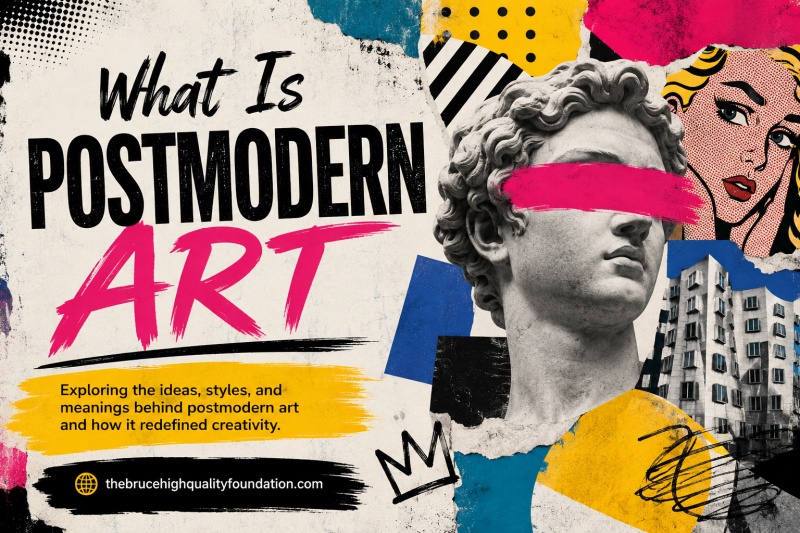
Postmodern art is a body of art movements that emerged in the mid-20th century as a reaction against modernism, characterized by skepticism toward universal truths, embrace of irony and appropriation, and the breakdown of boundaries between high art and popular culture. If you’ve ever stood in a museum wondering why a soup can or a preserved shark is considered art, you’re already engaging with postmodern questions. Understanding what is postmodern art helps us make sense of contemporary visual culture and the diverse, often challenging artworks we encounter in galleries and public spaces today.
In this guide, I’ll walk you through everything you need to know about postmodern art. We’ll explore how it differed from modernism, what made it revolutionary, and why it still influences the art world in 2026. Whether you’re an art student, a curious museum visitor, or someone who just wants to understand what they’re looking at, this article will give you the tools to appreciate and critique postmodern art with confidence.
Our team has spent years studying these movements, visiting exhibitions, and teaching these concepts to beginners. We’ve distilled all that knowledge into this accessible guide that skips the pretentious art-speak and gets straight to what matters.
Table of Contents
What Is Postmodern Art?
Postmodern art refers to artistic production that developed primarily between the 1950s and the early 2000s, though its influence continues today. It arose as a direct response to modernism, challenging the idea that art should pursue universal truths, formal purity, or progressive evolution toward some ideal state. Instead, postmodern artists embraced fragmentation, questioned authority, and deliberately blurred the lines between “high” culture (classical art, opera, literature) and “low” culture (advertising, comic books, television).
The term “postmodernism” itself gained traction in the 1970s, though artists had been working in postmodern modes since the 1950s. French philosopher Jean-Francois Lyotard famously defined postmodernism as “incredulity toward metanarratives” – meaning a skepticism toward big, overarching stories about history, progress, or absolute truth. This philosophical stance directly shaped how artists approached their work.
The Historical Context: Why Postmodernism Emerged
Postmodern art didn’t appear in a vacuum. The devastation of World War II shattered many people’s faith in the optimistic narratives of modernism, which had promised that reason, science, and progress would lead humanity to a better future. The atomic bomb, the Holocaust, and the Cold War made such optimism seem naive at best and dangerous at worst.
Meanwhile, mass media exploded. Television entered nearly every American home by the 1960s. Advertising became increasingly sophisticated. Consumer culture boomed. Artists couldn’t ignore these changes – and many chose to engage directly with popular culture rather than turn their backs on it. The result was Pop Art, the first major postmodern movement, which treated soup cans and celebrity portraits as worthy subjects for fine art.
Key Philosophical Foundations
Several thinkers influenced postmodern art, even if they weren’t artists themselves. Jacques Derrida’s concept of “deconstruction” suggested that texts (and by extension, artworks) don’t have fixed meanings – they can be endlessly interpreted and reinterpreted. Roland Barthes declared the “death of the author,” arguing that the creator’s intentions matter less than the viewer’s interpretation.
Jean Baudrillard introduced concepts like “simulacra” (copies without originals) and “hyperreality” (when the copy becomes more real than reality itself). These ideas became crucial for understanding everything from Andy Warhol’s silkscreens to the digital images that dominate our lives today.
Modern Art vs. Postmodern Art: Key Differences
One of the most common points of confusion – and the question we hear most often – is how modern art differs from postmodern art. The distinction matters because these movements had fundamentally different goals, even if they sometimes look similar to casual viewers.
Modernism, which flourished roughly from the 1860s to the 1950s, believed in progress, originality, and the pursuit of pure forms. Modernist artists like Picasso, Mondrian, and the Abstract Expressionists sought to create something new, authentic, and universally meaningful. They generally maintained a clear distinction between high art and popular culture.
Postmodernism, emerging after World War II, rejected these assumptions. Postmodern artists like Warhol, Barbara Kruger, and Jeff Koons embraced appropriation (using existing images), questioned the possibility of true originality, and deliberately mixed high and low culture. Where modernists sought transcendence, postmodernists embraced irony and skepticism.
| Aspect | Modern Art | Postmodern Art |
|---|---|---|
| Time Period | 1860s – 1950s | 1950s – 2000s (ongoing influence) |
| Core Belief | Progress toward universal truths | Skepticism toward all grand narratives |
| View of Originality | Highly valued; artist as genius | Questioned; appropriation celebrated |
| High vs. Low Culture | Clear separation maintained | Boundaries deliberately blurred |
| Artistic Tone | Often serious, transcendent | Ironic, playful, self-aware |
| Subject Matter | Pure form, abstraction, nature | Consumer goods, media, identity |
| Technique | Traditional media mastery | Any means necessary; conceptual priority |
| Authorship | Individual artist as authority | Death of the author; viewer interpretation |
This table captures the essential differences, but remember that art history is messier than any chart suggests. Some artists bridged both movements, and individual works might combine modern and postmodern elements.
Key Characteristics of Postmodern Art
Postmodern art isn’t defined by a single style – it includes everything from Roy Lichtenstein’s comic-book panels to Marina Abramovic’s endurance performances to Jeff Koons’s shiny balloon animals. What unites these diverse works are certain attitudes and approaches rather than visual similarities.
Irony and Skepticism
Postmodern art rarely takes itself entirely seriously. It often winks at the viewer, acknowledging its own artificiality. When Andy Warhol displayed silkscreened portraits of Marilyn Monroe, he wasn’t just celebrating celebrity – he was also commenting on how fame reduces people to endlessly reproducible images. The irony lies in the double meaning: we see both the glamorous icon and the factory-produced commodity.
This skepticism extends to institutions. Postmodern artists questioned museums, galleries, and the art market itself. The Guerrilla Girls, an anonymous feminist art collective, created posters asking “Do women have to be naked to get into the Met. Museum?” They used humor and statistics to critique institutional sexism.
Appropriation and Pastiche
Appropriation means taking existing images, objects, or styles and recontextualizing them as art. Sherrie Levine famously photographed photographs by canonical male artists like Walker Evans and Edward Weston, presenting her copies as her own work. She wasn’t trying to pass them off as originals – she was asking questions about originality, authorship, and the gendered nature of art history.
Pastiche refers to borrowing and mixing styles from different periods or sources. Postmodern architecture might combine classical columns with modern glass facades. Postmodern paintings might mash up Renaissance techniques with advertising aesthetics. Nothing is off-limits.
The High/Low Culture Breakdown
Modernism generally respected the boundary between high culture (opera, classical painting, literature) and low or mass culture (television, advertising, comic books). Postmodernism deliberately collapsed this distinction. Pop Art treated soup cans and celebrity photos as worthy subjects for gallery walls. Jeff Koons made sculptures based on inflatable pool toys and porcelain figurines.
This wasn’t simple celebration of consumerism – it was often critical. But the critique happened from within, using the language of popular culture rather than rejecting it from an imagined position of artistic purity.
Simulacra and Hyperreality Explained
Baudrillard’s concepts sound intimidating, but they’re actually quite relevant to our digital lives. A simulacrum is a copy that has no original – like a digital image that exists only as code, or a Warhol silkscreen that’s a copy of a publicity photo that’s already a manufactured image.
Think of it this way: when you see a celebrity’s photo on Instagram, you’re not seeing the real person. You’re seeing a filtered, edited, posed image that may have been retouched. That image might be more “real” to you than the actual human being. That’s hyperreality – when the representation becomes more significant than what it represents.
Postmodern artists explored these conditions decades before social media made them everyday experiences. Warhol’s Marilyn silkscreens predicted our current world of endlessly circulating, manipulated images.
Institutional Critique
Many postmodern artists turned their attention to the art world itself. They examined how museums decide what’s valuable, who gets to be called an artist, and how money shapes aesthetic judgments. Hans Haacke created works that exposed the financial connections between museum trustees and controversial industries. Andrea Fraser performed as a museum tour guide, delivering subversive commentary that questioned the institution’s authority.
This self-awareness is a hallmark of postmodernism. The art world doesn’t get a free pass – it’s subject to the same skeptical examination as everything else.
Major Postmodern Art Movements
Postmodernism isn’t a single style but an umbrella term covering many distinct movements. Understanding these helps you recognize different approaches within postmodern art.
Pop Art (Mid-1950s to 1970s)
Pop Art embraced imagery from advertising, comic books, and mass media. Andy Warhol’s Campbell’s Soup Cans and Marilyn Monroe portraits are iconic examples. Roy Lichtenstein blew up comic book panels to monumental scale, complete with Ben-Day dots. Claes Oldenburg made soft sculptures of everyday objects like hamburgers and typewriters.
Pop Art asked: if advertising can be visually compelling, why can’t it be art? It treated consumer culture as both subject and material.
Conceptual Art (1960s to 1970s)
Conceptual Art prioritized ideas over traditional aesthetic concerns. If the concept was good, the physical form mattered less – or not at all. Joseph Kosuth’s “One and Three Chairs” displayed a chair, a photograph of a chair, and a dictionary definition of “chair,” asking which representation was most “real.” Sol LeWitt created wall drawings based on written instructions that others could execute.
This movement challenged the assumption that art must be beautiful or skillfully crafted. Art could be a set of instructions, a documented action, or a purely intellectual proposition.
Minimalism (1960s to 1970s)
Minimalism reduced art to essential geometric forms – boxes, grids, serial structures. Donald Judd created precise stacks of identical boxes. Carl Andre arranged metal plates or bricks directly on the floor. The movement rejected emotional expression and symbolism in favor of pure objecthood.
Though Minimalism shares modernism’s interest in purity, it’s considered postmodern because of its institutional critique and its challenge to traditional sculpture’s assumptions about pedestals, composition, and meaning.
Performance Art (1960s onward)
Performance Art used live action as the medium. Carolee Schneemann’s “Interior Scroll” involved the artist reading from a scroll pulled from her vagina, challenging taboos around female sexuality and body autonomy. Marina Abramovic has spent decades testing the limits of her body and her relationship with audiences through endurance pieces.
Performance art often addressed identity, politics, and the body in ways that traditional media couldn’t. It also questioned the art object’s commodity status – a performance can’t be easily bought or sold.
Feminist Art (1970s onward)
Feminist Art emerged alongside the women’s liberation movement. Judy Chicago’s “The Dinner Party” honored historical women with an elaborate installation featuring painted porcelain plates. Cindy Sherman’s “Untitled Film Stills” featured the artist posing as various female stereotypes from B-movies, questioning how media constructs femininity.
This movement challenged the male-dominated art world and examined how gender shapes both art-making and art-viewing. It brought personal, domestic, and traditionally “feminine” subjects into the gallery.
Neo-Expressionism (1980s)
Neo-Expressionism revived figurative, emotionally charged painting after the cool conceptualism of the 1970s. Jean-Michel Basquiat’s raw, graffiti-influenced canvases addressed race, class, and identity. Julian Schnabel created massive paintings on broken ceramic plates. The movement was deliberately messy, personal, and against the restrained intellectualism of earlier postmodern approaches.
This demonstrates postmodernism’s pluralism – it could accommodate both cool conceptualism and hot expressionism. There was no single “correct” approach.
Young British Artists (1990s)
The Young British Artists (YBAs) burst onto the scene in the late 1980s and 1990s, often with shock tactics and unconventional materials. Damien Hirst preserved animals in formaldehyde and created spot paintings. Tracey Emin displayed her unmade bed complete with cigarettes and condoms. The movement was heavily marketed and commercially successful, deliberately blurring art and spectacle.
The YBAs embodied postmodern concerns with media attention, institutional critique, and the commodification of art – even as they became commodities themselves.
10 Iconic Postmodern Artworks Everyone Should Know
Seeing specific examples helps make postmodern art concrete. Here are ten works that define the movement and remain influential in 2026.
1. Andy Warhol – Campbell’s Soup Cans (1962)
Thirty-two canvases, each depicting a different variety of Campbell’s soup, lined up like supermarket shelves. Warhol used commercial silkscreening techniques to emphasize the mechanical reproduction. The work asks: if soup companies can hire artists to design attractive labels, why can’t an artist treat those labels as art? It’s both celebration and critique of consumer culture.
2. Roy Lichtenstein – Whaam! (1963)
This monumental diptych depicts a fighter plane exploding another aircraft in classic comic-book style, complete with bold outlines, primary colors, and Ben-Day dots. Lichtenstein took disposable entertainment and gave it the scale and presence of history painting. The work questions hierarchies between “serious” art and popular culture.
3. Joseph Kosuth – One and Three Chairs (1965)
An actual wooden chair, a photograph of that chair, and a dictionary definition of “chair” mounted on the wall. This conceptual piece asks which is the “real” chair and questions how representation relates to reality. It epitomizes Conceptual Art’s prioritization of ideas over craftsmanship.
4. Carolee Schneemann – Interior Scroll (1975)
In this performance piece, Schneemann stood naked on a table, painted her body, extracted a paper scroll from her vagina, and read from it. The text was an ironic response to a male filmmaker who dismissed her work. The piece brought female sexuality and body autonomy into the art space with shocking directness.
5. Cindy Sherman – Untitled Film Stills (1977-1980)
Sherman photographed herself posing as various female characters from imaginary B-movies – the femme fatale, the housewife, the ingénue. By staging these stereotypical images, she revealed how media constructs femininity. The series launched her career and remains a touchstone for discussions of gender and representation.
6. Guerrilla Girls – Do Women Have To Be Naked To Get Into the Met. Museum? (1989)
This poster, featuring a reproduction of Ingres’s “Grande Odalisque” with a gorilla mask over the face, presented statistics about gender inequality in major museums. The anonymous collective used humor, data, and bold graphics to challenge institutional sexism and racism. Their work continues today, making them one of postmodernism’s longest-running collectives.
7. Jean-Michel Basquiat – Untitled (Skull) (1982)
A frenzied, raw painting of a skull that incorporates graffiti elements, anatomical diagrams, and scrawled text. Basquiat combined street art techniques with fine art references, addressing race, mortality, and identity. The work sold for over $110 million in 2017, demonstrating how postmodern art entered the investment-grade market.
8. Damien Hirst – The Physical Impossibility of Death in the Mind of Someone Living (1991)
A fourteen-foot tiger shark preserved in a tank of formaldehyde. This YBA signature work confronts viewers with mortality on a massive scale. The title is characteristically wordy and philosophical. Love it or hate it, the piece defined 1990s art and sparked endless debates about what qualifies as art.
9. Jeff Koons – Balloon Dog (Orange) (1994-2000)
A ten-foot-tall, mirror-polished stainless steel sculpture that looks exactly like a twisted balloon animal. Koons took the cheapest, most disposable party favor and transformed it into an expensive, permanent monument. The work embodies postmodern themes of kitsch, scale shifts, and the transformation of low culture into high art.
10. Maurizio Cattelan – Comedian (2019)
A banana duct-taped to a wall. When this work sold for $120,000 at Art Basel Miami, it became an internet sensation and a flashpoint for debates about art’s value. The piece is pure postmodern provocation – it asks what makes something art (context? intention? the artist’s reputation?) and mocks the art market while participating in it.
How to Recognize Postmodern Art: A Beginner’s Guide
After teaching these concepts for years, I’ve developed a simple checklist for identifying postmodern approaches. When you’re looking at art and wondering whether it fits this category, ask yourself these questions:
Does the work use imagery from advertising, television, or consumer products? Pop Art and its descendants treat mass media as raw material. If you see brand names, celebrity faces, or comic-book aesthetics, you’re likely looking at postmodern work.
Is the artist questioning what art actually is? Pieces that challenge definitions – like Kosuth’s chairs or Duchamp’s readymades – embody postmodern skepticism toward fixed categories.
Does the work mix “high” and “low” elements? Combining fine art techniques with kitsch, advertising, or pop culture references is a postmodern signature.
Is there an ironic or self-aware tone? Postmodern art rarely presents itself with modernist seriousness. It often winks at the viewer or acknowledges its own artificiality.
Does the piece critique institutions or power structures? Works that examine museums, gender roles, racial inequality, or the art market itself follow postmodern traditions of institutional critique.
Is appropriation involved? If the artist is using existing images, objects, or styles rather than creating something completely “original,” that’s a postmodern approach.
Remember, no single characteristic defines postmodernism. It’s the combination of skepticism, irony, and boundary-crossing that marks this movement.
Frequently Asked Questions
What defines postmodern art?
Postmodern art is defined by its skepticism toward modernism’s grand narratives of progress and universal truth. Key defining characteristics include irony and self-awareness, appropriation of existing imagery, the breakdown of boundaries between high and low culture, institutional critique, and pluralism – the acceptance of multiple, competing viewpoints rather than a single correct perspective. Postmodern art emerged in the mid-20th century and encompasses movements like Pop Art, Conceptual Art, and Feminist Art.
What is postmodernism in simple terms?
In simple terms, postmodernism is the idea that there’s no single ‘right’ way to see the world and no universal truth that applies to everyone. Where modernism believed in progress toward perfect forms and absolute truths, postmodernism says ‘everything is relative’ and questions authority. In art, this means mixing high culture (like classical painting) with low culture (like advertising), using irony, borrowing from existing sources, and questioning the institutions that define what counts as art.
What is the difference between modern art and postmodern art?
Modern art (roughly 1860s-1950s) believed in progress, originality, and the pursuit of universal truths through pure form. Artists like Picasso and Mondrian sought to create authentic, meaningful works that transcended ordinary life. Postmodern art (1950s-2000s) rejected these beliefs, embracing skepticism, irony, and the blurring of high and low culture. While modernists maintained boundaries between fine art and popular culture, postmodernists like Warhol and Koons deliberately collapsed those distinctions. Modernism valued the artist as genius creator; postmodernism questioned authorship and celebrated appropriation.
Is Damien Hirst postmodern?
Yes, Damien Hirst is a quintessential postmodern artist. As a leading member of the Young British Artists (YBAs), Hirst embodies postmodern characteristics including the use of unconventional materials (preserved animals, pharmaceutical cabinets), institutional critique, the blurring of art and spectacle, and an ironic relationship with the art market. Works like ‘The Physical Impossibility of Death in the Mind of Someone Living’ challenge traditional definitions of art while commenting on mortality and consumerism. His spot paintings and spin paintings question the role of the artist’s hand in creating valuable artworks.
What is the main idea behind postmodernism in art?
The main idea behind postmodernism in art is skepticism – questioning assumptions about truth, beauty, progress, and the boundaries between different types of culture. Postmodern artists reject the notion that art must pursue universal truths or formal purity. Instead, they embrace irony, appropriation, and pluralism. Key concepts include: challenging the distinction between high and low culture, questioning institutional authority, using existing imagery rather than insisting on pure originality, and acknowledging that meaning is created by viewers rather than fixed by artists.
What are the criticisms of postmodern art?
Critics of postmodern art argue several points: first, that its rejection of universal values leads to moral and aesthetic relativism where ‘anything goes.’ Second, that its irony and self-awareness can feel cold, detached, or emotionally empty. Third, that its celebration of consumer culture sometimes becomes indistinguishable from endorsement. Fourth, that the art market has commodified postmodern shock tactics, making them predictable rather than subversive. Finally, some critics argue that postmodernism’s skepticism toward all narratives leaves us without foundations for addressing real injustices or making meaningful art.
Is postmodern art still happening today?
While the historical period of postmodernism (roughly 1950s-early 2000s) has passed, its influence continues strongly in contemporary art. Many artists today still employ postmodern strategies like appropriation, institutional critique, and the mixing of high and low culture. However, some scholars argue we’ve entered a ‘post-postmodern’ or ‘metamodern’ period characterized by a return of sincerity and hope alongside irony. Others suggest we live in a ‘digital postmodernism’ where simulacra and hyperreality have become our everyday reality through social media and AI-generated content. The questions postmodern art raised remain highly relevant in 2026.
Conclusion: The Legacy of Postmodern Art
Understanding what is postmodern art means grappling with fundamental questions about truth, representation, and cultural value. This movement didn’t just produce interesting objects – it changed how we think about creativity, authorship, and the relationship between art and everyday life.
The postmodern era may have ended, but its questions remain urgent. When we scroll through filtered Instagram images, we’re living in Baudrillard’s hyperreality. When we remix memes and share appropriated content, we’re practicing postmodern techniques. When we question whose stories get told in museums, we’re continuing postmodern institutional critique.
Postmodern art taught us to be skeptical of easy answers and to question the boundaries that separate different kinds of culture. Whether you love or hate individual postmodern works, the movement expanded what art can be and who gets to make it. In 2026, those expansions remain part of our creative landscape.
The next time you encounter something in a gallery that seems confusing, ironic, or deliberately provocative, remember what you’ve learned here. Ask the postmodern questions: What’s being questioned? What boundaries are being crossed? What assumptions are being challenged? Armed with this framework, you can approach contemporary art with confidence and curiosity rather than confusion.
Keep exploring, keep questioning, and remember that in art, as in life, the questions are often more valuable than the answers.