
When I first started taking art seriously, I spent weeks tracing images thinking I was improving. My lines looked clean. My proportions seemed perfect. But when I tried to draw something from my own imagination, I could not do it. That moment changed how I understood art practice forever.
Understanding the difference between copying and tracing in art learning matters more than most beginners realize. These two approaches look similar on the surface, but they create wildly different results in your skill development over time. One builds genuine artistic ability while the other can leave you stuck in a frustrating plateau.
Through conversations with art teachers, analysis of how professional artists actually learned their craft, and my own experience helping beginners at our foundation, I have seen this confusion cause more harm than almost any other misconception in art education. This guide will give you a clear understanding of both methods, why copying is considered the superior learning tool, when tracing might serve a legitimate purpose, and exactly how to structure your practice for maximum growth.
Table of Contents
What Are Copying and Tracing in Art?
These terms get mixed up constantly, so let us start with clear definitions. The confusion is understandable. Both involve creating artwork that resembles an existing image, but the cognitive and mechanical processes involved are fundamentally different.
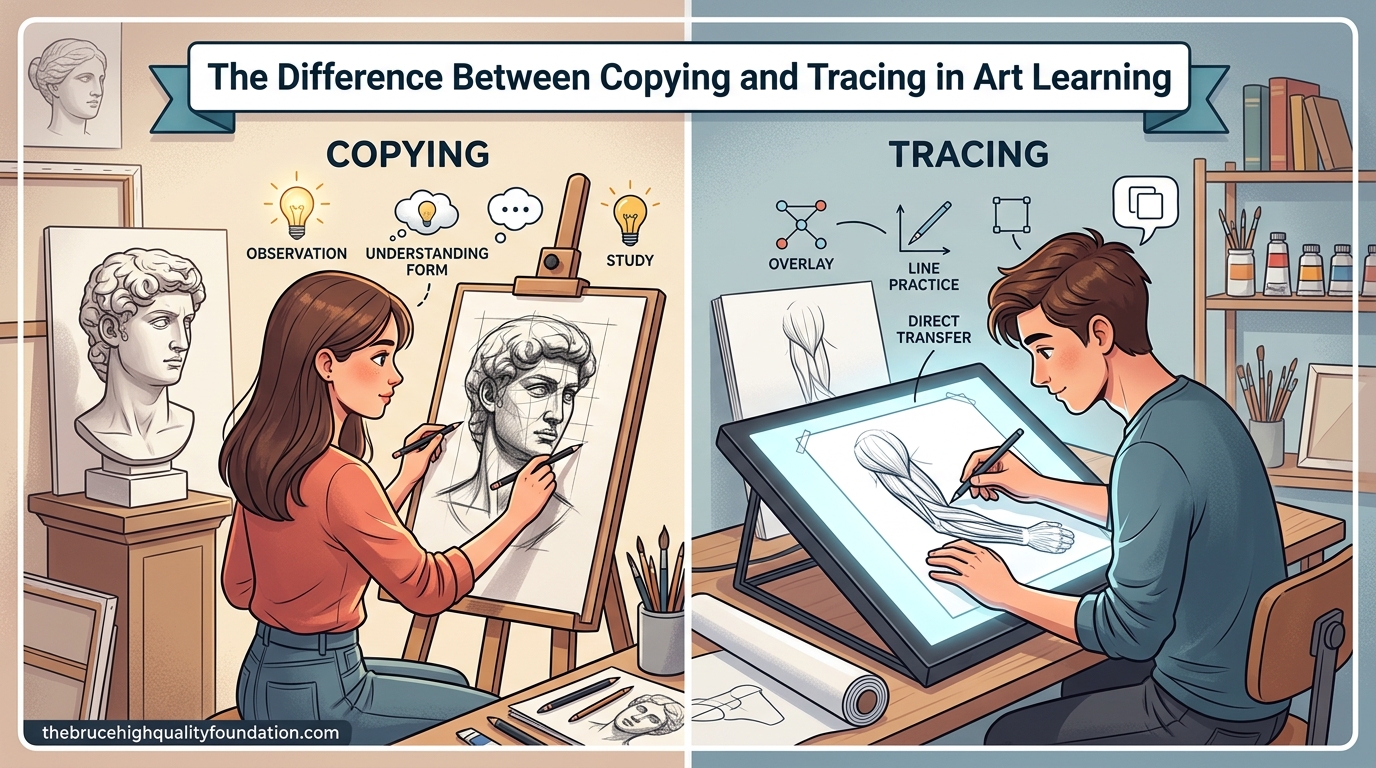
Copying: Learning Through Observation
Copying, sometimes called sight-copying or observational copying, means recreating artwork by looking at the original and interpreting it through your own hand. You study the source image, make decisions about proportions and values, and translate what you see onto your own paper or canvas. Your brain processes the visual information, makes judgments about relationships and angles, and sends those instructions to your hand.
This approach requires active engagement with the artwork. When you copy a drawing by Ingres, you are not just making marks. You are analyzing his line weight decisions, understanding his approach to form, and training your eye to see proportions the way he did. The process is slow and demanding, but it builds lasting understanding.
Tracing: Following Lines Directly
Tracing involves placing paper over an existing image and following the outlines, or using tools like light boxes and tracing software to replicate lines exactly. The defining characteristic is that you are not making decisions about form. The original artwork provides the lines, and your job is simply to reproduce them as accurately as possible.
When you trace, you skip the cognitive processing entirely. Your hand follows predetermined paths without your brain needing to understand why those paths create the forms you see. The output looks like the original, but you have learned almost nothing about how to create similar results independently.
The Key Distinction
To directly answer the common question: No, copying and tracing are not the same thing. Copying involves cognitive processing, decision-making, and active skill development. Tracing bypasses these processes by providing pre-made lines. This distinction explains why one builds artistic ability while the other often creates dependency without comprehension.
Copying vs Tracing: Side-by-Side Comparison
Most competitors in this space explain the difference in paragraphs, but a comparison table helps visualize the contrast more clearly. Here is how these approaches stack up across the factors that matter most for your artistic development.
| Factor | Copying (Sight-Copying) | Tracing |
|---|---|---|
| Skill Development | Builds genuine observational skills and visual processing | Minimal skill transfer to independent work |
| Muscle Memory | Develops hand control through meaningful repetition | Creates muscle memory for tracing motions, not drawing |
| Observation Skills | Forces you to see relationships, angles, and proportions | Does not require or develop observation abilities |
| Cognitive Engagement | High engagement with visual problem-solving | Low cognitive load, passive reproduction |
| Independence | Progressively enables independent drawing ability | Can create dependency without building understanding |
| Time Investment | Slower initial progress, faster long-term growth | Faster initial results, slower long-term development |
| Appropriate Use | Core learning tool for all skill levels | Limited specific applications only |
Why Copying Builds Real Skills While Tracing Can Create Dependency
Art teachers and professional artists consistently report the same frustration with tracing: it produces confidence without competence. You finish a traced piece that looks impressive, but you cannot replicate the process without the original image in front of you. This creates what educators call a dependency loop.
When you copy through observation, your brain builds neural pathways for visual processing. You learn to see angles and recognize how three-dimensional forms translate to two-dimensional representations. This understanding transfers to any subject you want to draw. With tracing, those pathways never develop because the cognitive work is done for you.
I spoke with several working illustrators who admitted to tracing heavily in their early years. What they described was a common pattern: tracings looked good, but any attempt at original work revealed the gap in their actual understanding. Eventually, they had to go back and relearn observation from scratch, which took more time than if they had started with copying practices.
The psychological satisfaction of completing a nice-looking piece reinforces the behavior. This creates a feedback loop where beginners keep tracing because it feels productive, never realizing they are not developing the skills they need. The piece on your wall looks great. The underlying ability to create independently does not grow.
Forum discussions reveal this pattern constantly. Artists report that tracing taught them muscle memory but not understanding. The community consensus is clear: copying from observation builds real skills while tracing can become a crutch that prevents genuine artistic growth.
How Master Artists Used Copying for Decades
Here is what gives copying legitimacy beyond modern pedagogical theory: historical precedent. The greatest draftsmen in Western art history learned through copying, and art institutions have encouraged this practice for centuries.
The Renaissance apprenticeship system required young artists to copy masterworks as their primary training method. Before he painted the Sistine Chapel ceiling, Michelangelo spent years copying works by Giotto and other early masters. This was not considered cheating or a shortcut. It was the established path to developing genuine skill.
Museums worldwide still permit and encourage visitors to copy works in their collections. Walk through the Louvre, the Uffizi, or the Met on any given day and you will find artists with sketchbooks carefully copying paintings and sculptures. This tradition continues because copying masterworks provides a form of direct transmission of technique that no textbook or video can replicate.
The practice of copying extends beyond Western art. Japanese woodblock printing traditions involved master-apprentice relationships where extensive copying of approved works preceded any original creation. Chinese painting schools similarly emphasized copying classical examples as the foundation for developing personal style.
When we look at artists celebrated for their drawing ability, the pattern holds. Ingres was known for his meticulous copies of earlier works before developing his distinctive style. David Hockney has spoken openly about spending years copying master drawings as a young artist. These were not artists who traced. They engaged deeply with their sources, analyzing and internalizing technique through the act of recreation.
What Professional Artists Say About Copying and Tracing
Real artist communities have developed nuanced views on this topic through accumulated experience. The consensus that emerges from platforms like Reddit artist communities and professional forums is remarkably consistent.
Artists value honesty about the learning journey. When successful professionals admit to tracing early in their careers, they almost always pair that admission with the caveat that it was a temporary phase. They emphasize recognizing when tracing becomes a crutch versus when it serves a legitimate purpose.
The community respects artists who give credit to original creators. If you reference another artist’s work, acknowledging that source matters to the art community. This ethical dimension separates legitimate reference use from plagiarism. Professional artists distinguish between openly using references and secretly tracing, understanding that transparency maintains trust within the creative community.
Skill development over time is valued more than immediate results. Artists who show their journey, including struggles and mistakes, build more credibility than those who present only polished final pieces. This suggests the art community fundamentally values growth and process over perfection.
Many successful artists trace for specific professional applications but would never recommend it as a primary learning method. Comic artists sometimes use tracing for background elements or when working under extreme deadline pressure. But they typically learned to draw properly first and use tracing as a time-saving tool, not a skill-building method.
The 70/30 Rule: A Practical Framework for Art Practice
The 70/30 rule appears in People Also Ask questions but no major competitor actually explains what it means. This is a significant gap in available content that I want to address directly.
In art practice, the 70/30 rule suggests allocating your study time with approximately 70% focused on observational copying and 30% on other learning methods. The 70% represents direct practice that builds visual processing skills through meaningful engagement with reference images. The 30% covers supplementary activities like studying anatomy references, practicing specific techniques, experimenting with materials, and yes, even limited tracing for specific purposes.
The reasoning behind this split is straightforward. Observational copying provides the highest return on investment for skill development. When you spend time sight-copying, every minute contributes to building your ability to see and render independently. The 30% allows for variety and targeted study that addresses specific weaknesses without abandoning the foundation of observational practice.
Applying this practically means structuring your practice sessions around extended copying work. If you practice for two hours, roughly 80 to 90 minutes should involve some form of observational copying from life or quality reference images. The remaining time might include studying anatomy charts, watching technique tutorials, or working on specific problem areas like hands or perspective.
This ratio is not arbitrary. Art educators who have observed thousands of students over decades notice that beginners who spend too much time on theory or passive study without direct observational practice struggle to translate knowledge into ability. The hand needs to learn what the eye sees, and that translation only happens through doing.
Beginners sometimes interpret this as permission to trace 30% of the time. That misses the point. The 30% is for varied practice methods, not primarily tracing. If you want to study color theory, do exercises. If you need to understand anatomy, draw from anatomy references without tracing. The variety keeps practice engaging while the 70% observational core ensures continuous skill development.
When Tracing Might Actually Be Appropriate
Being absolutist about tracing being never acceptable does a disservice to nuance. There are legitimate uses for tracing in an artist’s workflow, even if it should not be your primary learning method.
Preliminary layout work sometimes benefits from tracing. If you are designing a complex composition and want to test element placement, tracing basic shapes can speed up the exploration process. The key is recognizing this as a layout tool rather than a skill-building exercise.
Technical reference for consistent elements is another appropriate use. If you are illustrating a book with recurring characters, tracing your own previously-approved designs ensures consistency. Professional illustrators use reference extensively, and some use preliminary tracing to establish accurate bases before adding personal style.
Learning specific software tools may involve tracing exercises. When learning vector illustration software, tracing existing artwork helps you understand how the tools work before needing to create original paths. This is educational scaffolding that should be temporary.
Therapeutic or relaxation purposes carry different value than skill development. Some people find tracing meditative and enjoyable without any aspiration toward artistic skill. If the goal is relaxation and enjoyment rather than growth, tracing serves that purpose appropriately.
The problem emerges when tracing becomes a default approach rather than a deliberate choice for specific situations. Professional artists who trace typically do so with full awareness of what they are doing and why. Beginners often trace because it feels productive without recognizing the opportunity cost to their skill development.
Ethical and Legal Considerations
Beyond skill development, copying and tracing raise ethical questions that the art community takes seriously. Understanding these dimensions matters whether you create art as a hobby or professionally.
Copyright law treats tracing as a potential derivative work. If you trace someone’s original artwork and present the result as your own, you may be infringing on their intellectual property rights. This is especially true for commercial use but applies to personal work shared publicly as well.
The distinction between referencing and tracing becomes crucial here. If you use a photo reference to create an original interpretation, you are referencing. If you trace the outlines from that photo, you are creating a derivative work that may require permission or license. Many artists do not realize how thin this line can be.
Credit and attribution matter within the art community. When you create work inspired by or based on another artist’s creation, acknowledging that influence demonstrates respect for creative effort. The DeviantArt community and similar platforms have developed conventions for this, such as linking to the original work when posting fan art or studies.
Commercial contexts raise the stakes significantly. If you are selling work that involves tracing another artist’s imagery, you need clear permission or licensing. The art-for-hire industry has established norms around reference use, with reputable clients requiring proof that artists created original work rather than traced others’ imagery.
Intent distinguishes acceptable practice from problematic behavior in community contexts. Artists who openly share that they traced for learning purposes receive different treatment than those who present traced work as original creation. Transparency maintains trust. Deception damages it.
Frequently Asked Questions
Is tracing and copying the same thing?
No, copying and tracing are fundamentally different. Copying involves observing a source image and recreating it through your own decisions about proportions, lines, and values. Tracing involves directly following existing lines, which bypasses the cognitive processing that builds skill. Copying develops observational ability while tracing can create dependency without building genuine competence.
What is the 70/30 rule in art?
The 70/30 rule suggests allocating approximately 70% of your practice time to observational copying and 30% to supplementary learning activities. This ratio prioritizes direct skill-building through sight-copying while allowing variety in your study approach. The rule emphasizes that most of your practice should involve active engagement with reference material rather than passive study or tracing.
Is tracing a bad way to learn art?
Tracing is generally considered poor for learning because it bypasses the cognitive processes that build genuine skill. When you trace, you reproduce lines without understanding why they go where they do. This can create attractive results without corresponding ability. Most professional artists and art educators recommend tracing only in limited, specific situations rather than as a primary learning method.
Is it okay for artists to trace?
Tracing can be appropriate in specific professional contexts such as layout work, ensuring consistency in recurring elements, learning software tools, or therapeutic purposes. However, it should be a deliberate choice for particular situations rather than a default practice. For learning purposes, tracing is generally discouraged in favor of observational copying which builds real skill.
Why is tracing considered bad for learning art?
Tracing is considered problematic for art learning because it skips the cognitive processing required for genuine skill development. When you trace, your brain does not learn to see proportions, relationships, or forms because the decisions are made for you. This creates a dependency where you can only produce work when tracing over existing images, never developing the ability to draw independently.
Who is the greatest drawer of all time?
Opinions vary, but artists frequently cited for exceptional drawing ability include Leonardo da Vinci for his anatomical studies and engineering sketches, Jean-Auguste-Dominique Ingres for his meticulous draftsmanship, Michelangelo for his powerful figure studies, and more recently, artists like Burne-Jones and John Singer Sargent. The Renaissance masters developed their drawing skills through extensive copying of earlier masters and direct observation.
The Path Forward for Your Art Learning
Understanding the difference between copying and tracing in art learning is not about following rules dogmatically. It is about making informed choices that serve your growth as an artist. The evidence is clear: observational copying builds the skills you need to create independently, while tracing can provide shortcuts that become dead ends.
If you are a beginner, prioritize copying exercises in your practice. Use the 70/30 framework as a starting point, with the majority of your time spent on sight-copying from quality references. This might feel slower initially. Your results will not look as polished as traced work from someone who has been practicing for the same amount of time. But your underlying ability will grow in ways that tracing cannot replicate.
If you have been tracing heavily and recognize that pattern in yourself, do not feel guilty. Many successful artists went through a tracing phase. The important step is recognizing the limitation and beginning to incorporate more observational practice. You can still create traced work for enjoyment while building your skills through copying.
The historical precedent and modern community consensus both point toward the same conclusion. Copying masterworks, studying through observation, and engaging actively with reference material creates the foundation for genuine artistic ability. These approaches have worked for centuries of artists and remain the most reliable path to skill development today.
For more guidance on developing your artistic practice through structured learning, explore our resources on art learning techniques and compare different art education alternatives to find the approach that fits your goals.
The craft of drawing develops through doing. Every observation you make, every proportion you judge, every line you draw from seeing rather than following builds your capability as an artist. Trust the process even when results feel slow. The skills you build through copying will serve you for a lifetime of creative work.