
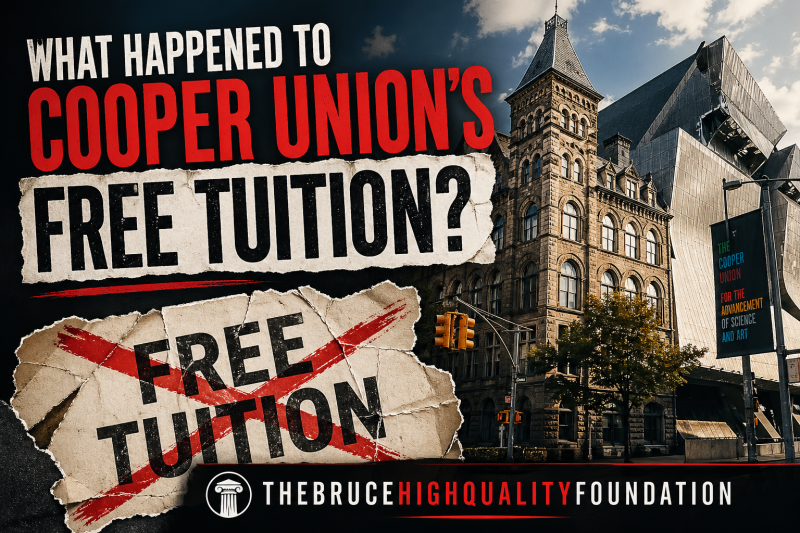
For 154 years, Cooper Union stood as a remarkable exception in American higher education. While other elite colleges charged ever-increasing tuition, this small school in Manhattan’s East Village offered every undergraduate student a full-tuition scholarship. That changed in 2014. Cooper Union’s free tuition policy ended, sparking protests, legal action, and a community crisis that continues to unfold today. The story involves financial mismanagement, student occupations, and a bold plan to restore what was lost by 2026.
Cooper Union’s tuition crisis represents one of the most significant reversals in educational history. The institution founded on the radical principle that quality education should cost nothing fell victim to the same financial pressures facing colleges nationwide. Yet the ending remains unwritten. In 2026, Cooper Union announced that seniors would once again attend tuition-free, marking the first step in a planned return to full free tuition by 2028.
This timeline traces the complete journey from Peter Cooper’s founding vision in 1859 through the controversial 2013 decision to end free tuition, the student activism that followed, and the ongoing restoration efforts. Whether you are a prospective student wondering about costs, an alum tracking your alma mater, or simply interested in educational policy, this guide provides the definitive account of what happened to Cooper Union’s free tuition.
Table of Contents
Peter Cooper’s Revolutionary Vision (1859)
Peter Cooper was not a typical philanthropist. A self-made industrialist who never had formal schooling himself, he believed that education should be “as free as air and water.” When he founded Cooper Union for the Advancement of Science and Art in 1859, he created something unprecedented: an institution where working-class New Yorkers could receive world-class education in art, architecture, and engineering without paying a single cent.
Cooper’s vision was explicit. He declared that the institution should provide education that “would not only improve the mind, but elevate the character and fit the recipient for the duties of citizenship.” The original charter stated that education at Cooper Union would remain free forever. For over a century and a half, that promise held true.
The school operated through a combination of endowment income, revenue from the land under the Chrysler Building (which Peter Cooper’s family owned), and careful fiscal management. This model worked brilliantly for generations, producing graduates who shaped American architecture, engineering, and art without burdening them with student debt.
Complete Timeline of Cooper Union’s Tuition Policy Changes
1859-2012: The Free Tuition Era
For 153 consecutive years, every undergraduate admitted to Cooper Union received a full-tuition scholarship. This was not financial aid based on need. It was not merit scholarships awarded to a select few. Every single student, regardless of background or income, paid nothing for their education. During this period, Cooper Union built a reputation as one of America’s most selective and prestigious institutions, with notable alumni including Thomas Edison, Daniel Libeskind, and Alex Katz.
The free tuition policy created a unique culture. Students came from every socioeconomic background. Working-class kids from Queens studied alongside artists from Manhattan. Everyone was equal because nobody paid. As one alum from the class of 2012 recalled, “We knew we were the last fully free class, and that gave us a strange sense of responsibility.”
2011: The Reinvention Plan and Financial Troubles Begin
The seeds of crisis were planted years before anyone announced tuition. In 2006, Cooper Union completed 41 Cooper Square, a controversial new academic building designed by Thom Mayne. The $177 million structure, while architecturally striking, drained the school’s finances and required taking on significant debt.
Meanwhile, the 2008 financial crisis hit the school’s endowment hard. Investments in hedge funds performed poorly. The land lease under the Chrysler Building, long a reliable revenue source, faced uncertainty. By 2011, the school was running an operating deficit that would eventually reach $12-16 million annually.
President George Campbell Jr. had led the school since 2000, but the financial situation was deteriorating rapidly. In 2011, the board announced a “Reinvention Plan” and hired consultants to find solutions. The stage was set for dramatic changes.
2013: The Tuition Announcement That Shocked the Community
April 23, 2013, marks the day everything changed. The New York Times broke the story: Cooper Union would end its free tuition policy for undergraduates starting in Fall 2014. Under new president Jamshed Bharucha, who had taken office in 2011, the board concluded that the financial model was no longer sustainable.
The announcement cited years of deficits, rising costs, and insufficient endowment returns. Bharucha stated that charging tuition was necessary to preserve the school’s academic quality and financial stability. The plan initially proposed charging approximately $20,000 per year, though with significant financial aid for lower-income students.
The reaction was immediate and fierce. Students, alumni, and faculty expressed outrage. The decision felt like a betrayal of Peter Cooper’s founding mission. Within days, protests began organizing. A movement called “Free Cooper Union” emerged, using a red square as its symbol. The battle for Cooper Union’s soul had begun.
2014: Free Tuition Ends After 155 Years
Fall 2014 brought the first tuition-paying class to Cooper Union in over a century and a half. The incoming students faced bills of $19,275 per semester for the School of Art, with slightly different rates for Architecture and Engineering. The school introduced a new scholarship structure: all students received a half-tuition scholarship automatically, but families needed to cover the remaining half unless they qualified for additional need-based aid.
For a school that had defined itself by universal free education, the shift was wrenching. The class of 2018 became known as the first tuition-paying cohort in Cooper Union history. Meanwhile, protests continued. Students occupied the president’s office for 65 days, from December 2013 into early 2014, demanding Bharucha’s resignation and a reversal of the tuition decision.
Faculty issued a vote of no confidence in Bharucha. Alumni began withholding donations in protest. The New York Attorney General’s office started investigating whether the school’s fiscal mismanagement violated its charter and Peter Cooper’s original intentions.
2015: The Consent Decree and Legal Settlement
In 2015, the crisis reached a legal resolution. The Committee to Save Cooper Union, an alumni group, filed a lawsuit arguing that charging tuition violated the school’s founding principles. The New York Attorney General negotiated a settlement that became known as the consent decree.
The agreement required Cooper Union to develop a plan to return to free tuition. The consent decree established that the school’s charter obligated it to provide free education whenever financially possible. A working group was formed to create a sustainable path forward.
The settlement also addressed governance concerns. The board structure was modified to include more diverse perspectives. Transparency requirements were added for financial decisions. Bharucha ultimately resigned in 2015, leaving the school to navigate its future under interim leadership.
2018: The 10-Year Plan to Restore Free Tuition
On September 19, 2018, Cooper Union announced what many had been waiting for: a 10-year plan to return to full-tuition scholarships. The board of trustees approved the plan, which targeted 2028 as the year when free tuition would be fully restored.
The plan required significant financial restructuring. The school committed to growing its endowment through fundraising, improving investment returns, and controlling costs. Mark Epstein, a Cooper Union alum and philanthropist, played a crucial role in developing and supporting the plan.
The 10-year plan set specific benchmarks. Each year, the school would increase scholarship levels as financial conditions allowed. The goal was gradual but steady progress toward Peter Cooper’s original vision. For the first time since 2014, there was a concrete commitment to reversing course.
2026: Free Tuition Returns for Seniors
September 2025 brought a major milestone. Cooper Union announced that all seniors would attend tuition-free through the 2027-28 academic year. This accelerated the 10-year plan’s timeline, marking the first return of universal free tuition since 2014.
The announcement was strategically timed. Making seniors tuition-free created an incentive for students to complete their degrees at Cooper Union and sent a powerful message about the school’s commitment. Each successive senior class would benefit, building momentum toward the 2028 full restoration goal.
President Laura Sparks called the move “a significant step toward fulfilling Peter Cooper’s vision.” The announcement received widespread media coverage and renewed alumni enthusiasm. For the first time in a decade, the conversation shifted from what was lost to what was being rebuilt.
What Caused the Cooper Union Financial Crisis?
Understanding what happened to Cooper Union’s free tuition requires examining the financial decisions that led to the crisis. Multiple factors combined to create an unsustainable situation.
The 41 Cooper Square building stands as the most visible symbol of fiscal challenges. The $177 million construction project, completed in 2009, went over budget and required the school to take on significant debt. Operating costs for the facility added to annual expenses. Critics argued that the project represented administrative overreach and misplaced priorities.
Investment strategy also played a major role. The school’s endowment, which had historically provided stable income, suffered from poor hedge fund investments following the 2008 financial crisis. While other institutions recovered, Cooper Union’s portfolio continued underperforming, reducing the revenue available for operations.
The Chrysler Building land lease, once a reliable revenue stream, became complicated by lease renegotiations and changing real estate market conditions. This external factor, combined with internal fiscal management issues, created a perfect storm.
Administrative spending drew criticism from the Committee to Save Cooper Union and other observers. Compensation for top administrators increased significantly during the Campbell and Bharucha presidencies. Meanwhile, faculty salaries stagnated and student services faced cuts. The perception that leadership prioritized their own interests over the school’s mission fueled protest movements.
The Student Protests and Free Cooper Union Movement
The response to ending free tuition went far beyond grumbling. Students organized one of the most sustained protest campaigns in recent educational history.
The Free Cooper Union movement emerged within days of the April 2013 announcement. Students adopted a red square as their symbol, representing the “red line” that charging tuition crossed. The movement organized rallies, created educational materials about Peter Cooper’s vision, and built coalitions with faculty and alumni.
In December 2013, the protests escalated dramatically. Students occupied President Bharucha’s office in the Foundation Building, vowing to remain until their demands were met. The occupation lasted 65 days, through the winter holidays and into February 2014. Students organized rotating shifts, maintained their academic studies, and used the occupied space for teach-ins about educational policy.
The Committee to Save Cooper Union, formed by concerned alumni, took a legal approach. They filed the lawsuit that eventually produced the 2015 consent decree. This group conducted independent financial analysis, challenged board decisions, and advocated for transparent governance.
The protests succeeded in several ways. They brought national media attention to the crisis. They pressured the Attorney General to investigate. They contributed to Bharucha’s eventual resignation. Most importantly, they kept alive the ideal of free tuition as a non-negotiable part of Cooper Union’s identity.
Current Status: Is Cooper Union Free Now?
As of 2026, Cooper Union operates under a hybrid model that represents partial restoration of the original free tuition policy. Understanding the current scholarship structure helps prospective students and families navigate costs.
All undergraduate students currently receive a half-tuition scholarship valued at approximately $22,275 per year. This automatic award applies regardless of family income or academic standing. Students must cover the remaining half through family contributions, outside scholarships, or loans.
Additional need-based aid is available for families with demonstrated financial need. Students from lower-income households may qualify for full-tuition scholarships or amounts between the half-tuition baseline and full coverage. The school provides a net price calculator for families to estimate their specific costs.
The 2026 announcement changed the picture for seniors. Students in their final year now receive full free tuition. This policy applies to the class of 2025 and will continue for each subsequent senior class through 2028. The goal is that by 2028, all four undergraduate years will be tuition-free once again.
Non-tuition expenses remain. Students must cover housing, meals, books, and supplies. New York City’s high cost of living makes these expenses significant, even when tuition itself is free or reduced. The school provides support for these costs through additional aid programs.
Frequently Asked Questions
When did Cooper Union stop being free?
Cooper Union stopped being completely free in Fall 2014. The announcement was made on April 23, 2013, that the school would begin charging undergraduate tuition for the first time in its 154-year history. The class entering in Fall 2014 became the first tuition-paying cohort at Cooper Union since its founding in 1859.
Does Cooper Union still have free tuition?
As of 2026, Cooper Union offers partial free tuition. All undergraduates receive a half-tuition scholarship worth approximately $22,275 annually. Additionally, since September 2024, all seniors attend completely tuition-free through the 2027-28 academic year. The school plans to restore full free tuition for all students by 2028.
Why did Cooper Union start charging tuition?
Cooper Union started charging tuition due to a financial crisis caused by multiple factors: the expensive 41 Cooper Square building construction, poor hedge fund investment returns following the 2008 financial crisis, complications with Chrysler Building land lease revenue, and years of operating deficits reaching $12-16 million annually. The board determined that charging tuition was necessary to maintain academic quality and financial stability.
When will Cooper Union be tuition free again?
Cooper Union has committed to restoring full free tuition by 2028 under its 10-year plan approved in 2018. The process began with making seniors tuition-free starting in 2024. Each successive year brings the school closer to the goal of universal full-tuition scholarships for all undergraduate students, returning to Peter Cooper’s original vision.
What is The Cooper Union controversy?
The Cooper Union controversy refers to the 2013 decision to end the school’s 154-year tradition of free undergraduate tuition, which sparked protests, a 65-day student occupation of the president’s office, faculty votes of no confidence, alumni withholding donations, and a lawsuit by the Committee to Save Cooper Union. The controversy also involved allegations of financial mismanagement and led to a 2015 consent decree requiring the school to develop a plan to return to free tuition.
The Future of Free Tuition at Cooper Union
The story of Cooper Union’s free tuition is still being written. From Peter Cooper’s revolutionary vision in 1859 through the crisis years of 2013-2014 to the hopeful restoration efforts of today, this institution has demonstrated both the vulnerability and resilience of educational ideals.
The 2028 goal for full tuition restoration represents more than a financial target. It symbolizes a community’s commitment to reclaiming its founding principles. The students who protested, the alumni who sued, and the administrators who developed the 10-year plan all contributed to keeping Peter Cooper’s vision alive.
For prospective students and their families, Cooper Union in 2026 offers a compelling value: half-tuition scholarships for all, full free tuition for seniors, and a credible path toward complete restoration. For observers of educational policy, Cooper Union’s journey provides essential lessons about institutional sustainability, community activism, and the enduring power of a founding mission.
The question “what happened to Cooper Union’s free tuition” now has an evolving answer. What happened was a painful interruption. What is happening now is a determined restoration. By 2028, if all goes according to plan, the answer may simply be: it returned.