
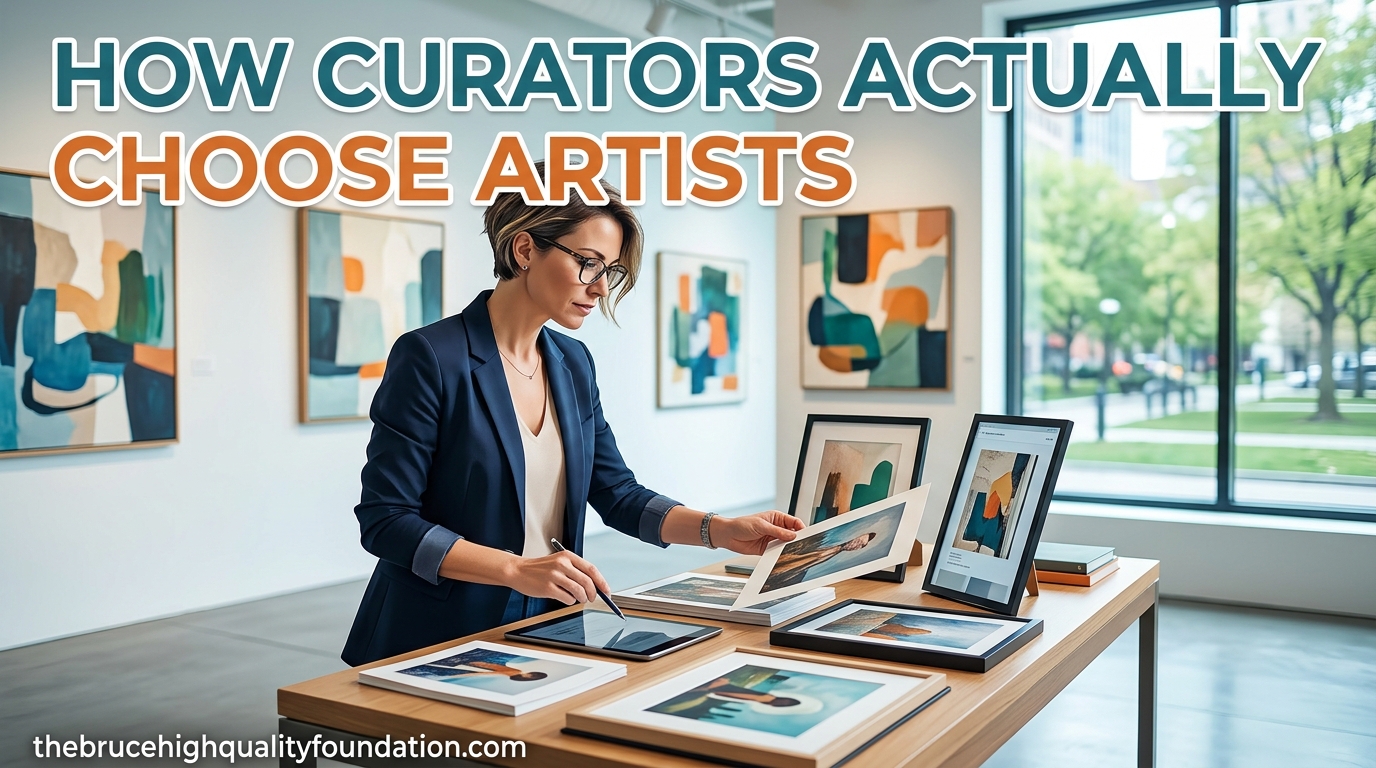
Most artists spend years believing that great work alone will get them noticed. The reality is far more complex. Curators and gallery directors make decisions based on relationships, timing, and a set of professional standards that rarely get discussed publicly. This guide reveals how curators actually choose artists so you can stop wasting energy on cold submissions and start building meaningful connections in the art world.
Whether you are an emerging artist trying to get your first gallery representation or a mid-career creator looking to land museum exhibitions, understanding the selection process changes everything. We dug into curator interviews, forum discussions, and industry research to give you an insider perspective on what actually drives these decisions.
Table of Contents
The Reality: How Curators Actually Discover Artists
Curators rarely find artists through cold submissions. Instead, the most reliable path into a gallery or museum runs through personal introductions. According to multiple curator interviews and industry discussions, over 80% of artist discoveries happen through existing art community networks. A gallery director might hear about you from another artist they represent, or a museum curator might discover your work at an art fair while browsing with a colleague.
Art fairs have become one of the most important discovery venues in recent years. Galleries attend these events specifically to scout new talent, and curators often describe them as efficient ways to see hundreds of artists in a concentrated timeframe. If you want to get noticed, exhibiting at relevant art fairs often yields better results than sending unsolicited emails.
Social media has shifted some of these dynamics. Instagram, Artsy, and Behance have created new pathways for artists to catch curator attention directly. However, even digital discovery tends to happen when curators are actively researching specific styles or mediums rather than passively browsing. The artists who succeed online typically have cohesive feeds that tell a clear artistic story.
Studio visits remain the gold standard for serious curator interest. When a curator asks to see your work in person, that signals genuine potential. Most curators we spoke with described requesting studio visits as the key inflection point in their selection process. Everything before that is preliminary screening.
What Curators Look for in Artist Portfolios
Cohesive Body of Work
The single most consistent criterion across all curator feedback is portfolio cohesion. This does not mean your work must look identical across every piece. Rather, curators look for a clear artistic vision that connects your projects together. They want to see that you have developed a distinctive voice rather than producing disconnected experiments.
Technical skill matters, but it ranks below cohesion in most curator assessments. A polished portfolio with a clear direction beats a technically impressive but tonally inconsistent collection every time. Curators want to understand what you are trying to say as an artist and whether you have the skill to say it effectively.
Originality continues to be highly valued, though curators acknowledge this is difficult to define precisely. What they often describe is authentic personal vision rather than work that clearly derives from other artists. If your portfolio could only exist in reference to other artists, that signals a problem. If it could stand alone while acknowledging influences, that suggests the originality curators seek.
Professional presentation standards include several elements that artists sometimes overlook. Clean, high-resolution documentation of your work matters. Clear labeling with consistent formats helps curators organize their review process. An organized digital presence, whether through a personal website or professional platform, signals that you take your practice seriously.
The Role of Relationships and Personal Networks
The art world runs on relationships more than most artists initially realize. A curator who trusts an artist they discovered years ago will give that artist serious consideration before exploring unknown names. This does not mean the system is corrupt or purely political. Rather, relationships create efficiency. Curators need to make hundreds of decisions with limited time, and personal trust reduces the risk of representing artists who might not deliver.
Cold submissions rarely work because curators simply do not have time to review them properly. A gallery director might receive hundreds of unsolicited submissions monthly, and most go unopened. The artists who get serious consideration typically have someone in their corner who can make an introduction. That introduction does not need to come from another famous artist. It might come from an art advisor, a collector, a curator at a smaller institution, or even another gallery who cannot take on new artists but wants to help.
Building genuine connections within the art community takes time, and there are no shortcuts. Artists who succeed in getting noticed focus on creating relationships based on authentic interest in the art world rather than purely transactional networking. Attend openings, engage with curators whose work you respect, support other artists, and let relationships develop naturally. The artists who burn out typically are those who treat every interaction as a stepping stone to representation.
Trust between curator and artist develops when both parties demonstrate consistency over time. Curators want artists who will show up professionally, deliver work when promised, and maintain the quality standards that got them noticed in the first place. Artists want curators who will advocate for them, provide exhibition opportunities, and help them grow professionally. Long-term relationships benefit both sides.
Cold Submissions: Why They Rarely Work
The numbers are not encouraging for artists who rely solely on cold submissions. Industry discussions reveal that curators spend an average of 30 seconds reviewing unsolicited submissions before deciding whether to look further. That 30 seconds must establish enough promise to justify additional time investment, and most submissions fail to make that cut.
The volume problem explains much of this dynamic. A single gallery might receive thousands of submissions annually across email, mail, and digital platforms. Even with dedicated staff time, reviewing all of them thoroughly becomes impossible. The practical result is that cold submissions get filtered quickly, often by assistants who do not flag everything for the gallery director to review.
Cold submissions might work in specific circumstances. If you are targeting a gallery with a specific connection to your medium or style, and your submission clearly demonstrates you understand their program, that alignment might get attention. However, even in these cases, having a mutual contact who can vouch for your work dramatically increases your chances. The exception proves the rule: rare successes with cold outreach typically involve either exceptional timing or work that perfectly matches an explicit gallery need.
How to Approach Galleries and Curators
Research precedes every effective approach. Before reaching out to any gallery or curator, understand their program, the artists they represent, and their exhibition history. If your work clearly does not fit their aesthetic, do not waste either of your time. If you can identify genuine alignment, your approach should emphasize that specific connection.
Professional outreach means sending clean, concise emails that respect the recipient’s time. Include your artist statement, a few portfolio images, a link to your website, and a clear reason for your interest in their program. Do not send massive attachments. Do not write a novel. Do not follow up daily. Do follow up once after two weeks if you have not received a response, and then give the relationship time to develop.
Finding the right fit matters more than approaching as many galleries as possible. Artists who land representation typically have targeted their search to galleries whose programs genuinely align with their work. A rejection from a prestigious gallery does not mean your work lacks quality. It often simply means you are not the right fit for their specific program at that moment.
Building ongoing relationships with curators takes patience. Even when a gallery cannot represent you currently, maintaining that connection might lead to future opportunities. Check in occasionally with relevant news about your practice, exhibition invitations you have received, or interesting projects you are working on. Curators who see artists grow over time sometimes become advocates years after initial contact.
Professional Presentation Tips for Artists
Your artist statement often determines whether a curator reads further. It should be concise, specific to your practice, and written in plain language. Avoid jargon, sweeping generalizations about your place in art history, and cliches that could describe thousands of other artists. The best artist statements communicate what you make, why you make it, and what you are trying to achieve with your current body of work.
Portfolio organization should tell a clear story. Curators who review dozens of portfolios daily appreciate logical flow and consistent presentation. Group work by series, include clear dates, and ensure image quality is consistently high. Consider the sequence carefully. The first and last works in your portfolio leave strong impressions.
Digital presence expectations have risen dramatically in recent years. A professional website with clean navigation, proper documentation of your work, and a way to contact you is now baseline. Artists without websites appear less serious to curators who expect this minimum standard. Your website does not need to be elaborate, but it must be functional and professional.
If you want to learn more about crafting documents that capture curator attention, we have a guide on how to write an artist statement that does not suck with practical examples and common mistakes to avoid.
The Timeline of the Selection Process
Responses to professional inquiries typically take longer than artists expect. Gallery directors might take four to eight weeks to respond to initial inquiries, particularly during exhibition preparation periods when their schedules become extremely full. If you have not heard back after three weeks, a single polite follow-up is appropriate. Do not send multiple follow-ups or use read receipts as pressure tactics.
Serious curator interest usually involves multiple stages. Initial contact leads to portfolio review. If the portfolio captures interest, a studio visit or meeting typically follows. That meeting allows the curator to understand your practice more fully and assess whether you might fit their program. Decision timelines after studio visits vary widely, from a few weeks to several months depending on institutional planning cycles.
Understanding how museums select exhibitions provides useful context for the overall selection environment, even when you are targeting gallery representation rather than museum shows. Many of the same principles around timing, fit, and relationship building apply across different institutional types.
Differences Between Gallery and Museum Curation
Commercial galleries prioritize artists who can sell and who will contribute to a coherent gallery program. They consider whether your work appeals to their existing collector base, whether you can produce work consistently, and whether your pricing fits their market positioning. Gallery representation involves ongoing business relationships, not just curatorial appreciation.
Museum curation involves different priorities. Museums often focus on artists whose work fits specific exhibition themes, contributes to collection development goals, or represents significant cultural moments. Museum curators might prioritize artists whose work has critical recognition or who bring new perspectives to established narratives. The timeline for museum inclusion typically extends longer than gallery representation processes.
Some artists pursue both paths, understanding that galleries handle commercial work while museums handle more conceptual or archival projects. Others focus on one track depending on their practice and career goals. Neither path is superior. The right approach depends on your work, your goals, and where you see your practice fitting within the broader art ecosystem.
Understanding how curation works in practice helps artists position themselves effectively regardless of which institutional path they pursue. If you are exploring how professionals approach display and presentation, our guide on learning curator-level art display techniques offers practical insights you can apply to your own practice.
Conclusion
How curators actually choose artists comes down to a combination of relationship, fit, and professional presentation. Great work matters, but it is only part of the equation. Building genuine connections within your art community, presenting yourself professionally, and targeting the right institutions for your specific practice will yield far better results than cold submissions and broad outreach campaigns.
The artists who succeed long-term treat their careers as relationship-building exercises, not one-time transactional encounters. Stay in touch with curators who have shown interest in your work, support other artists in your community, and focus on developing a cohesive practice that speaks clearly. The rest will follow.
FAQs
How does a curator choose art?
Curators select artists based on portfolio cohesion, artistic merit, professional presentation, and personal network connections. The most common discovery path is through personal introductions, art fairs, and gallery networks rather than cold submissions.
What is the 70 30 rule in art?
The 70/30 rule in art typically refers to the principle that artists should spend roughly 70% of their time creating work and 30% on professional development, marketing, and relationship building. This balance helps maintain creative output while building the connections necessary for career growth.
What is the 80 20 rule in art?
The 80/20 rule, or Pareto principle, applies to art careers in several ways. Artists often find that 80% of opportunities come from 20% of their relationships. Similarly, collectors might acquire 80% of their favorites from 20% of the artists they discover. Understanding this distribution helps artists focus their efforts strategically.
Who famously got rejected from art school?
Many famous artists faced rejection from art schools before achieving recognition. Vincent van Gogh was rejected by the Royal Academy of Fine Arts in Amsterdam. Claude Monet failed the entrance exam for the École des Beaux-Arts. Frida Kahlo was rejected from medical school and later from the National School of Fine Arts in Mexico. These examples illustrate that institutional rejection does not determine artistic worth or future success.