
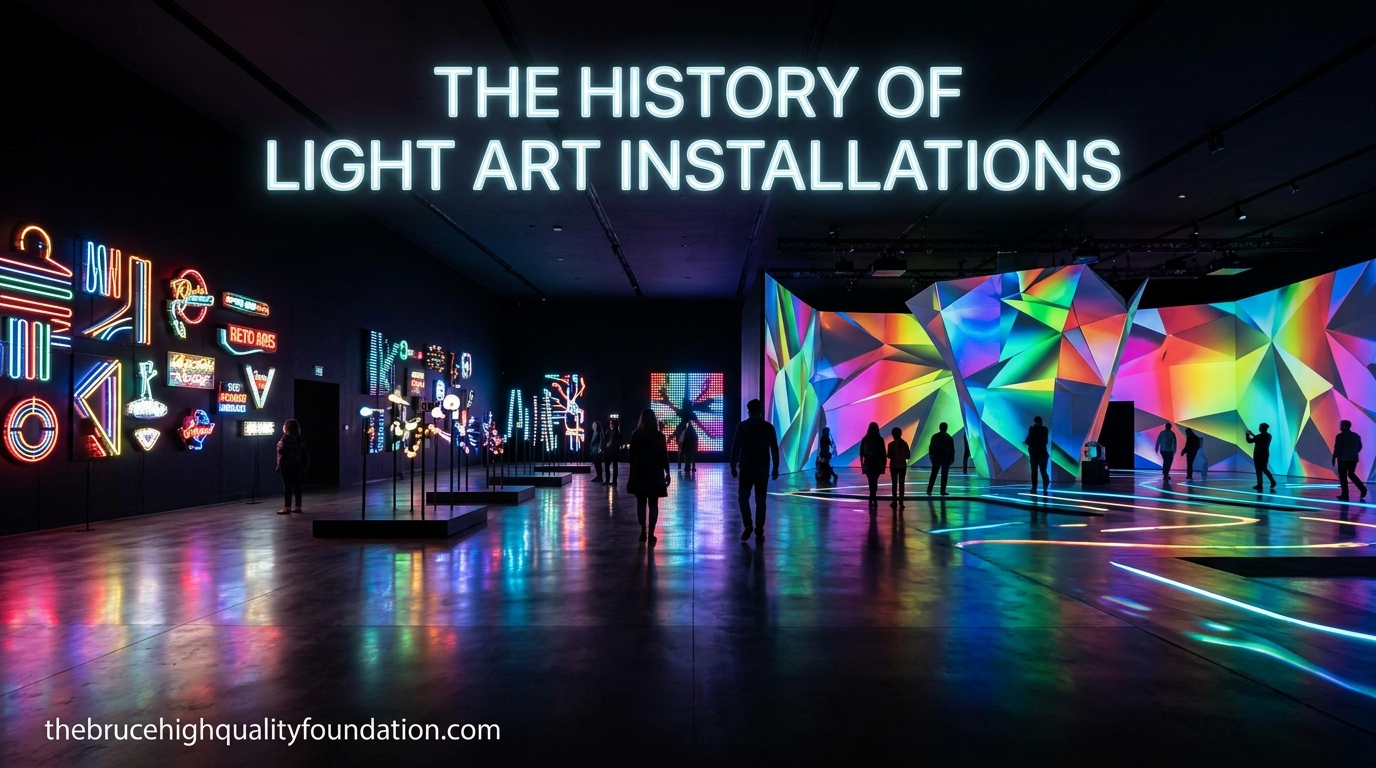
Light has fascinated artists for centuries. Long before electricity powered gallery walls, painters and architects shaped light into emotional and spiritual experiences. Today, the history of light art installations reads like a journey through human ingenuity, from stained glass cathedral windows to stadium-sized immersive environments that respond to your movement. Our team spent weeks tracing the evolution of this art form, and what we found tells a bigger story about how technology and creativity have always moved forward together. Whether you are an art student researching a paper, a curious gallery-goer, or someone who wandered into a James Turrell skyspace and wanted to understand what just happened to your perception, this guide covers the full timeline. For broader context on the artists shaping contemporary visual culture, check out our guide to the 100 Most Influential Contemporary Artists.
The history of light art installations spans roughly four hundred years of creative experimentation. It begins with architects like Gian Lorenzo Bernini channeling sunlight through church domes and extends all the way to algorithm-driven LED sculptures that react to weather data in real time. What connects these eras is a shared ambition: to make light itself the subject of art, not just a tool for illuminating something else.
Table of Contents
What Is Light Art? A Clear Definition
Light art is a visual art form in which light serves as the primary medium. Unlike painting, where light is represented through pigment, or sculpture, where light falls across a surface, light art uses actual illumination as its material. The result is often an immersive experience that transforms how viewers perceive space, color, and time.
Light art installations can take many forms. They range from Dan Flavin’s spare arrangements of fluorescent tubes to James Turrell’s vast architectural chambers that frame the sky. They include neon signs, LED arrays, projection mapping on buildings, fiber optic sculptures, and laser performances. The common thread is that without the light, the artwork would not exist.
This distinguishes light art from lighting design. A theater lighting designer uses illumination to support a performance. A light artist makes the illumination itself the performance. The light is not a supporting actor. It is the entire cast.
Early Origins: Light in Art from the Baroque to the 19th Century
Long before Thomas Edison patented the light bulb, artists were already treating light as a creative force. The history of light art installations begins not with electricity but with architecture, painting, and a deep understanding of natural illumination.
Gothic Cathedrals and the First Light Art
Gothic cathedral builders of the 12th and 13th centuries were among the earliest artists to treat light as a medium. The soaring stained glass windows at Chartres Cathedral in France filter sunlight into saturated blues, reds, and golds, filling the nave with color that shifts throughout the day. Abbot Suger of Saint-Denis, who is widely credited with launching the Gothic style, wrote in the 1140s that light was a manifestation of the divine. His architectural innovations were designed to flood church interiors with heavenly radiance.
These windows were not decorative additions. They were structural and spiritual instruments. The light itself carried narrative and emotional weight, much like a contemporary installation would today. Art historians often point to Gothic stained glass as a prototype for the immersive light environments of the 20th and 21st centuries.
Bernini and the Baroque Mastery of Natural Light
Gian Lorenzo Bernini took the theatrical potential of light to new heights in the 17th century. In the Cornaro Chapel at Santa Maria della Vittoria in Rome, his sculpture of Saint Teresa in Ecstasy is positioned so that a hidden window bathes the figure in golden light. The effect is dramatic, almost cinematic, and it was entirely deliberate.
Bernini used similar techniques in his design of Saint Peter’s Baldachin and the Fountain of the Four Rivers. By controlling how and where natural light entered a space, he created what we would now call site-specific installations. His work at the Vatican, where light pours through the Dove of the Holy Spirit window in the Cathedra Petri, is a masterclass in using illumination to produce awe.
Chiaroscuro, Tenebrism, and Painted Light
While architects manipulated actual light, painters developed techniques to represent it with startling realism. Caravaggio mastered tenebrism in the early 1600s, pushing figures out of deep shadow through sharp, dramatic illumination. Rembrandt used chiaroscuro to create psychological depth, his subjects emerging from darkness as though lit by a single candle.
These painters were not making light art in the modern sense, but their obsession with how light shapes perception laid conceptual groundwork for what came later. They demonstrated that light could be a subject, not just a condition of visibility. That idea would take on new life once electric light became available.
The Dawn of Electric Light in Art
The invention of gas lighting in the early 19th century and electric arc lamps in the 1870s opened entirely new possibilities. The Paris Opera House installed electric lighting in 1881, and world’s fairs began using artificial illumination as spectacle. The 1889 Paris Exposition Universelle lit the Eiffel Tower with thousands of electric lamps, turning an engineering structure into a glowing beacon visible across the city.
These public displays were not yet framed as art by their creators, but they seeded a cultural awareness that electric light could transform environments and captivate audiences. The step from spectacle to art was shorter than it appeared.
The Modernist Revolution: Bauhaus, Constructivism, and the Birth of Electric Light Art (1920-1940)
The 1920s marked the moment when artists first picked up electric light as deliberately as a painter picks up a brush. Two movements drove this breakthrough: Russian Constructivism and the German Bauhaus. Both believed art should engage with modern technology rather than retreat from it.
Laszlo Moholy-Nagy and the Light-Space Modulator
Hungarian-born artist Laszlo Moholy-Nagy is widely considered the father of light art. His Light-Space Modulator, created between 1922 and 1930, was a motorized sculpture of metal and glass that cast moving shadows and light patterns across gallery walls. It was exhibited at the 1930 Paris exhibition of the Union des Artistes Modernes and remains one of the most influential kinetic sculptures ever made.
Moholy-Nagy taught at the Bauhaus in Weimar and later in Dessau, where he championed the idea that artists should work with light, motion, and new materials rather than paint and canvas. His 1925 book Painting, Photography, Film argued that light could be an independent artistic medium. He also experimented with photograms, cameraless photographs made by placing objects directly on light-sensitive paper, further demonstrating his obsession with light as raw material.
Thomas Wilfred and the Clavilux
While Moholy-Nagy worked in Europe, Danish-born American artist Thomas Wilfred was developing his own approach to light as art. In 1922, Wilfred invented the Clavilux, a keyboard-controlled instrument that projected colored light compositions onto screens. He called these performances “lumia,” a term he coined for silent visual art made from light.
Wilfred’s Clavilux recitals were staged in concert halls across the United States during the 1920s and 1930s. Audiences watched abstract patterns of color shift and morph in real time, controlled by the artist at a console. His work is a direct ancestor of today’s immersive digital environments and projection-based installations. The Smithsonian American Art Museum acquired one of his later Clavilux models in 2016, cementing his place in the history of light art installations.
Constructivist Experiments
Russian Constructivists also explored light as medium. Naum Gabo created transparent plastic sculptures that refracted and split light into spectral components. His Realistic Manifesto of 1920 argued for art that incorporated space and time, not just static form. While Gabo worked with transparent materials rather than electric light directly, his ideas about art as a spatial and temporal experience directly influenced later light artists.
The 1939 New York World’s Fair
The 1939 New York World’s Fair made light art accessible to millions. The General Motors Futurama exhibit and the Trylon and Perisphere used dramatic electric lighting to create futuristic environments. These displays demonstrated that light could transform public spaces into experiential art, even if the organizers were more focused on commerce than culture. The fair planted seeds that would flower in the light art movement of the 1960s.
The History of Light Art Installations: Pioneering Artists Who Changed Everything
The artists profiled below are the figures most responsible for transforming light from a theatrical effect into a standalone art form. Each brought a distinct philosophy, technical approach, and body of work that expanded what light art could be.
Dan Flavin: The Poet of Fluorescent Tubes
Dan Flavin (1933-1996) did more to legitimize light as a fine art material than almost anyone else. Beginning in 1963 with his work the diagonal of May 25, 1963, which consisted of a single yellow fluorescent tube mounted at a 45-degree angle on a gallery wall, Flavin spent three decades exploring what commercially available fluorescent fixtures could achieve.
His installations are deceptively simple. Standard white and colored fluorescent tubes, the kind found in offices and warehouses, arranged in corridors, corners, and room-sized configurations. But the effect is transformative. The colored light spills across walls and floors, dissolving the boundaries of the gallery and immersing viewers in a bath of saturated color.
Flavin’s work at Donald Judd’s Spring Street building in New York, at the Chinati Foundation in Marfa, Texas, and at the Hessel Museum at Bard College demonstrates how his installations respond to architecture. His untitled (to the people of Nauman, Florida) at Dia:Beacon fills an entire room with pink, yellow, and green light, turning the architecture into a perceptual puzzle. Flavin showed that hardware-store materials could produce experiences as profound as anything in marble or oil paint.
James Turrell: Perception, Skyspaces, and Roden Crater
James Turrell (born 1943) has spent over five decades making viewers question what they see. His work exists at the intersection of art, psychology, and optics. Trained in perceptual psychology at Pomona College and deeply influenced by his Quaker upbringing, Turrell creates environments where light behaves like a solid object.
His skyspaces are architectural chambers with an aperture in the ceiling that frames a section of open sky. At sunrise and sunset, concealed LED lights shift the color of the chamber’s interior, altering how the viewer perceives the sky overhead. There are over 80 skyspaces installed worldwide, including a permanent installation at MoMA PS1 in New York. Reddit users frequently share transformative experiences from these installations, describing them as meditative and even disorienting.
Then there is Roden Crater. Since 1979, Turrell has been transforming an extinct volcanic cinder cone in northern Arizona into a massive naked-eye observatory. The project, which has cost tens of millions of dollars and is still being completed, includes tunnels and chambers aligned with celestial events. It represents the most ambitious single light art installation ever attempted.
Robert Irwin: The Art of Conditional Perception
Robert Irwin (1928-2023) began his career as an abstract painter in the 1960s but gradually removed elements from his work until only light and space remained. His scrim installations, in which translucent white fabric is stretched across gallery spaces at precise angles, create the illusion of walls that appear and disappear as the viewer moves through the room.
Irwin’s philosophy of “conditional art” holds that an artwork is completed by the viewer’s presence and the specific conditions of its environment. His 1977 installation at the Museum of Contemporary Art in Chicago used fluorescent lights and translucent scrim to transform a gallery into what appeared to be an infinite corridor of light. His site-conditioned installations at Dia:Chelsea in New York have been celebrated for their subtlety and power. Like his contemporaries in the Light and Space movement, Irwin treated perception itself as the medium.
Olafur Eliasson: Immersive Environments for the Public
Danish-Icelandic artist Olafur Eliasson (born 1967) brought light art to a mass audience with The Weather Project at Tate Modern in 2003. The installation filled the museum’s vast Turbine Hall with a giant semicircular sun made from hundreds of mono-frequency lamps, a mirrored ceiling, and artificial mist. Over two million visitors came to see it, many lying on the floor to bask in its orange glow.
Eliasson’s studio in Berlin operates like a laboratory, employing engineers, architects, and scientists alongside artists. His works include Your rainbow Panorama (2011), a circular walkway of colored glass mounted on the roof of the ARoS Aarhus Art Museum in Denmark, and In real life, a retrospective at Tate Modern in 2019 that included a corridor of dense fog lit by monofrequency lamps. His installations demonstrate how light art can be both visually spectacular and socially engaged, addressing themes of climate, community, and shared experience.
The Light and Space Movement: California’s Contribution to Light Art
In the 1960s and 1970s, a group of artists working in and around Los Angeles developed an approach to art that was inseparable from its environment. The Light and Space movement, sometimes called California Minimalism, produced some of the most important light art installations in history and remains one of the most influential art movements of the postwar period.
Origins in Southern California
The movement grew from the unique conditions of Southern California: abundant natural light, a culture of automotive finishes and surfboard resins, and proximity to the aerospace industry, which provided new materials like acrylic, fiberglass, and polyester resin. Artists began working with these materials to create objects and environments that explored how light interacts with surfaces and spaces.
The Ferus Gallery in Los Angeles, which operated from 1957 to 1966, was an important gathering point. Artists associated with the gallery, including Robert Irwin and Larry Bell, began moving away from object-making toward environmental and perceptual art. The term “Light and Space” was first used by critic John Coplans in a 1971 exhibition at the UCLA Art Galleries.
Key Artists of the Movement
Beyond Turrell and Irwin, the movement included Doug Wheeler, whose immersive white-light environments erase the boundaries of the room, creating the sensation of floating in infinite space. Maria Nordman created austere, meditative installations using natural and fluorescent light. Larry Bell explored how glass panels coated with thin films could capture and scatter light. Helen Pashgian, often overlooked in early accounts, created luminous acrylic spheres and columns that seem to glow from within, their appearance shifting dramatically depending on viewing angle and ambient conditions.
What united these artists was a phenomenological approach rooted in the ideas of philosopher Maurice Merleau-Ponty. They were less interested in representing the world than in creating conditions where viewers could examine their own process of seeing. The movement’s influence extends directly into the immersive art experiences that fill galleries and warehouses today.
Connection to Installation Art Traditions
The Light and Space movement shared DNA with broader installation art practices of the era. Artists like Christo and Jeanne-Claude were simultaneously transforming environments at a monumental scale, though with fabric and landscape rather than light. Both movements shared the conviction that art should be an experience, not an object. This parallel development helped establish installation art as a major category of contemporary practice, paving the way for light artists working today.
Women Pioneers in Light Art History
Most surveys of light art history focus heavily on male artists, but women have been central to the development of the medium from the beginning. Their contributions deserve dedicated attention.
Jenny Holzer: Text as Light
Jenny Holzer (born 1950) has been using LED signs, projection, and neon to display text in public spaces since the late 1970s. Her Truisms series, which presented provocative statements like “ABUSE OF POWER COMES AS NO SURPRISE” on LED tickers and plaques, began in 1977 and evolved into large-scale architectural projections. Her installation at the Guggenheim Museum in 1989 wrapped the entire spiral ramp in a scrolling LED text display. Holzer proved that light art could carry political and social content, not just aesthetic experience.
Mona Hatoum: Domestic Tension
Palestinian-British artist Mona Hatoum (born 1952) uses electric light to create works charged with personal and political meaning. Her Hot Spot (2006) is a globe-shaped steel cage lit from within by red neon, presenting the entire planet as a site of danger. Her Prayer Mat (1995) uses a grid of glowing silicone rubber to evoke both devotion and discomfort. Hatoum’s work demonstrates how light art can combine beauty with unease.
Chiharu Shiota: Thread, Memory, and Illumination
Japanese artist Chiharu Shiota (born 1972) creates vast installations of black or red thread that fill entire rooms, often incorporating illuminated objects. Her In the beginning was… (2015) at the 56th Venice Biennale suspended a web of red yarn from the ceiling, threaded with keys and lit to create shifting shadows. Shiota’s work weaves together light, line, and space to explore themes of memory and human connection.
Adela Andea: LED-Driven Futures
Romanian-American artist Adela Andea creates large-scale installations from LED components, fluorescent tubes, and optical fibers that suggest bio-luminescent ecosystems or digital landscapes. Her works blur the boundary between natural and technological light, pointing toward a future where the two are increasingly intertwined.
The Digital Era: LED Innovations, Projection Mapping, and Beyond
The development of affordable, programmable LED technology in the late 1990s and 2000s transformed what light artists could achieve. LED arrays could change color, brightness, and pattern with a precision that fluorescent tubes and neon never allowed. This opened the door to interactive installations, real-time data visualization, and architectural-scale projections.
Projection Mapping and Architectural Light
Projection mapping uses software to warp and project video onto irregular surfaces, turning buildings, bridges, and landscapes into screens for light art. Artists like Krzysztof Wodiczko have used projection to overlay political imagery onto public monuments since the 1980s. By the 2010s, the technique had become a staple of light art festivals worldwide, with artists transforming entire city blocks into animated canvases.
The technology has also enabled more intimate works. Artists project light onto fog, water, and dust to create volumetric images that appear to float in air. These techniques draw a direct line from Moholy-Nagy’s Light-Space Modulator to today’s computational light works, showing how each generation of artists builds on the tools available to them.
Interactive and Participatory Light Installations
Contemporary light installations increasingly respond to viewer input. Sensors detect movement, sound, and biometric data, causing the light to shift in real time. Works like Random International’s Rain Room (2012), which used motion sensors to create a downpour that parted around the viewer, introduced a new level of physical participation to light-based art.
TeamLab, the Tokyo-based collective founded in 2001, has become one of the most prominent practitioners of interactive digital light art. Their borderless exhibitions, which fill entire warehouses with projected flowers, waves, and calligraphy that respond to touch and movement, attract millions of visitors annually. Their success has inspired a wave of similar venues worldwide, making immersive light art one of the most commercially visible forms of contemporary art.
Climate Art and Environmental Themes
A growing number of light artists are addressing climate change and environmental crisis. Olafur Eliasson’s Ice Watch (2014, 2018) transported glacial ice to city centers, where it slowly melted under the sun and artificial lights. Luke Jerram’s Gaia (2018) projects a seven-meter illuminated globe into cathedrals and public halls, encouraging viewers to contemplate the fragility of the planet.
These works use light’s emotional power to make abstract environmental data tangible. They continue the tradition that began with Gothic cathedral windows, using illumination to make the invisible visible and the distant feel immediate.
Major Light Art Festivals and Where to See Light Art Installations Today
One of the best ways to experience the history of light art installations is to visit the festivals and institutions that showcase contemporary work alongside historical pieces.
Notable Light Art Festivals
Vivid Sydney, held annually in Australia, transforms the Sydney Opera House, Harbour Bridge, and surrounding buildings with massive projection mapping and light sculptures. It attracts over two million visitors each year and has run since 2009. The Berlin Festival of Lights illuminates landmarks like the Brandenburg Gate and Berlin Cathedral every October. Lumina, held in various locations across Europe and North America, focuses on site-specific installations that respond to local architecture and environment.
Museums and Permanent Installations
Dia:Beacon in upstate New York houses permanent installations by Dan Flavin that occupy entire floors of the former Nabisco box-printing factory. The Chinati Foundation in Marfa, Texas, features Flavin’s untitled works in six former army barracks buildings. The MoMA PS1 Guide in Queens, New York, includes James Turrell’s permanent installation Meeting, one of his earliest skyspaces. The Mattress Factory in Pittsburgh maintains long-term installations by artists including James Turrell, Yayoi Kusama, and Rolf Julius.
Light art also intersects with performance traditions. Martin Creed’s Work No. 850, in which the lights in an empty gallery switched on and off at regular intervals, blurred the boundary between light installation and performance gesture. Works like this are featured in our guide to the 50 Most Important Performance Art Pieces in history.
For visitors who want to see light art in context, these institutions offer something no photograph can reproduce: the full sensory impact of standing inside a work of art made from light itself. Many Reddit users report that visiting a Turrell skyspace at sunrise is a transformative experience, and museum-documented visitor accounts consistently describe a sense of calm disorientation unique to light installations.
Frequently Asked Questions
Who is the famous light installation artist?
James Turrell is arguably the most famous light installation artist alive today. His skyspaces and the ongoing Roden Crater project in Arizona have made him a household name in contemporary art. Dan Flavin, who pioneered fluorescent tube art in the 1960s, and Olafur Eliasson, known for The Weather Project at Tate Modern, are equally significant. Together these three artists define the mainstream understanding of what light installation art looks like.
Who are the key artists in installation art?
The key artists in installation art include Dan Flavin (fluorescent tube installations), James Turrell (skyspaces and perceptual environments), Robert Irwin (scrim and conditional installations), Olafur Eliasson (immersive public environments), Jenny Holzer (LED text installations), Doug Wheeler (infinite light spaces), and Chiharu Shiota (thread and light installations). In a broader installation art context, artists like Christo and Jeanne-Claude, who wrapped buildings and coastlines, and teamLab, which creates digital immersive rooms, have also shaped the field.
What are some famous light painting artists?
Famous light painting artists include Gjon Mili, who photographed Pablo Picasso drawing with a flashlight in 1949, and Man Ray, who experimented with space writing using a penlight in the 1930s. In the contemporary era, artists like Darren Pearson, Eric Staller, and LAPP (Light Art Performance Photography) duo JanLeonardo Woellert and Joerg Miedza have pushed the technique into elaborate choreographed performances. Light painting uses long-exposure photography to capture patterns drawn with handheld light sources.
Who is the artist famous for light in paintings?
In art history, several painters are celebrated specifically for their treatment of light. Caravaggio (1571-1610) pioneered dramatic chiaroscuro, using extreme contrasts between light and dark. Rembrandt van Rijn (1606-1669) used warm, golden light to create psychological depth in his portraits. J.M.W. Turner (1775-1851) made light the primary subject of his landscapes, dissolving forms into luminous atmospheres. In the 19th century, the Impressionists, especially Claude Monet, made the study of natural light’s changing effects the foundation of their entire movement.
The Future of Light Art Installations
The history of light art installations is still being written. Emerging technologies like artificial intelligence, augmented reality, and low-energy LED systems are opening possibilities that earlier artists could only imagine. AI-driven light sculptures that respond to emotional data, AR overlays that transform ordinary streets into luminous galleries, and solar-powered installations that operate without a grid connection are all in development right now.
Sustainability is becoming a central concern. As light art festivals proliferate around the world, artists and organizers face questions about energy consumption and environmental impact. Some are responding with works powered entirely by renewable energy or installations that use light to visualize climate data. This aligns with the medium’s long tradition of making the invisible visible, from Bernini’s hidden windows to Eliasson’s melting glaciers.
The history of light art installations reminds us that art has always been a conversation between creativity and technology. From Chartres Cathedral to Roden Crater, from Moholy-Nagy’s spinning metal to teamLab’s algorithm-driven landscapes, artists have continually found ways to make light speak. As our tools evolve, so will the installations. The only certainty is that artists will keep finding new ways to illuminate the world. For more on the creators driving these developments, explore our guide to the 100 Most Influential Contemporary Artists shaping visual culture in 2026.